Yes, you can appeal a final child support judgment in Texas, and the usual deadline is 30 days after the final judgment is signed. If you file a motion for new trial, that deadline can extend to 90 days, but an appeal is not a do-over of your case.
You may be reading this after a hearing that felt rushed, confusing, or plainly unfair. Maybe the judge used numbers you believe were wrong. Maybe important financial evidence never made it into the record. Maybe the final order says one thing, but what happened in court seemed very different.
That feeling matters. So does your next move.
A final child support order is often not the end of the road, but the path forward depends on what went wrong. Some parents need an appeal. Others need a motion for new trial. Others need a later modification because life changed after the order was signed. And if the issue is nonpayment, arrears, or wage withholding, the appropriate answer may be enforcement instead.
If you're asking, can you appeal child support after final judgment in Texas, the answer is yes. But the better question is this: Is an appeal the right remedy for your problem? That is where strategy begins.
Your Child Support Order Is Final But Feels Unfair What Now
A parent leaves court with a signed order in hand. On paper, the case is over. In reality, nothing feels resolved.
The support amount may seem disconnected from the evidence. The judge may have rejected documents that showed actual income. Or the court may have accepted the other side's numbers without addressing obvious problems. When that happens, many people assume they only have two choices: live with it or start over from scratch.
Texas law gives you more than that. In many situations, a final child support ruling can be challenged through an appeal after final judgment. That does not mean every bad result becomes reversible. It means the legal system recognizes that trial courts can make mistakes, and there is a process for higher courts to review them.
What often makes people feel stuck
Three things create most of the confusion:
- The order is final: People hear "final judgment" and assume no review is possible.
- The hearing felt wrong: They know something went badly, but they don't know whether the problem was factual, procedural, or legal.
- The clock starts fast: By the time they begin asking questions, valuable time may already be gone.
Practical rule: A final order can still be challenged, but you need to identify the right vehicle quickly and preserve your options before deadlines pass.
What a calm first review looks like
Start with the order itself. Read the signed, file-stamped final judgment carefully. Then compare it to what happened in court.
Ask yourself:
- Did the judge apply the law correctly?
- Did the court rely on the evidence that was admitted?
- Did I raise my objection during the trial court process?
- Has my situation changed after the order, or am I saying the order was wrong when signed?
That last question matters more than many realize. If the order was wrong when it was entered, you may be looking at an appeal or a motion for new trial. If the order made sense at the time but your circumstances later changed, modification may be the right path instead.
A strategic response begins by separating those ideas. Once you do that, the system starts to make more sense, and your options become clearer.
Understanding What an Appeal Actually Is and What It Is Not
An appeal asks a higher court to review whether the trial court made a legal mistake in the child support case that has already been decided. That is a narrower process than many parents expect.
If you left court feeling unheard, this distinction matters. The appellate court is not there to decide your support amount from scratch. It studies the record already created in the trial court and asks a different question: did the judge follow the law, use the right legal standard, and make rulings the record can support? The Texas family law appeal process overview explains that basic structure.
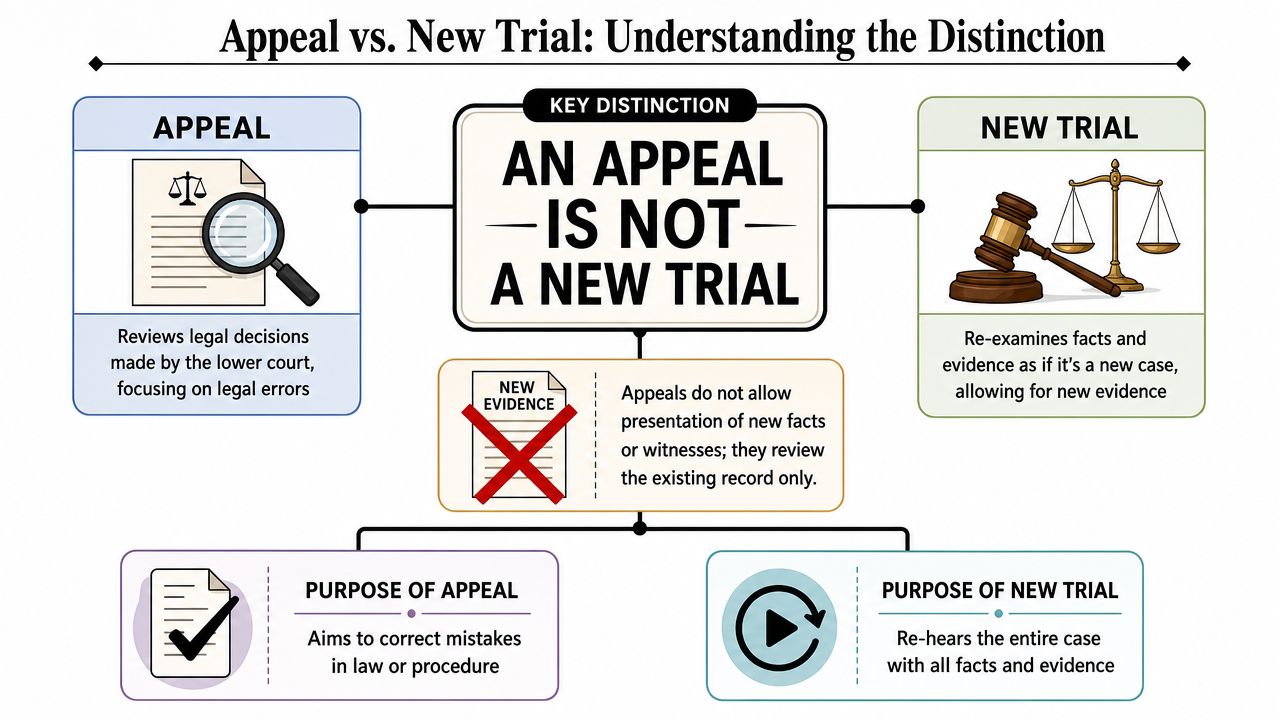
A useful way to frame it is this: an appeal reviews the judge's work, while a modification asks for a new order because circumstances changed, and enforcement asks the court to make someone obey the order already in place. People searching "can you appeal child support after final judgment in Texas" often need to sort out those three paths before they can make a good decision.
What the appellate court actually reviews
The appellate judges review the papers, exhibits, and hearing transcript from the trial court. Lawyers call that the appellate record. If a fact, objection, or document is not in that record, it usually cannot help you on appeal.
That surprises many parents. They may have better pay records now, a calmer explanation now, or a witness who is finally willing to speak. Those facts may matter in another kind of proceeding, but an appeal usually cannot be built on material that was never presented below.
Plain-English terms that matter
A few legal terms come up often in child support appeals:
- Appellate record: the clerk's papers, admitted exhibits, and reporter's transcript the higher court reviews
- Abuse of discretion: a ruling outside the range the law allows the trial judge to choose from
- Preserved error: a mistake that was raised properly in the trial court so the appellate court can review it
- Reversible error: a mistake serious enough that it may have affected the outcome
- Brief: the written argument explaining what went wrong and what relief the appellate court should grant
One sentence matters here. Feeling that the result was unfair is not, by itself, an appellate issue. The issue has to be tied to a legal error shown in the record.
What an appeal can do, and what it cannot do
An appeal can lead to the order being affirmed, reversed, or sent back to the trial court for further proceedings. In some cases, that means a fresh hearing under the correct legal rules. In other cases, it means the order stays exactly as it is.
An appeal usually cannot give you a chance to start over with better evidence that was available but never offered. It also does not pause deadlines automatically. If you are worried about missing the filing window, review the rules on late appeals in Texas family law cases as soon as possible.
Examples of issues that may support an appeal
A child support appeal may be worth examining if the record shows one of these problems:
- The judge used the wrong legal standard when calculating or ordering support
- The court excluded financial evidence after a proper objection or offer of proof
- The signed order does not match the ruling made in court
- The court acted without giving required notice or a fair opportunity to be heard
- The complaining party preserved the issue during the trial court process
By contrast, if your income dropped after the final order, the other parent stopped paying, or day-to-day realities have changed since judgment, those facts often point away from an appeal and toward modification or enforcement.
That is the strategic divide many articles miss. The first question is not whether the order feels wrong today. The first question is whether the order was legally wrong when it was signed, or whether the problem arose afterward. That answer determines which path gives you the best chance at a real remedy.
The Critical Deadlines for Filing a Texas Child Support Appeal
Appellate rights can be lost even when the underlying complaint is strong. Timing is part of the case.
In Texas family law, appeals are generally limited to final judgments, not temporary or partial orders. For the appeal itself, the standard deadline is 30 days after the final judgment is signed, and filing a motion for new trial can extend that window to 90 days, according to the Texas family law appeals overview from Hennan Culp.
A visual timeline helps because these deadlines move quickly.

The date that matters most
The countdown usually starts when the judge signs the final order, not when you receive it in the mail and not when you fully understand what it says.
That surprises many parents. They assume the important date is the day they saw the order or the day they felt the impact of it. For appellate timing, the signed judgment date is often the anchor point.
The two deadlines most people need to know
- Standard appeal window: The notice of appeal is generally due within 30 days after the final judgment is signed.
- Extended window: A timely motion for new trial can extend the notice deadline to 90 days.
Later appellate steps follow, but these first deadlines are the ones that preserve the case.
Here is a helpful related discussion on whether you can file an appeal late in Texas family law cases.
The court process can feel abstract until you see it laid out. This video offers a useful general overview of appeal timing and procedure:
Why delay is so dangerous
An appellate court does not conduct a new hearing or take new evidence. That means your lawyer's early work is not about gathering fresh proof for a second chance at trial. It is about preserving the right to challenge what already happened.
Missing the deadline can end the appeal before the court ever reaches the merits.
If you're still deciding whether the order was wrong, don't wait for complete certainty. Get the dates calculated immediately. You can evaluate the legal issues once the right to appeal is protected. You may still decide not to proceed, but you don't want that choice made for you by the calendar.
Appeal vs Modification vs Enforcement Choosing the Right Path
You read the order, feel your stomach drop, and ask a single question: "How do I fix this?" The hard part is that Texas law offers more than one path after a child support order becomes final, and each path solves a different problem. Choosing the wrong one can cost time, money, and strategic ground.
A common point of confusion for parents is treating every unfair result as an appeal issue. That is rarely the full picture. The better starting question is narrower and more useful: What exactly went wrong, and when did it go wrong?
That question works like a map.
If the problem existed at the time the judge signed the order, you may be looking at an appeal. If life changed after the order, you may need a modification. If the order is valid but someone is not obeying it, enforcement is usually the right tool.
Start with the source of the problem
Appellate courts review whether the trial court made a legal or procedural mistake based on the record already created. A modification case asks for a new order because present-day facts are different. An enforcement case asks the court to make someone comply with the order already in place.
Those are different jobs. A hammer, a wrench, and a lock key all solve problems, but only if you use the right tool for the right task.
Choosing Your Legal Strategy Appeal vs Modification vs Enforcement
| Action | Purpose | Timing | Key Question |
|---|---|---|---|
| Appeal | Challenge legal or procedural error in the final order | Shortly after final judgment | Was the order wrong when the judge signed it? |
| Modification | Change the order because circumstances changed later | After the order is in place | Is the order outdated because life changed? |
| Enforcement | Require compliance with an existing order | When a party is not following the order | Is someone violating the order that already exists? |
When appeal is the right path
An appeal focuses on what happened in the courtroom and what appears in the record. The appellate court does not hear the case from scratch. It reviews the transcript, exhibits, rulings, and signed order to decide whether the trial court committed reversible error.
Suppose the court used an income figure that the evidence did not support, refused to apply the correct legal standard, or made a ruling that affected the child support calculation. Those are the kinds of problems that point toward appeal, assuming the issue was preserved properly.
When modification is the right path
Modification addresses a different kind of unfairness. The original order may have made sense on the day it was signed, but later events can make it unworkable.
A job loss, a major increase in income, a change in the child's needs, or a shift in custody can all change the legal analysis. That is not the appellate court's job because those facts were not part of the original record. In that situation, a modification suit usually fits the problem better than an appeal.
When enforcement is the right path
Enforcement comes into play when the order should be followed as written but is being ignored.
If support is unpaid, income withholding is not being honored, or arrears are building, the issue is usually compliance, not whether the original order was legally wrong. An enforcement action asks the court to compel performance and, in some cases, impose consequences for noncompliance.
If your concern is "the judge made the wrong call based on the record," consider appeal. If your concern is "the facts changed after judgment," consider modification. If your concern is "the order is not being followed," consider enforcement.
Where a motion for new trial fits
A motion for new trial sits close to the judgment and can be part of a larger appellate strategy. It is not the same as an appeal, and it is not a substitute for modification or enforcement.
In the right case, it gives the trial judge a chance to correct an error while the case is still in that court. It can also affect deadlines and sharpen the issues for later review. Whether to file one depends on the record, the type of error, and the relief you want to pursue.
A practical way to decide
Consider three parents facing three different problems.
- Parent One: The judge excluded key financial records and set support using a number unsupported by the evidence. That points toward appeal.
- Parent Two: The support amount was workable at first, but a serious income change happened months later. That points toward modification.
- Parent Three: There is a valid order, but payments are not being made. That points toward enforcement.
One more strategic question sometimes follows. If the order takes effect immediately and the financial impact is serious, you may also need to examine whether to request a stay of enforcement pending appeal in Texas. That issue is separate from whether the appeal itself has merit.
The key is to diagnose the problem before choosing the procedure. Many cases feel like "an appeal" at first glance. After careful review, the better answer is often modification, enforcement, or a combination of steps taken in the right order.
Common Grounds for Successfully Appealing a Child Support Order
A strong appeal usually starts with one question: what, exactly, did the trial court do wrong under Texas law?
That question matters because an appeal is not a second hearing. The court of appeals does not retry the child support case or choose the result it likes better. It reviews the existing record for legal error that probably affected the outcome. If you treat the appeal like a chance to tell your story again, you can miss the issues that prevail.
The best appellate arguments in child support cases are usually specific, preserved, and visible on paper. They often fall into a few recurring categories.
Misapplication of the law
Sometimes the judge uses the wrong legal rule, the wrong calculation method, or findings that do not match the governing standards. That is often one of the clearest paths to appeal because the error can often be shown by comparing the order and findings to the law the court was required to apply.
A common example is a support amount based on an incorrect treatment of income or net resources. If your case centers on that problem, a closer look at appealing a child support calculation in Texas can help you see whether the issue is appellate or whether it points to a different remedy.
This is one place many parents get stuck. The order may feel unfair because the amount is too high or too low. An appellate lawyer asks a narrower question first. Was the amount produced by a legal mistake, or is the actual problem that circumstances later changed? That difference often separates an appeal from a modification.
Excluding or mishandling financial evidence
Child support orders often rise or fall on financial proof. Pay records, tax returns, business documents, proof of health insurance costs, and evidence about irregular income can all matter.
If the trial court wrongly excluded important evidence after a proper objection or refused to consider admitted evidence in a way that affected the support ruling, that may create a real appellate issue. The transcript and exhibits are often the map here. They show what was offered, what objection was made, how the judge ruled, and why the missing evidence mattered.
A good record works like a receipt. It shows the appellate court what happened and why it mattered.
Abuse of discretion
"Abuse of discretion" sounds abstract, but the practical idea is narrower than many people expect. It does not mean the judge made a decision you disagree with. It means the ruling fell outside the range the law allows.
In child support cases, that can happen if the court departs from the required framework without a legally sufficient basis, ignores controlling factors, or makes a decision unsupported by the evidence that was admitted. Appellate courts give trial judges room to make judgment calls. They do not give them unlimited room.
That is why strategy matters. If the record shows two reasonable ways the judge could have ruled, an appeal is harder. If the record shows the judge chose a path the law did not permit, the issue gets stronger.
Failure to preserve the complaint
Many potentially strong arguments never get traction on appeal because no one preserved them in the trial court.
Preservation usually means the problem was raised at the right time, in the right way, and the trial judge had a fair chance to rule on it. If evidence was excluded, the record often needs to show what the evidence would have been. If the complaint concerns procedure, the objection usually must appear in the transcript. If findings were needed, a request may have been required.
This can feel harsh. A parent may be completely right that something improper happened. But appellate courts are usually limited to complaints that were properly presented below. In plain terms, you cannot appeal an error the record does not clearly capture.
Procedural error that affected the result
Some appealable issues have less to do with the support formula and more to do with how the hearing was conducted.
Examples include lack of proper notice, being denied a fair chance to present a material issue, or a ruling entered through a procedure that did not satisfy basic legal requirements. Courts do not reverse for every procedural flaw. The mistake must have probably led to an improper judgment or kept a party from fully presenting the case.
That is why procedure matters as much as substance. A child support order can look orderly on its face and still rest on a hearing process that was legally defective.
Mixed family-law issues can shape the child support ruling
Child support does not always stand alone. In some cases, the support ruling is tied to findings about conservatorship, possession, credibility, reimbursement claims, or income disputes that also affect other parts of the final judgment.
When that happens, the appeal has to be framed carefully. Sometimes the child support complaint is the headline issue. In other cases, it is one piece of a larger final-order challenge. The strategic question is not just "Can I appeal?" It is "Which error gives the appellate court the clearest reason to reverse, and does that fit an appeal better than a modification or enforcement action?"
That is the framework many parents need. The order may feel wrong for several reasons at once. A careful review separates legal error in the judgment from later changed circumstances and from simple noncompliance with an existing order. Only then can you choose the right path.
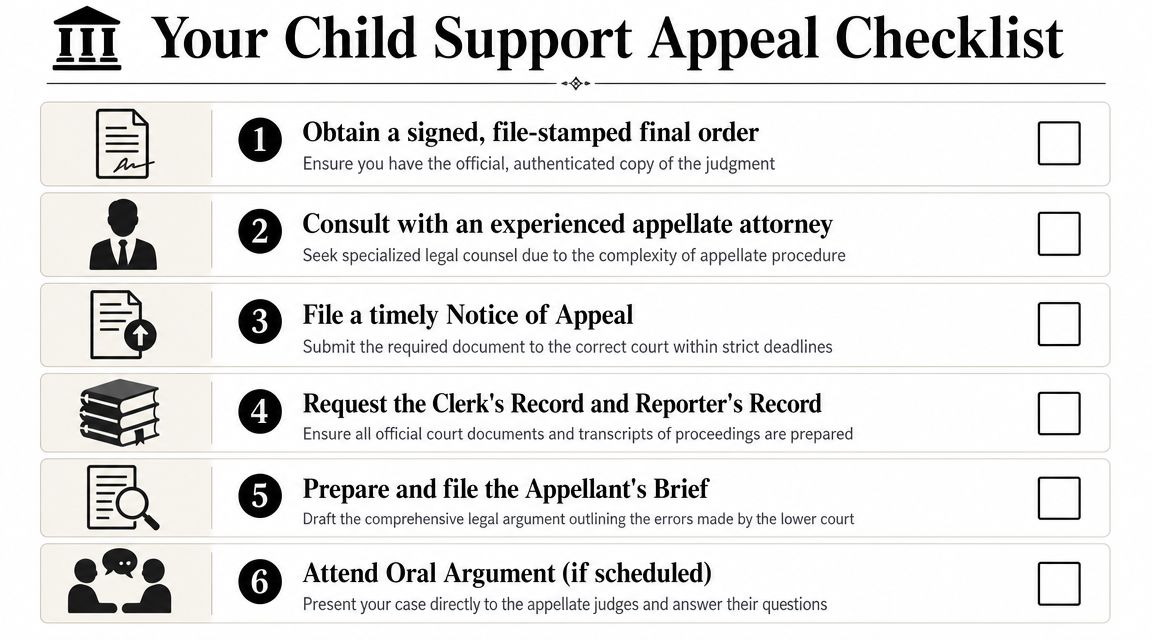
A Practical Checklist for Pursuing Your Child Support Appeal
You leave the courthouse with a signed order in your hand, and one question keeps circling in your mind: do I appeal, ask to modify the order, or force the other side to follow it? That decision matters more than many parents realize. The wrong choice can cost time, money, and sometimes the chance to challenge the order at all.
A good checklist helps you slow the problem down and sort it correctly. Appeals are about legal error in the final judgment. Modifications address changed circumstances after the order. Enforcement deals with violations of an order that is already in place. Before you do anything else, make sure you are solving the right problem.
Confirm what was actually signed
Start with the signed, file-stamped final order. Check the date the judge signed it, not the date you received it.
Then read the order carefully. Many parents focus on what they remember the judge saying in court, but the written order controls. If the written order says something different from what you expected, that difference needs attention right away.
Gather the pieces of the record
An appeal works like a review of a paper trail and hearing record, not a fresh trial. Your memory still matters because it helps you spot issues, but the court of appeals will focus on what is in the official record.
Collect the materials that show what the trial court had before it, including:
- pleadings and motions
- hearing notices
- admitted exhibits
- written findings, if any
- docket information
- information needed to request the reporter's record
If something important happened at the hearing, ask whether it was recorded and how to request the transcript. A strong appellate issue often rises or falls on that detail alone.
Protect every deadline immediately
Put every possible deadline on your calendar as soon as you have the signed order. If there is any uncertainty about post-judgment motions or appellate deadlines, get legal advice early enough to act, not after the window may have closed.
This step comes first for a reason.
Parents often want to spend a week deciding whether the ruling was unfair. Fairness matters, but timing controls whether an appellate court can even hear your complaint. Missing a deadline can end the appeal before the legal issue is ever examined.
Write down the legal problem, not just the frustration
Now turn your reaction into a clear issue statement. That means asking focused questions:
- What part of the order appears legally wrong?
- What ruling by the judge caused the problem?
- Was the issue raised in the trial court?
- Does the record show an objection, offer of proof, or request that preserved the complaint?
- Is the problem really an appeal issue, or is it better handled through modification or enforcement?
That last question is where many cases become clearer. If your complaint is that the judge used the wrong income evidence or excluded evidence that should have been considered, you may be looking at an appeal. If your income, the child's needs, or the parenting schedule changed after the final order, modification may be the better fit. If the other parent is refusing to pay what the order already requires, enforcement is usually the direct path.
Get appellate guidance before you commit to a path
Trial strategy and appellate strategy are related, but they are not the same. An appellate review asks different questions: Was error preserved? What standard of review applies? Does the record support the complaint? Is there a realistic remedy if the appeal succeeds?
The Law Office of Bryan Fagan, PLLC handles Texas family law appeals, including child support disputes and other post-judgment family law matters. If you are considering an appeal, the useful first step is a focused review of the final order, the deadlines, and the available record.
Use this five-part action list today
- Get the signed, file-stamped final order
- Calendar every appeal-related deadline
- Collect the documents and hearing record information
- Identify the specific legal error you believe occurred
- Speak with an appellate lawyer before choosing appeal, modification, or enforcement
A child support order can feel unfair for several different reasons. Your next step depends on which kind of problem you have. A calm review of the order, the timeline, and the record will usually show the right path.