You usually can't file a direct appeal from a temporary order in Texas family court. In most cases, you have to wait for a final judgment, although a narrow remedy like mandamus may be available in rare situations, and after a final order the notice of appeal is typically due within 30 days, with some filings extending that to 90 days.
If you're reading this right after a temporary orders hearing, the word temporary may feel almost insulting. The judge may have changed where your child sleeps, how often you see them, who pays support, or who stays in the home. Those effects start now, not at some distant final trial.
That frustration is real. But the right response isn't to assume an appeal is available just because the ruling feels urgent or unfair. The better question is strategic: What can you do next that has a realistic chance of helping? In some cases, the answer is to press for modification in the trial court. In others, it may be to preserve error carefully and build toward a strong appeal after final judgment. In a smaller group of cases, it may be time to evaluate mandamus.
When a Temporary Order Feels Anything But Temporary
A parent leaves a hearing with a new possession schedule that cuts time with their child. A spouse walks out ordered to pay support they don't believe the evidence justified. Someone else is suddenly under restrictions that affect daily parenting, finances, and access to property.
Those are called temporary orders, but clients don't experience them as temporary. They experience them as immediate.
That gap between the legal label and real life is where a lot of confusion starts. People ask, understandably, "Can you appeal a temporary order in Texas family court?" Usually, the answer is no. But "no appeal" doesn't mean "no options."
Why this moment matters so much
Temporary orders often shape the rhythm of the case that follows. They can influence parenting schedules, bargaining positions, and how the court views the status quo going into later hearings.
If you want a useful overview of what happens at this stage, review this guide to a Texas temporary order hearing. The hearing record often matters more than people realize.
Practical rule: The days right after a temporary ruling are for decision-making, not panic. The wrong filing can waste time. The right move can protect the case.
Some clients want to fight immediately no matter the cost. Others feel defeated and want to give up. Neither reaction is a strategy. The actual work is figuring out whether the judge made a legal error, whether the harm can be addressed in the trial court, and whether the record is strong enough for later review.
The General Rule Why You Usually Cannot Appeal a Temporary Order
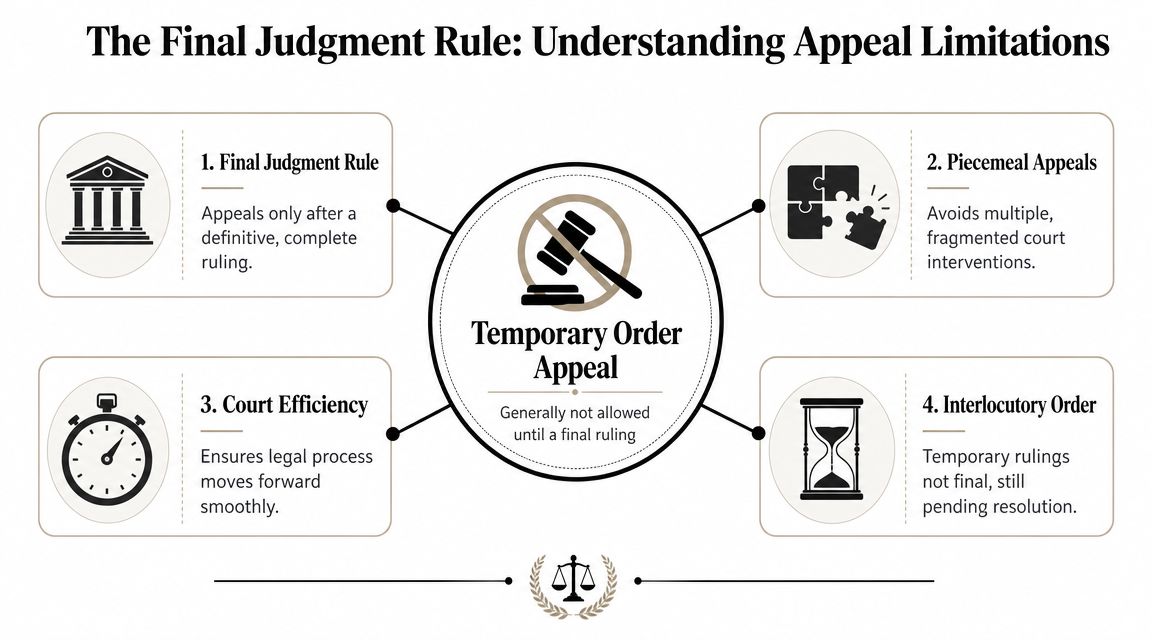
Texas family law follows a basic appellate principle. Appeals usually come from final judgments, not interim rulings. In family cases, that rule has real force.
Under Texas Family Code § 105.001(e), temporary orders rendered before a final order are generally not subject to interlocutory appeal, and Texas Family Code § 109.002(c) repeats that rule for appellate review, as explained in this discussion of temporary orders and Texas appellate jurisdiction.
What counts as a final judgment
A final judgment is the order that fully resolves the case. In a divorce, that usually means the decree addresses the divorce itself, property division, and any remaining child-related issues. In a SAPCR or modification case, it means the court has entered the order that disposes of the live claims before it.
A temporary order is different. It manages the case while the case is still pending. It may address custody, support, possession, use of property, or other short-term issues, but it is not the court's final decision.
Why the law treats temporary orders differently
The courts don't want family cases splintered into multiple appeals over interim rulings. If every temporary order could go straight to the court of appeals, many cases would stall while the family remained in limbo.
That doesn't make a bad temporary ruling easier to live with. But it does explain why the system treats these orders as tools for case management rather than final adjudications.
A few definitions help here:
| Term | Plain-English meaning |
|---|---|
| Interlocutory appeal | An appeal taken before the case is over |
| Final judgment | The order that finishes the case at the trial court level |
| Briefing | Written legal argument filed in the appellate court |
| Reversible error | A mistake by the trial court serious enough to justify relief on appeal |
A bad result is not automatically an appealable result. Appellate courts review legal error, not general unfairness.
That distinction matters. Many clients tell me, "The judge just got it wrong." Sometimes that's true in a practical sense. But appellate procedure asks a narrower question: Was there an appealable legal error, and is there a vehicle to challenge it now?
The Narrow Paths to Challenge a Temporary Order
There are exceptions, but they are narrow and procedural. They are not a general escape hatch.
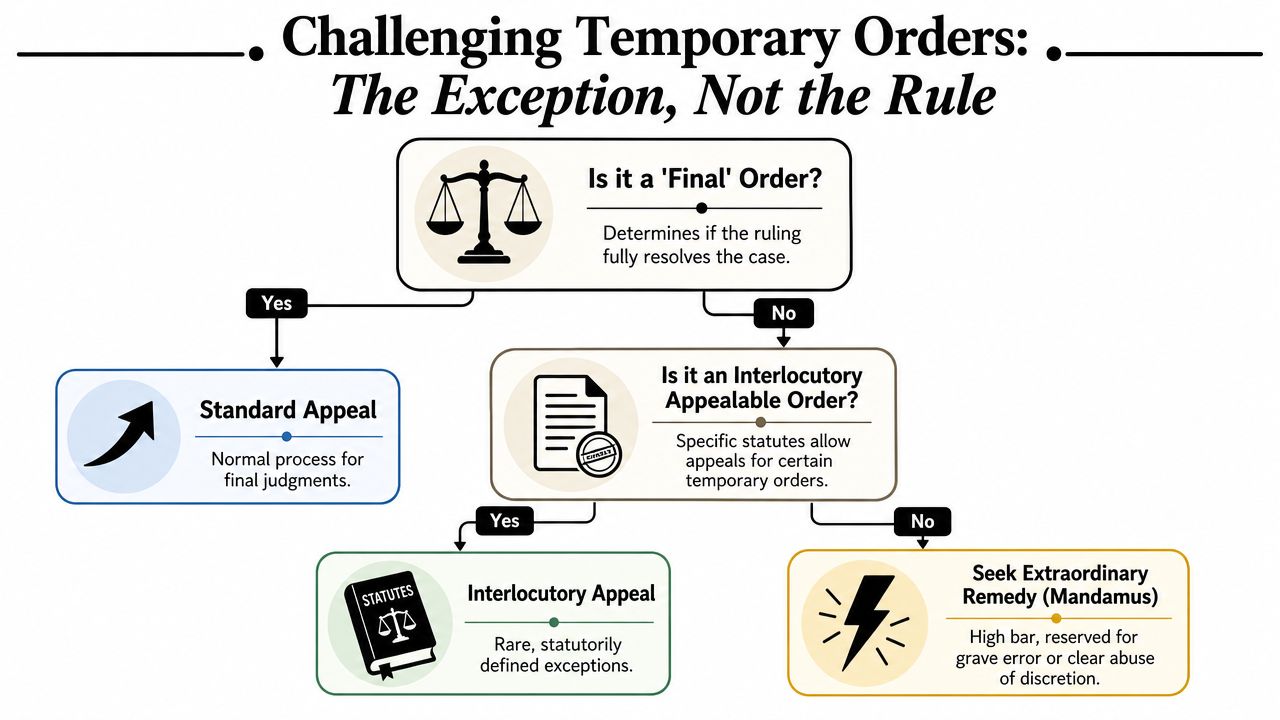
Texas law provides that temporary orders are not subject to interlocutory appeal as a general rule, but some family matters have special statutory paths. In cases involving parental termination or child protection, Texas appellate courts use an accelerated appeal process, and the courts are directed to bring those cases to final disposition within 180 days of the notice of appeal when reasonably possible. Once a final order exists, the notice of appeal is typically due within 30 days, and some post-judgment filings can extend that to 90 days, as summarized in this guide to appealing family court orders.
Interlocutory appeal is the exception
An interlocutory appeal is an appeal before final judgment. In family law, you should never assume one exists. The right has to come from a statute or a rule that clearly authorizes it.
If you're trying to sort out whether your order falls into one of those unusual categories, this overview of an interlocutory appeal in Texas family law is a useful starting point.
What works and what usually doesn't
Clients often want to challenge temporary orders for reasons like these:
- The judge believed the other side. That's usually not enough by itself for immediate appellate intervention.
- The order feels harsh. Harsh and appealable are not the same thing.
- The order disrupts daily life. That matters significantly, but it doesn't create appellate jurisdiction.
- The order falls within a special statute or extraordinary review mechanism. That may justify fast action.
Appellate practice differs sharply from trial practice. A trial court decides facts and credibility. An appellate court reviews the record under a defined standard of review, which is the legal lens the higher court uses to evaluate the trial court's decision. In many family matters, that lens is abuse of discretion, a deferential standard that gives the trial judge room to make judgment calls.
Seeking a Writ of Mandamus An Extraordinary Remedy
When people ask whether they can appeal a temporary order in Texas family court, the more realistic emergency question is often whether they can seek mandamus.

Mandamus is not a normal appeal. It is an extraordinary proceeding asking an appellate court to direct a trial court to correct a serious legal problem. Under Texas Family Code § 109.002, a trial court may enter temporary orders during the pendency of an appeal to protect the child's safety and welfare, and subsection (b-5) allows review of that temporary order by petition for writ of mandamus or by proper assignment in the appellant's brief, as shown in the text of Texas Family Code Chapter 109.
What abuse of discretion means
Abuse of discretion means the trial court made a decision outside the zone the law allows. In plain English, it is more than a ruling you dislike. It is a ruling the judge had no sound legal basis to make.
Examples that may raise mandamus concerns include:
- Ignoring a mandatory legal rule. If the judge applies the wrong legal standard, that can matter.
- Acting without authority. A jurisdictional defect can be serious.
- Entering an order after a major procedural breakdown. If the process itself denied a party a fair chance to be heard, that may deserve closer review.
Examples that usually do not justify mandamus by themselves include:
- A credibility dispute. The judge believed the other witness.
- A close factual call. The evidence pointed in two directions, and the judge chose one.
- A complaint that the order is unfair. Appellate courts need a legal basis for intervention.
What no adequate remedy by appeal means
The second major hurdle is showing no adequate remedy by appeal. That means waiting for a final appeal would not realistically fix the problem.
This is why mandamus is rare. If the issue can be corrected later in an appeal from the final judgment, appellate courts are often reluctant to intervene mid-case.
For readers looking specifically at this tool, this page on a petition for writ of mandamus in Texas family court explains the procedure in more detail.
A short video can also help clarify how this remedy differs from a standard appeal:
Reality check: Mandamus is strongest when the problem is legal and immediate, not merely painful and disputed.
What an appellate lawyer looks for first
Before recommending mandamus, I would want to know:
- What exactly did the judge order?
- What was said on the record?
- Were objections made clearly and ruled on?
- Is there a transcript, exhibits, and a signed order?
- Would a later appeal fix the harm?
That record review matters because appeals are not retrials. The appellate court generally reviews what is in the record, not what someone wishes had been said. If the transcript is thin, the objections are vague, or key facts were never offered into evidence, the odds of extraordinary relief drop quickly.
Strategic Decisions After an Unfair Temporary Ruling
You walk out of a temporary-orders hearing with a result that changes where your child sleeps, how bills get paid, or whether you can see important records. The order is called temporary, but its effects are immediate. At that point, the right question is not whether the ruling feels unfair. The right question is which response gives you the best chance of improving your position without wasting time and money on the wrong fight.
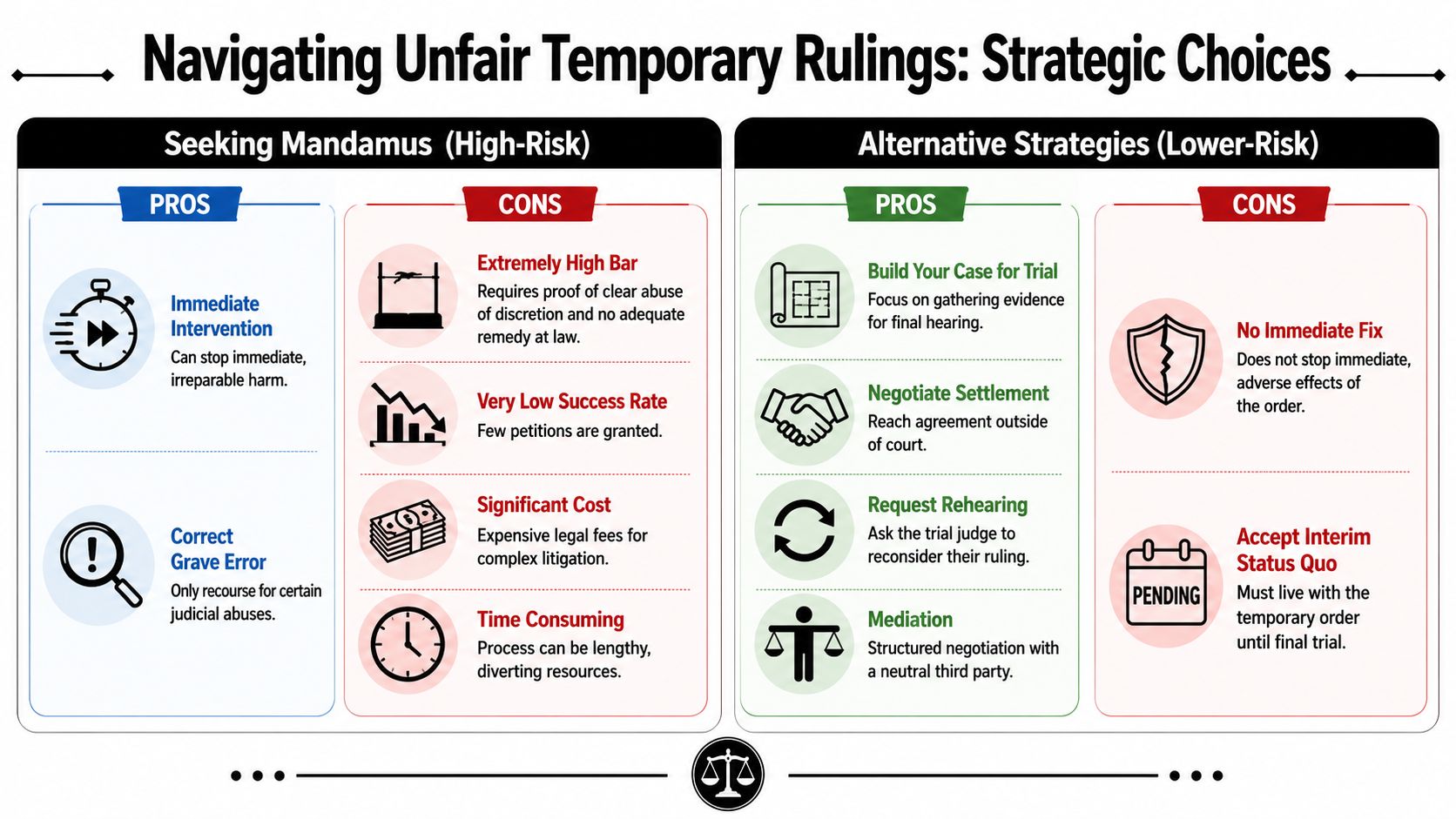
Texas law generally blocks an immediate appeal of temporary orders in family cases. That leaves three practical choices in many cases: pursue mandamus if the problem is legally clear and urgent, ask the trial court to modify temporary orders if the facts or circumstances support that request, or focus on building a clean record for the final trial and any later appeal. The statutory framework for temporary orders and related appellate procedure appears in Texas Family Code Chapter 109.
Option one seeks immediate correction
Some temporary orders justify an immediate appellate response. A judge may have acted without authority, refused basic due process, or signed an order that creates harm a later appeal cannot repair. In that narrow set of cases, mandamus may be the right move.
The trade-off is simple. Mandamus is expensive, fast-moving, and hard to win. I do not recommend it just because the ruling was harsh or because the judge believed the other side. I recommend it when the legal error is strong, the record is usable, and delay would cause damage that a final appeal cannot fix.
Option two asks the trial court to revisit the issue
A motion to modify temporary orders is often the better use of effort. Trial judges can change temporary relief when new facts matter, when the order is unworkable in practice, or when a narrower correction may solve the immediate problem.
That path often makes sense when:
- New facts developed after the hearing.
- The order is creating practical problems the court did not fully anticipate.
- A targeted fix could protect the child, preserve property, or stabilize parenting time.
- The issue is better addressed by updated evidence than by an appellate attack on the existing record.
Clients sometimes resist this option because it feels like asking the same judge for help after that judge already ruled against them. Sometimes that concern is justified. But if the problem is factual, developing better evidence in the trial court is often more productive than filing an emergency appellate petition that has little chance of success.
Option three builds the final appeal now
In many cases, the smartest response is disciplined trial work. That means making precise objections, getting rulings, offering excluded evidence properly, requesting findings when available, and making sure the written order matches what the judge ordered.
A final appeal is often shaped long before the final decree is signed. If the legal error is not preserved, it may be gone. If the record is incomplete, the appellate court usually will not fill in the gaps for you.
Common problems that may matter later include:
- Using the wrong legal standard
- Refusing notice or a meaningful opportunity to be heard
- Excluding key evidence after a proper offer of proof
- Admitting evidence over a specific, preserved objection
- Signing an order that does not match the court's oral ruling
Choosing the right path
The strategic question is not which option sounds strongest in the abstract. It is which option fits the kind of error you have.
| Situation | Usually the better path |
|---|---|
| Clear legal defect and immediate harm | Evaluate mandamus quickly |
| Changed circumstances after the hearing | Seek modification in trial court |
| Weak immediate remedy but strong issue for later | Preserve error and prepare for final appeal |
| Mostly factual disagreement with the judge | Focus on trial preparation and record building |
That last category matters more than many clients expect. A large share of temporary-order complaints come down to disputed facts, credibility calls, and incomplete proof. Appellate courts rarely step in quickly on those issues. In that setting, the stronger strategy is often to accept that the temporary ruling will stand for now, tighten the evidence, and fight for a better result at the final trial.
An appellate-focused review can still help before any appeal exists. The Law Office of Bryan Fagan, PLLC handles Texas family law appeals and appellate record analysis. That kind of review can help you decide whether to pursue mandamus, return to the trial court for a modification request, or preserve issues carefully for a later appeal.
Filing something fast just to feel proactive usually backfires. A weak emergency filing can drain resources, damage credibility, and leave you in the same position, except with less time to prepare for the hearing that may matter most.
How an Appellate Attorney Can Help You Seek Justice
After an unfair temporary ruling, people often need two things at once. They need honesty about the limits of the law, and they need a concrete plan.
Under Texas Family Code § 105.001(e), a temporary order in a SAPCR or family-court case is generally not subject to interlocutory appeal, so the usual appellate path is unavailable until a final judgment is entered. That means important work often happens in the trial court first, or later through preserved issues in an appeal from the final decree, as discussed in this review of temporary-order appeals in Texas family court.
What appellate counsel actually does
An appellate attorney doesn't retry the case. Appellate counsel studies the record, identifies legal error, analyzes the standard of review, and decides whether the best move is immediate extraordinary relief, trial-court correction, or final-judgment appeal.
That review often includes:
- Record analysis. What testimony, exhibits, objections, and rulings are preserved?
- Procedure analysis. Were the Texas Rules of Appellate Procedure triggered yet, or is the case still in a pre-appeal posture?
- Issue screening. Is this a factual complaint, a procedural problem, a jurisdictional issue, or a likely abuse-of-discretion argument?
- Briefing strategy. If an appeal or mandamus is viable, how should the legal argument be framed for appellate judges?
If your case also involves related issues, it may help to review the firm's pages on Texas family law appeals, child custody appeals, divorce appeals, property division appeals, and protective order appeals.
If you believe the court made a mistake in your family law case, waiting passively is rarely the best answer. The better approach is to get a disciplined review of the order, the hearing record, and the available procedural paths before deadlines tighten and options narrow.
If you believe the court made a mistake in your family law case, our appellate attorneys can help you seek a fair outcome. Contact The Law Office of Bryan Fagan, PLLC today for a free consultation.