Skip to content
Generally, no. In most Texas family law cases, you must file a notice of appeal within 30 days after the final judgment is signed, although some post-trial motions can extend that deadline to 90 days, and there is a narrow 15-day window in some cases to ask for more time.
You may feel like the court got it wrong, and then the worst part happens. You look at the calendar and realize the ordinary appeal deadline may already have passed. That moment can feel final, especially in a case involving custody, support, property division, or a protective order.
But the answer to can you file an appeal late in texas family law cases isn't always a flat no. It depends on how late the filing is, whether any post-trial motion changed the timetable, and whether you need a different remedy altogether because a direct appeal is no longer available.
Appeals in family law are procedural by design. That can feel frustrating, but procedure also creates opportunities when the facts fit the rule. A missed deadline by a few days may call for one strategy. A judgment discovered to be defective months later may call for another.
Feeling Lost After an Unfair Ruling and a Missed Deadline
Many people don't realize that the appeal clock starts when the judge signs the final order, not when the parties feel ready to respond. That matters because family cases move quickly, and the written order often controls rights that affect daily life right away.
If you're in this position, the first step isn't panic. It's figuring out whether the appeal is definitely late, barely late, or no longer an appeal problem at all.
The first question is how many days have passed
Texas Rule of Appellate Procedure 26.1 generally requires a notice of appeal within 30 days after the judgment is signed, and Rule 26.3 creates a 15-day grace period if the party also files a motion to extend time, as explained in this discussion of Texas family law appeal timing. That narrow window gives some families a real, though limited, path forward.
That distinction matters more than many individuals expect. Someone on day 34 is in a very different position from someone on day 104. The legal tools are not the same.
Practical rule: Before you argue about fairness, verify the signed date of the order and count the days from that date.
Appeals are not new trials
A direct appeal doesn't let you start over or bring in new witnesses to tell the story again. The appellate court reviews the existing record for legal or procedural error.
That is why timing and record preservation work together. If the notice of appeal isn't handled correctly, the court may never reach the questions you care about most.
Some of the most common issues people want reviewed include:
- Custody rulings: Orders affecting conservatorship, possession, or access.
- Support findings: Child support obligations or enforcement decisions.
- Property division errors: Whether the trial court divided property under the correct legal standards.
- Protective order concerns: Whether the court followed the required process and evidence rules.
- Contempt and enforcement problems: Orders that may carry serious practical consequences.
Common appellate terms in plain English
- Abuse of discretion: The trial court had a range of choices, but made a decision outside the range the law allows.
- Reversible error: A legal mistake significant enough that the result should be changed or the case sent back.
- Briefing: The written legal argument filed in the appellate court explaining what the trial court did wrong and why the law requires relief.
People often assume a missed deadline ends every possible remedy. Sometimes it does. Sometimes it doesn't. The key is to identify the correct procedural path before more time passes.
Understanding Texas's Strict Appellate Deadlines

In Texas family law cases, the baseline rule is straightforward. The notice of appeal is generally due 30 days after the trial court signs the final judgment, and some post-trial motions can extend that deadline to 90 days, as outlined in this explanation of Texas notice-of-appeal deadlines and supported by this discussion of final judgment timing in family cases.
A good way to think about it is a train schedule. Once the train leaves the station, the court doesn't get to decide that your reason for arriving late was emotionally compelling. The court first has to ask whether it has jurisdiction, meaning legal power to hear the case at all.
Why jurisdiction changes everything
When a deadline is jurisdictional in effect, the appellate court doesn't choose whether to forgive the delay. If the notice is outside the rule-based window, the court generally cannot decide the merits.
That surprises many litigants because trial courts often deal with equitable concerns and factual disputes. Appellate courts start with a different question. They ask whether the case arrived properly.
If the notice is untimely, even a strong argument about custody, support, or property division may never be heard on the merits.
What counts as a final order
Not every ruling from the bench is immediately appealable. In family law, parties sometimes try to appeal too soon because they are reacting to a hearing result rather than a signed final order.
A final order is usually the written judgment that resolves the matter the court intended to decide. If the order is interlocutory, meaning not final, the appeal may fail for being premature. If it is final and the deadline runs out, the appeal may fail for being late.
That is why experienced appellate review starts with documents, not assumptions.
The basic deadline framework
| Situation | General timing rule | Practical consequence |
|---|---|---|
| Final judgment signed | 30-day notice-of-appeal deadline | This is the ordinary rule |
| Certain timely post-trial motions filed | Deadline may extend to 90 days | The appeal may still be timely |
| Filing outside the allowed window | Court may lack jurisdiction | The appeal is usually dismissed |
This is also why appeals differ sharply from trials. At trial, parties present testimony and exhibits. On appeal, the fight is about the existing record, the applicable standard of review, and whether the law was applied correctly.
The 15-Day Grace Period A Motion for Extension of Time
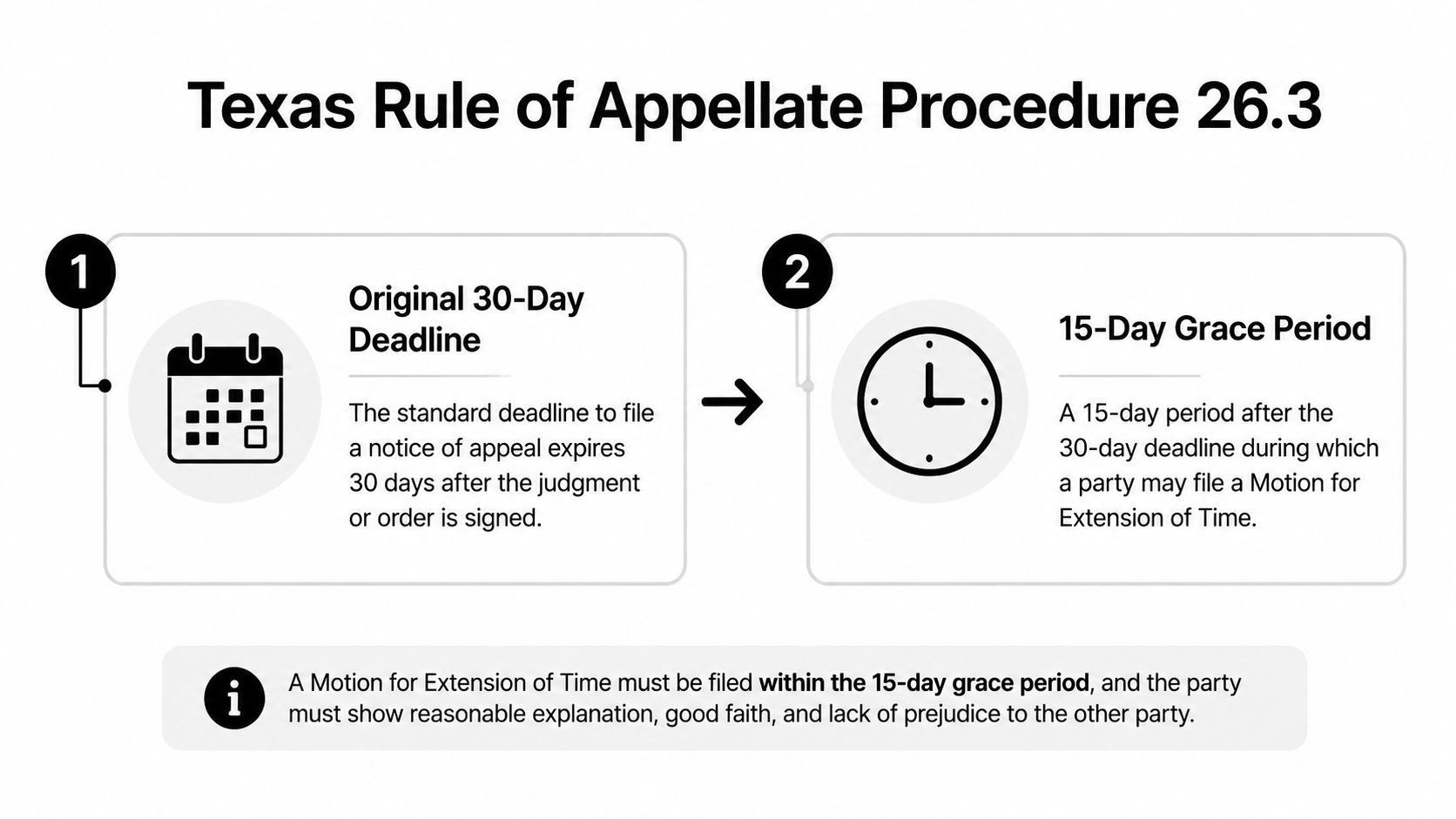
For people who just missed the ordinary deadline, this is often the most important part of the analysis. In Texas family law, a late appeal is usually fatal because the timetable is jurisdictional, and if no valid notice of appeal is filed within the applicable period, the court generally dismisses the case rather than deciding the merits, as summarized in this discussion of challenging a final divorce or custody order.
There is, however, a narrow safety valve.
When the grace period may help
If you're just outside the ordinary filing deadline, you may still be inside the additional rule-based period for seeking an extension. This guide to an extension of time to file a family law appeal in Texas discusses that procedure in practical terms.
The critical point is that the grace period is not automatic. You don't preserve the appeal by filing late and hoping the court excuses it.
What usually has to happen
You generally need two things working together:
- A notice of appeal filed within the grace-period window
- A motion for extension of time that explains the delay
That motion should be specific, factual, and careful. It should explain why the filing wasn't made by the original deadline and why the court should allow the late notice within the narrow rule-based period.
A weak explanation can turn a salvageable case into a dismissed one.
What works better than broad excuses
Courts respond better to concrete explanations than vague frustration. Examples may include a misunderstanding about the signed date of the final order, confusion caused by post-judgment activity, or a delay connected to receiving and identifying the operative written judgment. The explanation still has to fit the rule and the case facts.
What usually does not work is treating the extension as an open-ended fairness request. Appellate courts focus on compliance, dates, and whether the filing falls within the limited period the rules allow.
Why this remedy is narrow
This grace-period procedure doesn't erase the deadline. It creates a very short opportunity to repair the problem. If that window has also passed, the analysis changes completely.
That is why timing review should happen immediately, along with a quick assessment of the issues you want to raise. In family law appeals, common reversible-error arguments often involve:
- Applying the wrong legal standard
- Excluding or admitting evidence in a way that affected the outcome
- Signing an order that doesn't match the relief legally supported by the record
- Failing to follow required procedure in a way that likely caused harm
An appellate lawyer usually starts with the docket, the signed order, any post-judgment filings, and the exact filing date of the notice. That timeline often decides the entire case before the briefing begins.
How Post-Trial Motions Can Reset the Appellate Clock

Sometimes a client says, "I think I missed the appeal deadline," but after reviewing the file, the notice wasn't late at all. The reason is often a timely post-trial motion that extended the appellate timetable.
Sometimes the central issue is whether the deadline was longer from the start, rather than whether a late appeal can be forgiven.
How these motions change the timeline
Texas family law authorities emphasize that appellate review is limited to the record and doesn't allow new evidence, and that if the notice of appeal is untimely, later steps like record preparation and briefing never matter, as explained in this overview of the Texas family law appeal process.
A timely post-trial motion can change that timing analysis by extending the notice-of-appeal deadline. In practical terms, that may move the deadline from the ordinary 30-day period to 90 days after the signed order when the right type of motion is filed on time.
Common post-trial motions to investigate
Ask whether trial counsel filed any of the following within the initial post-judgment period:
- Motion for new trial: A request asking the trial court to set aside the judgment and try the case again.
- Motion to modify the judgment: A request asking the trial court to correct or change the signed order.
- Other qualifying post-judgment motions: In some situations, filings aimed at changing the judgment may affect the appellate timetable.
These motions matter for two reasons. First, they can preserve complaints for appellate review. Second, they can alter the deadline calculation.
Why trial and appeal strategy overlap
A post-trial motion gives the trial court a chance to fix its own mistake. That may sound like a long shot, but it serves a strategic purpose even when the court denies the motion. It sharpens issues, clarifies objections, and can preserve the record for appeal.
Appeals are built on that record. The clerk's record gathers the filed documents. The reporter's record contains the hearing or trial transcript. Briefing is where the appellate lawyer applies the standard of review to those materials and argues why the error was harmful.
Check the court file before assuming the appeal is dead. A motion filed by prior counsel may have extended the timetable even if no one explained it clearly.
A simple way to evaluate this issue
| Question | Why it matters |
|---|---|
| Was there a signed final order? | The deadline runs from the signed order |
| Was a timely post-trial motion filed? | It may extend the notice deadline |
| Was the notice of appeal filed after that extension period? | If so, the court may still lack jurisdiction |
This is one of the most common places where families lose time. They focus on the hearing date, not the signed order. Or they assume no appeal exists because the ordinary deadline passed, without checking whether a motion reset the clock.
The Bill of Review Your Last-Resort Option

If you're well outside both the ordinary appeal deadline and the short extension window, a bill of review may become part of the discussion. This is not a late appeal. It is a separate, extraordinary lawsuit filed in the trial court to attack a prior judgment under limited circumstances.
That distinction matters. A bill of review doesn't reopen every disappointing result. It exists for unusual situations where equity may justify relief after ordinary deadlines have passed.
When this remedy enters the conversation
Texas family law materials point out a major gap in common online guidance. Many articles stop at "you missed the deadline," but they don't explain what comes next. This plain-English discussion of post-judgment remedies after an appeal deadline passes highlights that gap and notes that a bill of review may be the only realistic path for some parents or former spouses who discover a serious problem much later. For a side-by-side comparison, this discussion of bill of review versus appeal in Texas family cases is a useful starting point.
What makes a bill of review hard
This remedy carries a high burden. Courts don't use it to give parties a second chance because they regret the outcome or wish they had appealed sooner.
In practice, a person usually needs a strong, well-supported explanation showing that the original judgment should not stand and that the failure to correct it earlier wasn't caused by that person's own neglect.
Examples that may trigger closer analysis include:
- Concealed information: A spouse allegedly hid assets during the divorce process in a way that prevented a fair property ruling.
- Lack of meaningful participation: A party did not have a fair chance to present a claim or defense because of wrongful conduct affecting notice or participation.
- Serious procedural irregularity: The judgment was obtained through conduct that undermined the basic fairness of the proceeding.
What this is not
A bill of review is not a substitute for an appeal you chose not to file. It is not a vehicle for introducing arguments that were available all along but never pursued. And it isn't a general request for mercy.
That is why the factual investigation matters so much. The documents, service history, hearing notices, trial filings, and final judgment all need close review.
The farther you are from the original judgment date, the more important it is to ask whether you need a different remedy, not a late notice of appeal.
A practical comparison
| Direct appeal | Bill of review |
|---|---|
| Filed in the appellate court system after final judgment | Filed as a new proceeding in the trial court |
| Reviews legal or procedural error in the existing record | Challenges the judgment under narrow equitable grounds |
| Strongly tied to short appellate deadlines | Considered when those deadlines have passed |
| Not a retrial | Also not a retrial, but a separate attack on the judgment |
In family law, this issue comes up often in cases with long-term effects. Custody, support, and property orders can shape a family for years. If a problem surfaces months later, the question is no longer "Can I file the appeal late?" It becomes, "What procedural vehicle still exists, and do my facts fit it?"
How to Assess Your Case and Take Action Now
A parent calls after a custody order was signed weeks ago. They believe the ruling was wrong, but they are no longer asking, "Was the judge fair?" The immediate question is narrower and more useful. What procedural path, if any, is still open today?
Start with dates. In late-appeal situations, a good case can be lost by using the wrong remedy, and a weak case can waste months if no one checks jurisdiction first. The signed judgment, the date notice was received, any post-trial motions, and the date a notice of appeal was or was not filed all matter.
Then look at the kind of complaint you have. An appeal addresses legal error shown in the record. A bill of review addresses a different problem, usually one tied to notice, service, or another defect that kept a party from presenting a meritorious position. Those are different tools, and choosing the wrong one creates avoidable delay.
The file usually answers more than the client interview does. Pull the signed order, docket sheet, clerk's notices, post-judgment motions, hearing settings, and any reporter's record you can get quickly. If there were competing drafts of the final order, comparing them can expose language changes that matter on appeal or in post-judgment motion practice. For a practical overview of that review process, see CatchDiff's guide for legal teams.
A useful initial assessment usually turns on four questions:
- Is there still appellate jurisdiction? Check whether the ordinary deadline ran, whether the 15-day extension window may still be available, and whether any post-trial filing changed the timetable.
- What error is being claimed? Focus on rulings the record can support, not general unfairness.
- Was the issue preserved? Objections, offers of proof, and post-trial filings often determine whether an appellate court can review the complaint.
- What remedy fits these facts? Direct appeal, motion for extension, restricted appeal in the right case, or bill of review are not interchangeable.
Strategy matters here because each option asks for a different showing. A motion for extension depends on timing and a reasonable explanation. A bill of review requires much more factual development and is filed in the trial court as a separate proceeding. That difference affects cost, speed, record gathering, and the odds of getting meaningful relief.
Counsel's job at this stage is to make an early, disciplined call. Is there a live route into appellate review? Is the record strong enough to justify the expense? If the appeal door is closed, do the facts support a different post-judgment remedy, or is the better path a future modification rather than an attack on the existing judgment?
Act quickly. In this part of Texas family law, waiting rarely improves the facts, and it often eliminates options that were still available a few days earlier.
Frequently Asked Questions About Late Family Law Appeals
A missed deadline does not always end the analysis. It changes the question from "Can I still appeal?" to "Is there any procedural path still open, and what proof does it require?" Those are different questions, and the answer depends on dates, notice, the trial court record, and what was filed after judgment.
What if I didn't receive notice of the signed judgment right away
Late notice can matter. It may affect appellate deadlines in some situations, but it does not automatically revive a case.
The first step is to pin down three dates: when the judgment was signed, when notice was received, and what the clerk's record and docket show. If a rule-based remedy is still available, timing will control it. If too much time has passed, the inquiry shifts to other post-judgment options.
What's the difference between an appeal and a modification
An appeal asks a higher court to review whether the trial court made a legal or procedural error in the judgment already signed.
A modification asks the trial court to change certain ongoing family law orders because facts have changed after the order was entered. That is common with conservatorship, possession, child support, and similar continuing issues.
The trade-off is practical. An appeal focuses on the existing record and past error. A modification focuses on current circumstances and future relief. Choosing the wrong vehicle costs time and money.
What is a reversible error in plain English
A reversible error is a mistake serious enough that it probably affected the outcome. The appellate court must be able to see both the error and the harm from the record.
That usually means more than saying the result felt unfair. It means identifying a specific ruling, preserved objection, excluded evidence, or legal standard the trial court got wrong.
Can I file late if I only missed the deadline by a few days
Sometimes, yes. Texas procedure can allow a short extension window if the required filing is made on time within that grace period and the party gives a reasonable explanation for the delay.
That remedy is narrow. Missing even the extension window usually changes the case completely.
Is a bill of review the same thing as an appeal
No. A bill of review is a separate proceeding filed in the trial court to attack a final judgment after the ordinary appellate timetable has expired.
It is much harder than a direct appeal. The required proof is different, the factual development is heavier, and the cost is often higher because the case may require evidence outside the original appellate record.
Should I appeal or file something else
That depends on the procedural posture of the case. Some clients still have a direct appellate option. Others may need to examine a restricted appeal, a bill of review, or a future modification instead of trying to force a standard appeal that the court no longer has jurisdiction to hear.
That early decision matters. The wrong filing can waste the little time still available.
If you believe the court made a mistake in your family law case, The Law Office of Bryan Fagan, PLLC can help assess whether any post-judgment remedy is still available. Contact the firm today for a free consultation.