A final family court order can land with a thud. You read it once, then again, and the same thought keeps coming back: this wasn’t fair.
Maybe the judge ruled on custody in a way that doesn’t match the evidence you heard in court. Maybe the property division seems legally wrong. Maybe you never got a real chance to participate at all. In Texas family law, those situations don’t all call for the same remedy. The strategic question is whether your case belongs in a direct appeal or in a bill of review.
That distinction matters because these remedies solve different problems. One asks a higher court to review what happened in the trial court. The other asks the same trial court to set aside a final judgment that should not stand. If you choose the wrong path, you can lose time, advantage, and sometimes the chance to seek relief at all.
When Your Family Court Ruling Feels Unjust
The hardest cases often start with a simple reaction: “The court got this wrong.”
A parent leaves a hearing convinced the judge overlooked testimony about the child’s daily needs. A spouse reads a divorce decree and sees assets classified in a way that doesn’t match the proof offered at trial. Another person learns much later that a final order was entered without their knowledge and now has to figure out how that could have happened.
Those are very different problems, even if they feel the same on day one. The law cares about how the unfair result happened. Was the mistake visible in the courtroom record? Or did something outside the record keep you from having a fair chance to defend yourself in the first place?
That’s why post-judgment strategy in Texas family law has to start with diagnosis, not emotion. If you want a practical overview of options after a final order, this guide to post-judgment relief in Texas family court is a helpful starting point.
Why the first decision is so important
Clients often assume any unjust order can be “appealed.” Sometimes that’s right. Sometimes it isn’t.
An appeal is usually the tool for trial court error. A bill of review is usually the tool for a final judgment that can no longer be challenged through the ordinary post-trial process. In family law, that difference shows up in divorce decrees, custody orders, child support rulings, enforcement judgments, and protective orders.
Practical rule: The first question is not whether the order feels wrong. The first question is what kind of wrong happened.
When that answer becomes clear, the next steps become much easier to map.
Understanding Your Two Paths for Justice in Texas
A direct appeal and a bill of review are not interchangeable. They serve different purposes, involve different courts, and demand different proof.
Here is the quickest side-by-side view:
| Issue | Appeal | Bill of review |
|---|---|---|
| Where it is filed | Court of appeals | Same trial court that signed the judgment |
| Main purpose | Review alleged legal error in the existing case | Attack a final judgment that is no longer challengeable by ordinary post-trial methods |
| What the court looks at | The appellate record, including reporter’s and clerk’s records | New pleadings and evidence aimed at showing the judgment should be set aside |
| Core theory | The trial court made a reversible error | You were prevented from properly presenting your case through fraud, accident, wrongful act, or official mistake |
What an appeal is really asking for
An appeal asks a higher court to review what the trial judge did. In family law, that often means arguing the judge misapplied the Texas Family Code, excluded evidence that should have come in, admitted evidence that should have stayed out, or made a discretionary ruling that the law doesn’t support.
Appeals are not retrials. The court of appeals does not hear the witnesses again or take brand-new proof. Instead, appellate judges study the written record, the exhibits, and the parties’ briefs.
If you are still within the filing window, understanding how to file a notice of appeal is one of the first practical steps.
What a bill of review is really asking for
A bill of review is an equitable proceeding aimed at a prior judgment that is already final. It is filed in the same trial court that issued the original judgment, not in the court of appeals. Texas authorities describing the remedy explain that a bill of review is filed in the same trial court that issued the judgment, while an appeal goes to the intermediate court of appeals, and that appeals are controlled by strict deadlines under Texas appellate rules while bills of review can extend up to four years from judgment date, but require proof of fraud, accident, wrongful act, or official mistake that prevented participation, as discussed by Wilson Legal Group’s article on bills of review in Texas.
That difference changes the whole strategy. A bill of review is not about showing the trial judge got it wrong on the evidence presented. It is about showing the judgment should not stand because something outside the ordinary process prevented a fair presentation of the case.
The plain-English difference
Think of it this way:
- Appeal means, “The judge made a legal mistake in the case that was tried.”
- Bill of review means, “This final judgment should be reopened because I was wrongfully prevented from fully presenting my side.”
An appeal reviews the old case. A bill of review starts a new proceeding attacking the old judgment.
That is the foundation of any smart decision in bill of review versus appeal texas analysis.
Key Differences A Detailed Comparison
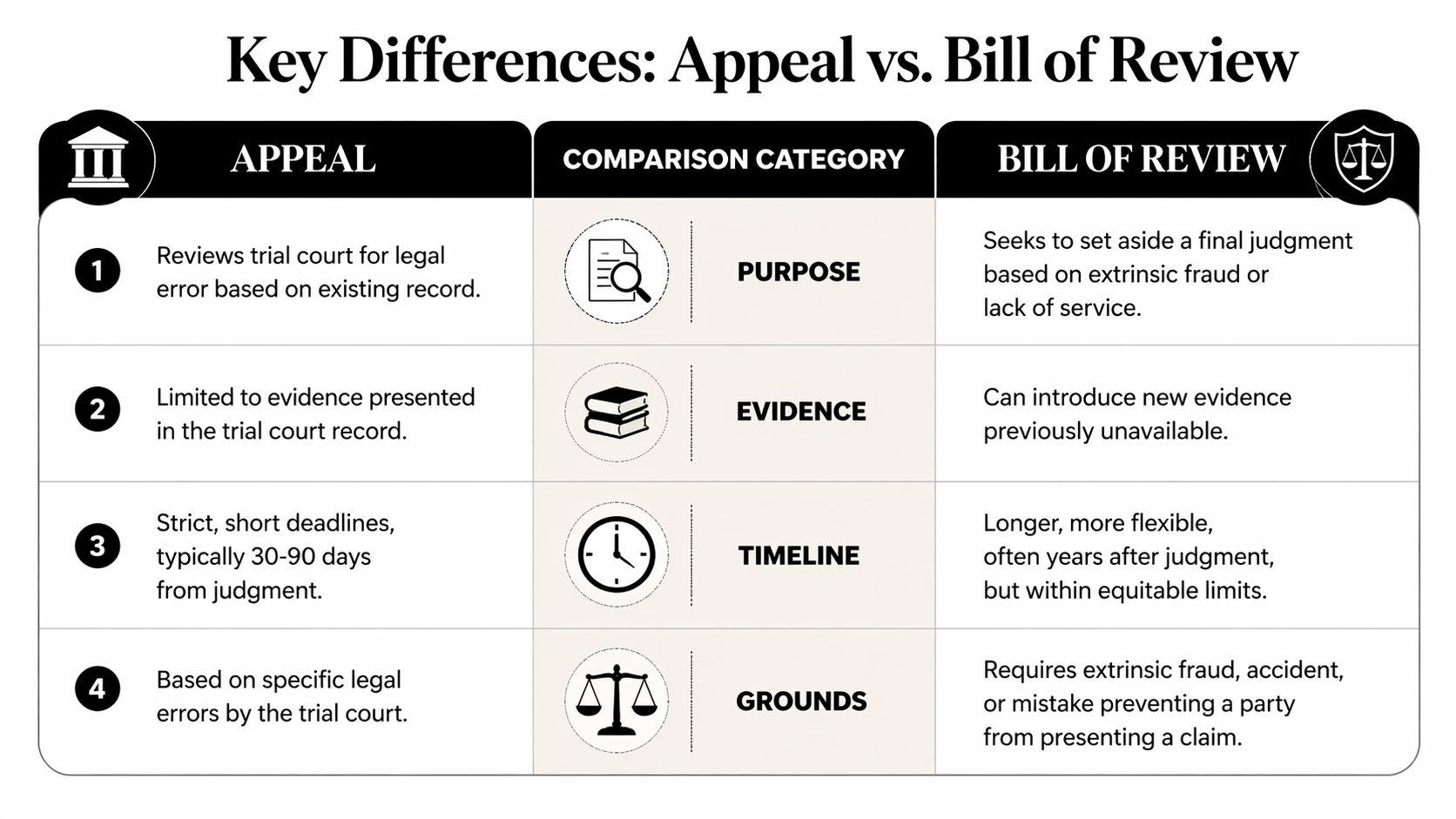
The choice between an appeal and a bill of review usually turns on four things: timing, burden, forum, and proof. If you get those four right, your case strategy gets sharper very quickly.
Timing usually decides the first branch
Timing is often the first hard filter.
Texas materials discussing this issue explain that a bill of review may be available for four years after a judgment is signed, while appeals must be filed within strict deadlines that typically range from 30 to 90 days, and the trial court’s plenary power generally lasts only 30 days from the date the judgment is signed; after that period, setting aside the judgment generally requires a bill of review, as explained in this discussion of an appeal of default judgment or bill of review in Texas.
That means a family law client who acts quickly may still have ordinary appellate options. A client who discovers the problem much later may be outside the appeal window and forced to evaluate a bill of review instead.
Burden of proof is not remotely the same
An appeal asks whether the trial court committed reversible error. In plain English, that means a legal mistake significant enough to justify changing the result or sending the case back.
A bill of review asks for much more. The petitioner usually must show a meritorious defense or claim to the underlying case and also show that they were prevented from presenting it because of fraud, accident, wrongful act, or official mistake.
That is a major strategic divide. One remedy focuses on trial court error. The other focuses on whether the final judgment should be undone at all.
Where the case goes
These remedies don’t just involve different arguments. They go to different courts.
| Category | Appeal | Bill of review |
|---|---|---|
| Decision maker | Court of appeals | Original trial court |
| Lens of review | Legal and procedural review of the existing record | Equitable attack on the final judgment |
| Typical objective | Reverse, modify, or remand | Vacate the prior judgment so the case can proceed properly |
That matters because the decision maker affects tone, evidence, and procedure. Appellate practice is brief-heavy and record-driven. Bill of review practice is trial-court litigation, often with pleadings, evidence development, and factual disputes.
The evidence question
Clients often realize which remedy fits at this point.
In an appeal, the court generally works from the existing record. That includes the reporter’s record, the clerk’s record, admitted exhibits, and the legal briefing. If a fact never made it into the record, an appellate court usually can’t treat it as evidence.
A bill of review is different by design. It exists for situations where the reason the judgment is unjust may not appear in the original record. Lack of notice, fraudulent conduct, or an official mistake may have to be proven through evidence developed after judgment.
Key distinction: If your best proof lives outside the trial record, an appeal may not solve the real problem.
Standards of review in plain English
Family law appeals often turn on the standard of review. That phrase means the level of deference an appellate court gives to the trial court.
Here are three terms clients should understand:
- Abuse of discretion means the trial court acted unreasonably or without reference to guiding legal rules.
- Reversible error means the legal mistake was important enough to justify appellate relief.
- Briefing means the written legal argument filed with the appellate court explaining the facts, law, and requested outcome.
Different issues get different review standards. Legal questions may receive closer review. Fact-sensitive rulings often receive more deference. In family law, many custody and property issues are reviewed through an abuse-of-discretion framework.
A bill of review creates a different posture. The petitioner faces a harder road because the law favors finality once normal post-judgment deadlines pass.
What works and what usually does not
Some patterns tend to hold true in practice.
Appeals tend to work better when:
- The error is visible in the record. The transcript, exhibits, and written order show the problem.
- The trial court applied the wrong legal rule. This can happen in property characterization, evidentiary rulings, or procedural due process issues.
- The court refused relevant evidence. If the record preserves the objection and the excluded proof mattered, appellate review may be the right vehicle.
Bills of review tend to fit better when:
- The judgment is already final and the ordinary deadlines are gone.
- The unfairness happened outside the courtroom record. Lack of service is a classic example.
- You need new evidence to explain why the judgment should be set aside.
What usually does not work is trying to use a bill of review as a substitute for an appeal you could have taken but did not pursue. Courts do not treat the bill of review process as a simple second chance.
Common Scenarios When to Use an Appeal vs a Bill of Review

Family law clients usually understand the difference best through situations that look familiar. The legal label matters less than the pattern.
Scenarios that usually point toward an appeal
A direct appeal generally fits when the complaint is about what the judge did with the evidence and law that were already before the court.
Take a property division dispute. If the trial record shows clear evidence that an asset was separate property, but the court treated it as community property anyway, that points toward appellate review. The same is true when a judge excludes important testimony, misreads a statutory requirement, or enters a ruling that the record does not reasonably support.
Custody cases often fit this model too. If the complaint is that the judge reached a conservatorship or possession ruling that amounts to an abuse of discretion based on the evidence heard, that is usually an appellate issue.
Scenarios that usually point toward a bill of review
A bill of review usually fits when the injustice occurred because the person never had a fair chance to present the case.
The classic example is a default divorce or default custody order entered after defective service. If a parent did not know the suit was pending and only later discovered a final order, the problem is not merely that the judge ruled incorrectly on the record. The deeper problem is that the person may have been denied the opportunity to appear at all.
Texas authorities discussing bills of review explain that the petitioner must prove a meritorious defense to the underlying action. In family law, that means a viable position on issues such as custody or property division that the petitioner was prevented from asserting through fraud, accident, or wrongful act, which is different from an appeal’s focus on legal error in the record, as described in this Freeman Law discussion of bills of review in Texas.
A practical split in real family cases
Here is a useful way to sort your situation:
- Appeal problem: “The judge heard my case, but made a legal mistake.”
- Bill of review problem: “I was prevented from fully presenting my case in the first place.”
If your strongest argument starts with “the record shows,” think appeal.
If it starts with “I never had the chance to show,” think bill of review.
That isn’t a final legal conclusion, but it’s a strong early indicator.
Where motion for new trial fits
Some clients are still in the immediate post-judgment stage, which means a third option may matter first: the motion for new trial. In some cases, that is the fastest and cleanest way to challenge a recent family law judgment before the case moves into full appellate posture. This overview of a motion for new trial in Texas family law helps explain where that remedy fits.
That matters because not every bad result should go straight into appeal briefing, and not every old judgment belongs in a bill of review. Timing and posture still control.
A few examples from the decision tree
| Situation | Better fit |
|---|---|
| Judge misapplied law to evidence admitted at trial | Appeal |
| Court excluded key testimony and the error was preserved | Appeal |
| Default decree entered after lack of proper notice | Bill of review |
| New evidence is needed to show fraud or wrongful prevention from participating | Bill of review |
The strategic point is simple. You do not choose the remedy based on frustration alone. You choose it based on the source of the unfairness.
Strategic Pros and Cons Choosing Your Remedy

Both remedies can be powerful. Both also come with hard trade-offs.
Why appeal is often the cleaner route
An appeal is usually more structured. The legal questions are framed by the record, the briefing schedule, and the standards of review. If the transcript and exhibits clearly preserve the mistake, an appeal can be the most direct path to relief.
That structure is also its limitation. Appeals are unforgiving about deadlines and preservation. If the issue was not preserved, or if the proof you need never made it into the record, the appellate court may not be able to fix the problem even if the outcome feels unjust.
Why a bill of review can be the only path left
A bill of review can reopen a door that seems shut. It allows a party to attack a final judgment after ordinary remedies have expired.
But it is purposely difficult. Texas commentary on the subject explains that a bill of review is an equitable proceeding attacking a prior judgment no longer subject to challenge by motion for new trial or appeal, and that a person who failed to invoke the right of appeal when it was available is precluded from proceeding by bill of review unless an adequate explanation is given, as described in this JD Supra article on bills of review in Texas.
That means a bill of review is not a backup plan for ordinary inaction. Courts expect a real explanation for why appeal was not the available route.
The trade-off in one list
- Appeal advantage: Better for legal error shown in the record.
- Appeal drawback: Short deadlines and no new evidence.
- Bill of review advantage: Can address hidden problems that prevented fair participation.
- Bill of review drawback: Higher burden, more factual litigation, and no easy substitute for a missed appeal.
The longer route is not the easier route. A bill of review gives more time, but usually demands more proof.
Choosing counsel and process
This is the point where case evaluation matters most. Some matters need appellate counsel immediately to secure the record, identify preserved issues, and prepare briefing. Others need a trial-level strategy for evidence gathering and equitable relief. Some firms handle one side of that divide better than the other.
For families dealing with appellate and post-judgment family law issues, The Law Office of Bryan Fagan, PLLC is one example of a Texas practice that evaluates both appeals and bill of review options in family law matters.
A Checklist for Evaluating Your Texas Family Law Case
You can do an initial case sort with a few disciplined questions. This will not replace legal advice, but it will help you spot the right lane faster.
Start with timing
Ask yourself when the final order was signed. If the order is recent, ordinary post-judgment and appellate remedies may still be on the table. If the order is much older, the analysis shifts toward whether an extraordinary remedy is available.
Timing is not just a calendar issue. It often determines whether the law still allows appellate review at all.
Identify the kind of mistake
Was the problem something the judge did in court, based on the evidence and arguments presented?
Or was the problem that you were kept from participating fairly because of lack of notice, fraud, accident, wrongful conduct, or official mistake?
That single distinction often separates appeal cases from bill of review cases.
Locate your proof
Use this short checklist:
- Record-based proof: Is the error shown in the reporter’s record, clerk’s record, admitted exhibits, or written rulings?
- Outside proof: Do you need affidavits, documents, or testimony that were never part of the original case?
- Merits proof: If you are considering a bill of review, can you show you had a real claim or defense worth presenting?
Examine your own role carefully
This part is uncomfortable but necessary. Did you miss a hearing or deadline because of your own oversight, or because something external prevented a fair response?
Bills of review are difficult when the failure to act was caused by a party’s own negligence. Appeals are difficult when the record does not preserve the complaint. A candid evaluation saves time.
Ask not only “Was I wronged?” but also “How can I prove it under the correct procedural path?”
A practical final screen
If your answers sound mostly like “the judge made the wrong call on the evidence presented,” you may be looking at an appeal.
If your answers sound mostly like “I was denied a fair chance to present my side and need new evidence to prove that,” a bill of review may deserve closer examination.
Next Steps How Our Appellate Attorneys Can Help
Choosing between these remedies is not a formality. It is one of the most consequential strategic decisions in a Texas family law case after judgment.
A careful review usually starts with the order itself, the date it was signed, and the available record. After that, counsel needs to identify whether the complaint is about appellate error, equitable grounds for setting the judgment aside, or a still-available post-trial motion. In family law, that review often touches custody findings, possession terms, support rulings, property characterization, enforcement orders, and protective orders.
What a serious case review should include
A meaningful consultation should answer questions like these:
- What deadlines still matter: Not in general, but in your exact case posture.
- What standard applies: Abuse of discretion, legal error, preservation issues, or equitable proof requirements.
- What evidence exists: In the appellate record, outside it, or both.
- What outcome is realistically available: Reversal, remand, modification, or reopening of the underlying case.
That kind of review should also account for the Texas Rules of Appellate Procedure and the family-law-specific framework that shaped the original order. Appellate strategy in a divorce property case is different from appellate strategy in a conservatorship dispute, even when both involve claims of unfairness.
Why early action still matters
Even when a bill of review may be available longer than an appeal, delay rarely helps. Documents get harder to locate. Memories fade. Litigation positions harden.
Early legal analysis also helps avoid a common mistake. Many people spend precious time arguing fairness in general terms when the primary need is to frame the problem in the correct procedural language. Courts do not grant relief because a result feels harsh. They grant relief when the law and proof support a recognized remedy.
If you believe the court made a mistake in your family law case, our appellate attorneys can help you seek a fair outcome. Contact The Law Office of Bryan Fagan today for a free consultation.
If you believe the court made a mistake in your family law case, a focused review can clarify whether an appeal, a bill of review, or another post-judgment remedy fits your situation. Contact The Law Office of Bryan Fagan, PLLC to schedule a consultation and evaluate your options for seeking a fair outcome.