
When a judge issues a child custody order that feels fundamentally unfair, it can be devastating. You may feel your case was handled unjustly and that the outcome doesn't protect your child's best interests. This is a common and deeply frustrating experience for many parents. However, a judge's decision is not always the final word. A child custody appeal in Texas offers a path to seek justice when you believe the court made a significant legal mistake. This process isn't a second trial, but a careful, strategic review aimed at correcting errors and restoring fairness.
When You Feel the Court Got It Wrong

Going through an emotional and stressful court battle, only to receive a custody order that you believe is wrong, can leave you feeling powerless and unheard. It’s natural to feel that the system has failed you and your child.
The Texas legal system, however, has a built-in mechanism for accountability: the appellate process. A child custody appeal in Texas is not an opportunity to present new evidence or re-argue your case from scratch. Instead, it is a technical review of the trial proceedings to determine if a major legal mistake—known as a reversible error—occurred. Our goal is to shift your focus from frustration to strategic action by showing you a clear path to seek a just outcome for your family.
Understanding Key Appellate Concepts
An appeal changes the focus of your case. We are no longer debating the facts of your family life but are instead analyzing whether the judge applied the law correctly. To do this, appellate attorneys focus on critical legal principles:
- Abuse of Discretion: This is the most common standard of review in family law appeals. It means the trial judge’s decision was not just one the appellate court disagrees with, but one that was arbitrary, unreasonable, or made without reference to guiding legal principles.
- Reversible Error: Not every mistake warrants a new outcome. A reversible error is a legal blunder so significant that it likely caused the court to reach the wrong decision. A minor procedural issue is not enough; the error must have fundamentally impacted the final judgment.
The appellate process is a marathon, not a sprint. It can be just as demanding as the initial trial, which is why it's important to seek emotional support during this challenging time. A strong support system is invaluable.
Valid Grounds for a Texas Custody Appeal
Simply disagreeing with the judge's final decision is not enough to win on appeal. A Texas child custody appeal is not a second chance to make your case. Instead, the entire process hinges on proving that the trial court made a specific, significant legal mistake that harmed your case. Without identifying such an error, an appeal cannot succeed.
Understanding the Standard of Review: Abuse of Discretion
The most common ground for appealing a family law decision is "abuse of discretion." This is a high legal standard to meet. To succeed, we must demonstrate that the judge's decision was so arbitrary, unreasonable, or disconnected from the facts and law that it cannot be defended. It's not about showing the appellate court would have made a different choice; it's about proving the trial judge made a choice that had no reasonable basis.
For example, imagine a case where multiple credible witnesses testify about a parent's ongoing, untreated substance abuse that directly endangers a child. If the trial judge ignores this undisputed evidence and grants that parent unsupervised possession without any safeguards—like drug testing or counseling—that ruling is likely an abuse of discretion. It is an arbitrary decision that fails to prioritize the child’s best interest as required by Texas law.
Common Reversible Errors in Texas Family Courts
Sometimes, the error is not about the judge’s reasoning but a clear misapplication of the law. These "legal errors" can be more straightforward because they involve a direct conflict between the court's order and the Texas Family Code. For instance, if a judge bases a custody decision on an outdated statute, that is a clear legal error and strong grounds for an appeal.
Here are some common reversible errors we identify in Texas custody appeals:
Common Grounds for Child Custody Appeals
| Type of Error | Plain-English Explanation | Example Scenario |
|---|---|---|
| Abuse of Discretion | The judge's decision was arbitrary and had no reasonable basis in the facts or the law. | A judge appoints a parent with a documented, untreated history of domestic violence as the primary conservator without ordering protective measures or supervision. |
| Legal Error | The judge incorrectly applied a specific law or legal rule from the Texas Family Code. | The court allows a grandparent to sue for custody under a less strict legal standard that the legislature has since replaced with a more demanding one. |
| No Evidence / Insufficient Evidence | The record contains no evidence to support a key finding made by the judge, or the evidence is too weak to legally support it. | A judge restricts a parent's visitation due to an allegation of substance abuse, but no evidence of substance abuse was ever presented during the trial. |
| Error in Admitting/Excluding Evidence | The judge improperly allowed harmful evidence (like hearsay) or excluded critical evidence, and that mistake likely led to an improper judgment. | A judge refuses to allow a parent to introduce certified criminal records showing the other parent’s recent convictions for crimes involving family violence. |
Certain legal questions, especially those involving the interpretation of a statute, are reviewed "de novo." This means the appellate court gives no deference to the trial judge and examines the legal issue with fresh eyes. You can learn more in our guide explaining what de novo review is.
The Importance of Preserving Error for Appeal
One of the most critical aspects of appellate law is "preservation of error." Even if a judge makes a clear mistake during your trial, you generally cannot challenge it on appeal unless your trial attorney made a timely and specific objection on the record. Without a proper objection, the appellate court will likely rule that you "waived" your right to complain about the error. This is why having a trial attorney who understands how to protect your rights for a potential appeal is absolutely essential.
The Clock is Ticking: Your First Steps in a Custody Appeal
When a judge signs a final custody order, the clock starts ticking on an incredibly time-sensitive process. The actions you take in the first few days and weeks are absolutely critical for a successful child custody appeal in Texas.
You typically have only 30 days from the date the final order is signed to file a Notice of Appeal. This document officially informs the trial court and the other party of your intent to challenge the decision. It is the first and most important step in the appellate process.
Missing the 30-day deadline is almost always fatal to an appeal. Barring rare exceptions, if the Notice of Appeal is not filed on time, you lose your right to appeal forever, no matter how flawed the judge's decision may have been.
Assembling the Record: The Foundation of Your Appeal
Filing the Notice of Appeal is just the beginning. Your appellate attorney must also formally request the official "record" from the trial court. An appeal is not a do-over; you cannot introduce new evidence or call new witnesses. The court of appeals is limited to reviewing only what is in the official record from your original trial.
The record consists of two parts:
- The Clerk’s Record: A collection of all documents filed in your case, including petitions, motions, and the final order itself.
- The Reporter’s Record: The official, word-for-word transcript of everything said during your trial, prepared by the court reporter.
These documents are the entire universe for your appeal. Your attorney will meticulously review them to identify the specific moments where legal errors occurred. If an error is not documented in the record, it legally did not happen for the purposes of your appeal.
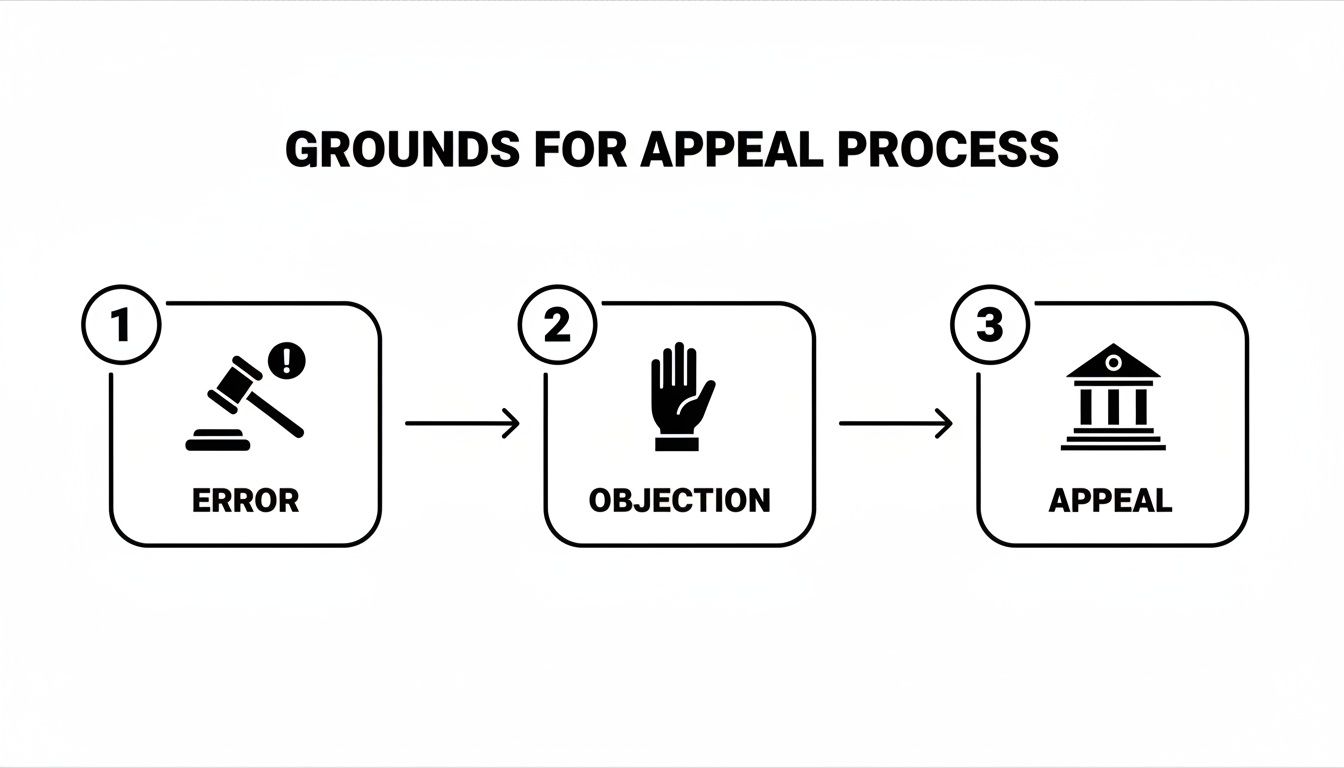
As this chart illustrates, an error must be properly objected to at trial to be "preserved" for appeal. This makes it a valid issue to argue before the appellate court.
Why You Must Act Immediately
The first 30 days after a ruling are filled with strict procedural deadlines. Requesting and paying for the Clerk’s and Reporter’s Records have their own tight timeframes. A simple misstep can create procedural problems that could get your appeal dismissed before your arguments are even heard.
Because these initial steps are so unforgiving, it is vital to contact an appellate attorney as soon as you receive a final order you believe is unfair. An experienced attorney can immediately assess the situation and ensure every filing is handled correctly and on time. For a closer look at this first critical step, read our guide on how to file a Notice of Appeal.
Crafting Your Argument: The Appellate Brief

Once the appeal is underway, the focus shifts to crafting the legal argument. The core of any child custody appeal in Texas is the appellate brief. This is not a simple letter to the court; it is a meticulously researched and written legal argument designed to persuade a panel of appellate justices that the trial judge made a reversible error. There are no witnesses or new evidence—the appeal is won or lost based on the strength of this written argument, built exclusively from the trial record.
What is Briefing? The Art of Legal Argument
The process of writing and filing these arguments is called "briefing." The first brief comes from the person appealing (the Appellant). Your attorney's job is to build a clear, compelling case for the justices, connecting specific moments from the trial to established legal errors.
An appellate brief must:
- Identify the Issues: It must clearly state the legal questions, such as, "Did the trial court abuse its discretion by ignoring undisputed evidence of family violence when appointing the primary conservator?"
- Cite to the Record: Every factual statement must point to its exact location in the Clerk’s Record or Reporter’s Record. If we argue the judge ignored testimony, we must cite the page and line number where it appears.
- Apply the Law: We then connect those facts to the Texas Family Code and prior appellate court decisions (precedent) to show precisely why the judge's action was a reversible error.
After the Appellant's Brief is filed, the other parent (the Appellee) files a response brief arguing that the trial judge ruled correctly. We may then file a final Reply Brief to address their arguments.
A strong brief is more than a summary of facts. It is an artful work of legal persuasion. The audience is not a jury but a panel of experienced judges seeking clear legal analysis. Emotional arguments that may have been effective at trial have no place here. Learn more about the strategy behind what an appellate brief is and why it is the most important part of your appeal.
Oral Argument: Presenting Your Case to the Justices
In some cases, the court schedules an oral argument. This is a formal, strictly timed session where attorneys appear before a panel of three justices to answer questions. It is not a retrial. The justices will have already read the briefs and will ask tough questions to probe the weak spots in each side's case. Your attorney must think on their feet, provide direct answers, and consistently guide the discussion back to the core legal errors that demand reversal.
If you believe the court made a mistake in your family law case, our appellate attorneys can help you seek a fair outcome. Contact The Law Office of Bryan Fagan today for a free consultation.
What Does a Successful Appeal Look Like?
Many parents who consider appealing a child custody order in Texas imagine the appellate court will simply overturn the old order and issue a new, better one. While this is a possible outcome, it is not the most common one. Understanding what "winning" an appeal typically means can help you set realistic expectations.
After reviewing the briefs and the trial record, the court of appeals will issue a written opinion that leads to one of several outcomes.
Affirmance: The Original Order Stands
The simplest outcome is an affirmance. This occurs when the appellate court finds that no reversible error occurred during the trial. If your appeal is affirmed, the original custody order remains in full effect. The justices are essentially concluding that the trial judge acted within the bounds of the law and their discretion, even if the appellate court might have decided the case differently.
Reverse and Remand: A Second Chance at a Fair Outcome
The most common "win" in a family law appeal is a "Reverse and Remand." Here, the appellate court agrees that the trial judge made a reversible error—a mistake so critical that it likely led to the wrong outcome. The court then "reverses" (vacates) the flawed order and "remands" (sends) the case back down to the same trial court for new proceedings.
A "Reverse and Remand" is not a final victory, but a crucial second chance. It allows you to re-argue your case, but this time, the judge must follow the appellate court's instructions to correct the original error. For example, the court might order a new hearing where evidence that was improperly excluded must now be considered. This gives you another opportunity to achieve a fair outcome on a level playing field.
Reverse and Render: The Rarest Victory
A "Reverse and Render" is the most decisive victory, but it is exceptionally rare in child custody cases. This is when the court of appeals not only reverses the trial court's order but also "renders" the judgment that should have been entered. This only happens when the correct legal result is so clear that another hearing would be pointless. Because custody decisions are deeply fact-specific and rely on the judge's firsthand observations of the parties, a "render" is a long shot.
Family dynamics are constantly changing. In 2023, Tarrant County saw thousands of new filings for custody modifications, which shows how often circumstances evolve after an initial order. You can read more about these Tarrant County family law case statistics. This is why sending a case back for a new hearing is often the most appropriate remedy.
If you feel a serious legal error was made in your family law case, our appellate attorneys can help you explore your options. Contact The Law Office of Bryan Fagan today for a free consultation to see if an appeal is the right next step for you.
Common Questions About a Child Custody Appeal in Texas
Pursuing an appeal can feel overwhelming, and it is natural to have many questions. Here are straightforward answers to some of the most common concerns we hear from parents considering an appeal.
How Long Does a Child Custody Appeal Take in Texas?
It is important to set realistic expectations. A child custody appeal is a lengthy process, typically lasting anywhere from nine months to over a year. This timeline includes several stages: preparing the official trial record, which can take months; the "briefing" stage, where each side gets time to write their legal arguments; and finally, the months the appellate justices spend reviewing the case and writing their opinion. Patience is essential during an appeal.
Can I Introduce New Evidence During My Appeal?
No. This is one of the most critical rules of appellate procedure. The appellate court's role is not to hold a new trial but to review the original one for legal errors. The court can only consider the evidence that was already presented to the trial judge, which is contained in the official "record" (the Clerk's Record and Reporter's Record). You cannot add new text messages, witness testimony, or photos you found after the trial. The appeal is decided solely on what happened in the trial court.
What Is the Standard of Review and Why Does It Matter?
The “standard of review” is the legal test the appellate court uses to evaluate the trial judge’s decision. For most child custody issues, that standard is “abuse of discretion.” This is an incredibly high bar. The appellate court will not reverse a decision just because it would have ruled differently. To win, we must prove that the trial judge acted unreasonably, arbitrarily, or without reference to guiding legal rules and principles. It’s not enough to show the judge was wrong; we must show the decision was legally indefensible.
Does Appealing Change My Current Custody Order?
Filing a child custody appeal in Texas does not automatically pause the current order. The judge’s order remains in full force and effect while the appeal is pending. You must continue to follow the visitation schedule, pay child support, and comply with all other terms of the ruling. Failure to do so can result in an enforcement action against you. While it is sometimes possible to ask the appellate court to suspend parts of an order, this is rarely granted in custody cases. Compliance with the current order is your safest course of action.
If you believe the court made a mistake in your family law case, our appellate attorneys can help you seek a fair outcome. The path to justice requires precision, experience, and strategic advocacy. Contact The Law Office of Bryan Fagan, PLLC today for a free consultation to evaluate your case.