If you are looking at a final divorce decree that feels fundamentally wrong, you are not alone. You may feel your case was handled unfairly, especially when it comes to the division of your property. While Texas law requires a “just and right” division of the assets you built together, trial courts can and do make mistakes. When the final order leaves you with a deeply unfair outcome, an appeal may be your path to justice. This guide explains how community property law in Texas should work and what you can do to seek a fair result.
What You Can Appeal in a Texas Divorce Case
The sinking feeling you get when reviewing a flawed property division is often the first sign that you may have grounds for an appeal. Many people walk away from a divorce trial confused by an outcome that doesn't align with the facts or the law. Perhaps an inheritance you believed was protected was incorrectly included in the marital estate, or a family business was severely undervalued, leaving you with a fraction of what you deserved.
This sense of injustice is where the appellate process begins. An appeal is not a second trial or a chance to present new evidence. Instead, it is a focused, strategic review of the trial court record to determine if the judge made a significant legal mistake—a “reversible error”—that led to the unfair outcome. Understanding how appeals differ from trials is the first step toward restoring balance.

Your Path to a Fair Outcome
The first step toward correcting an unjust property division is understanding your appellate rights under the Texas Rules of Appellate Procedure. The process involves a meticulous review of the trial record—every document, every piece of testimony, and every ruling—to pinpoint exactly where the court went wrong.
Some of the most common reversible errors in Texas family courts include:
- Mischaracterization of Property: The court mistakenly classified separate property (such as a gift or inheritance intended only for you) as community property, making it subject to division.
- Flawed Asset Valuation: A significant asset, like a business or real estate portfolio, was valued incorrectly, which skewed the entire property division.
- Abuse of Discretion: The judge’s decision was not supported by the evidence presented in court or was based on an incorrect application of the Texas Family Code.
We will break down these core concepts, explain the types of mistakes trial courts often make, and show you how a well-argued appeal can be the key to achieving a just and right division.
Understanding Community vs. Separate Property in Texas
Under Texas law, a marriage is treated like a partnership. Nearly everything you and your spouse earn or acquire during the marriage belongs to the "community estate." This principle, known as the community property presumption, means that the law presumes most assets are jointly owned and subject to division in a divorce.
However, not all assets are part of the community estate. Property you owned before the marriage, or assets you personally received as a gift or inheritance during the marriage, are considered your separate property. This distinction is critical because separate property cannot be divided by the court. When a judge gets this wrong, it is a significant legal error that can form the basis of a successful appeal.

The Power of the Community Property Presumption
In practice, Texas law begins with a powerful assumption: any asset acquired by either spouse from the date of marriage to the date of divorce is presumed to be community property. This includes income, real estate, vehicles, and retirement accounts.
The burden of proof is not on the spouse claiming an asset is shared; it is on the spouse claiming an asset is separate. If you cannot provide sufficient proof, the judge must treat the asset as belonging to the community estate. This creates opportunities for trial court errors, especially when financial records are complex or were not presented clearly.
Carving Out Your Separate Property
To overcome the community presumption, you must prove an asset is your separate property with clear and convincing evidence. This is a higher legal standard than the "preponderance of the evidence" standard used in many civil cases. You must present a firm and unambiguous case.
What qualifies as separate property?
- Property owned before marriage: Any asset you held title to before you were married.
- Gifts received during marriage: A specific gift made only to you, such as jewelry from a parent.
- Inheritance received during marriage: Money or property you inherited from a family member's estate.
- Personal injury settlements: The portion of a settlement intended to compensate you for pain and suffering is typically separate. However, funds for lost wages during the marriage would likely be community property.
This system is not new; Texas is one of nine community property states, and our laws have deep historical roots codified in the Texas Family Code. This long-standing legal framework provides clear rules that courts must follow.
Community Property vs. Separate Property at a Glance
| Asset Type | Generally Community Property If… | Generally Separate Property If… |
|---|---|---|
| Salary/Wages | Earned by either spouse during the marriage. | N/A |
| Home/Real Estate | Purchased during the marriage, even if only one name is on the title. | Owned by one spouse before marriage, or purchased with separate funds. |
| Bank Accounts | Funded with earnings from the marriage, or has commingled funds. | An account held before marriage and never mixed with community funds. |
| Retirement Accounts | The portion that accrued between the date of marriage and date of divorce. | The value that existed before the marriage, plus any growth on that amount. |
| Inheritance | N/A | Received by one spouse during the marriage from a deceased person's estate. |
| Gifts | A gift was given to the couple jointly (e.g., a wedding gift). | A gift was clearly intended for only one spouse. |
This table is a general guide. The specific facts of your case, especially how funds were handled and documented, can change the classification of an asset.
Where Trial Courts Get It Wrong
One of the most frequent and significant reversible errors we see on appeal is the mischaracterization of property. This occurs when a judge incorrectly labels separate property as community, or vice versa. It’s a critical mistake that can invalidate the entire property division.
For example, if you used money from an inheritance (your separate property) for a down payment on a home, that portion of the home's equity should remain your separate property. If a court fails to recognize this and divides the entire value of the home, that is a classic, correctable error. A prenuptial agreement template can help clarify property characterization beforehand, but an appeal is necessary to fix mistakes after a final judgment. An appellate court has the authority to review the trial record and reverse a property division based on mischaracterization. For a deeper look at this legal framework, see our article on how Texas community property law works.
Following the Money: The Art and Science of Tracing Separate Property
Simply stating that an asset is yours is not enough in a Texas divorce. Because of the strong community property presumption, the burden is on you to prove its separate nature with clear and convincing evidence. This forensic accounting process is called tracing, and it is one of the most technical and critical parts of any complex property division case.
For example, imagine you inherited $50,000. That money is your separate property. If you kept it in a separate account and never added community funds, tracing is straightforward. But in reality, you might have deposited it into a joint checking account, paid bills from that account, and later used the remaining funds to buy stocks. The lines have now become blurred.

To prove those stocks are still your separate property, you must meticulously follow the money. This requires building a complete paper trail that leads directly from the original separate asset to the current asset, proving that only your separate funds were used for that investment.
Building an Unbreakable Chain of Evidence
Tracing is like financial detective work, piecing together years of records to create an unbroken chain of evidence. If there are gaps in the chain or if the evidence is unclear, a court will likely rule that the asset has been commingled and is now part of the community estate, subject to division.
To build a successful tracing claim, you will need specific documents:
- Bank Statements: Show the movement of funds between accounts over time.
- Deeds and Titles: Prove ownership of real estate or vehicles before marriage or show how a purchase was funded.
- Wills and Trust Documents: Establish that an inheritance was your separate property from the start.
- Brokerage Account Statements: Demonstrate the purchase and sale of investments using separate funds.
The Texas Family Code §3.003 requires "certain and positive evidence" to overcome the community presumption. Tracing is the only method to meet this demanding legal standard.
When Tracing Fails: A Classic Reversible Error
When a trial court gets tracing wrong, it results in the mischaracterization of property—one of the most common reversible errors in a divorce appeal. This is the legal term for when a judge incorrectly labels your separate asset as community property, often because the tracing evidence was not presented clearly or was misunderstood by the court.
What does “abuse of discretion” mean? This is the standard of review for most family law appeals. It means the trial judge made a decision that was unreasonable, arbitrary, or without reference to any guiding rules or principles. A decision to divide properly traced separate property is a textbook example of an abuse of discretion.
If you presented clear tracing evidence at trial but the judge divided your separate asset anyway, that is precisely the type of error an appeal is designed to correct. For example, if bank records prove you sold a stock you owned before marriage and used those exact proceeds for the down payment on the marital home, that portion of the home's equity should be awarded to you. If the trial judge ignores this evidence, you have strong grounds for an appeal. An appellate attorney specializes in reviewing the trial record for these exact mistakes to determine if the judge applied the law correctly.
Understanding the Standard of Review: Common Errors in Property Division
You may leave the courtroom feeling the judge’s decision was not just unfair but legally incorrect. In Texas, a divorce decree must achieve a “just and right” division of your community estate. While this standard is flexible, that flexibility does not give a judge unlimited power.
When a trial court’s ruling is unreasonable, arbitrary, or lacks a basis in the facts and law, it constitutes an abuse of discretion. This is the key to winning a property division appeal. An appeal is not about re-arguing the facts; it's about proving the judge made a specific, significant legal error that produced an unjust result.
Mischaracterization of Property
The most common and impactful error is the mischaracterization of property. This happens when the judge confuses what is yours (separate property) with what is "ours" (community property). When a court wrongly labels your separate property as community property, it improperly subjects it to division.
Consider a business you owned and operated for years before you were married. If the court treats the entire business as community property without accounting for its separate property origins, you could be forced to give up half of an asset that was legally yours alone. This often occurs when the evidence tracing the asset's origins was complex or was not presented with sufficient clarity at trial.
In Texas, dividing a spouse's documented separate property is a clear abuse of discretion and one of the strongest arguments for reversal on appeal.
An appellate court will review the evidence presented to the trial judge. If the record contains clear and convincing proof of an asset's separate character—such as deeds, bank statements, or trust documents—and the judge disregarded it, you have a powerful case for a successful appeal.
Flawed and Inaccurate Asset Valuations
A fair division is impossible if the asset values are wrong. A "just and right" outcome depends on an accurate understanding of what the community estate is worth. When a court accepts a flawed or unsupported valuation for a major asset, it invalidates the entire division.
This error is common with complex, hard-to-value assets, such as:
- Family-Owned Businesses: Business valuation is complex. A judge may accept a valuation that uses an incorrect methodology or ignores key factors like personal goodwill, resulting in a number that is far from accurate.
- Real Estate Holdings: An appraisal might be outdated, or the appraiser may have overlooked market conditions that significantly affect a property's true value.
- Complex Financial Instruments: Assets like stock options, restricted stock units, and pensions are notoriously difficult to value correctly, and simple errors can lead to major financial imbalances.
If an asset’s valuation was not supported by sufficient evidence at trial, an appellate court can find that the judge abused their discretion. For a detailed analysis of this issue, read our guide on appealing a business valuation in a Texas divorce.
A Disproportionate Split Without Justification
While Texas law does not require a strict 50/50 split, any division must be equitable. A judge has the discretion to order a disproportionate division—such as 60/40 or 70/30—but they cannot do so arbitrarily. There must be legally valid reasons for an unequal split, and those reasons must be supported by evidence in the trial record.
Factors like fault in the divorce (such as cruelty or adultery), a significant disparity in earning capacity, or the needs of the children can justify an unequal division. However, a judge cannot simply decide that one person "deserves" more. If the court awards your ex-spouse a much larger share of the estate without a clear, evidence-based reason, that may be an abuse of discretion and a strong basis for an appeal.
Navigating the Texas Appellate Process Step by Step
If you are certain the trial court made a mistake in your property division, it is essential to understand how an appeal works. An appeal is not a new trial where you can introduce new evidence or call different witnesses.
Instead, an appeal is a technical legal review of what already occurred at trial. The appellate court’s role is to examine the official trial record for reversible error—a mistake so significant that it likely caused an unfair result. The entire process is governed by strict deadlines and complex rules found in the Texas Rules of Appellate Procedure.
Step 1: Initiating the Appeal with a Notice of Appeal
The appellate journey begins with a single, critical document: the Notice of Appeal. Filing this document officially informs the trial court and the other party that you are challenging the final judgment. The deadline for this step is absolute.
In most Texas family law cases, you have only 30 days from the date the final judgment is signed to file your notice. If you miss this deadline, your right to appeal is almost certainly lost forever. While certain post-trial motions can extend this deadline to 90 days, you should never rely on that possibility. The clock starts ticking immediately.
Step 2: Preparing the Appellate Record
Once the appeal is initiated, the next step is to assemble the official appellate record. This is the complete collection of documents and transcripts the appellate judges will use to review your case. The record has two main components:
- The Clerk’s Record: This includes every document filed in your case, from the original petition and motions to discovery responses and the final judgment.
- The Reporter’s Record: This is the official, word-for-word transcript of everything said during your trial—all witness testimony, attorney arguments, and rulings made by the judge.
The appellate record defines the universe of your appeal. If a piece of evidence, a statement, or an objection does not appear in the record, then for appellate purposes, it never happened. This is why thorough trial preparation is so vital.
The infographic below highlights the common types of reversible errors an appellate attorney looks for when reviewing the record in a property division case.
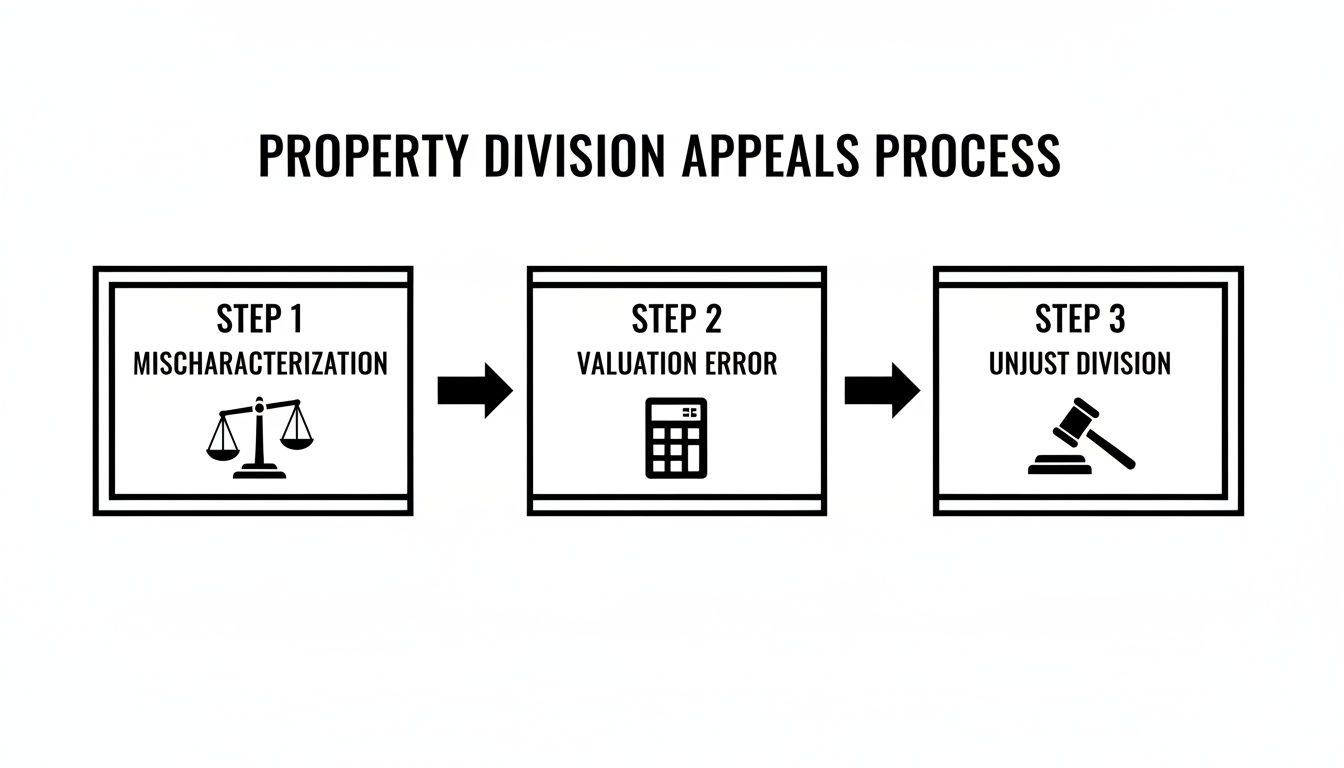
As shown, the strongest grounds for appeal often involve the court mischaracterizing separate property, relying on a flawed valuation, or ordering a division that is fundamentally unjust.
Step 3: Crafting the Appellate Brief
After the record is prepared, the core analytical work begins. This is where your appellate attorney conducts deep legal research, cross-referencing the facts of your case with the Texas Family Code and decades of case law to build a persuasive argument. This work culminates in the appellate brief.
Plain-English Definitions: A brief is a formal written argument submitted to the court. Briefing is the process of writing and filing these arguments. A reversible error is a legal mistake made by the trial judge that is serious enough to require the appellate court to overturn the decision.
The brief is a formal legal document that meticulously explains every error the trial court made, why those mistakes are legally significant, and why the decision should be reversed. It is the single most important document in your appeal. The other side will file a responsive brief, and your attorney may then file a final reply. In some cases, the court may schedule an oral argument, where the attorneys argue their points directly to the panel of judges. After reviewing all briefs and arguments, the appellate court will issue its written decision.
Why You Need a Specialized Appellate Attorney
If you believe the court’s decision in your divorce was wrong, it is vital to understand that winning on appeal requires a different skill set than winning at trial. The skills that make a great trial lawyer—such as persuading a jury or thinking quickly in the courtroom—are distinct from the skills that win an appeal.
A trial lawyer operates in the world of live testimony and courtroom dynamics. An appellate lawyer, by contrast, operates in the world of legal precedent, procedural rules, and the cold, hard facts of the written record. They are two different legal disciplines.
A Fresh Perspective on the Record
One of the greatest advantages of hiring an appellate specialist is a fresh set of eyes. Your appellate attorney was not involved in the emotional and strategic battles of your trial. This objectivity is a powerful asset, allowing them to systematically analyze the clerk’s and reporter’s records to identify reversible errors that may have been missed.
Their focus is entirely on critical questions of law:
- Did the court misunderstand or misapply community property law in Texas?
- Was there legally sufficient evidence in the record to support the judge’s decision?
- Did the judge commit an abuse of discretion by making an arbitrary or unreasonable ruling?
To build a winning appeal, every word from the trial matters. Appellate teams often use professional legal transcription services to ensure the record is perfect. This meticulous attention to detail is how a feeling of injustice is transformed into a powerful legal argument for reversal.
Masters of a Different Courtroom
The appellate world operates under a strict and unforgiving set of rules: the Texas Rules of Appellate Procedure. These rules are filled with complex deadlines and rigid formatting requirements. A single procedural misstep can result in your case being dismissed before a judge ever considers its merits.
An appellate specialist understands these technicalities and knows how to navigate the procedural traps.
An appeal is won not with new evidence, but with a meticulously crafted written argument that demonstrates how the law was misapplied to the existing facts. Your appellate brief is the single most important tool for achieving a different outcome.
This unique combination of deep legal research, persuasive writing, and oral advocacy is what can turn an unfair outcome into a just one. It is about restoring balance and ensuring the law was applied correctly.
Common Questions About Property Division Appeals
When a judge issues a final property division, it can feel like the end of the road. But if that decision seems deeply unfair, you likely have many questions. Let's address some of the most common ones we hear from clients navigating the complexities of community property law in Texas and the appeals process.
How Long Do I Have to Appeal a Property Division Order in Texas?
Time is of the essence. The deadline to initiate an appeal is extremely strict. In nearly all cases, your Notice of Appeal must be filed with the court within 30 days from the date the judge signs the final judgment.
This is one of the firmest deadlines in Texas law. Missing it means losing your right to appeal, permanently. While certain post-trial motions, such as a Motion for New Trial, can sometimes extend this deadline to 90 days, you should never rely on that possibility. The best course of action is to contact an appellate attorney immediately after receiving a judgment you believe is wrong.
What Does "Abuse of Discretion" Mean in a Property Appeal?
This legal term is central to your appeal. Abuse of discretion is the standard of review appellate courts use to evaluate a trial judge's decision. It does not mean the judge acted with bad intentions.
In legal terms, an abuse of discretion occurs when a judge makes a ruling that is arbitrary, unreasonable, or made without reference to guiding legal rules and principles. It is a classic form of reversible error.
What does this look like in practice? Imagine you presented clear and convincing evidence—bank statements and deeds—proving an inheritance was your separate property, but the judge divided it as community property anyway. That is an abuse of discretion. Another example is a judge ordering a highly disproportionate 80/20 property division without any evidence in the record to justify it. An appellate court would almost certainly view that as a reversible error.
Can I Introduce New Evidence or Witnesses in My Appeal?
This is a common misconception. The answer is a firm no. An appeal is not a second trial or a "do-over" where you can present facts you forgot to include the first time.
The appellate court is strictly limited to reviewing the official trial record from your original case. That record consists of only two parts:
- The Clerk’s Record: Every document, motion, and order filed in your case.
- The Reporter’s Record: A word-for-word transcript of everything said during court hearings.
Your appellate lawyer’s job is to act as a legal detective, scrutinizing that existing record to find legal mistakes. They cannot introduce a new document or call a new witness. This is precisely why it is so critical that all evidence is presented correctly and all necessary objections are made at trial. Your entire appeal depends on what is already in that record.
If you believe the court made a mistake in your family law case, our appellate attorneys can help you seek a fair outcome. Contact The Law Office of Bryan Fagan today for a free consultation at https://familylawcourtappeals.com.