You may feel your case was handled unfairly if a judge’s ruling on your 401(k) division seems unjust. This is more than just a financial inconvenience—it’s a decision that can profoundly affect your retirement security. Splitting a 401(k) in a Texas divorce requires a specific legal tool called a Qualified Domestic Relations Order (QDRO) to transfer funds without harsh tax penalties. When this complex process goes wrong, it can be a legitimate reason to seek justice through an appeal.
A mistake in dividing a 401(k) can compromise your financial future. If you believe the court made a significant legal error, the Texas appellate process offers a pathway to correct it and restore a fair outcome.
Why an Unfair 401(k) Split Can Be Appealed
If the court's ruling on your 401(k) feels deeply unfair, you have reason to be concerned. The financial fallout from a divorce is significant, particularly when it comes to the retirement savings you’ve spent a lifetime building. For many Texans, a 401(k) is their most valuable asset besides their home. How it is divided will directly impact your financial well-being for years to come.

What You Can Appeal in a 401(k) Division
In Texas, the standard for dividing community property is that it must be "just and right," which often means a 50/50 split of assets acquired during the marriage. However, arriving at that division is a complex process filled with potential legal pitfalls.
An appeal is not a retrial; it is a review of the trial court’s record for specific legal mistakes. Common reversible errors in 401(k) cases include:
- Mischaracterization of Property: The court incorrectly treats separate property (owned before marriage) as community property.
- Incorrect Valuation: The court uses the wrong date or method to value the account, leading to an unfair division.
- Flawed QDRO: The judge signs a QDRO that is legally defective or contradicts the divorce decree.
An error in calculating the community property portion, valuing the account, or drafting the legal documents is not just frustrating—it can be a reversible error. This means it provides legitimate grounds to seek justice through the appellate process.
Understanding key legal terms is the first step toward protecting your rights.
Key Appellate Terms in Plain English
| Legal Term | Plain-English Definition |
|---|---|
| Reversible Error | A legal mistake made by a trial judge that is serious enough to require an appellate court to overturn the decision. |
| Abuse of Discretion | A legal standard where a judge makes a decision that is arbitrary, unreasonable, or without basis in law or fact. |
| Appellate Record | The official collection of documents and transcripts from the trial court that the appellate court reviews. No new evidence is allowed. |
| Briefing | The process of writing and submitting detailed legal arguments (briefs) to the appellate court explaining why the trial court’s decision was legally wrong. |
| Standard of Review | The specific legal lens an appellate court uses to analyze a trial court’s decision. For property division, it is typically "abuse of discretion." |
Knowing what these terms mean will help you understand the appellate process and how it can be used to correct an unjust outcome.
The Role of the QDRO in an Appeal
The single most important legal tool in this process is the Qualified Domestic Relations Order (QDRO). This is a special court order, separate from your divorce decree, that tells the 401(k) plan administrator exactly how to divide the account.
Without a properly executed QDRO, transferring funds to your ex-spouse would be treated as a regular withdrawal, potentially triggering income taxes and early withdrawal penalties. A flawed QDRO or a divorce decree with conflicting instructions can lead to devastating financial losses and may constitute a reversible error.
It’s also critical to remember details that can have huge consequences, like updating your beneficiary designation forms. These complex financial issues are especially common in high-value cases, and our team has extensive experience protecting client interests in high net worth divorce appeals.
If your divorce decree has resulted in an unjust property division, the Texas appellate courts exist to provide a path to correct these errors.
Understanding a Common Reversible Error: Mischaracterizing Property
When fighting for a fair outcome, one of the most common and damaging mistakes a trial court can make is getting the property characterization wrong. In Texas, the law starts with a powerful presumption: any asset you or your spouse acquired during the marriage is community property. This means it belongs to both of you and is subject to a "just and right" division.
The burden of proof falls on the person claiming an asset as their separate property. For a 401(k), this requires meticulously proving which portion of the account was yours before the marriage.
The Challenge of Tracing Separate Property
Simply providing a 401(k) statement from around your wedding date is often not enough. To successfully prove your separate property claim, Texas law requires a process called tracing. This involves a detailed forensic accounting of your retirement account, tracking an asset from its separate property origins through any changes it underwent during the marriage.
This complex process requires sifting through years of statements to follow the initial separate property balance, accounting for its specific growth from market gains and dividends while isolating it from community contributions and the growth on those funds.
A trial court's failure to correctly identify and set aside proven separate property is a significant legal error. This mischaracterization can be considered an "abuse of discretion," which is a strong foundation for a successful appeal.
Why Outdated Formulas Lead to Reversible Errors
In the past, some courts used an inaccurate shortcut by taking the account's value at divorce and subtracting the value at marriage, labeling the remainder as "community." This is legally incorrect.
This simplistic formula ignores the passive growth—like stock market gains—on your original separate property funds. Under Texas law, that growth remains your separate property. When a court uses an incorrect formula, it unfairly awards a portion of your separate property to your ex-spouse. This is a classic example of a reversible error.
What a Proper Tracing Analysis Involves
To meet the high "clear and convincing" evidence standard in Texas, a proper tracing analysis must be precise. This is usually performed by a forensic accountant, who will methodically:
- Establish the starting balance: Pinpoint the exact value of the 401(k) on the date of marriage.
- Isolate separate property growth: Calculate earnings (interest, dividends, appreciation) tied only to that starting balance.
- Separate community contributions: Identify all contributions from earnings during the marriage, including employer matches.
- Calculate community property growth: Determine the investment growth resulting from community contributions.
A deep understanding of these property laws is critical. You can learn more by reading our guide explaining why Texas is a community property state. An attorney experienced in property division appeals knows how to spot when a trial court has misapplied these principles.
If you presented detailed evidence and the court still mischaracterized your 401(k), you may have strong grounds for an appeal. The appellate courts exist to review these exact types of legal errors and ensure the law was applied fairly.
How a Defective QDRO Can Lead to an Appeal
Many people believe their divorce decree is the final word on splitting assets. While it is a powerful court order, it cannot force a 401(k) plan administrator to divide an account. For that, you need a separate court order: a Qualified Domestic Relations Order (QDRO).
The decree states what should happen, while the QDRO tells the financial institution how to do it. The QDRO process is highly technical, and a small mistake in drafting or execution can cost you thousands. These are the kinds of mistakes that can create a reversible error, providing a pathway to correct it on appeal.
The chart below illustrates how a 401(k) evolves over time, from a separate asset into a divisible marital one.
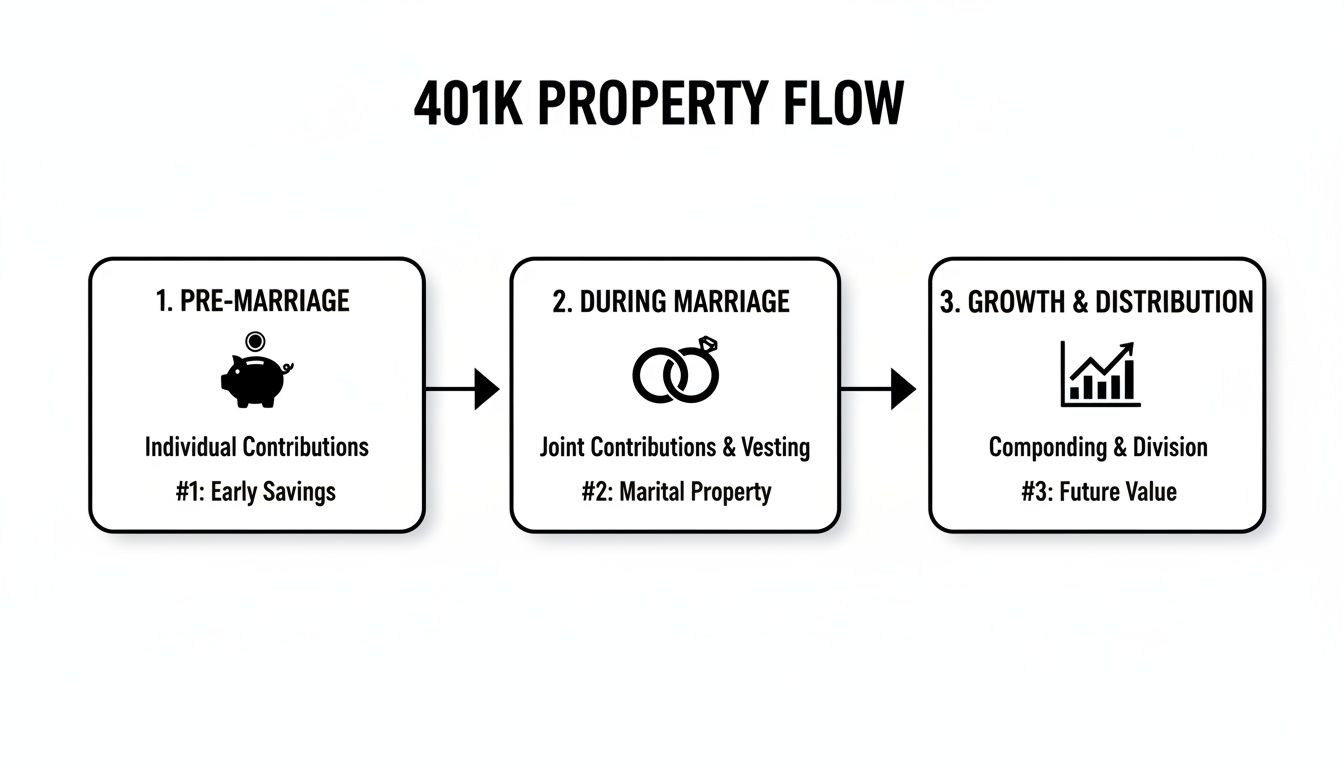
This is why the QDRO must be drafted with precision. It must carve out only the community property portion that grew during the marriage, leaving pre-marital separate property untouched.
The QDRO Process: From Draft to Distribution
Getting a QDRO from concept to distribution is a multi-step journey requiring careful coordination between your lawyer, the court, and the 401(k) plan administrator. One misstep can lead to delays, lost money, or an unfair outcome.
First, the QDRO must be drafted. This is not a fill-in-the-blank form. Every word must be customized to satisfy both Texas law and the specific internal rules of the retirement plan. Most plan administrators have their own preferred language and a pre-approval process that must be followed.
Next, the draft is sent to the plan administrator for pre-approval. This is a critical checkpoint to ensure the plan’s legal department will accept the order once the judge signs it. Skipping this step can result in a signed court order that is completely unenforceable.
Expert Insight: A classic, costly mistake is failing to specify how to handle market gains and losses. If a QDRO awards a flat dollar amount—say, $100,000—and the market declines before the transfer occurs, the employee spouse absorbs the entire loss. Ambiguous language here is a common basis for a successful appeal.
After pre-approval, the QDRO is presented to the judge for a signature, making it a binding court order. The signed QDRO is then sent back to the plan administrator, who finally implements the order and divides the funds.
What Every QDRO Must Contain
For a QDRO to be "qualified" under federal law, it must contain specific information. Omitting or getting any of this wrong can invalidate the document.
At a minimum, it must include:
- Clear Identification: The full name and last known mailing address for both the employee ("participant") and the ex-spouse receiving funds ("alternate payee").
- The Correct Plan: The exact official name of the 401(k) plan.
- Specific Division Details: The exact dollar amount or percentage of benefits being awarded and the specific valuation date. Vague language will be rejected.
If a judge signs a QDRO with vague or legally flawed language that causes an unjust division, it can be considered an abuse of discretion. This is precisely the kind of error the appellate process is designed to correct.
Spotting Reversible Errors in Your 401(k) Division
It is one thing to feel a judge got your divorce ruling wrong; it is another to prove it in an appellate court. An appeal in Texas is not a second trial but a focused review of the trial record to find specific legal mistakes that led to a fundamentally unfair result. These kinds of errors happen frequently in complex 401(k) divisions.

The key is to identify a "reversible error." This is not about disagreeing with the outcome; it is about pinpointing where the judge misapplied Texas law or procedure in a way that materially harmed you.
Understanding the "Abuse of Discretion" Standard of Review
Family law judges in Texas have significant latitude, a concept known as "discretion." However, this power is not unlimited. A judge commits an abuse of discretion when they make a decision without any basis in the law or facts—acting arbitrarily. When this happens and causes an unjust outcome, an appellate court can reverse the trial court's order.
Procedural mistakes can also be grounds for appeal. Avoiding preventable slips like missed deadlines is critical, as one small mistake can have massive financial consequences for a client.
Common Reversible Errors in 401(k) Cases
- Mischaracterizing Separate Property: This is the most common and costly error. If you provided clear and convincing evidence tracing your separate property portion of a 401(k), but the court still treated the entire account as community property, this is a major legal mistake and a strong basis for an appeal.
- Using the Wrong Valuation Date: The date a 401(k) is valued can significantly impact the division, especially in a volatile market. The divorce decree must name a legally appropriate valuation date, almost always the date the divorce is finalized. Using an outdated or arbitrary date is an error an appellate court will take seriously.
- Ignoring Post-Divorce Market Fluctuations: There is always a delay between the divorce finalization and the actual division of the 401(k). A properly drafted QDRO awards a percentage of the account, not a fixed dollar amount, ensuring both parties share in market gains or losses during this gap. A decree awarding a flat dollar amount that results in an unequal split is a reversible error.
- Drafting a Decree That Conflicts With the QDRO: The divorce decree (the "what") and the QDRO (the "how") must align perfectly. When the decree is vague or contradicts the QDRO (e.g., using different valuation dates), it creates a legal conflict that can be challenged on appeal.
To understand how these issues are addressed, it is helpful to see how an appeal differs from a trial.
How an Appeal Differs From a Trial
The table below breaks down the fundamental differences between trial and appellate courts.
| Aspect | Trial Court | Appellate Court |
|---|---|---|
| Purpose | To hear evidence, determine facts, and apply the law to make an initial ruling. | To review the trial record for legal errors that may have caused an improper judgment. |
| Evidence | Hears live testimony from witnesses and accepts new evidence. | Does not hear new testimony or consider new evidence; the review is limited to the existing record. |
| Focus | Deciding the outcome of the dispute (e.g., how to divide the 401k). | Determining if the trial judge followed the proper legal rules and procedures according to the standard of review. |
If any of these scenarios sound familiar, you might have solid grounds for an appeal. An experienced appellate attorney can review your trial record to determine if the court's mistake constitutes a reversible error.
The Texas Appellate Procedure for Correcting an Unfair 401(k) Split
If you walked out of the courtroom feeling the judge got your 401(k) division wrong because the law was not followed or your evidence was ignored, the appellate process is your path forward. An appeal is not a "do-over" but a formal procedure to ask a higher court to review the trial judge’s decision for significant legal mistakes.
An appeal is not a new trial. You cannot present new evidence or have witnesses testify again. Instead, your appellate lawyer will scrutinize the existing trial record—every document and transcript—to find a reversible error that justifies a different outcome.
Step 1: Filing the Notice of Appeal and Preparing the Record
The first step is filing a Notice of Appeal. This official document initiates the process and is subject to strict deadlines under the Texas Rules of Appellate Procedure. Missing this deadline could forfeit your right to appeal.
Once the notice is filed, the official appellate record is assembled. This is the complete file the appellate court will review and includes:
- The Clerk’s Record: All paperwork filed in your case, from the initial petition to the final divorce decree.
- The Reporter’s Record: The official, word-for-word transcript of everything said during your court hearings.
The appellate court’s review is limited to what is contained in this record.
Step 2: Crafting the Argument in the Appellate Brief
With the record prepared, your attorney will draft the appellate brief. This is the core of the appeal—a detailed, persuasive legal document explaining exactly where the trial judge erred. This is a technical argument grounded in law and facts from the record, not an emotional retelling of your story.
For example, the brief might argue the judge committed an "abuse of discretion" by mischaracterizing your separate property portion of the 401(k) despite clear tracing evidence. The argument would cite specific pages in the trial transcript and legal precedent to show why the decision was legally flawed and led to an unfair division. You can explore a deeper analysis of these issues in our complete guide to splitting a 401(k) in divorce.
An appellate brief is a work of legal precision. Its goal is to demonstrate that the trial court's mistake was not just a minor disagreement, but a significant reversible error that materially harmed your financial rights and requires the appellate court to intervene.
After your brief is filed, the opposing side files a response. Your attorney may then file a final reply brief. The court may also schedule an oral argument, where lawyers argue the case before a panel of appellate justices.
Step 3: The Appellate Court’s Decision
The appellate court reviews the trial judge's decision based on the applicable standard of review. For property division, this is typically the "abuse of discretion" standard. This requires your lawyer to prove the judge’s decision was so arbitrary and unreasonable that it fell outside the bounds of any acceptable legal conclusion.
If your appeal is successful, the appellate court can reverse the incorrect property division and remand (send back) the case to the trial court with instructions to correct the error. This is a complex fight, but with an attorney who understands both Texas family law and appellate procedure, it is the path to restoring a just and right division of your assets.
Common Questions on Appealing a 401(k) Division
When you are facing an unfair divorce outcome, you need clear answers about the specific issues affecting your case. Here are some of the most common questions that arise when helping clients appeal a 401(k) division.
Getting these details right is essential to ensuring the final property division is genuinely fair.
What Happens to the Loan I Took from My 401(k) Before the Divorce?
An outstanding loan against your 401(k) is almost always treated as a community debt. This loan reduces the total value of the account available for division. For example, if the community portion of your 401(k) is worth $200,000 with a $40,000 loan, the net value for division is $160,000.
It is critical that your divorce decree and QDRO clearly state how this debt is handled. If the language is vague or the trial court assigns the debt in a way that creates a wildly unbalanced result, this could be considered an abuse of discretion and grounds for an appeal.
Can My Ex-Spouse Claim My 401(k) Contributions Made After Our Divorce?
No. In Texas, the community estate is terminated on the day your divorce is finalized. From that point forward, your earnings are your separate property. Any contributions you make to your 401(k) after the divorce decree is signed belong only to you.
A properly drafted QDRO establishes a specific valuation date—typically the date of divorce—to create a hard cutoff. This ensures your ex-spouse can only claim a share of the funds accumulated during the marriage.
If a poorly written decree or QDRO mistakenly allows your ex-spouse to receive a portion of your post-divorce contributions or their growth, it is a major legal error. This misapplication of Texas community property law is exactly the kind of mistake that can be corrected through an appeal.
How Long Until I Receive My Money After the QDRO is Approved?
Once a judge signs the QDRO, the order must be sent to the 401(k) plan administrator for their internal review and approval. This process can take anywhere from a few weeks to several months, depending on the complexity of the order and the plan administrator's backlog.
This delay poses a financial risk, as the account's value remains exposed to market fluctuations. Your decree and QDRO must include language addressing how market gains and losses are handled between the date of divorce and the actual payout date to protect both parties from unfair outcomes due to market volatility.
What if We Agreed on a 50/50 Split but the Market Dropped Before the Split Happened?
This scenario highlights the importance of precise wording in your divorce decree. A carefully drafted order should clarify whether the division is based on a percentage (e.g., 50% of the account value) or a fixed dollar amount (e.g., $100,000).
- A percentage split is usually the fairest approach, as both parties share in market gains or losses that occur before the funds are separated.
- A fixed dollar amount shifts all market risk to the employee spouse. If the market declines, they must absorb the entire loss while still paying the full awarded amount.
If your decree was ambiguous or the court’s order resulted in a lopsided outcome due to market shifts, it could be challenged on appeal as an abuse of discretion. The purpose of the appellate courts is to ensure the property division is truly "just and right" as required by Texas law.
If you believe the court made a mistake in your family law case, our appellate attorneys can help you seek a fair outcome. Contact The Law Office of Bryan Fagan today for a free consultation.