You may feel your case was handled unfairly. When a family court judge hands down a ruling that feels fundamentally wrong, it is easy to feel defeated, especially for dads in Texas who believe their role was minimized or their rights ignored. But it's important to know this: an unfair verdict is not the end of the road. You have the right to seek a fair outcome through the appellate process.
This guide is designed to provide clear, practical insights into your dads rights in texas and explain how the appeals process can correct legal errors made in a trial court. We will explore what happens when you need to challenge an unfair ruling and fight for a just result for you and your children.
Understanding Your Rights as a Father in a Texas Appeal
Walking out of a courtroom with an order that harms your relationship with your children is a difficult experience. It can leave a father feeling powerless. The good news is that Texas law has evolved beyond outdated biases that once favored one parent over the other. The entire family law system is built around one central idea: the best interest of the child.
Your role as a father is not just valued—it is legally protected. When you believe a court has made a critical error and failed to uphold those protections, the law provides a path forward.

The Modern View of Fatherhood in Texas Courts
While Texas fathers once faced an uphill battle in custody cases, the legal landscape has shifted dramatically. While national statistics still show mothers as the custodial parent in roughly 80% of cases, Texas is making real progress. Fathers here now get about 33% of parenting time, which is closing in on the national average of 35%. This isn't just a number; it represents a profound change in how our courts recognize a father's essential role. You can find more details on these trends in our article about divorce and custody statistics in Texas.
In the past, courts often assumed mothers should be primary caregivers. Today, those barriers have been dismantled. The Texas Family Code, specifically Section 153.002, mandates that the primary consideration in any custody decision is the best interest of the children, without regard to the parent's gender.
This legal standard is the foundation of your rights. It forces the court to base decisions on practical factors like:
- Who can provide a safe, stable, and loving home?
- What are the child's emotional and physical needs right now?
- What is the quality of the relationship each parent has with the child?
Your gender is legally irrelevant. Your ability to be a great parent is what counts.
What You Can Appeal in a Texas Family Law Case
So, what happens when a court gets it wrong and issues a ruling that ignores these principles? This is where an appeal comes in.
Understanding your rights is step one, but knowing how to challenge an unfair judgment is just as critical. The appellate process isn't a do-over or a second trial. Instead, it is a focused review by a higher court designed to identify and correct legal mistakes made by the trial judge. These mistakes are called "reversible errors." An appeal is a powerful opportunity to restore balance and fight for the fair outcome your family deserves.
Establishing Paternity: The Foundation of a Father's Rights
Before a Texas court can protect your rights as a father, it must legally recognize you as one. This crucial first step is called establishing paternity. It is the formal process that makes you the official, legal father of your child. Without it, you have no legal ground to stand on when asking a judge for custody, visitation, or a say in how your child is raised.
For many unmarried dads, this process begins in the hospital with a form called an Acknowledgment of Paternity (AOP). It is a voluntary way to establish legal fatherhood. However, while it seems simple, signing the AOP is often just the first step. It makes you the legal father, but it does not create a clear, court-ordered roadmap for your rights and responsibilities.
The Acknowledgment of Paternity: An Incomplete Solution
Signing an AOP is a significant legal act. It officially puts your name on the birth certificate and creates the parent-child relationship. The problem is, it doesn't automatically grant you a visitation schedule or define your role in making major decisions for your child.
This can put you in a difficult position. You could be obligated to pay child support but have no legally enforceable order that guarantees you will see your child. The other parent could dictate when and if you get access, leaving you with little power until you obtain a court order. If this sounds familiar, it's vital to understand the custody laws for unmarried parents in Texas to ensure you can protect your relationship with your child.
Why a Court Order Offers Real Protection
The most secure way to both establish paternity and define your rights is through a court case known as a Suit Affecting the Parent-Child Relationship (SAPCR). This formal legal process accomplishes two goals: it confirms you as the legal father and produces a detailed court order that spells out every aspect of your role as a co-parent.
Think of the AOP as the foundation for a house, while the SAPCR builds the entire structure. A final order from a SAPCR will cover all the critical bases:
- Conservatorship: This determines who gets to make the major decisions for your child—things like medical care, school, and religious upbringing.
- Possession and Access: This is the detailed visitation schedule, specifying exactly when the child will be with you.
- Child Support: A clear, calculated breakdown of each parent's financial responsibility.
This court order is not a suggestion; it's legally binding. If the other parent violates the visitation schedule, you do not have to argue or negotiate. You can go straight to the court and ask a judge to enforce your rights. It is what transforms you from just an acknowledged father into a parent with legally protected rights and duties.
Now, what if you have already been to court and believe a significant legal mistake was made in your paternity or custody case? Perhaps the judge ignored critical evidence or misapplied the law. An unfair outcome does not have to be the end of the story. The appeals process exists specifically to correct these kinds of errors and ensure the final result is a just one.
Decoding Texas Custody and Visitation Orders
When a judge issues a court order concerning your children, the legal terminology can be confusing. The first thing you will notice is that Texas courts do not really use the word "custody." Instead, you will see terms like "conservatorship" and "possession and access." Understanding what these terms mean is a critical step in protecting your rights as a father.
"Conservatorship" is about decision-making. It outlines who has the legal authority to make the significant calls in your child's life—such as where they go to school, what doctor they see, and decisions about their religious upbringing.
Joint Managing Conservatorship: The Texas Standard
In Texas, the law starts with the presumption that children do best when both parents are actively involved. That is why the default, preferred arrangement is for both parents to be named Joint Managing Conservators (JMC).
Being a JMC means you and the other parent share the rights and duties of raising your child. It does not automatically mean a 50/50 split of time, but it ensures you both have a say in major decisions. Typically, one parent is designated as the "primary" conservator, which gives them the right to decide where the child lives (usually within a certain geographic area) and to receive child support. Even then, the other parent retains a host of important rights to stay involved.
The purpose of a JMC is to keep both parents actively and meaningfully involved in their child's life. A judge will only deviate from this standard if there is solid evidence of family violence, neglect, or substance abuse that would put the child in danger.
If a trial court names one parent a Sole Managing Conservator without that kind of evidence, it can be a serious legal mistake. This is what lawyers call an "abuse of discretion," a type of reversible error that can often be challenged on appeal.
Before any of this can happen, of course, you have to be the legal father. This chart shows the different ways fatherhood is legally established in Texas.
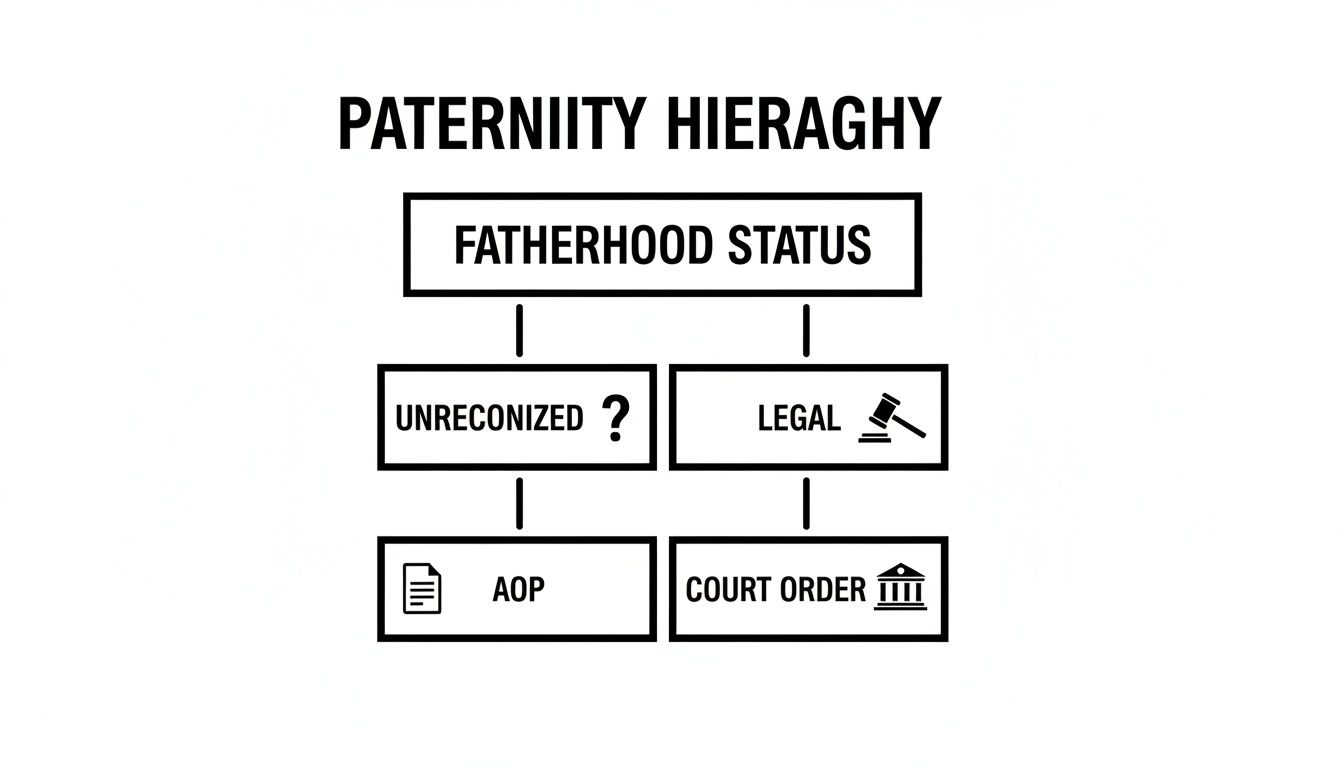
As you can see, a formal court order is the strongest path, offering far more protection for your rights than just signing an Acknowledgment of Paternity at the hospital.
Sole Managing Conservatorship: When is it Used?
While Joint Managing Conservatorship is the norm, there are situations where a court will grant one parent Sole Managing Conservatorship (SMC). This is a much more restrictive arrangement and is typically reserved for cases where there are serious concerns about the other parent's ability to act in the child's best interest.
In an SMC arrangement, one parent is given the exclusive right to make most of the major decisions for the child. The other parent is named a "Possessory Conservator," and their rights are significantly limited, though they usually still have the right to visitation.
Below is a table that breaks down the key differences between these two setups.
Joint Managing vs Sole Managing Conservatorship
| Feature | Joint Managing Conservatorship (JMC) | Sole Managing Conservatorship (SMC) |
|---|---|---|
| Decision-Making | Rights and duties are shared between parents, though one may have the final say on certain issues. | One parent has the exclusive right to make most major decisions. |
| Child's Residence | One parent is designated as the "primary" and has the right to determine the child's residence. | The Sole Managing Conservator determines the child's residence without input. |
| Legal Presumption | Presumed to be in the child's best interest. This is the starting point for Texas courts. | Not presumed; the court must have evidence that JMC would be harmful to the child. |
| Common Scenarios | The vast majority of Texas custody cases. | Used in cases involving family violence, substance abuse, neglect, or long-term parental absence. |
| Parental Roles | Both parents are "Joint Managing Conservators," with one being the primary. | One parent is the "Sole Managing Conservator" and the other is the "Possessory Conservator." |
Understanding this distinction is crucial. If you've been unfairly stripped of your rights and made a Possessory Conservator without good cause, it could be a significant error by the court—and a potential reason for an appeal.
Understanding the Standard of Review for Possession Orders
If conservatorship is about decision-making, "possession and access" is the part that covers the actual parenting schedule. It’s what most people think of as visitation.
To bring predictability to these schedules, Texas law provides a template called the Standard Possession Order (SPO). The SPO is a detailed calendar that lays out a clear schedule for when each parent has the children. It's designed to be a fair, workable starting point for most families.
The SPO generally includes a schedule for:
- Weekends: The non-primary parent usually gets the children on the first, third, and fifth weekends of a month.
- Holidays: Major holidays like Thanksgiving and Christmas are typically split or alternated between parents each year.
- Summer: The non-primary parent is usually entitled to an extended 30-day period of possession during the summer break.
The SPO is presumed by law to be in the child's best interest. But it is not set in stone. Parents can agree to a custom schedule, and a judge can order something different if the family’s situation calls for it—like if parents live far apart or have non-traditional work schedules. For a deeper dive, you can learn more about how the Standard Possession Order in Texas works.
Here’s the key takeaway for a potential appeal: if a judge orders a schedule that drastically limits your time with your child and does not have a very good, evidence-based reason for doing so, that decision could be a reversible error. An appellate court can review the trial record to see if the judge's order was legally justified. If it was not, the unfair order can be reversed, giving you another chance at a fair schedule that lets you be the dad you want to be.
Untangling Child Support and Your Financial Role
When navigating a custody case in Texas, the conversation will always include finances. Child support is not just a monthly payment; it's a legal framework designed to ensure children receive consistent financial backing from both parents. Understanding how this system works is essential for any father seeking to protect his rights and his children's future.
Texas courts use a specific, guideline-based formula, and it all starts with a number called "net monthly resources." This is a comprehensive look at all the money you have coming in.
How Texas Calculates Child Support
To determine your net monthly resources, the court will total all sources of income—your salary, bonuses, overtime pay, rental income, and even retirement benefits. From that total, they subtract certain mandatory deductions like federal income taxes, Social Security, union dues, and the amount you pay for your children's health insurance. The final number is your net monthly resources.
From there, the math is straightforward. The Texas Family Code sets percentages based on the number of children involved:
- One child: 20% of your net monthly resources
- Two children: 25% of your net monthly resources
- Three children: 30% of your net monthly resources
These percentages continue to scale up for larger families. This formulaic approach is meant to create a consistent and predictable standard for judges across Texas.
Health Insurance and Other Financial Responsibilities
Beyond the monthly payment, Texas law also requires parents to provide health insurance for their children. Usually, the parent paying child support is ordered to carry the policy. The court will then give you credit for the amount you pay for the child's portion of the premium, which can reduce your overall monthly support obligation.
It is also crucial to stay informed about changes in the law, as they can directly impact your financial obligations. The 2025 Texas family law reforms are significant for dads, especially regarding enforcement of parenting time. A key financial change taking effect on September 1, 2025, is the increase in the child support cap—it’s jumping from $9,200 to $11,700 in monthly net resources. This is the first major adjustment since 2019. You can dive deeper into how these new Texas family laws are transforming divorce and custody.
When You Can Change a Child Support Order
Life changes. A child support order that made sense a few years ago might be out of step with your reality today. Texas law allows you to request a modification of your support payments, but you need a valid reason. The legal standard is a "material and substantial change" in circumstances.
A "material and substantial change" isn't a temporary issue. It must be a significant and lasting shift in your financial situation, the other parent's situation, or your child's needs.
Common scenarios that could justify a modification include:
- A long-term job loss.
- A significant promotion and pay raise for either parent.
- A child develops a medical condition that requires expensive, ongoing treatment.
- The custody arrangement itself has changed, with one parent taking on more time and responsibility.
If you believe the court miscalculated your income or incorrectly denied your request to modify support, this could be grounds for an appeal. A reversible error is a mistake made by the trial judge that impacted the outcome. An appellate court can review the financial evidence and legal reasoning to ensure the law was followed correctly, giving you another opportunity for a fair result.
Holding the Other Parent Accountable When They Violate Court Orders
A court order is more than just paper; it is a legally binding document that protects your relationship with your child. When the other parent treats a judge's ruling like a suggestion, it is crucial to act decisively. You are not powerless.
When a parent ignores the possession schedule, your primary legal tool is a Motion for Enforcement. This is a formal legal action filed in the same court that issued your original order. It puts the judge on notice that the other parent is not following the rules and asks the court to step in.

What a Motion for Enforcement Can Accomplish
Filing this motion is about accountability and ensuring your child gets the stable, consistent relationship with you that the court intended. The process is specific. You must lay out each violation with dates and times, providing clear, documented proof.
A judge has a range of remedies available. Depending on the seriousness of the violations, a court can order:
- Make-up possession time to compensate for the time you were denied.
- Fines or financial penalties.
- Payment of your attorney’s fees and costs.
- In extreme cases of repeated disobedience, a judge can find the non-compliant parent in contempt of court, which could lead to jail time.
What to Do When Life Changes and Your Old Orders Don't Fit
Enforcement is for when someone breaks the rules. But what happens when the rules themselves no longer make sense? When major life shifts occur, a handshake agreement to change the schedule is not legally binding. To have real legal protection, you must go back to court for a formal modification.
The legal standard you must meet is a "material and substantial change" in circumstances. This change must be a significant, likely permanent shift in the life of the child or one of the parents.
A "material and substantial change" is the key that opens the door for a modification case. Without it, a judge does not have the authority to alter your existing orders for custody, visitation, or child support.
Examples of a material and substantial change include:
- One parent relocating for a new job.
- A major change in your work schedule that makes the current possession order impossible.
- Your child getting older (usually 12 or more) and expressing a mature preference about where they want to live.
- The other parent engaging in behavior that puts the child's well-being at risk.
The Modification Process: Proving Your Case
The process begins when you file a Petition to Modify the Parent-Child Relationship. You must prove to the judge that a material and substantial change has occurred and that your proposed new arrangement is in your child’s best interest. In cases where you are trying to resolve these disputes, having accurate mediation session transcripts can provide vital proof of what was discussed or agreed upon.
If you go through this process and the trial court denies your request to enforce or modify an order, and you believe the judge committed a legal error, that decision may be a reversible error. An appellate court can review the case to determine if the judge abused their discretion, giving you another chance to fight for a fair outcome.
The Judge Erred. What Are Your Next Steps? A Look at Appeals
You walked out of the courtroom with a final order that feels fundamentally unfair. The legal system has a built-in process for these exact situations: the appeal.
It is crucial to understand what an appeal is—and what it is not. An appeal is not a second trial. You do not present new evidence or re-argue your case. Instead, an appeal is a highly focused review by a higher court asking one specific question: did the trial judge make a serious legal mistake that changed the outcome of your case? This is your opportunity to challenge an unjust ruling and protect your rights as a father.
How Appeals Differ from Trials: Standard of Review
When you take your case to an appellate court, the judges do not hear from witnesses. Their entire review is confined to the official "record" from your trial. This record contains every document filed, every piece of evidence presented, and the transcript of every word spoken in court.
Higher courts give significant deference to the trial judge's decisions. They operate under the assumption that the trial judge was in the best position to evaluate witness credibility. To overcome this, you must prove the judge committed a reversible error.
A reversible error is a mistake so significant that it likely led to an improper judgment. In family law, this often means proving the judge committed an "abuse of discretion."
Abuse of Discretion: This legal term means the judge made a ruling without following established legal rules or principles. In plain English, the decision was arbitrary, unreasonable, or completely unsupported by the law and the facts presented in court.
For example, if you presented clear evidence of the other parent's instability, but the judge ignored it and awarded them custody based on a personal bias, that could be a classic abuse of discretion. The same applies if a judge misapplies the law on how to divide property, leading to a grossly unfair result.
Examples of Common Reversible Errors in Texas Family Courts
While every case is unique, certain patterns of legal errors frequently appear in appeals involving dads rights in Texas. Identifying these is the first step in evaluating your case for an appeal.
Here are a few common reversible errors in Texas family courts:
- Misapplying the "Best Interest of the Child" Standard: The judge may have focused on a single issue, ignored crucial evidence that favored you, or based a custody decision on outdated personal beliefs instead of weighing all the legally required factors.
- Improper Characterization of Property: The court might have incorrectly labeled property you owned before the marriage (your separate property) as community property. This mistake could cost you significant assets that should have legally remained yours.
- Admitting Improper Evidence: The judge may have allowed the other side to introduce testimony or documents that were legally inadmissible—such as unreliable hearsay or prejudicial information—and that evidence unfairly tipped the scales against you.
- Ignoring a Valid Premarital Agreement: If you had a legally sound prenuptial or postnuptial agreement, the court is required to enforce it. If the judge refused to do so, that is a major error that could be grounds for a successful appeal.
Successfully arguing these points requires a deep understanding of appellate procedure and the skill to craft a persuasive legal "brief." For a closer look at these concepts in custody battles, you can read our in-depth guide on the child custody rights for fathers. The job of an appellate attorney is to present the trial court's errors so clearly and convincingly that the higher court is compelled to step in and correct the injustice.
If you believe the court made a mistake in your family law case, our appellate attorneys can help you seek a fair outcome. Contact The Law Office of Bryan Fagan today for a free consultation.
Frequently Asked Questions About Dads Rights and Appeals
Navigating a family law case can be complex. When your relationship with your children is on the line, you need clear, straightforward answers. Here are some of the most common questions we hear from fathers in Texas.
Is the Deck Stacked Against Dads in Texas Custody Cases?
No. Texas law is gender-neutral. The Texas Family Code explicitly prohibits a judge from making decisions based on whether a parent is a mother or a father. The sole guiding principle is the "best interest of the child."
Courts start with the legal presumption that it is best for the child to have both parents named as Joint Managing Conservators. A court will only deviate from this standard if there is clear evidence of issues like family violence or substance abuse that could endanger a child. If a judge deviates from this standard without a well-supported, evidence-based reason, it may be an abuse of discretion—and potential grounds for an appeal.
Can I Stop Paying Child Support if I’m Not Getting My Visitation Time?
Absolutely not. In the Texas legal system, child support and visitation are two separate and independent obligations. One does not excuse the other.
If you stop paying court-ordered support, you are violating a court order. The consequences can be severe, ranging from wage garnishment and driver's license suspension to facing jail time for contempt of court. The correct legal procedure for denied visitation is to file a Motion for Enforcement. This brings the issue before the judge, who can compel the other parent to follow the order and grant you make-up time with your child.
How Fast Do I Need to Act to Appeal an Unfair Custody Ruling?
You must act immediately. The deadlines for appeals in Texas family law are strict and unforgiving, governed by the Texas Rules of Appellate Procedure. For most cases, you have just 30 days from the date the judge signs the final order to file your Notice of Appeal. If you miss this deadline, you may lose your right to challenge the decision forever.
While certain post-judgment motions can extend this deadline to 90 days, you should never assume you have that extra time. The clock starts ticking the moment the final order is signed.
This is why it is critical to consult with an appellate attorney as soon as you receive a ruling you believe is wrong. An experienced appellate lawyer can immediately evaluate your case for reversible errors and ensure every deadline is met, preserving your right to seek justice.
If you believe the court made a mistake in your family law case, our appellate attorneys can help you seek a fair outcome. Contact The Law Office of Bryan Fagan today for a free consultation at https://familylawcourtappeals.com.