Going through a divorce is never easy. When infidelity contributes to the end of your marriage, the court's final decision can feel like a second betrayal if you believe it was unjust. You may feel your case was handled unfairly, especially if the evidence of adultery was overlooked or the final property division seemed deeply unbalanced.
If you believe the trial court made a mistake in your divorce by adultery case, you need to understand your options. The Texas legal system provides a path to seek a fair outcome through the appeals process. This guide explains how an appeal can challenge an unjust ruling and restore balance after a difficult trial.
What You Can Appeal in a Texas Divorce Involving Adultery

It is a difficult experience to walk away from a divorce trial feeling like justice wasn't served. Perhaps the judge seemed to ignore clear proof of your spouse’s affair, or maybe the way your assets were divided felt more like a punishment than a fair split. These are valid concerns, and the Texas legal system offers a formal pathway to challenge that outcome: the appellate process.
It’s important to understand how appeals differ from trials. An appeal is not a second chance to present new evidence or re-argue your case. Instead, it is a detailed review of the trial court's record to determine if a significant legal mistake—a reversible error—was made. As appellate attorneys, our job is to meticulously examine every detail of your original trial, from transcripts to evidence rulings, to identify these specific errors.
A reversible error is a mistake made by the trial judge that was serious enough to have likely caused an incorrect or unfair judgment. Finding such an error is the key to a successful appeal.
Why Adultery Matters in a Texas Divorce Appeal
While Texas is a no-fault divorce state, meaning you don't need to prove wrongdoing to end a marriage, fault-based grounds like adultery can significantly impact the outcome. When proven, adultery can dramatically influence how a judge divides community property.
A judge has the discretion to award a "disproportionate share" of the marital estate to the non-adulterous spouse as part of a just and right division. This means you could receive more than 50% of the community assets.
The key word is discretion. The judge is not required to award you more, which is where many grounds for an appeal arise. If the trial court improperly excluded your evidence of the affair or misapplied the law regarding its financial impact, you may have a strong case for an appeal.
Sadly, infidelity is a painful reality for many couples. In fact, recent U.S. data shows that infidelity was a factor in approximately 59.6% of divorces, making it one of the top reasons marriages end. For more context, you can explore the global trends in divorce statistics.
This guide will break down the entire process, from what it takes to prove infidelity in a Texas courtroom to how we identify the kinds of legal errors that can be overturned on appeal. We're here to provide clarity and a strategic path forward in your search for a just resolution.
Adultery as a Ground for Divorce in Texas
In a Texas courtroom, adultery isn't just a personal betrayal—it’s a specific legal ground for a "fault-based" divorce. This distinction is critical because it can have a major impact on how the assets you and your spouse accumulated during the marriage are divided. If you are questioning your trial's outcome, understanding this concept is your starting point.
Most people are familiar with "no-fault" divorce, where one spouse simply states that the marriage has become "insupportable" due to conflict. However, alleging a specific fault like adultery is a different legal strategy. It shifts the case's focus from merely dissolving the marriage to holding one party accountable for actions that contributed to its failure.
Fault vs. No-Fault: A Strategic Choice
Deciding to file for divorce based on adultery is a deliberate legal move. While a no-fault divorce is often simpler, bringing fault into the case requires the judge to consider a new set of facts when making decisions about property.
The Texas Family Code explicitly gives judges the power to consider fault when dividing community property. In plain English, the court can evaluate both spouses' conduct and decide if one person's misconduct justifies giving the other an unequal, or "disproportionate," share of the marital estate.
When you plead adultery, you are asserting that your spouse's affair damaged the marriage—and often the marital finances—and that a simple 50/50 property split would not be a "just and right" result.
Under Texas Family Code § 6.003, a court may grant a divorce in favor of one spouse if the other has committed adultery. The word "may" is significant. It gives the trial judge discretion, and the exercise of that discretion is often where we find grounds for an appeal.
This judicial discretion is a double-edged sword. A judge has the authority to award the wronged spouse more than half of the assets but is not required to do so. A judge could hear clear evidence of an affair and still order an even split if other factors convince them it is the right call.
Understanding the Standard of Review: “Abuse of Discretion”
On appeal, we don't just argue that we disagree with the judge. We must prove the judge made a specific type of legal error. In family law, the most common standard is “abuse of discretion.”
- Abuse of Discretion (Plain-English Definition): This legal term means the trial judge made a decision that was unreasonable, arbitrary, or without reference to any guiding legal rules or principles. It’s not just a bad call; it’s a decision that falls outside the bounds of reasonable judgment.
If the trial court ignored strong evidence of adultery and its financial impact when dividing property, that could be considered an abuse of discretion, forming the basis for a successful appeal. Our job is to build a powerful legal argument demonstrating that the judge’s error led to an unfair financial outcome.
How Adultery Influences Property Division and Support

When adultery is proven, its most direct impact is on the financial aspects of the divorce, specifically the division of community property. Texas law presumes that a 50/50 split is "just and right," but this is only a starting point. When fault like adultery is established, the judge has the authority to award a disproportionate share of the marital estate to the wronged spouse.
Think of your shared assets as a pie. In a standard no-fault divorce, the pie is typically sliced down the middle. When adultery is proven, the judge can decide that a fair outcome means giving the non-adulterous spouse a larger piece. This is not about punishment; it is about achieving a fair and just division, especially if the affair caused financial harm to the marriage.
The Financial Drain of an Affair
An affair often has a financial cost paid for with marital funds. When community assets are used to finance an affair, the court views it as a waste of marital resources and a breach of trust. This becomes a powerful argument for an unequal division of property.
A judge will closely examine several factors when deciding how to adjust the split:
- The nature of the affair: Was it a single instance or a long-term relationship that required significant financial support? The latter is viewed more seriously.
- How much community money was spent: Did your spouse use marital funds on expensive gifts, secret vacations, or rent for an apartment for their affair partner?
- Any attempts to hide assets: Were secret bank accounts opened or assets intentionally hidden to fund the affair?
If you presented clear evidence that marital money was wasted on an affair and the trial court seemed to ignore it, that could be a significant abuse of discretion. From an appellate perspective, our job is to demonstrate that the final property division wasn't truly "just and right" because the judge failed to account for this financial damage.
Comparing Property Division Outcomes
To see how this plays out, let's compare how a property division might look in a typical no-fault case versus one where adultery has drained community assets.
| Factor | Typical No-Fault Divorce | Potential Adultery Fault Divorce |
|---|---|---|
| Asset Division Goal | A "just and right" division, often starting at 50/50. | A "just and right" division, adjusted for fault. |
| Bank Accounts | Split equally between spouses. | The wronged spouse may receive 60% or more to offset wasted funds. |
| Retirement Accounts | The community portion is divided evenly. | A larger percentage may be awarded to the non-adulterous spouse. |
| Sale of Marital Home | Proceeds are typically split 50/50. | The wronged spouse might receive a greater share of the proceeds. |
This table shows how a fault finding can shift the financial balance significantly, moving far beyond a simple even split to compensate for the misconduct.
Adultery and Spousal Maintenance
Beyond dividing assets, adultery can also influence decisions about spousal maintenance (often called alimony). While cheating does not guarantee spousal support, it is a key factor a judge can consider.
The Texas Family Code allows the court to weigh marital misconduct when deciding on the amount, duration, and nature of spousal maintenance. For example, if the affair left you in a difficult financial position while your spouse retains the ability to pay, the court may be more likely to award support. You can learn more about the nuances of alimony in Texas in our detailed article.
A key takeaway is that adultery is a tool for achieving fairness, not a guarantee of a specific outcome. The trial judge weighs it against all other evidence. If that balance seems skewed or the judge’s reasoning appears flawed, an appeal can be a pathway to correction.
If your divorce decree resulted in a property division that feels profoundly unfair despite clear proof of adultery and its financial toll, you have options. An appellate attorney can meticulously review the trial record to see if the judge abused their discretion, giving you a strategic opportunity to fight for a more just outcome.
The Reality of Proving Infidelity in Court

Claiming a divorce by adultery is one thing; proving it in a Texas courtroom is another challenge entirely. The legal burden of proof rests on the spouse making the accusation, and the evidence required is often more complex than people expect. If you have been through a trial and feel your evidence was mishandled, this is a critical area to examine for a potential appeal.
Courts rarely see "smoking gun" evidence like photos or videos of the act itself. Instead, Texas courts rely almost entirely on circumstantial evidence. Think of it like assembling a puzzle. A single piece of evidence may not be conclusive, but when all the pieces are connected, they can form a clear and compelling picture of infidelity for the judge. The goal is to create a strong, logical inference that adultery occurred.
Building a Case with Circumstantial Evidence
A successful case for adultery is built by weaving together multiple threads of evidence that all point to the same conclusion. A skilled trial lawyer knows how to present this evidence as a cohesive narrative.
Common pieces of evidence used in Texas divorce trials include:
- Digital Footprints: Text messages, direct messages, and emails indicating a romantic or sexual relationship.
- Financial Records: Credit card statements and bank records showing unexplained hotel bills, expensive gifts, secret trips, or large cash withdrawals.
- Eyewitness Testimony: Testimony from friends, family, or a private investigator who observed public displays of affection or a spouse staying overnight somewhere they shouldn't have been.
- Direct Admissions: A spouse's confession, whether made to you, written in a message, or told to a third party willing to testify, is powerful evidence.
This is also where a case can go wrong, leading to grounds for an appeal. The trial judge decides what evidence is admissible. If the court made an incorrect ruling and excluded crucial evidence like text messages or financial proof of an affair, that may be a reversible error that prevented a fair trial.
Common Reversible Errors in Adultery Cases
In an adultery-based divorce appeal, we often look for specific types of reversible errors that may have occurred during the trial. These mistakes can provide the legal foundation to challenge the court's final decision.
- Improper Exclusion of Evidence: The judge refused to admit valid, legally obtained evidence proving the affair and its financial impact. For example, wrongfully excluding bank statements that showed community funds were spent on the affair partner.
- Mischaracterization of Property: The court incorrectly classified separate property (owned before marriage) as community property, or vice versa. This fundamental error can lead to a skewed and unjust property division.
- Failure to Make a "Just and Right" Division: The judge ignored substantial evidence of wasted community assets due to the affair and ordered a strict 50/50 split without a reasonable basis for doing so. This can be an abuse of discretion.
- Erroneous Child Custody Ruling: The judge allowed the issue of adultery to improperly influence a child custody decision, despite no evidence that the parent’s conduct endangered the child’s physical or emotional well-being.
It's also worth noting how complex these situations can be. We're seeing a significant rise in 'gray divorces' among couples over 50, where issues like infidelity are often tangled up with decades of financial history and communication breakdowns. For more context on this, you can find some fascinating insights into how global trends impact divorce statistics on unifiedlawyers.com.au.
If you suspect the trial court mishandled the evidence of infidelity in your divorce, the fight may not be over. An error in admitting or excluding evidence is not just a technicality; it can completely alter the final property division and lead to a deeply unfair result. The job of an appellate attorney is to pinpoint these critical errors and build a powerful argument for why the decision must be reconsidered.
What to Expect from the Texas Appeals Process
Challenging a divorce decree can feel daunting, but the Texas appeals process is a structured, step-by-step procedure designed to ensure the law was correctly applied in your case. The entire focus of an appeal is on the existing trial record—the transcripts, evidence, and rulings from your original case.
Step-by-Step Insights on the Appellate Procedure
The path to an appeal follows strict timelines and rules under the Texas Rules of Appellate Procedure. While every case is unique, the journey involves several key stages.
- Filing the Notice of Appeal: This is the first and most time-sensitive step. A Notice of Appeal must be filed within 30 days of the judge signing the final divorce decree. This deadline is absolute. Missing it will likely forfeit your right to appeal.
- Record Preparation: After the notice is filed, the official clerk's record (all documents filed in the case) and the court reporter's record (the word-for-word trial transcript) are prepared. This collection of documents is the official record that the appellate court will review.
- Briefing: This is the core of the appellate work. The brief is a formal, written legal argument we prepare on your behalf. In it, we identify the specific reversible errors the trial judge made, citing case law and statutes to prove why those errors led to an unfair outcome in your divorce by adultery case.
- Oral Argument: In some cases, the court of appeals will schedule an oral argument. This is a formal hearing where attorneys present their arguments to a panel of appellate judges and answer their questions. It is an opportunity to highlight the most critical points from the written brief.
The infographic below shows how this process works—turning an unfair trial outcome into a just one.
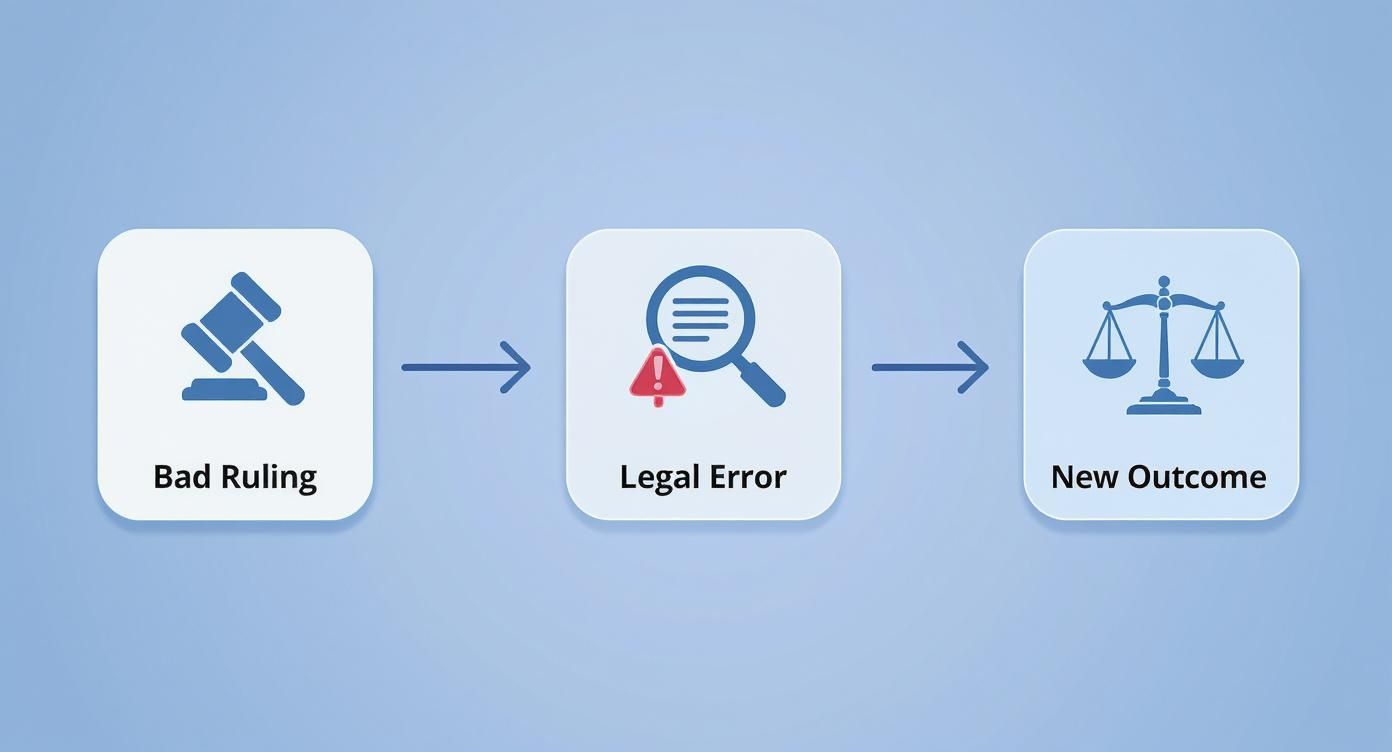
As you can see, identifying a legal error is the key. It gives the higher court the authority to correct the mistake and ensure you receive a fair and just outcome.
The Role of an Appellate Attorney
Navigating an appeal requires a different skillset from a trial. Trial work focuses on presenting facts and evidence to tell a compelling story. Appellate work is about deep legal analysis and persuasive writing aimed at an audience of experienced judges.
An experienced appellate attorney meticulously analyzes the trial record to find reversible errors and constructs an airtight legal argument to convince a higher court that the original judgment was legally flawed and must be corrected.
If you believe the court made a mistake in your divorce, you must act quickly. To determine if you have grounds for an appeal, contact a dedicated Texas family law appeal attorney to review the specifics of your case.
Common Questions About Adultery and Divorce Appeals
When you're dealing with the fallout from an affair during a divorce, it's natural to have a lot of questions. Let's break down some of the most common issues that come up, especially when considering an appeal.
What if Both Spouses Cheated? Can I Still File for Divorce Based on Adultery?
Yes, you can, but it complicates the matter. When both spouses have been unfaithful, a trial judge might determine that the fault is on both sides. This concept, known as "recrimination," can lead the court to grant a no-fault divorce and order an even, 50/50 split of community property. From an appellate standpoint, we would analyze how the trial court weighed each party's conduct and whether its final property division was still just and right under the circumstances.
How Does Adultery Affect Child Custody in Texas?
In most cases, it does not. Texas law is clear: custody decisions must be based solely on the "best interest of the child." A parent’s affair, by itself, is generally not considered relevant to that standard.
However, an affair can become a major factor if the behavior surrounding it endangered the child. For example, if the affair led to child neglect, exposed the child to inappropriate situations, or involved a new partner who posed a risk. Unless there is a direct link between the affair and harm to the child's well-being, judges typically separate the issue from custody decisions.
On appeal, the critical question becomes: did the trial court adhere to the "best interest" standard, or did it allow feelings about the affair to improperly influence its custody ruling without evidence of actual harm to the child?
How Long Do I Have to Appeal My Divorce Decree?
The deadlines to appeal a divorce decree in Texas are extremely strict and non-negotiable. Missing them means losing your right to appeal permanently.
You have a very narrow window: the Notice of Appeal must be filed within 30 days of the judge signing the final decree. While certain post-judgment motions can extend this deadline to 90 days, you should not rely on this possibility. It is crucial to speak with an appellate attorney immediately to ensure these deadlines are met and your rights are protected.
If you believe the court made a mistake in your family law case, our appellate attorneys can help you seek a fair outcome. Contact The Law Office of Bryan Fagan today for a free consultation at our family law court appeals website.