When a judge issues a final order in your family law case that seems to ignore the facts you presented, the sense of injustice can be overwhelming. You may feel your case was handled unfairly, especially if the decision is completely disconnected from the testimony and evidence. It's natural to feel defeated.
But in Texas, the law provides a specific path to challenge a ruling that is factually wrong. It’s called a factual sufficiency appeal. This is not simply about disagreeing with the judge; it's a powerful legal argument that the court's decision is so contrary to the weight of the evidence that it is clearly wrong and unjust.
When the Court's Decision Defies the Facts

If you believe the judge didn’t truly listen, or the final order makes no sense based on the evidence, those feelings are valid. This is precisely why our appellate system exists—as a safeguard to ensure court rulings are anchored in facts and fairness, not arbitrary judgment.
An appeal is not a second trial. You cannot present new evidence or re-argue your case from scratch. Instead, an appeal is a meticulous review of the trial court record to identify a significant legal mistake, which is known as a reversible error. A factual sufficiency challenge is one of the most critical tools for seeking justice in Texas family law, especially in disputes over child custody, property, and support.
Understanding the Goal of a Factual Sufficiency Appeal
With a factual sufficiency appeal, you are asking a higher court to examine all the evidence from the trial—both the evidence that supports the judge's decision and the evidence that contradicts it.
The central question becomes: is the evidence supporting the ruling so weak, or is the evidence against it so overwhelming, that the outcome is manifestly unjust?
In plain English, a factual sufficiency appeal argues that even if there is some evidence supporting the judge's order, the great weight and preponderance of the total evidence proves the decision was wrong and unfair. It directly challenges the factual foundation of the judgment.
For example, imagine a judge grants primary custody to a parent despite testimony from teachers, a therapist, and neighbors about that parent's instability and neglect. The judge might base their decision on a single positive report from months ago. A factual sufficiency appeal allows the appellate court to step back, weigh all the evidence, and determine if the final decision holds up to scrutiny.
If you believe a Texas judge's order on your divorce, children, or property division ignored the reality presented in your case, you have options. The law provides this specific path to seek justice and restore balance.
If you believe the court made a mistake in your family law case, our appellate attorneys can help you seek a fair outcome. Contact The Law Office of Bryan Fagan today for a free consultation.
Understanding Factual Sufficiency in Texas Appeals

Sometimes you walk out of a courtroom feeling that the judge’s decision was completely disconnected from the actual evidence. When that happens, a factual sufficiency appeal may be the most important strategy for restoring fairness.
The appellate court doesn't just look for a single piece of evidence that supports the judge's ruling. Instead, they review all the evidence—everything that supports the decision and everything that contradicts it—to determine if the outcome was just.
The question they answer is whether the judge's decision is so against the overwhelming weight of the evidence that it’s clearly wrong and unjust. This standard is reserved for situations where the ruling simply doesn't add up when you look at the complete factual picture.
How Factual Sufficiency Differs from Other Standards of Review
To know if a factual sufficiency challenge is the right strategy, you must understand how it compares to other ways an appellate court can review a case. These different "standards of review" are the specific lenses the higher court uses to examine the trial judge's actions, and choosing the right one is critical.
Each standard targets a different kind of mistake.
A factual sufficiency review is powerful because it is the only standard that requires the appellate court to weigh the evidence on both sides. It is designed to catch those decisions that might be technically supported by a sliver of evidence but are fundamentally unfair when the whole story is considered.
A factual sufficiency appeal in a Texas family law case is essential when the evidence against a ruling is too compelling to be ignored. While other types of appeals focus on legal errors or procedural missteps, this one goes straight to the heart of the matter: the facts themselves.
This is especially true in high-stakes cases like the termination of parental rights. According to the Texas Children's Commission, most appeals in these cases are built on legal and factual sufficiency challenges. The procedural rules are incredibly strict, and the Texas Supreme Court has even ruled that a lawyer's failure to properly preserve a factual sufficiency challenge can be considered ineffective assistance of counsel—that’s how vital this step is.
Plain-English Definitions of Appellate Standards
What are these different lenses the appellate court uses? Here is a simple breakdown of the three main standards of review in Texas family law.
| Standard of Review | What the Appellate Court Looks For | Common Example in Family Law |
|---|---|---|
| Abuse of Discretion | Did the trial court act arbitrarily, unreasonably, or without following guiding legal rules? | A judge creates a possession schedule that ignores the child's best interest for no stated reason. |
| Legal Insufficiency | Was there any evidence to support the finding? The court only looks at evidence that favors the verdict. | A judge orders spousal maintenance without any evidence showing the receiving spouse is eligible. We cover this in our guide to the legal sufficiency appeal in a Texas divorce. |
| Factual Insufficiency | Was the evidence for the finding too weak, or was the contradictory evidence so overwhelming that the ruling is clearly wrong and unjust? | A judge awards primary custody to a parent despite multiple credible witnesses testifying about that parent's documented history of neglect. |
Understanding these core concepts is the first step toward having a productive conversation with an appellate attorney. It helps you pinpoint what feels wrong about your court order and explore the most effective path forward.
How to Preserve Your Right to Appeal
A successful family law appeal doesn’t begin after the trial is over. The groundwork is laid long before you file a notice of appeal—it begins in the trial court. This crucial process is called error preservation, and it is the absolute bedrock of any factual sufficiency challenge in Texas family law.
If you do not properly preserve your arguments, the court of appeals can—and will—refuse to consider them, no matter how valid they are. Think of it like a football coach who sees a bad call but fails to throw the challenge flag at the right moment; they lose their chance to have the play reviewed. In law, missing these procedural steps is just as final and can close the door on your chance for justice.
For a factual sufficiency appeal, one procedural step is paramount: filing a Motion for New Trial.
The Critical Role of a Motion for New Trial
After the judge issues a final order that feels factually wrong, you cannot immediately ask a higher court to intervene. The Texas Rules of Appellate Procedure require that you first give the trial judge an opportunity to correct their own mistake. This is accomplished by filing a Motion for New Trial.
This is not a courtesy; it is a mandatory legal step for this type of appeal. The motion formally tells the trial court that the evidence presented does not support the decision. It must explain why the judgment is clearly wrong and unjust based on the "great weight and preponderance" of the evidence.
A Motion for New Trial is your formal notice to the trial judge, stating, “The factual basis of your ruling is flawed, and here is exactly why.” It is your last opportunity to have the original court reconsider its decision before escalating the case.
For a factual sufficiency challenge, filing this motion is non-negotiable. If you skip it, you waive your right to make that argument on appeal. The appellate court will be legally barred from ever considering whether the evidence was factually sufficient.
Strict Deadlines and Serious Consequences
The timeline for filing a Motion for New Trial is unforgiving. Under the Texas Rules of Civil Procedure, you must file it within 30 days of the date the judge signs the final judgment. There are virtually no exceptions.
Missing this deadline has immediate and severe consequences:
- You Waive Your Argument: You automatically forfeit your right to challenge the factual sufficiency of the evidence. Your appeal on that point is over before it begins.
- Your Appeal Timeline Shrinks: Filing the motion extends your deadline to file a Notice of Appeal from 30 days to 90 days. That extra time is invaluable for your legal team to prepare.
Building the Record for Appeal
Preservation is not just a post-trial action; it is a mindset that must guide your legal strategy from the start of the trial. An appellate court can only review what is in the appellate record—the official court reporter's transcript and all documents filed in the case. If it's not in the record, it doesn't exist for the court of appeals.
Your trial attorney must be vigilant by:
- Making Timely Objections: When improper testimony or evidence is introduced, your lawyer must object on the spot and state the legal reason. Failure to do so waives the objection forever.
- Getting Your Evidence Admitted: Crucial documents, photos, and expert reports must be properly offered and officially admitted into the record. If your key evidence isn't formally admitted, the appellate judges will never see it.
- Requesting Findings of Fact and Conclusions of Law: After a trial before a judge, your attorney should ask for written findings. These documents force the judge to explain the factual and legal reasons for their decision, making it easier to identify specific errors for an appeal.
A well-built appellate record provides all the material needed to construct a winning appeal. For a closer look at how this evidence is organized, check out our guide on how to write a compelling statement of facts.
Examples of Common Reversible Errors
When a judge’s decision seems to completely fly in the face of all the evidence you presented, it is deeply frustrating. A factual sufficiency appeal argues that the judge’s final order is so contrary to the overwhelming weight of the evidence that it is wrong and unfair. Let's look at a few real-world situations where this kind of appeal becomes necessary in Texas family law.
Child Custody Decisions That Ignore a Child's Best Interest
Nowhere are the stakes higher than in a child custody battle. The law is clear: every decision must be guided by the "best interest of the child." But what happens when a judge's ruling seems to ignore that standard entirely?
Consider a case where one parent is granted primary custody despite a mountain of evidence showing they are unfit. Imagine you had:
- Testimony from teachers, coaches, and neighbors about the parent's chronic neglect.
- Bank statements and employment records proving the parent could not provide a stable home.
- Text messages and emails documenting ongoing substance abuse.
If the other parent had only a single friend testify on their behalf, an appeal would argue that the judge’s decision was factually insufficient. The appellate court would be asked to look at the entire record and decide if giving custody to that parent was so against the great weight of the evidence that it was manifestly unjust.
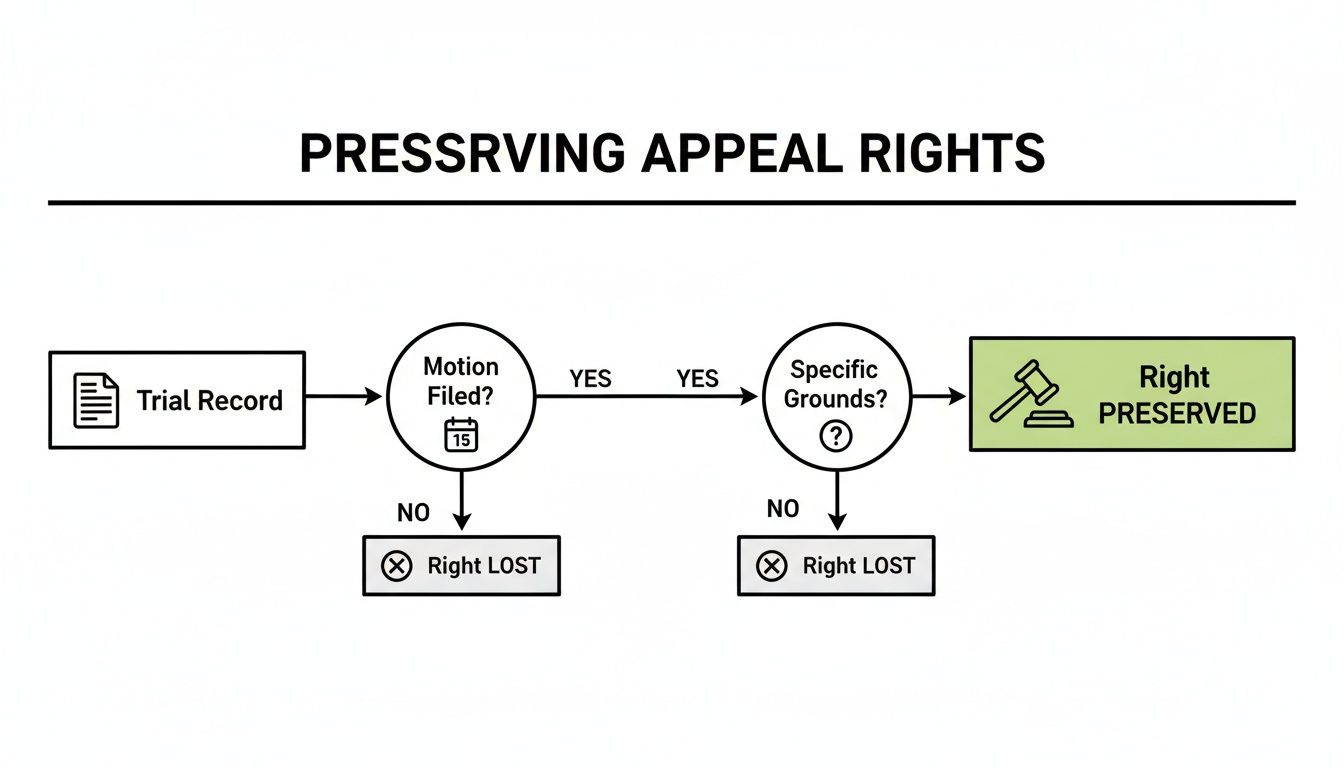
As this illustrates, you cannot wait to raise these issues. Taking crucial steps like filing a Motion for New Trial is essential to preserve your right to make a factual sufficiency argument on appeal.
Mischaracterizing Property in a Divorce
Another common ground for a factual sufficiency appeal is the division of marital property. Texas law distinguishes between separate property (assets owned before marriage or received as a gift/inheritance) and community property (everything acquired during the marriage). A mistake in this characterization can lead to a financially devastating outcome.
Imagine a spouse who built a successful business for years before getting married. At trial, the other spouse claims it became community property but offers only flimsy proof—perhaps pointing to one or two times a joint account was used for a minor business expense. Meanwhile, the business owner provides clean, meticulous records and expert testimony showing the business finances were always kept entirely separate.
If the trial judge ignores this overwhelming evidence and splits the business, that is a perfect candidate for a factual sufficiency appeal. The argument is that the evidence of commingling was far too weak to overcome the strong proof that the business remained separate property. This is a prime example of a reversible error, the kind of mistake an appeal is designed to correct. You can read more about what constitutes these types of mistakes in our guide to common reversible errors in Texas family court.
Deviating from Child Support Guidelines
Texas has statutory guidelines for child support to ensure fairness and predictability. A judge can deviate from those guidelines, but they must have a good, evidence-based reason. A factual sufficiency challenge often arises when a judge orders a support amount based on speculation instead of hard proof.
For example, a parent might claim their income has plummeted and they cannot afford the guideline support amount but offer no proof. If the other parent presents years of tax returns, pay stubs, and bank records showing a consistent, high income, a judge's decision to drastically lower support based on mere testimony could be factually insufficient. An appellate court would review that decision to determine whether it was supported by the facts on the record.
The Texas Family Law Appeal Process Step by Step
A Texas family law appeal follows a highly structured process governed by its own set of rules and deadlines. It’s crucial to understand that an appeal is not a second trial. Instead, it’s a methodical review of what happened at trial to identify specific legal errors.
Knowing the steps of this journey can provide clarity and confidence. The entire process is dictated by the Texas Rules of Appellate Procedure, which lay out strict requirements from the moment you decide to challenge a final order.
Step 1: Filing the Notice of Appeal
Your first official action is filing a Notice of Appeal. This document formally notifies the trial court and the court of appeals of your intent to challenge the final order. The timing is critical.
You typically have 30 days from the day the judge signed the final order to file this notice. However, if you have filed a Motion for New Trial—which is essential for preserving arguments like a factual sufficiency challenge—that deadline extends to 90 days. Missing this deadline will almost certainly end your appeal before it starts.
Step 2: Compiling the Appellate Record
Once the Notice of Appeal is filed, the focus shifts to gathering the appellate record. This is the complete case file that the court of appeals will study. The appellate justices are strictly limited to this record; they cannot consider new evidence or new testimony.
The record consists of two main parts:
- The Clerk’s Record: A collection of all official documents filed in your case, including petitions, motions, and the final judgment.
- The Reporter’s Record: The official, word-for-word transcript of everything said in court during hearings and the trial, prepared by the court reporter.
Your appellate attorney will request these records. Ensuring they are complete and accurate is a vital early task, as this record forms the entire universe of facts for the appeal.
Step 3: The Briefing Stage
This is where the core of the appeal takes place. Briefing is the process of your attorney writing a meticulously crafted legal argument called an appellate brief. This formal document identifies the exact errors the trial judge made and explains, using legal authority, why those mistakes require the decision to be overturned.
For a factual sufficiency appeal in Texas family law, the brief must:
- Clearly state the specific rulings being challenged.
- Provide a detailed narrative of the facts, with every statement citing directly to the appellate record.
- Build a compelling legal argument showing that the trial court's decision goes against the great weight and preponderance of the evidence.
- Support every point with relevant laws, such as the Texas Family Code, and precedent from other appellate cases.
After your brief (the Appellant's Brief) is filed, the other party (the Appellee) files their own brief defending the trial court's ruling. Your attorney may then file a final "Reply Brief" to address the Appellee’s arguments. These briefs are what will persuade the appellate judges.
Step 4: Oral Argument
In some cases, the court of appeals will schedule an oral argument. This is a formal proceeding where your lawyer argues your case before a panel of (usually) three appellate justices. This is not a time to rehash testimony; it is a high-level legal dialogue where the justices can ask probing questions about the arguments presented in the briefs.
Oral argument is a strategic opportunity for your attorney to emphasize the most critical facts, clarify complex legal points, and directly respond to the justices' concerns. It brings the written words of the brief to life.
Step 5: The Court's Decision and Possible Outcomes
After briefing and any oral argument, the justices deliberate and issue a written decision, known as an opinion. This process can take several months. The court has a few possible outcomes:
- Affirm: The court of appeals agrees with the trial court's decision, and the original judgment stands.
- Reverse and Remand: This is a significant victory. The court finds a reversible error and sends the case back to the trial court for a new trial or other proceedings to correct the mistake.
- Reverse and Render: The court finds an error and, instead of sending it back, issues a new judgment itself. This is less common but occurs when the record is so clear that the appellate court can make the correct ruling on the spot.
Understanding this step-by-step framework demystifies the appellate journey and shows why an experienced guide is so critical at every turn.
If you believe the court made a mistake in your family law case, our appellate attorneys can help you seek a fair outcome. Contact The Law Office of Bryan Fagan today for a free consultation.
How Our Appellate Attorneys Fight for a Fair Outcome
When a judge ignores the facts of your case, it can feel like your family's future has been decided unfairly. At this point, you need more than a lawyer; you need an advocate who knows how to strategically dismantle an unjust decision. At The Law Office of Bryan Fagan, our appellate attorneys focus on correcting flawed outcomes in Texas family law. Our work is not just about filing paperwork—it’s about methodically building a powerful case for justice.
A winning factual sufficiency appeal in Texas family law begins with a meticulous review of the trial record. We scrutinize every line of testimony, every exhibit, and every ruling to find the moments where the decision detached from the evidence. With focused experience in these specific appeals, we know how to identify the subtle but significant reversible errors that are often missed.
Drafting Compelling Arguments That Resonate with Judges
An appeal is won or lost in the written brief. This is our chance to show the appellate court precisely why the trial judge's order was clearly wrong and unjust. We don't just claim the decision was unfair; we prove it, weaving a compelling narrative anchored in the Texas Family Code and relevant case law.
We write our appellate briefs for a specific audience: the justices on the court of appeals. We understand how they think, what they look for, and how to frame complex family law matters in a persuasive and clear manner.
A strong appellate brief does more than list errors. It tells the story of your case through the lens of the evidence, guiding the appellate court to the unavoidable conclusion that the trial judge's ruling was so against the great weight of the evidence that it must be overturned.
We never lose sight of what is at stake. An unfair ruling can damage your relationship with your children, threaten your financial stability, and make it feel impossible to move forward. That's why we blend compassionate client support with aggressive legal strategy. We have seen firsthand how a well-argued factual sufficiency challenge can correct devastating errors in child custody orders, unfair property division, and wrongfully granted protective orders.
Our goal is simple: to restore fairness by holding the trial court accountable to the facts and the law.
If you believe a serious mistake was made in your family law case, our appellate team can help you determine the best path forward. Contact The Law Office of Bryan Fagan today for a free consultation to discuss your options.
Frequently Asked Questions About Texas Appeals
When you are considering an appeal, it is natural to have questions. The process can seem complex, but understanding these key concepts is the first step toward clarity. Here are answers to some of the most common questions about factual sufficiency appeals in Texas family law.
What Is the Difference Between an Appeal and a Motion for New Trial?
This is a crucial distinction, and understanding it is essential for preserving your rights.
A Motion for New Trial is a request to the same judge who made the final decision for a "do-over." You are pointing out a significant mistake and asking them to fix it. This motion must be filed within 30 days of the final judgment and is a mandatory first step for a factual sufficiency challenge.
An appeal comes after that. It is a formal request to a higher court—the court of appeals—to review the trial judge's work. You are not asking for a new trial but for a panel of judges to examine the record for legal error.
Can I Introduce New Evidence in a Factual Sufficiency Appeal?
No, and this is one of the most common misconceptions about appeals.
An appellate court acts like a referee reviewing game tape. They are strictly limited to the appellate record—everything officially presented and admitted as evidence during your trial. You cannot bring in new witnesses, submit new documents, or introduce facts that were not part of the original case. The entire focus is on whether the judge's decision was factually supported by the evidence they had at the time.
How Long Does a Family Law Appeal Typically Take in Texas?
Patience is essential, as an appeal is not a quick process. While every case is different, you can generally expect the process to take anywhere from 12 to 18 months, and sometimes longer.
The timeline depends on factors like the complexity of the legal issues, the appellate court's caseload, and whether the court schedules oral arguments.
If you believe the court made a mistake in your family law case, our appellate attorneys can help you seek a fair outcome. Contact The Law Office of Bryan Fagan, PLLC today for a free consultation at https://familylawcourtappeals.com.