
When a Texas judge issues a final divorce decree that seems to come out of left field, it can be deeply unsettling. You may feel your case was handled unfairly, especially when the outcome on property or child custody feels completely disconnected from the evidence presented in the courtroom. This is where a legal sufficiency appeal comes into play. It's a specific, powerful tool designed for one purpose: to challenge a ruling that has no factual basis in the trial record.
You’ve trusted the system, presented your case, and yet the outcome feels fundamentally wrong. This sense of injustice is real, but the judge's ruling isn't automatically the last word. A legal sufficiency appeal in a Texas divorce is a focused argument that the trial court made a critical legal error by issuing an order with no evidence to support it. Our goal is to seek fairness and restore balance through strategic appellate advocacy.

Understanding Legal Sufficiency in a Texas Divorce Appeal
You poured your emotions, finances, and an incredible amount of time into your divorce, only for the final decree to land with a thud. The decision isn't just disappointing—it feels fundamentally unjust, as if the judge ignored everything said and shown in court. Maybe the community estate was split in a wildly lopsided way with no financial data to support it, or a custody order was based on accusations that were never proven.
A legal sufficiency appeal is not a second chance to introduce new facts or re-try your case. Instead, it argues that the judge committed a serious legal error by making a ruling with literally no evidence in the record to back it up.
What Is a "Legal Sufficiency" Challenge?
So what does "legally insufficient" really mean? In plain English, it means your appellate lawyer must prove to a higher court that the trial record is completely empty of facts that could support a specific part of the judge's ruling. It’s a high bar, but it is a crucial check on the trial court’s power.
The core question the appellate court asks is: Is there any evidence in the trial record that a reasonable person could rely on to reach the same conclusion as the judge? If the answer is no, the ruling may be legally insufficient.
This is different from a "factual sufficiency" challenge, where we argue that the ruling goes against the great weight of the evidence. A legal sufficiency appeal argues there was a total absence of evidence.
Legal Sufficiency vs. Factual Sufficiency
| Standard of Review | What the Appellate Court Asks | Focus of the Review | Common Outcome |
|---|---|---|---|
| Legal Sufficiency | "Was there any evidence to support the finding?" | Considers only the evidence that supports the verdict, ignoring all contrary evidence. | Difficult to win; requires showing a complete lack of supporting evidence. |
| Factual Sufficiency | "Was the finding so against the great weight of the evidence as to be manifestly wrong?" | Considers all the evidence presented at trial. | More flexible than legal sufficiency, but still a high standard. |
Understanding this difference is critical for a successful appeal. A legal sufficiency challenge isn't about re-weighing the evidence; it's about proving a void where evidence should have been.
Common Grounds for a Legal Sufficiency Appeal in a Divorce
These "no evidence" challenges often appear in key areas of a divorce decree with life-altering financial and parental consequences.
Here are a few examples we see in our appellate practice:
- Property Division: A judge orders a 70/30 split of the community estate, but the record contains no exhibits or testimony to justify such a disproportionate division. Learn more about navigating complex property division appeals.
- Child Custody Determinations: The court severely restricts a parent's time with their child, yet no evidence was ever introduced to show that the parent posed a danger or that the restriction was in the child's best interest.
- Spousal Maintenance Awards: A court orders spousal support payments even though the requesting spouse offered no proof they met the strict eligibility requirements laid out in the Texas Family Code.
If you read your final decree and cannot find a connection between the judge's orders and the facts presented at trial, a legal sufficiency appeal may be the right path to seek justice. Our appellate attorneys can comb through the trial record, identify these critical gaps, and build a powerful argument showing why the decision is legally indefensible.
What Is a Reversible Error in Texas Family Law?
Winning a family law appeal isn’t about telling a higher court you disliked the outcome. To succeed, you must prove the trial judge made a specific, critical mistake known as a reversible error. This is the key that unlocks the door to appellate relief.
An appeal is not a do-over. You cannot present new evidence or re-argue your entire case. Instead, the appellate court focuses on one question: did the trial judge make a mistake so significant that it likely led to an improper judgment? If the answer is yes, the decision can be overturned.
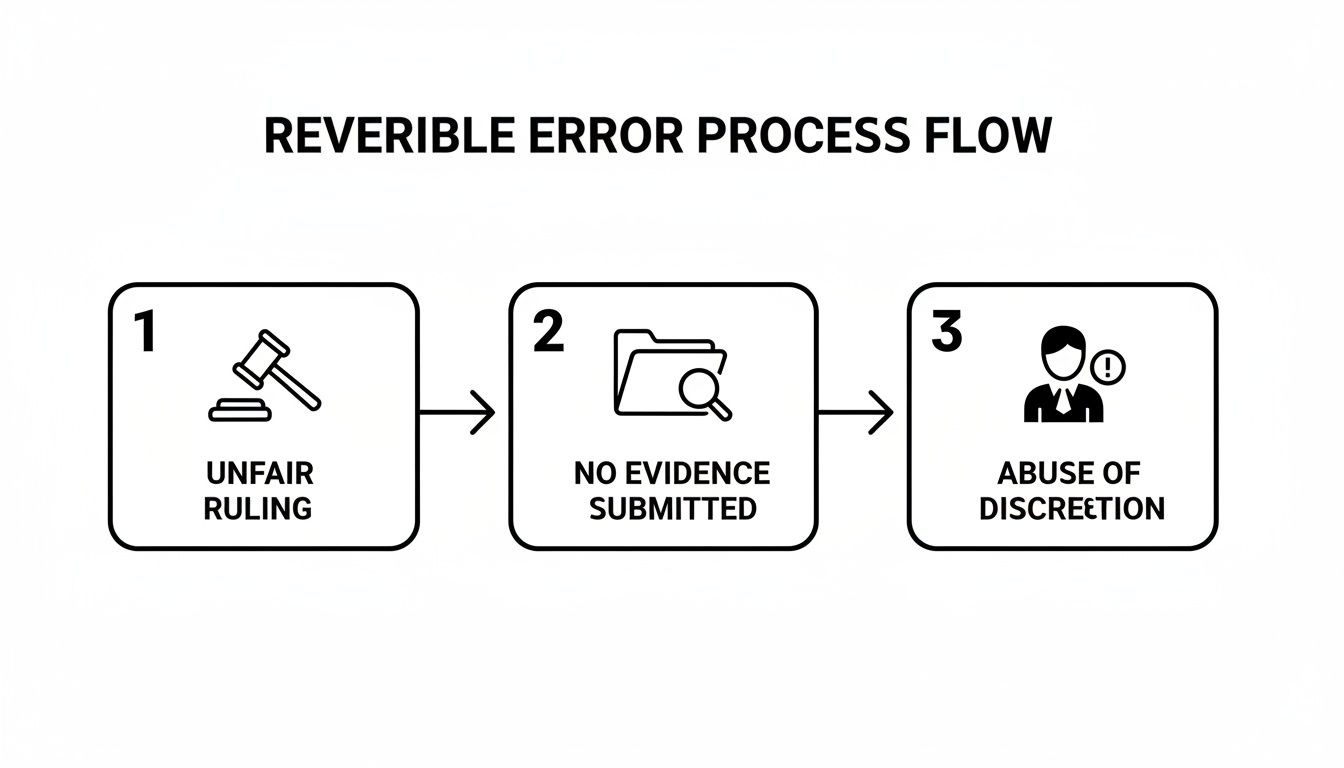
Abuse of Discretion: The Core of a Legal Sufficiency Appeal
When we talk about a legal sufficiency appeal in a Texas divorce, the most common type of reversible error we look for is an abuse of discretion. While it’s a legal term, the idea is simple.
- Abuse of Discretion (Definition): This occurs when a trial judge makes a decision that has no support in the evidence presented in court. The ruling is considered arbitrary or unreasonable because it’s completely disconnected from the facts in the record.
Think of it this way: a judge’s ruling must stand on the "legs" of evidence. If a key piece of evidence is missing, the decision is unstable and cannot stand. This is precisely when a legal sufficiency challenge is appropriate. For instance, if a judge orders you to pay contractual alimony but no contract was ever mentioned or entered into evidence at trial, that is a classic abuse of discretion.
Examples of Reversible Errors in Divorce Cases
The concept of reversible error becomes clearer with real-world examples. These are the red flags we look for when evaluating a potential appeal.
- Unjust Property Division: The judge divides your community estate with a lopsided 70/30 split. But the trial record contains no evidence to justify it. While a "just and right" division is the standard, a Texas judge needs an evidence-based reason—like fault in the divorce or significant differences in earning capacity—to deviate so far from 50/50. Without that proof, it’s an abuse of discretion.
- Unsupported Child Custody Restrictions: The final order includes a geographic restriction preventing the primary parent from moving out of the county. But was any evidence presented to prove this restriction was in the child's best interest? The law demands a factual basis for limiting a parent’s fundamental rights. You can learn more about how these principles work by reading about reversible error in Texas family court.
- Spousal Maintenance Without Proof: The court orders one spouse to pay post-divorce spousal maintenance. To receive maintenance in Texas, the requesting spouse must prove they qualify, which often means showing a marriage of at least 10 years and an inability to earn a sufficient income. If the record shows they never offered evidence to meet those legal requirements, the award is legally insufficient.
Distinguishing Error from Disagreement
It’s crucial to understand the difference between a reversible error and simply disagreeing with the judge’s decision. Family court judges have significant leeway—what the law calls "discretion"—especially when determining the "best interest of the child."
If two experts gave conflicting testimony and the judge believed one over the other, that is rarely an appealable issue. The judge weighed the evidence and made a choice. But if the judge ignored both experts and made a ruling based on no evidence at all, that crosses the line from a judgment call into an abuse of discretion.
The Path to a Legal Sufficiency Appeal in Texas
If you feel your divorce ruling was not based on the evidence presented at trial, you have options. However, challenging the decision is a technical process governed by the Texas Rules of Appellate Procedure. The clock starts ticking the moment the judge signs the Final Decree of Divorce.
You have a strict 30-day deadline to file a Notice of Appeal. While certain post-trial motions can extend this window to 90 days, you cannot count on it. Missing this deadline means your right to appeal is lost forever. For more information, see our guide on how to file a Notice of Appeal.
Step 1: Secure the Official Trial Record
Once the Notice of Appeal is filed, the next step is to order the official records from your trial. The appellate court was not present for your trial; its review is limited to what the trial judge saw and heard. These records are the foundation of your appeal and come in two parts:
- The Clerk’s Record: This is the complete paper trail of your case, including all petitions, motions, responses, and the final judgment.
- The Reporter’s Record: This is the official trial transcript—a word-for-word account of all testimony, attorney arguments, and the judge's comments.
Without these records, you cannot prove what was—or was not—presented. Your appellate lawyer will meticulously review every page to find the evidentiary gaps that form the basis of a legal sufficiency challenge.
Step 2: Pinpoint the Trial Court's Reversible Errors
After a painstaking review of the records, your lawyer will identify the specific legal mistakes the judge made. In an appeal, these are called "points of error" or "issues presented." They must be framed with legal precision.
For a legal sufficiency appeal, a point of error might state:
"The trial court abused its discretion in awarding the wife a disproportionate share of the community estate because there is no evidence in the record to support such a division."
This is not a complaint; it is a targeted legal argument. It tells the appellate judges exactly what to review and alleges a specific error: an abuse of discretion due to a total lack of evidence.
Step 3: Build Your Case in the Appellate Brief
This is where everything comes together in a formal legal document called the appellate brief. The brief persuasively combines facts from the record, your points of error, and the controlling law from the Texas Family Code and past appellate decisions.
A strong brief tells a compelling story of legal error. It guides the appellate judges through the trial record, highlights where the evidence is missing, and explains why that absence constitutes an abuse of discretion. The latest latest Texas judicial data shows that divorce decree reversal rates are as high as 24%, often because judges made mistakes in property division without sufficient evidence. This is where an experienced appellate attorney’s skill makes a difference—turning a feeling of injustice into a powerful, and hopefully winning, legal argument.
Crafting a Winning Argument for Your Appeal
In an appeal, the written brief is everything. The appellate justices will make their decision based almost exclusively on the strength and clarity of the arguments presented in your brief. Crafting a winning argument for a legal sufficiency appeal in a Texas divorce is a specialized skill. It requires digging deep into the record, applying the law with precision, and writing a narrative that persuades the appellate court that a reversible error occurred.

Uncovering the "No Evidence" Story in the Trial Record
A powerful appellate brief tells the story of how the trial court's decision became legally unsupportable. To find that story, our appellate attorneys immerse themselves in the trial record. We review the reporter’s record (the trial transcript) and the clerk’s record (exhibits and filings) with a fine-tooth comb.
We are not just re-reading what happened; we are hunting for what didn't happen—the gaps where crucial evidence should have been but wasn't. For example, if a judge ordered a disproportionate property division, we search for the complete absence of testimony or financial documents that could legally justify it. Scrutinizing every piece of sworn testimony, including a transcript of deposition, helps us pinpoint the exact moment a ruling disconnected from the facts.
Connecting the Dots for the Appellate Justices
Once we identify these "no evidence" points, we weave them into a compelling legal argument. This means drawing a direct line from the holes in the record to the specific statutes in the Texas Family Code and binding case law that the trial judge ignored.
The structure of the argument must be crystal clear:
- The Standard of Review: We start by reminding the court of the legal sufficiency standard—that a ruling cannot stand if there is no evidence at all to support it.
- The Statement of Facts: Next, we provide a neutral, fact-based summary of what happened at trial, citing directly to the record. You can read our detailed article on writing a statement of facts for more on this crucial section.
- The Argument and Authorities: This is the heart of the brief. Here, we show—with specific page and line numbers from the record—that no evidence supports the judge's decision. Then, we explain exactly why that lack of evidence constitutes a reversible error under Texas law.
An appeal is not a do-over. The brief must focus entirely on legal error and prove that the record itself shows the trial court was wrong. Texas appellate courts are reluctant to overturn a trial judge’s decision, which is why a meticulously crafted brief from a specialist is critical to give you the best possible chance at a just outcome.
Potential Outcomes of Your Texas Divorce Appeal
When considering a legal sufficiency appeal in a Texas divorce, it’s natural to ask, "What are my chances?" While no lawyer can guarantee a specific result, understanding the potential outcomes helps set realistic expectations for the process ahead. An appeal is a challenging process, but it is far from a lost cause.
Statistics show that a well-argued appeal has a real chance of success. The overall reversal rate for Texas family law cases is approximately 21%. For specific case types, the data reveals:
- Divorce Cases: 24% reversal rate
- Child Custody Modification Suits: 19% reversal rate
- Child Support Cases: 23% reversal rate
These numbers represent thousands of cases where an appellate court corrected a trial court’s mistake. There are three possible ways an appeal can conclude.
Outcome 1: Affirmation
The most common outcome is an affirmation, where the appellate court finds the trial judge did not commit a reversible legal error. In a legal sufficiency challenge, this means the justices found at least some evidence to support the judge’s decision. Even if the appellate judges would have decided differently, they will affirm the ruling if it was legally sound.
Outcome 2: Reversal and Remand
A reversal and remand is a significant victory. It means the appellate court agreed with your argument that the trial judge made a serious error, such as basing a decision on no evidence. The flawed part of the divorce decree is nullified.
The appellate court then "remands" or sends the case back to the trial court with instructions to hold a new hearing or trial on the specific issue appealed. For instance, if an unfair property division was reversed, the case goes back for a new, just and right division based on the evidence and the law.
Outcome 3: Reversal and Rendition
This is the best-case scenario. A reversal and rendition occurs when the appellate court not only finds an error but also concludes the correct legal outcome is so clear from the record that another trial is unnecessary.
Instead of remanding the case, the appellate court "renders"—or issues—the judgment that the trial court should have entered. This provides finality and avoids the time and expense of further proceedings. For example, if the trial court ordered spousal maintenance without any evidence of eligibility, the appellate court could reverse and render a new judgment stating that no maintenance is owed.
Common Questions About Texas Divorce Appeals
If you believe the judge in your divorce case made a mistake, you likely have questions about the appeals process. Understanding the rules and timelines is the first step toward making a clear-headed decision about seeking justice. Here are answers to some of the most common questions we hear about a legal sufficiency appeal in a Texas divorce.
How Long Does a Divorce Appeal Take in Texas?
Be prepared for a lengthy process. A Texas family law appeal typically takes a year or more from the date the notice of appeal is filed until a final decision is issued. This timeline is driven by a series of required procedural steps that cannot be expedited.
Here’s a rough breakdown:
- Record Preparation: It can take a few months for the court reporter to prepare the trial transcript and the court clerk to assemble the exhibits and filings.
- Briefing Schedule: Once the record is filed, the appellate court sets deadlines for the parties to file their written arguments (briefs). This stage often spans several months.
- Judicial Deliberation: After the briefs are submitted, a panel of appellate justices reviews the record and legal arguments before issuing a written opinion. This can take several more months.
An attorney specializing in appeals is essential for navigating this long and deadline-driven process.
Can I Submit New Evidence During My Appeal?
The answer is a firm no. An appeal is not a re-trial of your case. The appellate court’s role is to review the original trial for legal errors based only on the evidence and testimony that was presented to the trial judge. This collection of trial materials is called the "record."
An appeal is not a do-over. You cannot introduce a new document or call a new witness. The only question is whether the trial judge made a reversible error based on the information they had at the time of the trial. This is why a legal sufficiency challenge is so specific: it argues that based on the complete trial record, there was no evidence to support the judge’s decision.
Do I Need an Appellate Lawyer for My Divorce Appeal?
Yes. While your trial lawyer was your champion in the courtroom, appellate law is a completely different field. Winning an appeal requires a different set of skills than winning a trial.
Appellate practice is a specialized area focused on:
- An Objective Eye: An appellate lawyer provides a fresh perspective, allowing them to review the trial record and spot reversible errors that may be missed by someone who was involved in the original fight.
- Masterful Legal Writing: On appeal, your case is decided by the quality of the written brief. This unique form of writing must weave facts, statutes, and case law into a persuasive narrative for a panel of judges.
- Navigating Procedural Complexities: The Texas Rules of Appellate Procedure are notoriously complex. A single missed deadline or procedural misstep can lead to the dismissal of your entire appeal.
Hiring a dedicated appellate attorney is a strategic necessity. At The Law Office of Bryan Fagan, our appellate team works exclusively in this highly technical area, providing the focused expertise needed to fight for a fair outcome.
If you believe the court made a mistake in your family law case, our appellate attorneys can help you seek a fair outcome. Contact The Law Office of Bryan Fagan today for a free consultation at https://familylawcourtappeals.com.