Skip to content
When a judge's final order in your family law case feels deeply unfair, the sense of injustice can be overwhelming. You may feel your case was handled incorrectly, and a ruling that reshapes your life with your children and your financial future deserves a fair review. If your trial took place in one of ten specific Texas counties, that crucial next step is often the 14th Court of Appeals in Texas.
Your Path to Justice After an Unfair Ruling

It is a natural reaction to feel the court missed key evidence, misunderstood the law, or made a critical error. The Texas legal system has a process for addressing those exact situations, but it's vital to understand what an appeal is—and what it isn't.
An appeal is not a do-over of your trial. It is a formal request asking a higher court to examine the trial court’s work for legal mistakes. The appellate justices will not hear from witnesses or consider new evidence. Their job is to review the official trial record—transcripts, filed documents, and exhibits—to determine if a reversible error occurred.
A reversible error is not a minor mistake. It is a significant legal blunder that likely caused an improper outcome in your case. To better understand this, you can learn more about what a family law appeal is and how the process works.
The 14th Court of Appeals in Texas, established in 1967, is one of two appellate courts located in Houston. It has the authority to review civil cases, including all family law matters, from the trial courts in its ten-county district. Its most important function for you is providing a path to correct a trial court's misstep. This guide will walk you through that process.
Understanding the Role of the 14th Court of Appeals

If you are leaving a family court decision feeling that something went fundamentally wrong, your next step is not a new trial. Instead, you must turn to a higher court, and for many Texans, that means the 14th Court of Appeals.
This court’s role is critical but often misunderstood. The appellate court is like the review booth in a professional sports game. The referees on the field (the trial court) made a call, and now a team of experts is reviewing the instant replay to see if that call was correct based on the rules. They are not playing the game; they are checking the work.
Where Does the 14th Court of Appeals Have Authority?
This court’s authority, or jurisdiction, covers a specific region of Texas. If your family law case was decided in one of the 10 counties listed below, the 14th Court of Appeals is where your appeal would be filed:
- Austin
- Brazoria
- Chambers
- Colorado
- Fort Bend
- Galveston
- Grimes
- Harris
- Waller
- Washington
As an intermediate court, it is a crucial layer in the state's judicial system, positioned between the local trial courts and the highest courts in Texas. This structure ensures a process for review and accountability. You can get a broader view of the entire Texas court structure from Thomson Reuters.
How an Appeal Differs From a Trial
It is easy to confuse what happens at trial with what happens during an appeal. They are two distinct processes with different goals. The table below breaks down the fundamental differences between the court where your case started and the 14th Court of Appeals.
Key Differences Between Trial Courts and Appellate Courts
| Function | Trial Court (District Court) | 14th Court of Appeals |
|---|---|---|
| Primary Goal | To determine the facts of a case and apply the law. This is where evidence is presented and witnesses testify. | To review the trial court's proceedings for legal or procedural errors. No new evidence or testimony is permitted. |
| Who Hears the Case | A single judge (and sometimes a jury). | A panel of judges, typically three, who review the written record and legal arguments. |
| Key Question | "What happened?" | "Did the trial court make a legal mistake?" |
| Focus | Evidence, witness testimony, and establishing a factual record. | The official trial record, legal briefs, and oral arguments from attorneys. |
Understanding this distinction is the first step in building a strong appeal. You are not re-telling your story; you are pinpointing a specific legal error.
What Does the Court Actually Look At?
The judges at the 14th Court of Appeals do not hear new testimony or review new evidence. Their review is strictly limited to the official record from your original trial—every word of testimony, every piece of evidence, and every ruling the judge made. The goal is to find a reversible error.
Reversible Error: In plain English, this is a legal mistake made by the trial judge that was so significant it likely led to the wrong outcome. It is the foundation of any successful appeal, whether for a Texas child custody dispute or a complex divorce case.
This is a high standard. Simply disagreeing with the judge’s final decision is not enough. Your appeal must be built on a solid legal argument showing that a critical rule was broken or the law was misapplied, and that this mistake directly caused the unfair result.
Understanding the Standard of Review in Family Law
To succeed at the 14th Court of Appeals in Texas, it is not enough to just disagree with the trial judge. You must prove they made a specific, reversible legal error. The framework for how appellate justices review a trial judge's actions is called the standard of review.
For most Texas family law matters, such as child custody disputes or property division, the key standard is abuse of discretion.
Abuse of Discretion: In plain English, this occurs when a trial judge makes a decision that is arbitrary, unreasonable, or without reference to any guiding legal rules and principles.
It means the judge acted outside the bounds of what the law allows. Your appeal does not just say you dislike the outcome; it argues the judge made a ruling that the law did not give them the authority to make.
What Does Abuse of Discretion Look Like?
Think of the trial judge as a referee. The referee has discretion to make judgment calls, but every call must be grounded in the official rulebook.
- A Valid Call: The referee sees a potential foul and throws a flag. You might disagree, but it was their judgment call to make based on the rules. In court, this is like a judge hearing two different stories, finding one person more credible, and ruling based on that. Appellate courts rarely second-guess these calls.
- An Abuse of Discretion: Now, imagine the referee decides to award a team 10 points for a field goal instead of 3. That is not a judgment call—it's a decision that ignores the established rules. That is an abuse of discretion.
In a divorce case, this could be a judge ignoring undisputed evidence of a parent's substance abuse problem when deciding custody. Or it might be a judge miscalculating the value of a major community asset based on incorrect legal principles.
Your appeal must pinpoint exactly how the judge's decision was not supported by the law or the facts in the record. Understanding this standard is a critical step in building an effective appeal.
Common Reversible Errors in Texas Family Courts
A successful appeal is not about telling a higher court you disagree with the judge. It is about identifying a specific, critical mistake—a reversible error—in how the law was applied or the trial was conducted. The justices at the 14th Court of Appeals in Texas are not there to re-hear your case; they are there to review the trial record and determine if a significant error was made that likely changed the outcome.
These errors often fall into a few common categories.
Mischaracterization of Property
One of the most frequent and costly errors in Texas divorce cases is the mischaracterization of property. Texas law has clear rules defining separate property (owned before marriage or received as a gift or inheritance) versus community property (acquired during the marriage).
A reversible error occurs when a judge gets this wrong. For example, if you inherited money and kept it in a separate bank account, Texas law treats it as your separate property. If the trial court mistakenly classifies it as community property and divides it with your ex-spouse, that is a clear reversible error. Such a mistake can completely change the final property division, making it strong grounds for an appeal.
This infographic outlines some common reversible errors we see in Texas family law.
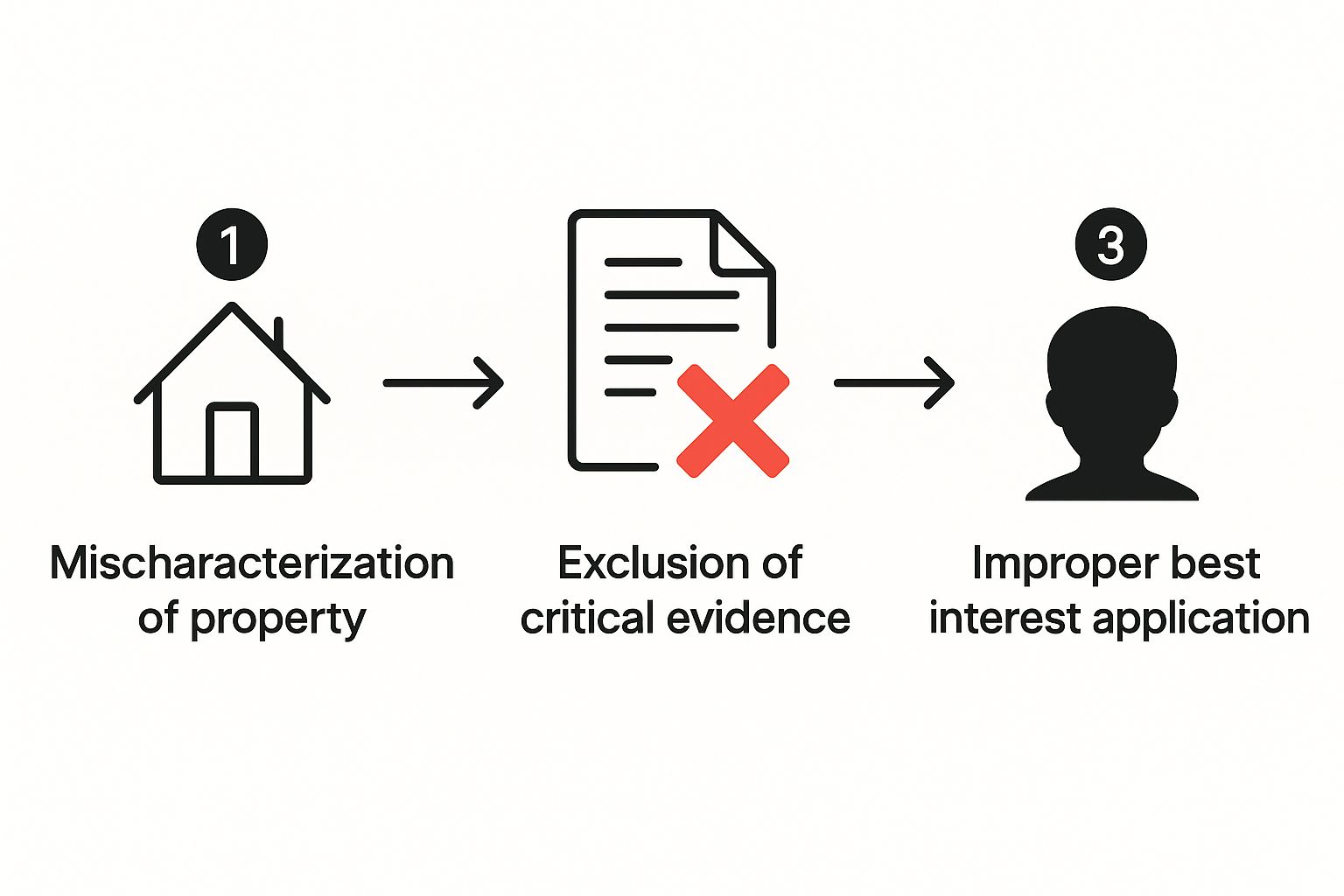
As you can see, mistakes involving property, evidence, and the legal standards for child-related decisions are often at the heart of a successful appeal.
Improper Application of the Best Interest Standard
When children are involved, every decision must be guided by one principle: the “best interest of the child.” This is the legal standard in Texas. While judges have broad discretion, their decision must be supported by the facts and evidence.
An "abuse of discretion" can occur when a judge ignores clear, undisputed evidence that is crucial to a child’s safety and well-being. For example, if a parent has a documented history of substance abuse, but the court grants them primary custody without explaining why that evidence was overlooked, the decision may not be in the child's best interest. Rulings like that are often grounds for appeal, particularly in sensitive matters like those involving protective orders where a child's safety is at stake.
A Step-by-Step Guide to the Texas Appeals Process

Navigating an appeal at the 14th Court of Appeals is not a re-do of your trial. It is a highly structured review process that follows a strict schedule based on the Texas Rules of Appellate Procedure.
The process begins with filing a Notice of Appeal. You typically have just 30 days from the date the final judgment is signed to file this document. Missing this deadline will likely forfeit your right to appeal, so timing is critical.
The Core Phases of an Appeal
Once the notice is filed, your case moves through several key stages designed to present a clear case to the appellate justices.
-
Preparing the Appellate Record: This is the complete file from your original trial. It includes the Clerk’s Record (all documents filed) and the Reporter’s Record (a word-for-word transcript of all hearings). The appeal is decided only on what is in this record.
-
Briefing: This is where the core legal work of the appeal happens. Your attorney drafts an appellate brief—a formal written argument. This document identifies the legal errors made by the trial judge, supports the argument with case law, and explains why the decision should be reversed.
-
Oral Argument: In some cases, the court will schedule an oral argument. This is a formal hearing where attorneys argue their case before a panel of justices. It is an opportunity to clarify complex legal points from the brief and answer the justices' questions, not to re-tell the case story.
-
The Court's Decision: After reviewing the record and the briefs, the justices issue a written opinion explaining their decision. They can affirm (agree with) the trial court's ruling, reverse (overturn) it, or remand it (send it back to the trial court for further proceedings).
The appellate process can feel complex. To better understand what to expect, it helps to review more in-depth guides on the Texas family law appeals process.
How an Appellate Attorney Can Help Your Case
Winning an appeal is different from winning at trial. There are no surprise witnesses or dramatic courtroom moments. It is a strategic legal argument fought on paper, grounded in the Texas Family Code, the Texas Rules of Appellate Procedure, and the existing case record. This is a highly specialized field, and success depends on a different skill set than trial advocacy.
Trial law is about building a case; appellate law is about deconstructing the trial record to find critical legal flaws. It requires an attorney who can meticulously analyze every transcript, exhibit, and ruling from your original case through the precise lens of appellate standards for the 14th Court of Appeals Texas.
At its core, an appeal is about identifying a specific, reversible error. We look for those moments where the trial judge may have misinterpreted the law or made a decision that went beyond their legal authority.
Once those errors are identified, we build a powerful written argument, called an appellate brief. This document is the entire case. It must clearly and persuasively explain to the justices where the trial court went wrong and why that mistake legally requires them to reverse the original decision.
Crafting this type of argument is what a seasoned Texas family law appeal attorney does best. They know how to frame the issues in a way that resonates with the appellate court and gives you the strongest possible chance at a fair and just outcome.
If you believe a legal error led to an unfair result in your family law case, our team is here to evaluate your options.
Frequently Asked Questions About Texas Appeals
Deciding whether to appeal a court's decision is a major step. It is normal to have questions about how the process works, how long it might take, and what you can realistically expect.
Here are answers to some of the most common questions we hear from clients considering an appeal to the 14th Court of Appeals in Texas.
How Long Does an Appeal Take?
There is no one-size-fits-all answer, but you should be prepared for a lengthy process. A typical family law appeal, from filing the Notice of Appeal to the court's final opinion, usually takes between 12 and 24 months. The timeline depends on the complexity of the legal issues and the court's existing caseload.
Can I Introduce New Evidence?
No. An appeal is not a do-over of your trial. The 14th Court of Appeals only reviews what happened in the trial court. Its decision is based entirely on the official "record," which includes all documents, exhibits, and transcripts from your original case.
What Are the Possible Outcomes?
An appeal generally has one of three outcomes:
- Affirm: The appellate court finds no reversible error and agrees with the trial court's original decision. The judgment remains in place.
- Reverse and Remand: The court finds a serious legal error, overturns the trial court’s ruling, and sends the case back down for a new hearing or trial consistent with its opinion. This is common in complex child custody or property division cases where the law was misapplied.
- Reverse and Render: This is less common but powerful. The appellate court reverses the trial court's decision and issues its own final judgment, ending the case.
How Much Does a Family Law Appeal Cost?
Appeals are a significant financial investment due to the highly skilled legal work required. Your attorney must meticulously review the entire trial record, conduct in-depth legal research, and draft a detailed and persuasive appellate brief. Because every case is unique, we provide a transparent breakdown of potential costs during our initial consultation.
If you believe the court made a mistake in your family law case, our appellate attorneys can help you seek a fair outcome. Contact The Law Office of Bryan Fagan today for a free consultation.