You may feel your case was handled unfairly and that the final decision in your divorce was deeply unjust. When a marriage with significant wealth comes to an end, the legal process is anything but standard. A high-net-worth divorce requires more than just a typical family lawyer; it demands the skill of a legal professional who specializes in untangling complex financial estates and can identify when a court has made a critical mistake. These cases are less about emotions and more about intricate business valuations in divorce, asset tracing, and high-level financial strategy to secure your financial future.
If you believe the court made a mistake in your case, the appellate process offers a path to seek justice.
The High Stakes of a High Net Worth Divorce in Texas
Going through a high-net-worth divorce in Texas can feel like your entire world is on the line. It's not just a marriage ending—it’s a high-stakes legal proceeding where your business, your investments, and the financial legacy you’ve built are all at stake. This guide is for anyone who feels their case was mishandled and is now seeking a fair outcome through the appeals process.
So, what exactly is a "high-asset" divorce? It isn't defined by a specific dollar figure. Instead, it’s about the complexity of the marital estate. These cases involve assets that are notoriously difficult to value and divide, demanding a much deeper level of legal and financial expertise. When a trial court misunderstands these complexities, it can lead to a fundamentally unfair result.
What Makes These Cases Different
The real challenge in a high-net-worth divorce lies in the nature of the assets. A simple miscalculation or mischaracterization of property can swing the final settlement by millions of dollars. This is why having specialized legal counsel is absolutely critical, both at trial and on appeal.
Common assets that ratchet up the complexity include:
- Business Interests: Valuing family-owned businesses, professional practices, or partnerships is an art and a science. When a court gets it wrong, it can lead to a profoundly unfair outcome that may be corrected on appeal.
- Complex Investments: Think beyond a simple 401(k). We're talking about portfolios with stocks, bonds, private equity, and venture capital that require sophisticated analysis.
- Trusts and Inheritances: Determining whether assets held in a trust or money that was inherited count as separate or community property is often a major point of conflict and a common source of legal error.
- Real Estate Holdings: Dividing multiple properties, like vacation homes or international real estate, introduces its own set of logistical and legal hurdles.
The financial stakes are staggering. When a trial court errs—perhaps by failing to understand the nuances of your business or by accepting a flawed property appraisal—the final divorce decree can feel devastatingly unjust. You might walk away convinced the judge made a critical error, incorrectly labeled your separate property as community, or relied on a faulty business valuation. This is precisely where the appellate process becomes your most powerful tool for seeking justice.
Common Reversible Errors in Texas Family Courts
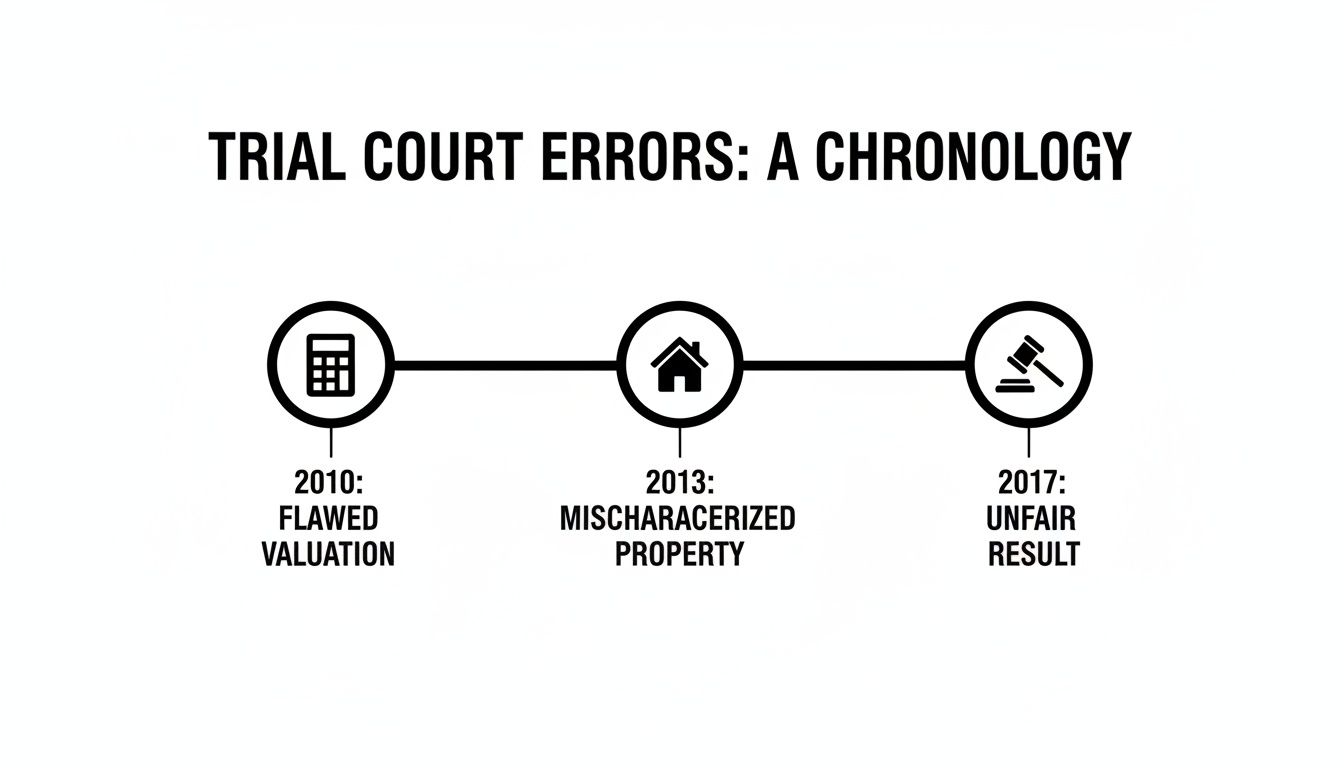
When you appeal a high-asset divorce decree, you are not simply asking for a do-over. Instead, you are pointing out specific legal mistakes made by the trial court that led to an unfair result. In legal terms, these are called reversible errors.
A reversible error is a mistake so significant that it likely caused the court to reach the wrong conclusion. It’s not a minor slip-up; it’s a fundamental flaw in the judgment. Our appellate attorneys are trained to meticulously review the trial record to identify these exact kinds of judicial errors. Common examples in high-net-worth cases include:
- Mischaracterizing Property: The court incorrectly labels your separate property (assets you owned before marriage or received as a gift or inheritance) as community property, making it subject to division. This is a frequent error in complex property division cases.
- Adopting a Flawed Business Valuation: The judge relies on an expert's valuation that used improper methods or ignored key financial data, leading to a wildly inaccurate price tag on a business.
- Failing to Trace Commingled Funds: The court doesn't correctly follow the trail of separate property funds that were mixed with community assets, which results in your separate estate being unfairly divided.
- Improperly Dividing Complex Assets: There's a miscalculation of the community interest in stock options, trusts, or retirement plans, throwing the entire distribution out of balance.
These are not small oversights. They are substantial mistakes that can shift the final property division by millions of dollars. If you believe your divorce decree contains such an error, an appeal offers a clear path to challenge and correct that injustice.
What Is an "Abuse of Discretion"?
When you appeal a property division in Texas, one of the key legal standards is "abuse of discretion." This is a specific type of reversible error.
In plain English, "abuse of discretion" means the trial court acted unreasonably, arbitrarily, or without following established legal rules. It doesn't mean the judge was biased or acted in bad faith. It simply means the decision was so far outside the accepted range of reasonable judgments that it needs to be corrected by a higher court.
Abuse of Discretion Example: Let's say two experts value your company. One uses standard, accepted industry practices and arrives at a $5 million valuation. The other uses a flawed, outdated method and comes up with $500,000. If the judge simply adopts the $500,000 value without any sound, logical reason for doing so, that could be a clear abuse of discretion. The decision wasn't based on solid evidence.
Understanding this standard is crucial. An appeal isn't just about saying you disagree with the judge. It’s about proving that the judge's decision-making process itself was legally or factually flawed, which is what led to the unjust result.
If you believe the court made a mistake in your family law case, our appellate attorneys can help you seek a fair outcome. Contact The Law Office of Bryan Fagan today for a free consultation.
Why a High-Asset Divorce Demands Specialized Expertise

Splitting up a multi-million-dollar estate isn't just a more complicated version of a standard divorce; it's a completely different legal field. The process goes far beyond simple math. You're dealing with a web of sophisticated financial instruments, layered business structures, and unique assets where one wrong move can literally cost millions. A general practice attorney, however competent, often lacks the deep financial insight needed for these cases. This makes specialized legal counsel an absolute necessity, not a luxury.
A true high net worth divorce attorney understands these complexities. They don’t work alone; they coordinate a team of hand-picked experts—forensic accountants, business valuation specialists, and appraisers—to make sure every single asset is correctly identified, characterized, and valued.
Key Differences Between Standard and High Net Worth Divorce
The table below gives you a quick snapshot of why high-asset divorces demand a more strategic and specialized approach.
| Aspect of Divorce | Standard Divorce | High Net Worth Divorce |
|---|---|---|
| Asset Types | Primarily home, cars, 401(k), bank accounts. | Businesses, stock options, private equity, trusts, unique collections, real estate holdings. |
| Financial Analysis | Straightforward division of known assets and debts. | Requires forensic accounting, business valuation, and asset tracing to find and value all assets. |
| Privacy Concerns | Generally low. | High risk of public exposure; requires NDAs and strategic filings to protect privacy. |
| Legal Strategy | Focuses on equitable distribution of tangible assets. | Involves complex tax planning, corporate law, and wealth preservation strategies. |
| Expert Witnesses | Rarely needed. | Essential; includes forensic accountants, valuators, tax experts, and specialized appraisers. |
| Cost & Duration | Typically lower cost and shorter timeline. | Significantly more expensive and time-consuming due to complexity. |
As you can see, the skills and resources required are worlds apart. It’s not just about the numbers being bigger; the entire structure of the case is more complex, making it more susceptible to judicial error.
The Critical Role Of Financial And Tax Planning
A strategic high-asset divorce isn't just about dividing what you own today—it’s about preserving your wealth for tomorrow. An experienced high net worth attorney always has an eye on the bigger picture, incorporating sophisticated high net worth tax strategies into the settlement process from day one. An improperly structured property division can trigger massive, and entirely avoidable, tax bills that can gut the value of your settlement.
The right legal team anticipates these tax traps and structures a settlement that protects your financial future long after the ink is dry. That kind of foresight is what separates a good attorney from a true expert in high-stakes family law.
Protecting Your Privacy From Public Scrutiny

For business leaders, public figures, and other high-profile individuals, privacy isn't just a preference—it’s a non-negotiable asset. A seasoned high-net-worth divorce attorney understands this. They know that protecting your reputation is every bit as critical as protecting your bottom line.
In Texas, court proceedings are generally open to the public. Without a strategic legal game plan, intimate details about your finances, business dealings, and personal affairs can easily become part of the public record. This exposure can create long-term damage, affecting everything from your professional credibility to your family's personal security.
Fortunately, Texas law provides specific tools to keep your case out of the public spotlight. An experienced lawyer proactively builds a wall of confidentiality around your case from day one.
Strategic Tools for Maintaining Confidentiality
Your legal team can draw from a well-established playbook to keep your private life private. These are legitimate legal procedures designed to balance the public's right to know with your fundamental right to privacy.
Here are a few common strategies we use:
- Confidentiality Agreements (NDAs): These are legally binding contracts that prevent both parties—and sometimes their teams—from sharing confidential information.
- Sealing Court Records: We can file a motion to seal records by proving that your need for privacy is specific, serious, and substantial enough to outweigh the public's general interest. This is a powerful tool for shielding proprietary business data or sensitive financial documents.
- Redacting Filings: This precision tool allows us to black out specific sensitive details like bank account numbers or children's names from documents filed with the court.
The core of a good privacy strategy is preventing sensitive information from ever hitting the public record in the first place. This requires meticulous planning from the very start.
Settling Matters Away From the Public Eye
Often, the single best way to protect your privacy is to resolve your divorce outside of a public courtroom. Alternative Dispute Resolution (ADR) methods like mediation and arbitration provide a private, controlled, and confidential setting to negotiate a settlement.
These negotiations happen behind closed doors, with only the essential parties present. This not only safeguards your reputation but also gives you far more control over the final agreement. You can learn more about these approaches in our guide on divorce mediation vs. litigation.
An effective attorney is equally comfortable negotiating discreetly in a conference room and litigating aggressively in a courtroom, fighting to protect your assets with the same intensity used to guard your good name.
Navigating The Texas Divorce Appeals Process
When a judge hands down a final order in your high-net-worth divorce that you believe is fundamentally unfair, the Texas appellate process offers a path to challenge that ruling.
It’s critical to understand that an appeal is not a retrial. You cannot introduce new evidence or call new witnesses. The appellate court reviews the case based only on what already happened in the trial court. A successful appeal depends on an attorney meticulously examining the existing record—the testimony, documents, and rulings—to prove the judge made a reversible error.
The Appeals Roadmap: A Step-by-Step Guide
The journey through the appellate courts follows a strict and unforgiving timeline governed by the Texas Rules of Appellate Procedure. Missing a single deadline can mean losing your right to appeal forever.
The process generally unfolds in these key phases:
- Filing the Notice of Appeal: This is the first step. It is a formal document filed with the trial court that officially signals your intent to challenge the judgment. The deadline is absolute and typically 30 days from the date the judgment is signed.
- Preparing the Appellate Record: The official record is assembled. This includes the Reporter's Record (a word-for-word transcript of the trial) and the Clerk's Record (all documents filed in the case). This record is the only information the appellate court will consider.
- Briefing: This is where the legal battle takes shape. Your attorney conducts deep legal research and writes a persuasive legal argument called an appellate brief. This document identifies the specific errors the trial judge made, explains why they were legally wrong, and argues why the higher court must reverse the decision.
- Oral Argument: In some cases, the court of appeals schedules an in-person hearing. This is a formal presentation where attorneys for both sides argue their case directly before a panel of appellate judges and answer their questions.
Understanding Key Legal Terms in Plain English
The world of appeals has its own vocabulary. Understanding these terms will help you navigate the process with your legal team.
Reversible Error: The foundation of any appeal. It’s a legal mistake made by a trial judge that was serious enough to have likely caused the wrong outcome. A minor error that didn't affect the judgment is not sufficient.
- Abuse of Discretion: A key legal standard in family law appeals. It means the trial court made a decision that was arbitrary, unreasonable, or without basis in established legal rules.
- Briefing: The formal process of writing and filing the detailed legal arguments (the "briefs") that explain to the appellate court precisely why the trial judge's decision should be overturned.
- Standard of Review: The specific lens an appellate court uses to analyze the trial judge's decisions. Different types of errors are reviewed under different standards, which is why an experienced appellate attorney is crucial.
Texas Divorce Appeal Timeline and Key Stages
The process is meticulous and lengthy. A successful appeal demands an attorney who not only grasps the financial intricacies of high-asset estates but is also a master of the precise rules and powerful strategies of appellate law.
| Stage | Description | Typical Timeline |
|---|---|---|
| Notice of Appeal | The initial filing that starts the process. | 30 days from judgment (or 90 days if certain post-judgment motions are filed). |
| Record Preparation | The court clerk and court reporter compile all trial documents and transcripts. | 60-120 days after the Notice of Appeal is filed. |
| Appellant's Brief Due | The person appealing files their written argument detailing the trial court's errors. | 30 days after the complete appellate record is filed. |
| Appellee's Brief Due | The other party files their brief, responding to the arguments and defending the trial court's decision. | 30 days after the Appellant's brief is filed. |
| Reply Brief Due | The appellant may file a final brief responding to the appellee's arguments. | 20 days after the Appellee's brief is filed. |
| Oral Argument/Submission | The case is either set for oral argument or "submitted on the briefs" for the judges' review. | Can be several months after briefing is complete. |
| Court's Opinion | The appellate court issues its written decision, either affirming, reversing, or modifying the trial court's judgment. | Can take anywhere from 6 months to over a year after submission. |
If you believe the court made a mistake in your family law case, our appellate attorneys can help you seek a fair outcome. Contact The Law Office of Bryan Fagan today for a free consultation.
Choosing the Right High Net Worth Divorce Attorney
Choosing your legal team is the most critical decision you'll make in a high-asset divorce or appeal. The right attorney isn’t just a lawyer; they are the architect of your legal strategy, capable of handling a complex trial while preserving all your rights for a potential appeal.
A general family lawyer, even a good one, often lacks the deep financial background or the forward-thinking appellate mindset these cases demand. You need a precise attorney with a proven track record in the unique challenges of high-net-worth disputes and appeals.
Questions to Ask a Potential Attorney
When you meet with a potential high net worth divorce attorney, your questions should focus on their real-world experience with complex finances and appellate law.
Come prepared with pointed questions like these:
- Financial Expertise: "What is your experience working with forensic accountants and business valuation experts? What types of complex assets have you handled in past cases?"
- Appellate Record: "Have you personally handled and argued a family law appeal? What were the key legal issues and the outcome?"
- Case Strategy: "How do you prepare a case at the trial level to ensure all potential issues for an appeal are properly preserved?"
- Team and Resources: "Who else in your firm would work on my case? What is their background in high-asset litigation and appeals?"
For a deeper dive, our guide on how to choose a family law attorney offers even more advice on how to vet potential counsel.
Red Flags to Watch For
Knowing what to avoid is as important as knowing what to look for. Be wary of any lawyer who guarantees a specific outcome. In these complex cases, strength comes from painstaking preparation and strategic thinking.
A lawyer who only thinks about trial—without planning for a possible appeal—is making a critical mistake. The best attorneys build a case from the ground up with the appellate record in mind.
Keep an eye out for these warning signs:
- Lack of Appellate Experience: An attorney who dismisses the importance of an appeal or has never handled one is a serious liability.
- No Network of Experts: If they cannot name specific forensic accountants or valuation professionals they have worked with and trust, they may lack the right resources.
- Guarantees of a Specific Outcome: The legal system is unpredictable. An ethical lawyer will discuss strategy and potential outcomes, but they will never promise a result.
- Poor Communication: If they are difficult to understand, unresponsive, or hide behind legal jargon, that is a poor reflection on their client service.
Ultimately, choosing the right attorney is about finding an advocate with the strategic vision and deep expertise to protect your financial future at every stage of the legal journey.
The Nuances of Modern Marriages
The complexity of these cases is often amplified by the realities of modern family finances. For instance, recent findings show that marriages where women are the primary breadwinners face significantly higher divorce rates. This dynamic can introduce unique hurdles in a high-asset divorce, from complex income structures to non-traditional financial arrangements that can make property division and spousal support claims harder to navigate. You can explore these trends and their effects on modern relationships in research on divorce rates at Fortune.com.
A skilled appellate lawyer knows how to weave these nuanced facts into a compelling argument for the court of appeals, showing exactly how a trial judge may have misunderstood the facts or misapplied the law in your specific situation.
If you believe the court made a mistake in your family law case, our appellate attorneys can help you seek a fair outcome. Contact The Law Office of Bryan Fagan today for a free consultation.
"""