Skip to content
You may feel your case was handled unfairly if you are looking at a Texas custody order that doesn't feel right. Many parents hear the term "joint custody" and assume it means a 50/50 split of time and responsibility, but in Texas, that's rarely the case. The official term is Joint Managing Conservatorship, a legal framework where both parents share the rights and duties of raising their child. If you believe the trial court misapplied the law in your joint custody order, an appeal may be the path to a fair outcome.
When a judge hands down a custody order that feels unjust, it can be disheartening. You may walk out of the courtroom feeling like the system completely missed the reality of your family's life. This is especially true when you learn that even under a Texas joint custody arrangement, one parent almost always ends up with more time and decision-making power. This imbalance often stems from legal errors that can be corrected through the appellate process.
The Truth About Joint Managing Conservatorship
The Texas Family Code presumes that naming both parents as Joint Managing Conservators is in the child's best interest. However, this is merely a starting point. How a judge applies that presumption can lead to a lopsided reality that doesn't serve your child well. A custody order is supposed to be a clear roadmap for co-parenting, but when that map leads you to a dead end, it might be because the judge made a reversible error by misapplying the law.

Why Joint Custody Is Not 50/50
Here’s the part that catches most parents by surprise: in nearly every Joint Managing Conservatorship, the court names one parent as the "primary" conservator. This one decision changes everything.
The primary parent gets the exclusive right to decide where the child lives, usually within a specific county or school district. This immediately creates an imbalance, directly impacting who gets more time with the kids and who pays child support.
The other parent—the non-primary conservator—is usually put on a Standard Possession Order (SPO), which is a far cry from equal parenting time. Let's break down what this unequal arrangement looks like:
- Designating a Primary Parent: This parent establishes the child’s home base and receives child support.
- Possession Schedules: The non-primary parent’s time is typically confined to the first, third, and fifth weekends of the month, along with some holiday time.
- Decision-Making Rights: While many decisions are supposed to be made together, the primary parent often gets the final say if there's a disagreement on crucial issues like medical care or education.
When a judge makes these calls without carefully weighing all the evidence from your trial, it can be a serious legal error. For instance, if you presented strong evidence showing that you and the other parent are equally capable and involved, but the court just rubber-stamped a standard, unequal schedule without explaining why, that decision could be legally flawed. While less common, parents who believe they should have sole authority can learn more about how to get full custody in Texas.
An appeal isn't a second chance to argue the facts of your case. It's about pointing out precisely where the trial court went wrong and failed to follow the law. A judge is required to craft an order based on your family's specific circumstances, not just apply a generic formula.
The injustice you feel from your custody order might be rooted in a legal mistake—an error that can be challenged and corrected on appeal.
Understanding the Standard of Review in Custody Appeals
You might be looking at your final custody order and feeling a gut punch of confusion and injustice. The order says “joint custody,” but the calendar in front of you tells a very different story. This is a common, frustrating experience for many parents in Texas. While our laws assume that Joint Managing Conservatorship is what’s best for a child, the way it plays out often leads to a major imbalance in actual parenting time. That gap between legal language and real-world schedules can be a powerful basis for an appeal.
The default blueprint for most Texas custody cases is the Standard Possession Order (SPO). It’s laid out in the Texas Family Code, and judges often lean on it as a predictable, off-the-shelf solution. The idea is to give kids a consistent routine, but “standard” definitely doesn’t mean “equal.”

Unpacking the Standard Possession Order
So, what does this "standard" schedule actually look like? For parents living within 100 miles of each other, the SPO typically gives the non-primary parent possession of the child on:
- The first, third, and fifth weekends of any given month.
- Alternating major holidays like Thanksgiving and Christmas.
- A solid chunk of time in the summer, usually 30 days.
The disparity becomes obvious pretty quickly. The primary parent gets the child for the vast majority of the time, including every single school night. The other parent’s time is largely confined to weekends and holidays. If a judge simply defaults to this schedule without truly weighing evidence that points toward a more balanced, 50/50-style arrangement, they might have made a legal error.
Texas Joint Custody vs 50/50 Possession: A Comparison
It's crucial to understand that the legal term "Joint Managing Conservatorship" doesn't automatically translate to a 50/50 split in parenting time. This is one of the biggest points of confusion for parents going through a divorce or custody battle. This table breaks down the difference.
| Concept | What It Means in Texas Law | Common Misconception |
|---|---|---|
| Joint Managing Conservatorship | A legal status where both parents share the rights and duties to make major decisions for the child (e.g., medical, educational, religious). | That it guarantees an equal, 50/50 split of physical possession of the child. |
| 50/50 Possession Schedule | A specific calendar arrangement where each parent has the child for roughly half the time. This is just one of many possible possession schedules a court can order. | That it is the "default" or most common outcome in Texas. The Standard Possession Order is far more common. |
The key takeaway is that you can be a Joint Managing Conservator and still have a possession schedule that is far from equal. The legal rights are separate from the physical time spent with your child.
Grounds for an Appeal Based on the Possession Schedule
An appeal isn’t a second chance to re-argue your case or present new evidence. It’s a very specific legal process designed to find out if the trial court made a legal mistake. If you believe the judge slapped the Standard Possession Order onto your case without considering important facts, you might have strong grounds to challenge that decision.
Common reversible errors related to possession schedules include:
- Ignoring Evidence: The judge disregarded compelling testimony or documents showing a 50/50 or other custom schedule would have been better for your child.
- Misapplying the "Best Interest" Standard: The court ordered the SPO but failed to explain why it was in the child’s best interest, especially when you presented evidence to the contrary.
- Abuse of Discretion: The court's decision was arbitrary or unreasonable, failing to properly analyze the evidence presented at trial.
Understanding the massive gap between the idea of "joint custody" and the reality of a Standard Possession Order is the first step toward building a strong appeal. If your court order feels like a rubber-stamped, one-size-fits-all decision instead of a thoughtful judgment based on your family's unique life, it’s worth a closer look for reversible error.
How Texas Courts Decide Child Custody Cases
When a custody ruling feels completely wrong for your family, one question usually surfaces: How on earth did the judge decide that was in my child’s “best interest”? This isn’t just a feeling or a vague concept. In Texas, it’s a specific legal standard, and it’s guided by a critical set of criteria known as the Holley Factors. Getting a handle on these factors is essential, because a judge’s failure to properly weigh them against the facts of your case can be the key to a successful appeal.
Of course, before a court can even start to weigh what's best for your child, it has to have the basic authority to hear your case in the first place. It’s worth taking a moment to understand what is jurisdiction in law and why it's the first hurdle to clear. Once jurisdiction is locked in, the judge’s entire focus shifts to your child's well-being.
The Holley Factors: The Court’s Roadmap
That phrase, “best interest of the child,” is the North Star for every custody decision made in a Texas courtroom. To give this idea some real teeth, the Texas Supreme Court laid out a list of points for judges to consider in a landmark case. These aren't just helpful suggestions; they are the analytical tools a court is required to use to build a fair custody order.
The Holley Factors guide the judge to evaluate things like:
- The child's emotional and physical needs, both right now and down the road.
- Any emotional or physical danger the child might face.
- The parenting skills and abilities of each person asking for custody.
- How stable the home environment is that each parent can offer.
- Any actions or failures to act by a parent that suggest an unhealthy parent-child relationship.
A judge has to look at the whole picture of your family’s life through this lens. They can’t just cherry-pick one or two factors and call it a day.
From Legal Factors to Real-Life Decisions
These factors aren’t just abstract legal theories—they get applied directly to the evidence and testimony you present in court.
For example, when a judge considers the stability of the home, they’re looking at much more than just the four walls of a house. They are assessing your work schedule, the strength of your support system with family and friends, and your ability to provide a consistent, predictable routine for your child.
Likewise, when evaluating parental abilities, the court digs into who has historically been the hands-on parent. Who helped with homework? Who scheduled the doctor's visits and took the kids? Who showed up for parent-teacher conferences? If you presented compelling evidence of your deep involvement, but the final order seems to ignore it completely without any real explanation, that could be a major legal error.
When a Judge’s Decision Becomes an "Abuse of Discretion"
This is where the door to an appeal swings open. An abuse of discretion is the legal term for when a trial judge makes a decision that is arbitrary, unreasonable, or completely disconnected from the guiding legal rules—like the Holley Factors. It’s the official term for when a judge gets it so wrong that it fundamentally warps the outcome of the case.
Abuse of Discretion: A legal standard used in appeals. It means the trial judge's decision was made without reference to guiding rules and principles, making it unreasonable or arbitrary. An abuse of discretion is a form of reversible error.
Think about it this way: if you presented credible, documented evidence of the other parent’s substance abuse—a clear red flag for potential danger—but the judge brushed it aside and awarded them primary custody, that’s a textbook example of an abuse of discretion. This creates what’s known as a reversible error: a mistake so significant that it likely led to an improper judgment. Our appellate team is trained to comb through the trial record, find these exact moments, and build a powerful argument that the court’s decision wasn’t just unfair—it was legally indefensible.
Building an Effective Texas Parenting Plan
Think of a parenting plan as the constitution for your co-parenting relationship. It’s the detailed instruction manual that spells out exactly how you and the other parent will raise your child after the judge signs the final order. When it’s built with care and foresight, a good plan can head off future conflict and give your kids the stability they crave.
But what happens when it's not? A vague, unworkable, or cookie-cutter plan forced on your family by a court can become a constant source of fighting. In fact, a poorly written parenting plan is often one of the most powerful reasons to pursue an appeal.
A truly effective plan is so much more than a basic pickup and drop-off schedule. It has to clearly define the rights, duties, and logistics that touch every major part of your child’s life. When it's done right, the plan becomes a clear roadmap, cutting down on the need for endless back-and-forth and stopping small disagreements from blowing up into full-blown legal wars.
Core Components of a Texas Parenting Plan
In any Texas joint custody case, the parenting plan has to cover a few non-negotiable bases. These are the pillars that hold the whole thing up, providing structure for you and the other parent. The judge is required to make specific orders on each of these points, and if that order isn't detailed enough, it can be a critical legal error.
At a minimum, the plan must include:
- Designation of the Primary Conservator: The plan has to name which parent has the exclusive right to decide where the child lives.
- Possession Schedule: It needs to lay out a clear, easy-to-read calendar showing when the child will be with each parent. This includes regular weekends, all major holidays, and summer break.
- Geographic Restriction: Almost every plan includes a geographic boundary—usually a specific county or a group of adjoining counties—where the primary parent must live.
- Allocation of Rights and Duties: This section details who gets the final say on big decisions, like those involving your child's education, medical procedures, and mental health care.
Connecting a Flawed Plan to a Reversible Error
When you're looking at things from an appellate lawyer’s perspective, the nitty-gritty details of the parenting plan are everything. An appeal isn't just about being unhappy with the result; it’s about finding a specific, legal mistake the trial judge made. A badly constructed parenting plan ordered by a judge is often a significant reversible error.
Here’s a real-world example: Imagine a judge orders a plan giving both parents the independent right to make educational decisions but fails to name a tie-breaker. You want one school, the other parent wants another. What happens? You’re stuck in perpetual gridlock, and your child’s schooling is caught in the middle. A provision like that, which practically guarantees conflict, is not in the child’s best interest and can be challenged as an abuse of discretion.
Reversible Error: In plain English, this is a legal mistake made by a trial court that is serious enough to have affected the outcome of the case. Proving a reversible error is the central goal of any family law appeal.
Our appellate attorneys have spent years dissecting court-ordered parenting plans to find these kinds of legal flaws. We comb through the fine print, looking for terms that are vague, completely impractical, or have no basis in the evidence presented at trial. Showing an appellate court that the judge’s order created a dysfunctional and unworkable co-parenting dynamic can be a powerful argument for getting the decision overturned.
Challenging an Unfair Custody Order Through an Appeal
When a judge gets it wrong in a Texas joint custody case, it can feel like a devastating blow. If you're walking away from a trial with an order that feels fundamentally unjust, you need to know that the fight isn't necessarily over. The path forward isn't a do-over trial, but a highly strategic legal appeal designed to correct those very mistakes.
An appeal is completely different from a trial. We won't be calling new witnesses or introducing new evidence. Instead, an appellate attorney acts like a legal detective, meticulously combing through every line of the trial record—the testimony, the documents, the judge's rulings—to find where the court went off track.
This is about legal precision, not emotional pleas. The goal is to build a rock-solid case demonstrating to a higher court that the trial judge made a significant legal error. A successful appeal can get that flawed judgment reversed, paving the way for a fair outcome for you and your child.
Understanding the Appellate Process Step by Step
Appealing a custody order follows a strict, time-sensitive roadmap laid out in the Texas Rules of Appellate Procedure. The clock starts ticking the moment the judge signs the final order, and missing a deadline can mean losing your right to appeal forever.
Here's a look at the key milestones on that road:
- Filing the Notice of Appeal: This is your first official move. It's a document filed with the court that says you intend to challenge the judge's decision. It typically must be filed within a very tight 30-day window after the final order is signed.
- Preparing the Appellate Record: We gather all the evidence from the original trial. This means ordering the clerk's record (all the paperwork filed in your case) and the reporter's record (a word-for-word transcript of everything said in court).
- Briefing: This is the heart of the appeal. We craft a powerful legal argument, called a brief, that lays out the judge's errors in detail. We back up every claim with citations to specific laws and past court decisions.
- Oral Argument: Sometimes, the court of appeals will ask the lawyers to appear and argue the case in person. The judges will ask pointed questions to test the strengths and weaknesses of each side's position.
- The Appellate Decision: Finally, the higher court issues a written opinion. They can either agree with the trial judge (affirm), disagree and overturn the decision (reverse), or send the case back to the trial court for a new hearing with specific instructions (remand).
Defining Key Appellate Terms in Plain English
The legal world has its own language, and appeals are no exception. But the concepts are actually pretty straightforward once you break them down. When navigating the appeals process, precise documentation is critical, including various forms of sworn statements like an affidavit of fact.
Here are a few terms you'll hear:
- Standard of Review: This is the specific lens the appellate court uses to look at the trial judge's decision. For most custody issues, the standard is "abuse of discretion." That's a high bar to clear. It means we have to prove the judge acted unreasonably, arbitrarily, or without any regard for the guiding legal principles.
- Reversible Error: This isn't just a minor slip-up. A reversible error is a mistake so big that it likely caused the judge to make the wrong decision. Finding one of these is the absolute key to winning an appeal.
- Briefing: This is the whole process of writing and filing the detailed legal arguments (the briefs) that explain our side of the story to the appellate court. We file an appellant's brief laying out the errors, and the other side files an appellee's brief in response.
The infographic below breaks down the three essential pillars of a Texas parenting plan, which is often the central document in any custody appeal.
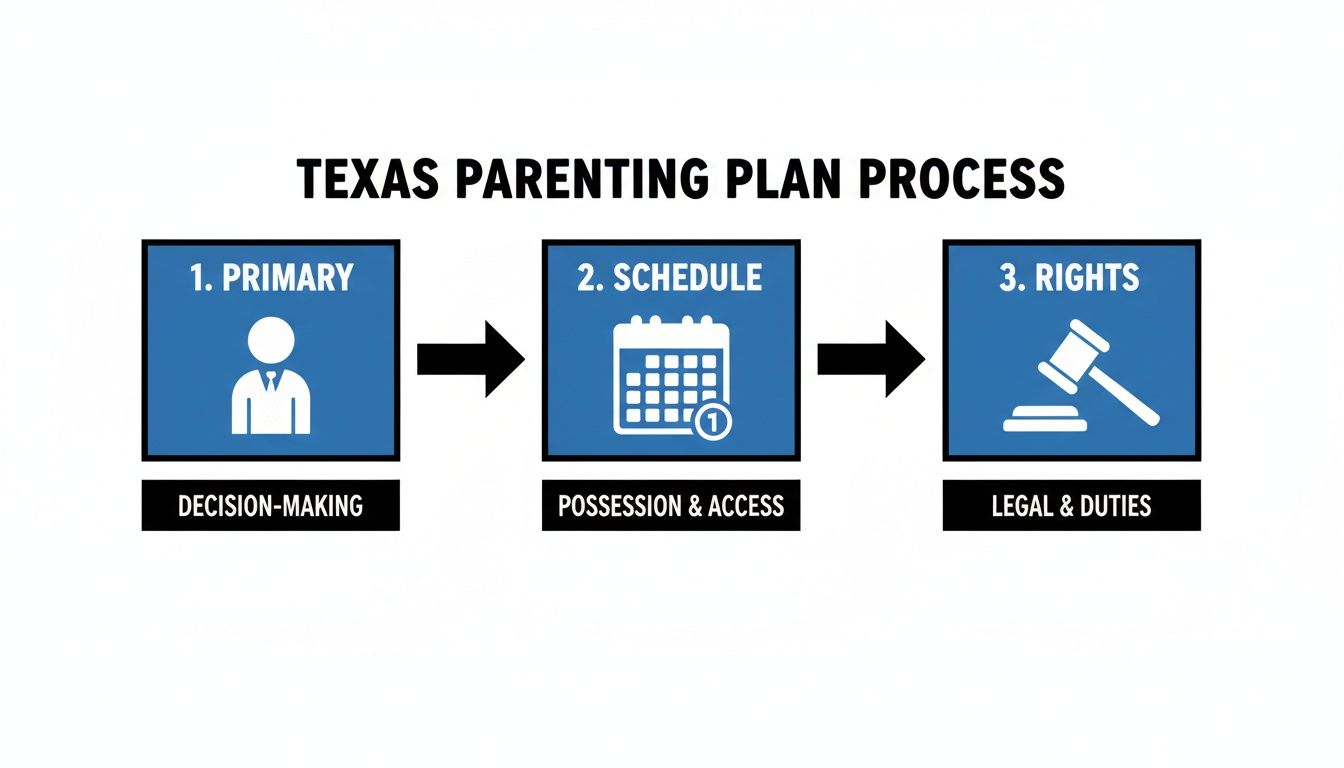
As you can see, every plan has to name a primary parent, set a possession schedule, and detail parental rights. A legal mistake in any one of these areas can be strong grounds for an appeal.
Trial vs Appeal: Key Differences in a Custody Case
It's vital to grasp that an appeal is not simply a second chance to argue your case. The entire focus, strategy, and even the "courtroom" itself are different. The table below highlights these critical distinctions.
| Aspect | Trial Court Process | Appellate Court Process |
|---|---|---|
| Purpose | To determine the facts of the case and apply the law to those facts. | To review the trial court's record for legal or factual errors. |
| Evidence | New evidence is presented through witness testimony, documents, and exhibits. | No new evidence is allowed. The review is limited to the existing trial record. |
| Key Players | Judge (or jury), parties, witnesses, trial attorneys. | A panel of appellate justices, appellate attorneys. Parties and witnesses do not appear. |
| Main Activity | Live testimony, presenting evidence, cross-examinations, making arguments to the judge. | Writing persuasive legal briefs, and sometimes presenting a 15-30 minute oral argument to the justices. |
| Focus of Argument | "The other parent is not fit because of X, Y, and Z." | "The trial judge made a legal error when they did X, Y, or Z." |
| Outcome | A final order establishing custody, possession, and child support. | A written opinion that affirms, reverses, or remands the trial court's order. |
Understanding these differences is the first step in building a successful appellate strategy. You're no longer telling a story to a judge; you're proving to a panel of legal scholars that a mistake was made.
Common Grounds for a Custody Appeal
A successful appeal isn't based on a feeling of unfairness; it's built on a specific, provable error. Here are some of the most common mistakes we see in Texas joint custody cases that can lead to a reversal:
- Misapplication of the Best Interest Standard: The judge ignored key evidence about a child's well-being or failed to properly weigh the "Holley Factors" that Texas law requires them to consider.
- Improperly Admitting or Excluding Evidence: The court allowed highly prejudicial or irrelevant evidence that swayed the case, or it refused to consider critical documents or testimony that would have changed the outcome.
- Ordering an Unenforceable Parenting Plan: The judge's final order is too vague, has contradictory terms, or is physically impossible for the parents to follow.
If you have a custody order that just doesn't seem right, you have options beyond just living with it. Whether you need to challenge that ruling through an appeal or you're looking into how to change a custody agreement through a modification, a clear legal strategy is your most powerful tool. An appeal provides a structured path to fight for a just result.
Common Questions About Custody Appeals in Texas
Getting a custody ruling that feels wrong can leave you feeling lost and overwhelmed. It's natural to have a ton of questions about what comes next. Knowing the road ahead is the best way to get back in the driver's seat and fight for the outcome your family needs.
Let's walk through some of the most common questions we get from parents who are thinking about appealing a custody order.
What Is the Deadline to Appeal a Custody Order in Texas?
Time is not on your side here. The deadline is rigid and unforgiving.
For most family law cases, you have just 30 days from the day the judge signs the final order to file a Notice of Appeal. If you miss this window, your right to challenge the decision is almost certainly gone for good. This is why it’s so critical to speak with an appellate lawyer the moment you get a ruling you believe is unjust.
To get a better handle on this critical first step, you can learn more about what is a Notice of Appeal and why it's so incredibly time-sensitive.
Can I Present New Evidence in My Custody Appeal?
This is a huge point of confusion for many people, and the answer is a firm no. An appeal is not a do-over of your trial. It's a review, not a retrial.
The court of appeals can only look at what was already presented to the trial judge. This is called the "record," and it’s made up of two key parts:
- The Clerk’s Record: This includes every document, motion, and order that was officially filed in your case.
- The Reporter’s Record: This is the official, word-for-word transcript of everything said in the courtroom during your hearings.
Our job as appellate attorneys is to comb through that existing record and pinpoint legal errors made by the judge. We're looking for mistakes in how the law was applied to the facts that were already there.
What Happens If I Win My Custody Appeal?
Winning an appeal can set you on one of two different paths toward a better result.
Sometimes, the appellate court will "reverse and render." This is the cleanest win. It means the higher court corrects the trial judge’s error and issues the right order itself.
More often, the court will "reverse and remand." This means they agree the trial judge made a serious mistake, so they throw out the incorrect order and send the case back down for a new trial or hearing. The key difference is that this time, they provide specific instructions on how the law must be followed, giving you a fresh, fair shot at the right outcome.
If you believe the court made a mistake in your family law case, our appellate attorneys can help you seek a fair outcome. Contact The Law Office of Bryan Fagan today for a free consultation. You can reach us at https://familylawcourtappeals.com.