When you believe your divorce decree was unjust, every detail of the trial comes under the microscope. You may feel your case was handled unfairly, especially regarding how your property was divided. The home appraisal might seem like a routine part of the process, but in a Texas divorce, its accuracy is the foundation of a fair property division. A valuation that’s off the mark can cost you tens of thousands of dollars, and if the trial court relied on that flawed number, it may be grounds for an appeal.
Why a Correct Home Appraisal is Crucial in a Texas Divorce Appeal
For most couples, the marital home is the most significant asset they own together. Texas law requires a "just and right" division of community property, and achieving that is impossible without knowing the true, unbiased value of your real estate. This is why a professional home appraisal isn't just a good idea—it's essential for a fair outcome.
The trial court leans heavily on this valuation to make pivotal decisions. Will one spouse buy out the other? Will the house be sold and the proceeds split? The appraisal provides the hard number needed to make these life-altering calculations. If that number is wrong, the entire property division can become fundamentally unfair.
The Financial Stakes of an Inaccurate Appraisal
A mistake on an appraisal report isn't a minor clerical error; it’s a direct hit to your financial stability. A valuation swing of just 5–10% can mean tens of thousands of dollars shifting from one spouse's column to the other. It’s no wonder that family law attorneys report that disputes over a home’s value pop up in nearly 20% of contested divorces. You can find more trends in divorce and property valuation on soulmatcher.app.
An unfair appraisal can create a grossly unfair outcome. Imagine this: an undervalued home allows your spouse to buy out your share for far less than it’s actually worth, leaving you without enough capital to start over. Conversely, an overvalued home could stick the spouse who keeps it with a crushing mortgage and immediate negative equity. This is the kind of injustice the appellate process is designed to correct.
Protecting Your Rights Through a Fair Valuation
Your best defense against an unfair division is ensuring the appraisal is performed by a qualified, neutral professional. An objective valuation protects you from a spouse trying to manipulate the numbers, emotional attachments clouding judgment, or simple guesswork. It transforms the home—the emotional heart of the family—into a clearly defined financial asset, which is exactly what’s needed for a just and right division.
Understanding the principles of fair property division is essential for securing your financial health. A precise appraisal isn't just about checking a box; it's a strategic tool that protects your interests and helps ensure the judge’s final orders are truly fair. If the trial court failed to ensure this, you may have grounds to seek justice on appeal.
Understanding the Home Appraisal Process in a Divorce Trial
When you’re in a divorce, the home appraisal can feel like a make-or-break moment for your finances. Understanding how it works is key to identifying potential errors that could have impacted your case. A proper appraisal isn't guesswork; it's a methodical process to determine your home’s true fair market value.
The process begins with selecting a professional. In a Texas divorce, this can happen in a few ways. Ideally, both spouses agree on a single, qualified, and neutral appraiser. If they cannot agree, the court might appoint one to ensure impartiality. Alternatively, each party can hire their own appraiser, which often results in two different valuations that must be reconciled.
The On-Site Inspection and Data Analysis
Once an appraiser is chosen, they will schedule a physical inspection of the property. They are not there to judge decor but to gather objective data about the house itself.
Here’s what they focus on during the walkthrough:
- Overall Condition: The home's general upkeep, any visible needed repairs, and the quality of construction.
- Size and Layout: The appraiser measures the gross living area (square footage) and assesses the functionality of the floor plan.
- Key Upgrades: Significant improvements, such as a remodeled kitchen or a new roof, are documented as they can add substantial value.
- Fixtures: Permanent items like HVAC systems, built-in appliances, and plumbing fixtures are included in the valuation.
After the inspection, the appraiser analyzes recent "comparable sales" or "comps"—similar homes in the immediate area that have sold recently. They make calculated adjustments for differences between your home and the comps to arrive at a data-backed opinion of value.
The purpose of this methodical approach is to remove emotion and speculation from the equation. The final number on the appraisal report should represent what a willing buyer would likely pay for the house on the open market at a specific point in time.
This infographic illustrates how the appraisal fits into the broader context of dividing your property.
As you can see, the appraisal is the bridge that converts a physical asset—your home—into a concrete number the court uses to ensure a fair property division.
The Final Appraisal Report as Trial Evidence
This work culminates in a detailed written report that outlines the appraiser's methodology, the comps used, and their final conclusion of value. In a divorce trial, this report becomes a crucial piece of evidence. It forms the factual basis for negotiations or the court's decision on how to divide the asset. If this evidence was flawed, and the court relied on it anyway, the entire foundation of your property division may be compromised.
Spotting Reversible Errors in a Flawed Appraisal
If you believe your final divorce decree resulted in a property division that feels deeply unfair, the cause may be a faulty home appraisal that the trial court mistakenly accepted as accurate. This isn't just a minor difference of opinion; a significant appraisal error can skew the entire division, creating an outcome so lopsided it may constitute a reversible error on appeal.
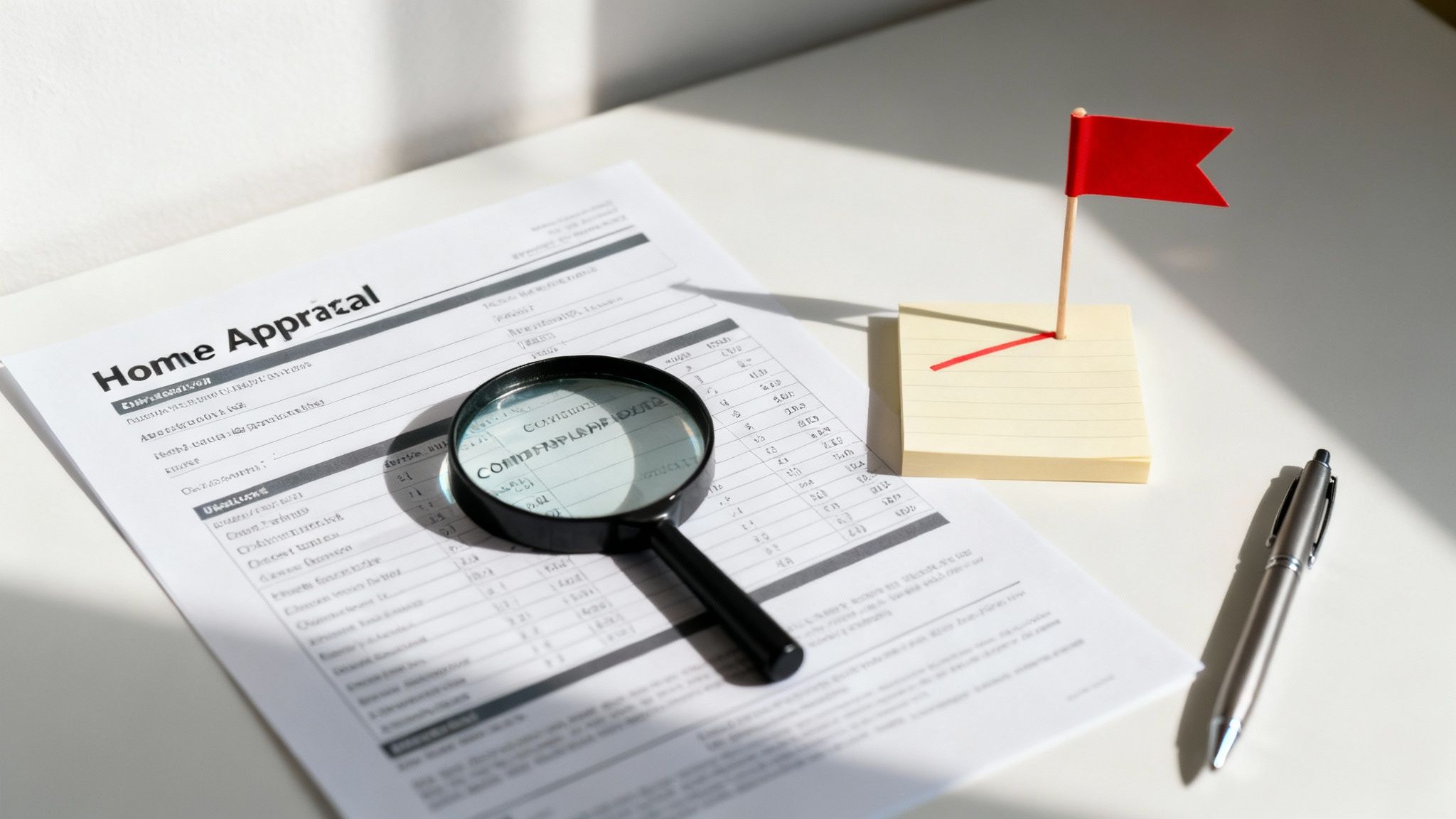
Mistakes in a home appraisal for divorce can be subtle, but their financial impact is significant. Knowing what to look for is the first step in challenging an unjust outcome. Your appellate attorney will scrutinize the trial record, including the appraisal report and related testimony, for red flags that point to a critical mistake.
Common Flaws That Can Invalidate an Appraisal
A reliable appraisal is built on current, objective data. When an appraiser uses outdated information, ignores key features, or allows bias to influence their work, the foundation of their opinion crumbles. If a trial court relies on such flawed evidence, it can lead to an unjust ruling.
Here are some common and serious appraisal errors that can form the basis of an appeal:
- Using Outdated "Comps": In a dynamic real estate market, a comparable sale from six or nine months ago is often irrelevant. Using stale data is a major red flag.
- Ignoring Significant Improvements: If you invested $50,000 in a kitchen remodel or added a new master suite, and those upgrades were not properly factored in, the appraisal is likely too low.
- Apparent Appraiser Bias: If the appraiser was hired exclusively by your ex-spouse and the valuation is suspiciously favorable to them, their neutrality is questionable. An appraiser must be a neutral expert, not an advocate for one side.
- Factual Inaccuracies: Simple mistakes in square footage, room count, or key features (e.g., valuing a three-car garage as a two-car) can drastically alter the final number.
Understanding the Standard of Review: When a Bad Appraisal Becomes Reversible Error
From an appellate standpoint, the key question is: did the trial court commit a legal error by relying on a deeply flawed appraisal? If the valuation was so inaccurate that it resulted in a property division that is not "just and right," the court may have committed an abuse of discretion.
Plain-English Definition: Abuse of Discretion
In Texas family law, an "abuse of discretion" occurs when a trial judge makes a decision that is arbitrary, unreasonable, or without reference to any guiding rules or principles. Simply accepting a home appraisal that is clearly not supported by credible evidence can be considered an abuse of discretion.
Imagine an appraisal comes in $75,000 under market value because the appraiser improperly used foreclosure sales as comps. If the judge divides the estate based on that artificially low number, the property division is not fair. That isn't just an unfortunate outcome; it is a potential reversible error that an appellate court has the authority to correct. You can learn more about what qualifies as a reversible error in Texas family law appeals from our other resources.
Why the Valuation Date Can Change Everything
When dividing property in a Texas divorce, the timing of the valuation can be just as important as the appraisal itself. The "date of valuation" is the specific day the court establishes as the official date for determining your home's worth. This single date can dramatically alter the financial outcome of your property division.
The period between separation and the final trial can last for months or even years. During that time, a home's value can change significantly, especially in a fluctuating real estate market. This creates a critical strategic issue that must be resolved correctly to ensure a fair division.
The Strategic Choice of Valuation Date
Texas law does not mandate a specific valuation date. The Texas Family Code provides flexibility, allowing courts to choose a date that will achieve a "just and right" division based on the specifics of the case. This gives your attorney the opportunity to argue for a date that best serves your financial interests.
Typically, the debate centers on two points in time:
- The Date of Separation: This freezes the home's value at the time the marriage effectively ended.
- The Date of Trial: This uses a more current value, reflecting what the house is worth at or near the time the judge makes a final ruling.
The choice is a strategic one, dependent on market trends and your goals for the property.
For example, a couple separates in January when their home is worth $450,000. By the time of their trial in December, a hot market has pushed the value to $500,000. That $50,000 increase in equity is now a major point of contention.
Arguing for a Fair Outcome at Trial and on Appeal
In that scenario, the legal strategy is clear. The spouse who wants to keep the home and buy out the other will argue for the earlier valuation date to minimize the buyout cost. The spouse moving out will argue for the date-of-trial valuation to receive their fair share of the market appreciation.
If the trial court chose a valuation date that resulted in a manifestly unfair outcome—for example, ignoring significant market changes without a valid reason—this decision could also be challenged on appeal as an abuse of discretion. A skilled appellate attorney knows how to analyze the trial record to build a compelling argument that the court's choice of valuation date undermined a just and right division of your assets.
What To Do When You Disagree on the Home's Value
It’s one of the most common disputes in a Texas divorce. Your appraisal values the home at $500,000, while your spouse’s report comes in at $450,000. This $50,000 gap can completely alter what a "just and right" division of your community estate looks like.
When you are facing a significant disagreement over value, it is important to understand your legal pathways. A discrepancy does not automatically mean one party is acting in bad faith. Two qualified appraisers can reach different conclusions by using different comparable sales or placing different weight on certain features. This is where your trial attorney’s strategy becomes critical.
Navigating the Valuation Dispute at Trial
When two appraisals conflict, there are several ways to resolve the issue before a final judgment.
The most direct approach is negotiation. Your lawyers can work to find a compromise, such as splitting the difference or making a concession on another asset to balance the division. This is often the most efficient solution.
If negotiation fails, the parties might agree to hire a third, neutral appraiser to act as a tie-breaker, agreeing in advance to accept that expert’s valuation. This removes the "battle of the experts" dynamic and provides the court with a single, unbiased number.
If all else fails, the issue is decided by the judge at trial. Each side presents its appraisal, and the appraisers may testify as expert witnesses. Your attorney’s job is to build a case for your valuation while highlighting the weaknesses in the opposing expert's report through cross-examination.
Choosing Your Path in an Appraisal Dispute
Here's a look at the pros and cons of common strategies for resolving conflicting home valuations.
| Method | Potential Pros | Potential Cons |
|---|---|---|
| Attorney Negotiation | Fastest and least expensive route. Keeps control with you, not a judge. | Requires cooperation and compromise from both sides. May not work in high-conflict cases. |
| Hire a Third Appraiser | Provides a neutral, unbiased "tie-breaker" value. Often accepted by courts as a fair resolution. | Adds the cost of another appraisal. You lose some control by agreeing to the outcome beforehand. |
| Go to Trial | Allows you to fully argue your case before a judge. A chance to be "proven" right. | Most expensive and time-consuming option by far. The outcome is uncertain and left entirely to the judge. |
A significant dispute over a home’s value can sometimes signal complexity in other areas, such as the characterization of assets. This is especially true if one spouse owns a business that also needs to be valued. Understanding the core principles of a fair business valuation for divorce can be helpful, as both processes rely on objective, expert-driven analysis to reach a just and right division of assets.
Common Questions About Divorce Appraisals in Texas
Navigating a divorce brings up countless questions, especially concerning the marital home. As it is often your largest asset, getting clear, accurate answers is the first step toward protecting your rights and ensuring the process is handled fairly.
Below are answers to some of the questions we hear most often from clients concerned about the valuation of their property.
Do I Have to Accept My Spouse's Appraisal?
No, absolutely not. You are under no legal obligation in Texas to accept an appraisal arranged by your spouse or their attorney. Accepting a single, potentially biased report without question is a significant financial risk.
An appraisal that is suspiciously low or high could be designed to serve your spouse's interests, not fairness. The best practice is to hire your own independent, qualified appraiser. This provides a crucial second opinion. If the two appraisals are far apart, it establishes a clear dispute for your attorney to resolve through negotiation or for the court to decide based on the evidence.
What If I Used My Inheritance to Improve the House?
This is a critical issue that can significantly impact your property division. If you used your separate property—such as an inheritance or funds owned before marriage—to make substantial improvements to the home, you may be entitled to be repaid.
Under the Texas Family Code, this is handled through a reimbursement claim. This claim is not automatic. You must provide clear evidence tracing the separate funds to the community asset and show how they enhanced its value. A successful reimbursement claim can be complex but is essential for protecting your separate property.
For example, if you used $50,000 from an inheritance to add a master suite to the community home, a successful reimbursement claim would allow that $50,000 to be returned to you as your separate property before the remaining equity in the home is divided.
Can We Just Agree on a Value Without an Appraisal?
Yes, you and your spouse can agree on a value for your home through a legal agreement called a stipulation. While this may seem like an easy way to save time and money, it is fraught with risk.
Agreeing on a value without a professional, neutral opinion is essentially guessing. Emotional attachment may cause one spouse to overvalue the home, while a desire for a quick resolution may cause the other to undervalue it. Proceeding without a formal home appraisal for divorce often results in one party receiving far less than they are entitled to. A diligent attorney will almost always advise against this unless the value is clear and both parties fully understand the risks involved.
If you believe the court made a mistake in your family law case, our appellate attorneys can help you seek a fair outcome. Contact The Law Office of Bryan Fagan today for a free consultation.