
You may feel your case was handled unfairly, especially when the future of a business you built is at stake. When you walk away from a final divorce trial believing the judge's decision was fundamentally wrong, it can be devastating. A critical mistake in how your business was valued, characterized, or divided can have financial consequences that last for years.
A strategic, well-informed approach to the appeals process is the only way to seek justice and protect what you’ve built. While an appeal isn't a second trial, it is a crucial opportunity to have a higher court correct serious legal errors the trial judge made.
Understanding What You Can Appeal in a Texas Business Divorce
The moment you’re served with divorce papers, it can feel like your business is immediately under threat. That’s a common and completely valid feeling. Here in Texas, the court’s job is to untangle your personal and business interests, which are often deeply intertwined. This process can feel invasive and incredibly disruptive to your day-to-day operations.
A common area for judicial error involves the complex intersection of business and marital property law. The constant meetings with lawyers, the never-ending requests for documents, and the sheer emotional drain can make it impossible to focus on managing your business. When a court makes a mistake on top of that stress, the pressure can feel immense and have very real financial consequences.
The Financial and Emotional Toll
The impact of divorce on business owners is huge, and it goes far beyond the courtroom. Research shows that 57% of business owners report a direct financial hit to their company during a divorce. Even more—a staggering 70%—say they struggle just to maintain focus on their work.
This split focus is expensive. On average, it leads to a revenue decline of about $4,000 every single month the divorce drags on. In the most extreme cases, one in twenty business owners are forced to shut down completely because of the financial strain. You can read more about these effects and get additional insights on Fortune.com.
This is exactly why having a calm, confident appellate strategy is so critical. A solid plan, grounded in the Texas Family Code and the Texas Rules of Appellate Procedure, can help restore balance and protect your company’s stability.
Taking Control with a Strategic Approach
Even though the trial process may have felt chaotic, an appeal brings a structured, methodical approach to seeking a fair outcome. It focuses on the law and the record to ensure due process was followed.
Here’s what the focus of an appeal often involves:
- Scrutinizing the Financial Record: This is the first line of defense. An appellate attorney reviews the profit and loss statements, balance sheets, tax returns, and expert reports admitted at trial to see if the court misinterpreted or ignored key evidence.
- Evaluating the Legal Team's Arguments: Your appellate attorney is the quarterback of the appeal. They will review how the trial lawyers presented the case and identify potential legal errors made by the court in its final ruling.
- Pinpointing Errors in Legal Classification: A core part of the appeal is determining if the trial court correctly applied Texas law. Did the judge mischaracterize separate property as community property? That is a common reversible error that can fundamentally alter the outcome.
Facing a potentially unfair outcome in a business divorce is daunting, but you don't have to accept it. With the right preparation and expert appellate guidance, you can challenge the court's errors and seek a fair resolution that allows your business to not just survive, but thrive.
Was Your Business Incorrectly Classified as Community Property?
When a business is involved in a divorce, the very first question the court must answer is: does the company belong to the marital estate? In Texas, the law starts with a simple assumption: any asset you or your spouse acquired during the marriage is community property. The burden is on you to prove otherwise, and the standard is high—you need clear and convincing evidence.
This all comes down to a legal concept called the inception-of-title rule. In plain English, this means an asset's character—whether it’s separate or community property—is determined the moment you first acquire it. The name on the company formation documents isn't the final say. What really matters is when and how the right to that business was first established. A trial court’s failure to correctly apply this rule is a common ground for appeal.
The Inception-of-Title Rule in Action
Let's walk through a common scenario. Imagine you started a small retail shop five years before you got married. On your wedding day, that shop was undeniably your separate property. But over the next ten years, you and your spouse poured your lives into it, and its value doubled.
Under the inception-of-title rule, the original business itself remains your separate property. The catch, however, is that the increase in value from the community's combined time, toil, and talent may create a reimbursement claim for the community estate. It's a classic point of conflict, and frankly, it's where trial courts can make a reversible error if they wrongly classify the entire business as community property.
When Separate Property Lines Get Blurry
Things get a lot murkier if you started the business during the marriage. You might have used funds from a separate inheritance to get it off the ground, but that initial character can be completely wiped out by commingling. This happens when you mix separate and community funds in a business account so thoroughly that no one can tell them apart anymore.
For example, if you routinely paid business expenses from your joint checking account or deposited company profits into a shared savings account, you’ve started to blur the lines. This is how separate property can morph into community property, making the entire business fair game for division by the court. Navigating these marital property laws is essential to protecting your business.
Here’s a quick breakdown to help you understand how Texas law might classify your business. This comparison highlights common scenarios you’ll face when classifying your company under Texas law.
Community vs. Separate Property in a Texas Business Divorce
| Characteristic | Community Property | Separate Property |
|---|---|---|
| When Founded | Founded or acquired during the marriage. | Founded before the marriage or acquired during marriage by gift or inheritance. |
| Funding Source | Launched with marital funds (e.g., joint savings, income earned during marriage). | Launched with documented separate funds (e.g., pre-marital savings, inheritance). |
| Commingling | Business and personal finances are heavily mixed in joint accounts. | Strict separation is maintained between business and personal/marital accounts. |
| Value Increase | The entire business value is divisible. | The initial value is separate, but the increase in value due to community effort may be subject to a reimbursement claim. |
| Spouse's Role | Spouse actively contributed "time, toil, and talent" to the business's growth. | Spouse had little or no involvement in the business operations or growth. |
Ultimately, meticulous documentation and clear financial boundaries are your best defense in proving a separate property claim. Without them, the legal presumption will likely favor community property.
The decision tree below maps out the three pillars of navigating a business divorce: strong records, a solid strategy, and the right support.
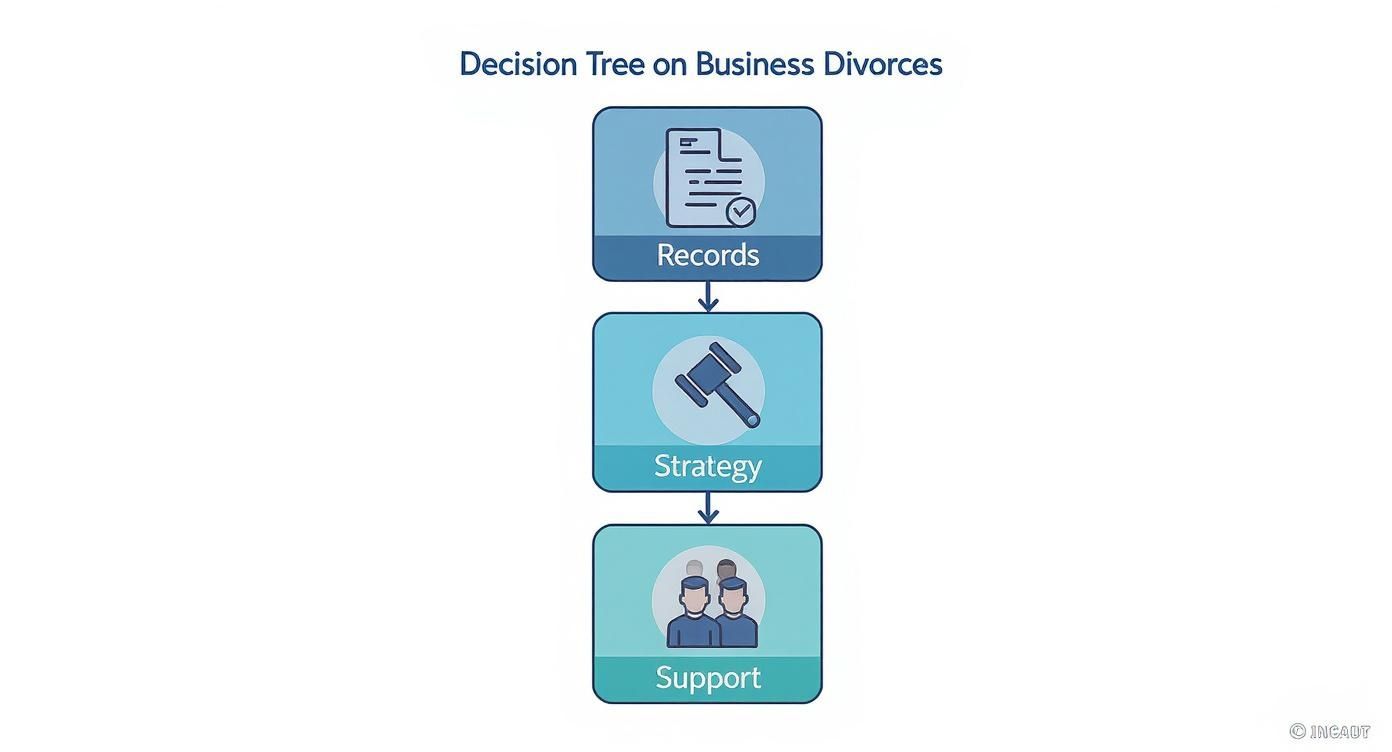
As you can see, a successful outcome hinges on organized records, a clear legal game plan, and a team of legal and financial experts who know what they're doing.
The Power of Meticulous Record-Keeping in an Appeal
While a prenuptial or postnuptial agreement is helpful, its strength at trial depends on the evidence presented to support it. The strength of any separate property claim is the ability to trace the asset's journey from the beginning.
An appellate review will focus on whether the trial court properly considered the evidence presented. This includes:
- Formation Documents: Articles of incorporation or partnership agreements that show the exact date the business was established.
- Capital Contribution Ledgers: Records detailing every initial and subsequent investment, making it crystal clear where the money came from.
- Bank Statements: Personal and business statements from before and during the marriage that prove the flow of funds.
- Loan Documents: Records of loans used to fund or expand the business, showing who the debtor was and what assets were used as collateral.
This isn't just paperwork; it's the evidence that defines the character of your business. If a trial court fails to properly consider this evidence, it could be deemed an abuse of discretion—a powerful argument for a successful appeal. An experienced appellate attorney can comb through the trial record to find out if the court made a mistake in its property characterization that unfairly cost you your business.
Appealing an Unfair Business Valuation
When you’ve poured your life’s work into building a business, putting a price on it is deeply personal. In a divorce, the business valuation often becomes the central battleground. Getting a credible, defensible valuation isn't just about finding a number—it’s about laying the groundwork for a fair and just property division.
If the trial court gets this wrong, the financial fallout can be devastating. This is also a common area for reversible error, which is a legal mistake so significant that it likely caused an improper judgment. An appellate court can step in and correct such fundamental errors made at trial.

How Texas Courts Are Supposed to Value a Business
Judges in Texas family courts don't guess. They must rely on established methodologies presented by financial experts, usually forensic accountants. While there are many ways to approach valuation, most methods fall into one of three categories.
- Asset-Based Approach: This is often the most straightforward method. An expert calculates the company’s net value by subtracting total liabilities from total assets. It is common for businesses with significant tangible assets.
- Market Approach: Similar to a real estate appraisal, an expert looks for comparable businesses in your industry that have recently sold and uses those prices to determine your business's value. The key is finding truly comparable companies.
- Income Approach: This method focuses on future earning potential and is common for service-based businesses like law firms or consulting agencies. An expert analyzes historical income and projects future earnings to arrive at a present-day value.
The correct method depends on the specific business. A court that applies a market approach to a highly specialized, one-of-a-kind business might be making a huge mistake. We call this an abuse of discretion, a legal term meaning the judge acted unreasonably or without reference to guiding legal principles. This is a powerful argument on appeal.
The Role of a Forensic Accountant in an Appeal
An appellate attorney will closely review the testimony of the forensic accountants from the trial. A forensic accountant is trained to dig deep into financial records, looking far beyond a tax return to provide an objective, court-ready opinion of value.
They analyze profit and loss statements, balance sheets, and accounts receivable to find irregularities and present their findings in a way a judge can understand. Reviewing this expert testimony is critical to identifying appealable errors. We dive deeper into this in our complete guide to business valuation for divorce in Texas.
The Crucial Difference: Personal vs. Enterprise Goodwill
One of the most complex parts of a business valuation is "goodwill"—an intangible asset representing the value of a company’s reputation and customer base. Under the Texas Family Code, it’s vital to separate goodwill into two distinct types:
- Personal Goodwill: This value is tied directly to one person's unique skills, reputation, or relationships. Think of a renowned surgeon whose name is the practice. In Texas, personal goodwill is not a community asset that can be divided in a divorce.
- Enterprise Goodwill: This value belongs to the business itself, regardless of who is running it (e.g., brand recognition, location). This type of goodwill is considered community property and must be valued and divided.
A frequent and serious error we see on appeal is when a trial court fails to properly separate personal goodwill from enterprise goodwill. This mistake can unfairly inflate the value of the marital estate, leading to a skewed division of assets.
An experienced appellate attorney will meticulously review the trial record to ensure the financial expert and the judge correctly handled this critical distinction. If you believe the court accepted a flawed appraisal or misunderstood your business's goodwill, those are precisely the kinds of reversible errors that can be successfully challenged on appeal.
Challenging an Unworkable Division of Business Assets
Once a business valuation is established, the next step is deciding how to divide it. This is where strategic thinking can save the company you’ve built. The goal is to untangle your financial lives without destroying the business in the process.
In Texas, judges have discretion to order a "just and right" division. This doesn't always mean a 50/50 split or forcing a liquidation. However, if the court’s order is unworkable or imposes an impossible financial burden, it may be considered an abuse of discretion and grounds for an appeal.

Common Ways to Divide a Business in a Divorce
Several standard approaches exist for dividing a business interest. The right one depends on the type of business, its profitability, and the other assets in the marital estate.
Here are three main strategies:
- The Structured Buyout: The spouse running the business keeps it and "buys out" the other spouse's share over time, often formalized with a secured promissory note that includes a payment schedule and collateral.
- The Asset Swap: The non-business spouse receives other community property of equal value, such as the family home or a larger share of retirement accounts, in exchange for their interest in the business.
- Co-ownership (Rare and Risky): In very amicable divorces, some former spouses attempt to continue as business partners. This requires an exceptional level of cooperation and iron-clad legal agreements to succeed.
Each of these options has significant tax implications that must be considered. An improperly structured buyout can create a massive and unnecessary capital gains tax bill.
Real-World Example: A Flawed Division Order
Consider a tech founder whose startup was valued at $2 million. The company had high potential but was cash-poor. If a trial court ordered an immediate lump-sum buyout, it would have choked the company's operations and killed its growth. Such an order could be considered an abuse of discretion because it fails to consider the reality of the business's finances.
A more creative and just solution might involve a combination of:
- A modest, upfront cash payment.
- A secured promissory note paid out over several years.
- A small percentage of the company's net profits for a set period.
This type of solution allows the business-operating spouse to continue growing the company without drowning in debt, while the other spouse receives a fair share of its current value and future success.
Here’s the key takeaway: Dividing a business isn’t a one-size-fits-all exercise. The final order must be grounded in the reality of the business's finances and be fair to both spouses. If a court orders a division that's completely unworkable—like a buyout payment the business could never afford—that could be considered an abuse of discretion and become a solid foundation for an appeal.
An airtight settlement agreement or final decree is non-negotiable. If the trial court's order is vague or financially impossible, it may be subject to challenge.
If you believe the court made a mistake in your family law case, our appellate attorneys can help you seek a fair outcome. Contact The Law Office of Bryan Fagan today for a free consultation.
What If the Judge Got It Wrong? Appealing Your Business Divorce Ruling
It’s a gut-wrenching feeling when you walk away from a final divorce trial believing the judge's decision was fundamentally wrong. When it comes to a business, a critical mistake in how it was valued, characterized, or divided can have devastating financial consequences that last for years.
While an appeal isn't a do-over of your trial, it is a crucial opportunity. It’s your chance to have a higher court step in and correct serious legal errors the trial judge made.
An appeal is a completely different ballgame from a trial. We won't be calling new witnesses or introducing new documents. Instead, the focus is entirely on the existing trial record—every transcript, piece of evidence, and court order. The goal is to pinpoint a reversible error, which is a mistake so significant that it very likely led the judge to an incorrect outcome.
Understanding the Standard of Review: "Abuse of Discretion"
One of the first things you'll hear about in an appeal is the standard of review. Think of it as the specific lens the appellate court uses to look at the trial judge's decisions. For most property division matters in a Texas divorce, that standard is abuse of discretion.
So, what does that actually mean? In plain English, an abuse of discretion happens when a judge makes a ruling without following established legal rules and principles. Their decision might seem arbitrary, completely unreasonable, or based on a flat-out misinterpretation of the law. It’s a tough standard to meet, but it's absolutely possible when the trial record clearly shows the judge made a major misstep.
Common Reversible Errors in a Business Divorce
In a complex divorce involving a business, mistakes often appear in a few key areas. Identifying these is the foundation of a successful appeal.
- Mischaracterizing the Business: This is a big one. The court might incorrectly label your separate property business—which you owned before marriage—as community property. This often happens when a judge ignores clear evidence tracing the source of funds, as required by the Texas Family Code.
- A Deeply Flawed Valuation: The judge might have relied on a questionable expert report that used the wrong valuation method, failed to separate personal from enterprise goodwill, or was built on faulty financial data. A judge’s valuation must be grounded in solid, credible evidence from the record.
- Ignoring Unchallenged Expert Testimony: Sometimes, a judge will simply disregard uncontradicted expert testimony for no good reason. If your forensic accountant presents a meticulous, well-supported valuation and the judge ignores it without a legally sound justification, this can be an abuse of discretion.
I’ve seen cases where a spouse won their appeal because the trial court did exactly that. Their expert clearly proved a huge chunk of the business's value was tied to the owner's personal reputation and contacts (separate property goodwill). The judge ignored this and threw it all into the community pot anyway. The appellate court saw this as a misapplication of Texas law and reversed the decision, finding the judge had abused their discretion.
The Appeals Process: Timelines and Procedures
The entire appellate process runs on a tight schedule dictated by the Texas Rules of Appellate Procedure. The clock starts ticking immediately. The first critical deadline is filing a Notice of Appeal, which is typically due within 30 days of the final judgment.
After that, the step-by-step process of preparing the record for the appellate court begins. This includes ordering the official clerk's and reporter's records from the trial.
Once the complete record is in hand, the real work begins: briefing. This involves drafting a highly detailed legal argument—the appellate brief—that methodically lays out the trial court’s errors. It must explain precisely why those mistakes demand reversal, backing up every point with legal precedent and statutes.
The complexity multiplies when a business has international ties, as this can lead to appealable errors if a court fumbles jurisdictional rules. You can read more about the unique challenges of dividing a multinational business during a divorce at fordfriedmanlaw.com.
After all briefs are filed, the court might schedule an oral argument where the attorneys argue the case in person. Finally, the appellate court will issue its formal written opinion. To get a more comprehensive look at what qualifies as a valid reason to file an appeal, you can review our in-depth guide on the grounds for appeal in Texas family law.
Answering Your Questions About Divorce and Your Texas Business
When you've poured your life into building a business, the thought of a divorce can feel like a direct threat to its survival. It's completely normal to feel like everything you've worked for is on the line.
Let's walk through some of the most common questions we hear from business owners facing this exact situation in Texas.
Common Questions About Divorce With a Business
Will my spouse automatically get half of my business?
No, not automatically. Texas is a community property state, but the goal is a "just and right" division, not always a strict 50/50 split.
If you started the business before marriage, it is likely your separate property. However, any increase in its value during the marriage could be considered community property, potentially leading to a reimbursement claim.
When a business is community property, a judge won't necessarily order you to sell it and split the proceeds. More often, one spouse is awarded the company, and the other receives assets of equivalent value through a structured buyout or an asset swap. This is where skilled negotiation can craft a solution that keeps the business running. Should a judge order a buyout that the company simply can't afford, that could be grounds for a property division appeals based on an abuse of discretion.
I don't have a prenup. How can I protect my business on appeal?
On appeal, the focus is on the evidence presented at trial. The absence of a prenup means the appellate court will look closely at the financial tracing documents and testimony admitted into the record to determine if the trial judge made a mistake.
An appellate attorney will review the evidence that was presented, such as:
- Company formation papers to prove the date of inception.
- Bank statements from before and during the marriage showing the flow of money.
- Capital contribution ledgers documenting all investments.
An appellate review determines if the trial court correctly analyzed this evidence. The key is to demonstrate how the judge misapplied the law to the facts that were already in the trial record. You can learn more about the specifics in our guide to business valuation for divorce.
What if my spouse and I disagreed on the business value and the judge chose their number?
This is an incredibly common scenario. When each side presents its own expert valuation, the judge must weigh the evidence and decide on a fair value.
If you believe the judge got it wrong, challenging that valuation on appeal comes down to proving an abuse of discretion. You'll need to show from the record that the judge ignored accepted valuation standards, relied on a flawed expert report, or disregarded critical, uncontradicted testimony from your expert.
It is a classic example of reversible error when a judge simply ignores sound, uncontradicted expert analysis without providing a good reason in the record.
Understanding Appeals in a Business Divorce
What exactly is an "abuse of discretion" and how does it affect an appeal?
In simple terms, an abuse of discretion is when a trial judge makes a decision that is arbitrary, unreasonable, or goes against established legal rules and principles. It’s not just about disagreeing with the judge; it's about showing from the record that their ruling was fundamentally flawed.
This is often tied to a reversible error—a mistake so significant that it very likely changed the final outcome of your case. An appeal is not a new trial; you cannot introduce new evidence. The entire process is a strategic review of the existing record to find these critical errors. The heart of the appeal is the briefing, which is the formal, written legal argument submitted to the appellate court that must follow the Texas Rules of Appellate Procedure precisely.
Here’s a step-by-step overview of the appellate process:
- File a Notice of Appeal within 30 days of the final judgment.
- Order the official clerk’s and reporter’s records from the trial.
- Draft and file your appellant’s brief, detailing the reversible errors.
- The other side files their appellee’s brief, and you may file a reply.
- You may have an oral argument in front of the appellate judges.
- The court issues its final written opinion.
For a more detailed breakdown of the process, check out our appeals overview.
Your Next Steps
While this FAQ provides a good starting point, every case has its own unique complexities. An appellate review can uncover issues you might not have noticed, from a fundamentally flawed business valuation to a misapplication of the Texas Family Code.
If you believe the court made a mistake in your family law case, our appellate attorneys can help you seek a fair outcome. Contact The Law Office of Bryan Fagan today for a free consultation.
Next Steps to Seek Appellate Review
https://www.youtube.com/embed/eAu60cVJ0Hk
If you’re walking away from your business divorce feeling the court’s decision was unjust, you must act quickly. The appeals process runs on a very strict clock, and every step must be precise. An appeal is not a second chance to present your case; it's a critical examination of the trial record to pinpoint significant legal errors made by the judge.
The entire process begins when you file a Notice of Appeal. This is the official document that informs the court system you are challenging the outcome. According to the Texas Rules of Appellate Procedure, you typically have only 30 days from the date the final judgment was signed to file this notice. Missing that deadline can permanently close the door on your right to appeal.
Building the Foundation for Your Appeal
Once the notice is filed, the meticulous work of compiling the appellate record begins. This is the complete file of your case—every document filed (the clerk's record) and every word spoken in court (the reporter's record). Your appellate lawyer will analyze this record, searching for a reversible error. This is not just any mistake; it must be an error so critical that it likely caused the unfair result you are now facing.
This is where having an experienced legal expert in your corner makes all the difference. Working with a seasoned Texas family law appeal attorney is essential, as they possess the unique skill of identifying trial court mistakes and transforming them into compelling legal arguments.
The heart of any appeal is the briefing. This is where your attorney drafts a powerful, detailed written argument. It lays out exactly how the judge erred, supports the argument with relevant case law and sections from the Texas Family Code, and explains precisely why the higher court needs to step in and correct the mistake.
After all written arguments are submitted, the court might set a date for oral arguments. This provides an opportunity for your attorney to stand before a panel of appellate judges and make your case in person. The goal of this entire, methodical process is to ensure the law was applied correctly and to restore fairness to the outcome.
If you believe the court made a mistake in your family law case, our appellate attorneys can help you seek a fair outcome. Contact The Law Office of Bryan Fagan today for a free consultation.