Skip to content
You may feel like the jury heard your story, saw the evidence, and still reached a result that doesn't make sense. In a Texas family law case, that can feel especially personal. A verdict may affect your children, your home, your finances, or your ability to move forward after a divorce.
When that happens, many people assume the jury “got it wrong.” Sometimes that's true in a practical sense. But on appeal, the focus is narrower and more useful. The question becomes whether the jury was given the right legal instructions before it made its decision.
That issue matters because an appeal isn't a new trial. Under the Texas Rules of Appellate Procedure, the appellate court reviews the record from the trial court. It doesn't call new witnesses or reweigh the evidence from scratch. In family cases, that record often includes the clerk's record, the reporter's record, the written charge, the objections to that charge, and the final judgment under the Texas Family Code.
Your Case Was Decided by a Jury and It Feels Wrong
A client in this position usually says some version of the same thing: “I know what happened in that courtroom, and the verdict still doesn't reflect it.”
That reaction is common after a jury trial involving conservatorship, property characterization, reimbursement claims, or other disputed family issues. You may have presented documents, testimony, and a clear theory of the case. Then the jury answered a set of written questions in a way that seems disconnected from what everyone just heard.
Sometimes the problem isn't the evidence. It's the roadmap the court gave the jury.
In a Texas family jury trial, jurors do not solely decide what seems fair. They answer specific questions under a written set of instructions called the court's charge. If those instructions are confusing, incomplete, or legally wrong, the jury can apply the wrong rule to the right facts. That can produce a verdict that feels unfair because it may have been guided by an unfair legal framework.
A bad verdict and a bad charge are not always the same thing. But when they overlap, the charge can become the center of the appeal.
That's why families who are looking at an appeal after a jury verdict in Texas family court need more than general frustration with the result. They need a close review of what the jury was told, what objections were made, and whether the error likely affected the outcome.
The good news is that Texas appellate courts do review these issues carefully. The process is technical, but it exists to protect fairness when a verdict rests on flawed instructions rather than a proper application of the law.
What Are Jury Instructions in a Texas Family Law Case
Before the jury begins deliberating, the judge gives it a written set of directions. Texas lawyers usually call this the charge of the court or the jury charge. In plain English, it is the official rulebook for the jury's decision.

What the charge usually contains
The charge typically includes several parts:
- Definitions the jury must use. These may explain legal terms tied to custody, property, or other disputed issues.
- Instructions on how to answer. The court tells jurors how to approach the questions and how to apply the law.
- The actual jury questions. These are the written questions the jurors answer after deliberating.
- Limits on what the jury decides. In family law, the jury may decide selected issues while the judge decides others.
That last point matters. In many Texas family cases, the jury doesn't decide every part of the case. A jury may decide a narrow but important issue, and the judge then enters judgment based in part on those answers. That makes precision in the charge even more important.
Why wording matters so much
A jury charge isn't just courtroom paperwork. It directs how jurors convert evidence into answers.
If the charge uses the wrong legal standard, leaves out a necessary instruction, or defines a term in a misleading way, the jury may never reach the question the law requires it to answer. That's why jury-charge complaints are often stronger on appeal than clients first realize. The issue is not merely that jurors disagreed with you. The issue is that they may have been asked to decide the case under faulty directions.
Practical rule: If the jury got the wrong rulebook, the verdict may reflect the instruction error as much as the evidence.
The appellate consequence is also distinctive. As explained in this discussion of challenges based on improper jury instructions, a bad charge can distort the jury's application of the governing legal standard rather than merely create a factual dispute. That is why appellate courts focus on the exact wording of the charge, the objections made on the record, and whether the instruction likely misled the jury. If the instruction was materially misleading, the remedy can be reversal or remand for a new trial instead of a simple modification of the judgment.
A useful way to think about it
Think of the charge as a GPS. The evidence is the road. The jury follows the route it is given. If the route is wrong, even careful drivers can end up in the wrong place.
That is the heart of how improper jury instructions affect Texas family law appeals. The appeal often turns on whether the legal directions were accurate, preserved, and harmful.
Common Examples of Flawed Jury Instructions
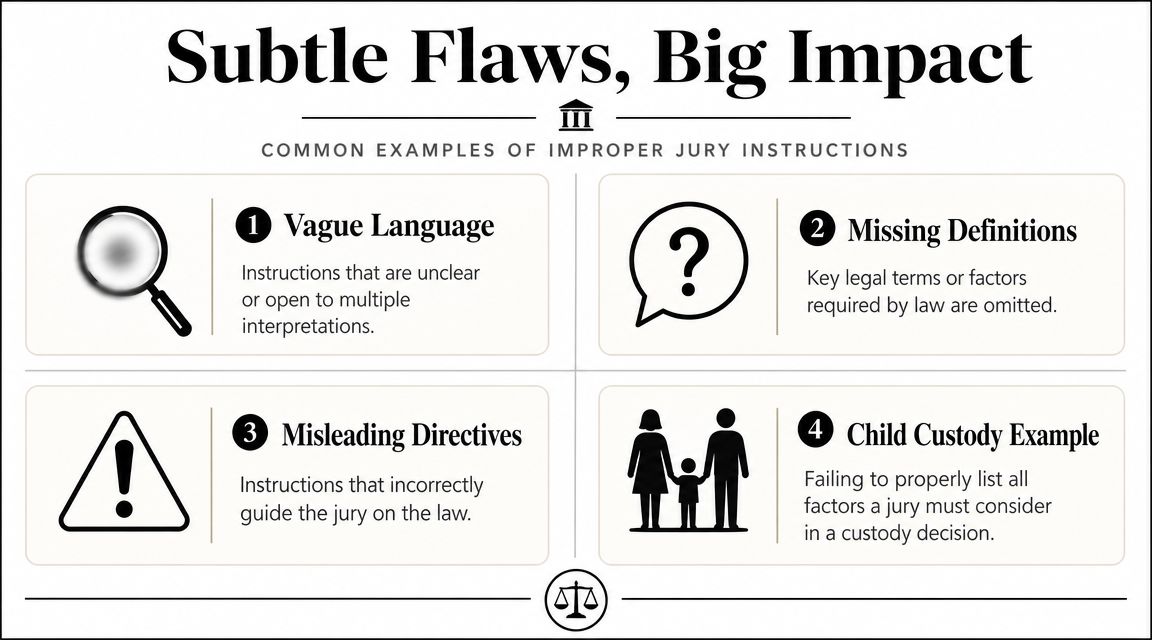
Improper instructions are often subtle. They don't always sound dramatic when read aloud in court. But small wording problems can shape the entire verdict.
Custody instructions that blur the legal standard
In a jury-tried custody dispute, a parent may leave court convinced the jurors never had a clear legal framework for the decision they were making. That concern can be valid if the instruction used vague language or omitted needed guidance tied to the issue submitted.
A sound instruction gives jurors a legally accurate path. A flawed one may invite them to answer based on general sympathy, personal beliefs, or an incomplete understanding of what Texas law requires.
For parents dealing with these issues, it helps to compare the verdict form and charge against the larger legal framework that governs Texas child custody appeals. The question isn't just whether the result was painful. It's whether the jury was told to evaluate the issue the right way.
Property instructions that confuse separate and community claims
Property cases are another common trouble spot. A jury may be asked to decide disputed characterization issues that affect the final division of the marital estate. If the definitions or questions are unclear, jurors can misclassify major assets without realizing they are doing so.
Common problems include:
- Missing legal definitions. A key term appears in the question, but the charge doesn't define it clearly enough for jurors to apply it correctly.
- Misleading phrasing. The wording nudges jurors toward a result that doesn't match the governing law.
- Incomplete submission. The charge asks part of the needed question but leaves out an instruction necessary for the jury to evaluate a party's position.
- Unsupported issues. The court submits an instruction or question that doesn't fit the evidence admitted at trial.
When that happens in a divorce case, the verdict can skew the judge's later rulings on division, reimbursement, or related claims. Anyone reviewing that kind of case should also understand the broader issues involved in Texas property division appeals.
Jurors usually want to follow the law. If the charge is unclear, they may do exactly what the court told them to do and still reach a legally defective answer.
What clients often miss after trial
Clients usually remember witness testimony, closing arguments, and the final answers on the verdict form. They often don't realize that the wording between those moments can be the most important part of the appeal.
A flawed instruction might involve:
| Problem in the charge | Why it matters on appeal |
|---|---|
| An omitted instruction | The jury may never have been told how to consider a valid theory of the case |
| A wrong definition | Jurors may apply the wrong legal meaning to disputed facts |
| A confusing question | The verdict may not clearly show what the jury actually decided |
| An instruction unsupported by the record | The jury may be invited to decide an issue it should not have considered |
That's why appellate review starts with the paper trail, not just the result.
The Critical Step of Preserving Error for Appeal
A strong appellate issue can still be lost if no one preserved it properly during trial.
That is one of the hardest realities for families to hear after a jury verdict. A bad instruction does not automatically create a winning appeal. Texas appellate courts usually require that the complaint was raised in the trial court, at the right time, with enough specificity for the judge to understand the problem and rule on it.
What preserving error means
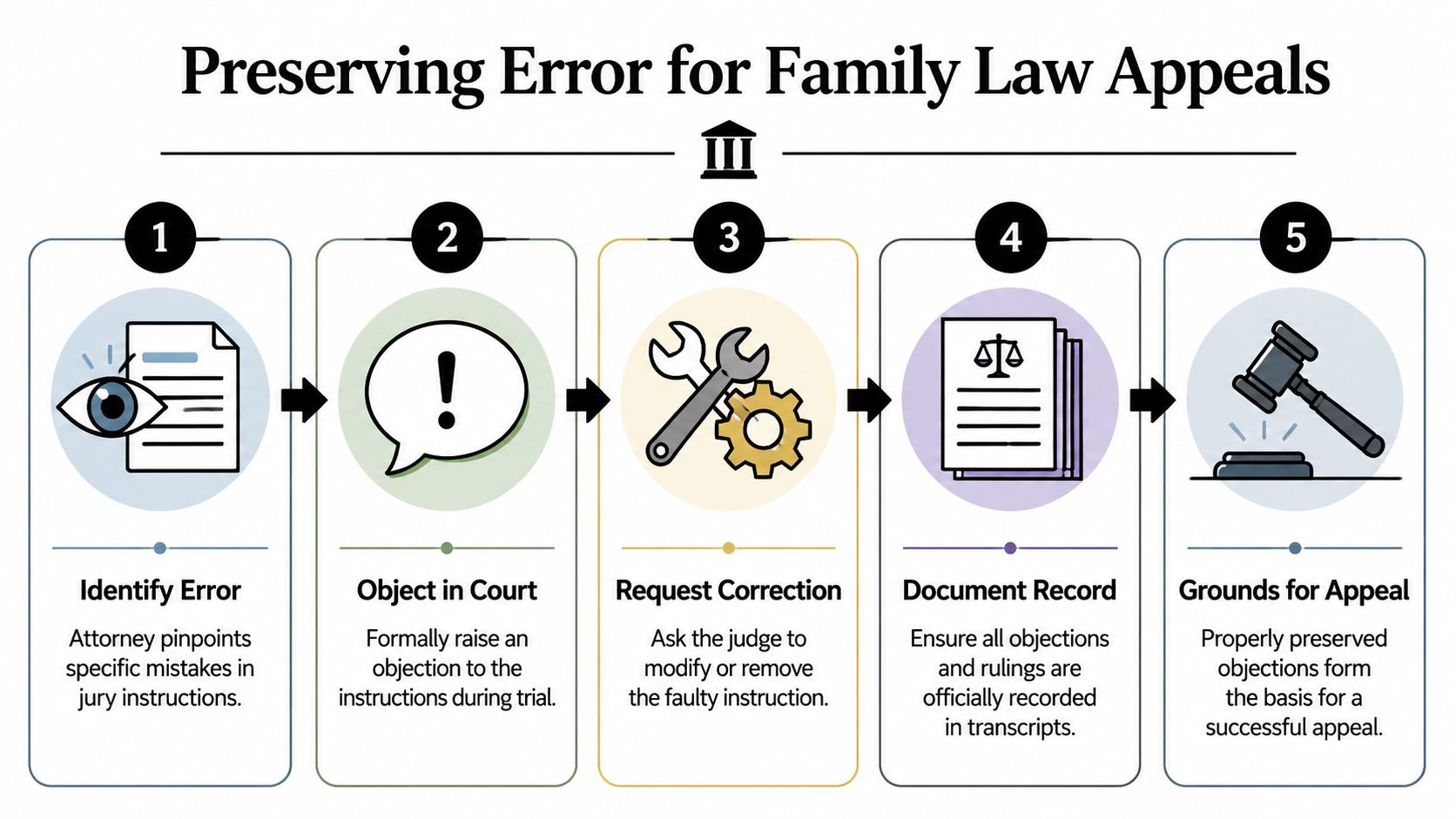
Preserving error means making the complaint in a way the appellate court can later review. In the jury-charge setting, that usually involves a specific, timely objection to the instruction or the submission of a requested instruction or question that correctly states the law.
A charge conference is the point in trial when the lawyers and judge review the proposed charge before it goes to the jury. Many appellate rights are protected or lost at this point.
A formal objection is not a hallway complaint or a vague statement that the charge seems unfair. It is an on-the-record objection that identifies the problem clearly enough for the trial judge to correct it if the judge agrees.
What usually works and what usually doesn't
Here is the practical difference:
- What works. Counsel identifies the exact wording that is wrong, states why it is wrong, and asks the court to correct it.
- What doesn't. Counsel says the charge is “confusing” or “improper” without explaining the legal defect.
- What works. Counsel gets a ruling on the objection, or at least makes sure the record shows the court refused the requested change.
- What doesn't. Counsel assumes the judge understood the complaint without making a clear record.
- What works. Counsel tenders a better instruction when needed.
- What doesn't. Counsel complains later, after the jury has already been charged.
For a fuller discussion of that issue, see this article on objections required to preserve appeal in Texas.
The appellate court reviews the record it has, not the objection your lawyer meant to make.
Why preservation can decide the whole appeal
Texas family-law guidance is clear that jury-charge complaints rise or fall on preservation. As explained in this analysis of specific and timely charge objections, an improper jury instruction is most likely to become reversible error when the appellant preserved a specific charge objection and can show the error probably caused an improper judgment or prevented the presentation of a theory of the case. If no timely objection was made, review is usually limited to a much harder harmless-error or egregious-harm standard.
That means the procedural failure itself can change the outcome of the appeal.
How this fits into the broader appellate process
Under the Texas Rules of Appellate Procedure, the appeal begins with a notice of appeal and moves forward on the appellate record. In family cases, that record generally includes the pleadings, written motions, admitted exhibits, the reporter's transcript, the charge conference material reflected in the record, the jury charge itself, and the signed judgment.
Then comes briefing. In plain English, briefing is the written argument filed in the appellate court. It explains what legal mistake happened, where it appears in the record, what rule or statute applies, and why the error justifies relief.
No new evidence comes in at that stage. If the trial lawyer did not preserve the charge issue, the appellate lawyer often has less room to work with. That's why charge preservation is not a technical side issue. It is often the bridge between an unfair trial and a viable appeal.
How Appellate Courts Review Faulty Jury Instructions
When a family law appeal reaches the court of appeals, the judges do not retry the case. They review the existing record. That is a major difference between a trial and an appeal, and it shapes every jury-instruction argument.
In plain English, the appellate court usually asks two questions. First, was the instruction wrong? Second, did the error matter enough to justify relief?
The first question was there legal error
Some complaints fail at the first step. The charge may have been awkwardly worded but still legally acceptable. Or the issue may have been submitted in a way Texas procedure allows, even if one side strongly disliked it.
Other complaints are stronger because the wording misstated the law, omitted a needed instruction, or submitted an issue in a misleading way. This is especially important in family cases where the jury may answer broad-form questions.
Broad-form submission is designed to reduce conflicting jury answers. But it can also complicate appellate review because one broad question may wrap several concepts into a single answer. According to Texas family-law jury trial guidance from DFPS, broad-form charges are used in family cases, and an instruction error can still be harmful even in that format. The same guidance notes that success on appeal depends on separating charge error, preserved error, and harm analysis.
The second question was the error harmful
Many appeals reach their turning point here.
A reversible error is a legal mistake serious enough to justify appellate relief. A harmless error is a mistake the appellate court believes probably did not affect the judgment.
In jury-charge appeals, harm usually means showing the bad instruction probably caused the rendition of an improper judgment or prevented a party from properly presenting a theory of the case. That is a demanding standard, but it is not impossible.
A helpful way to think about it is this: the appellate court is not asking whether the judge made any mistake at all. It is asking whether the mistake likely changed the path to the verdict.
What abuse of discretion means here
Clients often hear the phrase abuse of discretion and assume it means judicial misconduct. It usually doesn't.
In plain English, abuse of discretion means the trial court made a decision outside the range of reasonable legal choices. In family law, many rulings are reviewed through that lens because trial judges have discretion in how they manage cases and apply family-law standards. But discretion still has limits. A court cannot rely on a legally incorrect instruction on the grounds that it has discretion in other parts of the case.
If an instruction misstated the law or omitted a necessary legal component, the appellate court may treat that as more than a routine disagreement. It may treat it as a record-based legal error with real consequences.
Why record preparation and briefing matter so much
A jury-instruction appeal is often won or lost in the record and in the brief.
The appellate judges will look closely at:
- The exact text of the charge
- The exact objection made
- The court's ruling
- How the questions were submitted
- How the verdict answers connect to the judgment
That's why a careful review of the record matters before anyone promises results. A lawyer handling reversible error in Texas family court must connect the dots cleanly. Not just “the instruction was wrong,” but “this preserved error likely changed the verdict that drove the final judgment.”
The strongest appeals don't argue in broad strokes. They show precisely where the charge went wrong and why that mistake mattered.
Texas appellate data also show that appeals from judgments entered on jury verdicts are not merely theoretical long shots. The statewide reversal rate for appeals from judgments entered on jury verdicts was 27%, and in the 2010 to 2011 court year it was 34%. In the 2018 to 2019 court year, the jury-verdict reversal rate remained 27%, as discussed in this Houston Law Review article on reasons for reversal in the Texas Courts of Appeals. Those figures do not mean every family-law charge issue will win. They do show that appellate courts do reverse a meaningful share of jury-based judgments when harmful error is established.
Potential Outcomes and Your Path to a Fairer Result
If the appellate court agrees that a preserved jury-charge error probably affected the outcome, the usual remedy is not for the appellate court to rewrite the verdict itself. The more common result is reversal and remand.
That means the appellate court sets aside the judgment and sends the case back to the trial court for further proceedings, often a new trial on the affected issues. In practical terms, you get another chance to have the disputed issue decided under a legally proper charge.
What relief may look like in real life
A successful appeal can lead to outcomes such as:
- A new trial on jury issues. The case returns to the trial court so the disputed questions can be tried again under proper instructions.
- A corrected legal framework. The next round proceeds with clearer definitions, better wording, or a proper submission.
- A stronger settlement posture. Once the error is identified and the judgment is reversed, the case may resolve before another full trial.
That doesn't mean every appeal is worth filing. Some records show a real problem but no preserved objection. Others show an objection, but not enough harm. A careful case review is what separates frustration from a workable appellate strategy.
Why a prompt review matters
Appeals move on deadlines set by the Texas Rules of Appellate Procedure. The notice of appeal, the preparation of the clerk's and reporter's records, post-judgment motions when appropriate, and the briefing schedule all require close attention.
This is also where a focused appellate review helps. The Law Office of Bryan Fagan, PLLC handles Texas family law appeals by reviewing trial records, identifying potential reversible error, and preparing appellate briefs grounded in the Texas Family Code and appellate procedure. In a jury-instruction case, that kind of review usually starts with the charge, the objections, the verdict form, and the final judgment.
If your concern is that the jury was guided by the wrong legal instructions, the path forward is not guessing. It is record analysis, preservation analysis, and harm analysis. When those pieces line up, an appeal can offer a genuine route to a fairer result.
Schedule a Consultation to Evaluate Your Case
If you believe the court made a mistake in your family law case, it's important to have the record reviewed quickly. Strict appellate deadlines apply, and the strength of a jury-instruction appeal often depends on details that appear in the charge, the transcript, and the written rulings.

A consultation can help answer the questions that matter most. Was the instruction wrong. Was the issue preserved. Is there a realistic argument that the error affected the judgment. Those are answerable legal questions, and getting an honest assessment early can make a real difference.
This overview may also help as you think about next steps.
If you believe the court made a mistake in your family law case, our appellate attorneys can help you seek a fair outcome. Contact The Law Office of Bryan Fagan today for a free consultation.
If you believe your family law jury trial was affected by flawed instructions, preserved objections, or other appellate issues, The Law Office of Bryan Fagan, PLLC can review the record and help you evaluate whether an appeal offers a path toward a fairer result.