Skip to content
The trial is over, and the judge has signed the final divorce decree. You may feel your case was handled unfairly, and the outcome feels deeply wrong. After pouring your time and resources into your case, receiving a ruling on child custody or property division that seems to ignore the facts can be incredibly disheartening.
It is natural to feel that the system has failed you. You might be convinced the judge misinterpreted the law or overlooked critical evidence, leaving your family’s future on shaky ground. This is not the time for despair; it's the time for a calm, confident, and strategic plan. The path to correcting an unjust ruling is through an appeal, but that path has firm deadlines that are absolute.
Your Guide to Texas Divorce Appeal Timelines
In Texas family law, the clock on your right to appeal starts ticking the moment the judge signs the final order. From that moment, you have a very specific, limited time to file a Notice of Appeal. If you miss this window, the door to the appellate court almost always closes permanently.
There are two primary timelines, and which one applies to you depends entirely on the strategic actions taken immediately after the judgment is signed.
The Two Timelines: Understanding the 30 and 90-Day Rules
Think of this as a fork in the road. Your first move after the decree is signed determines whether you have a month or three months to initiate your appeal.
This flowchart maps out the two critical paths for your appeal deadline.
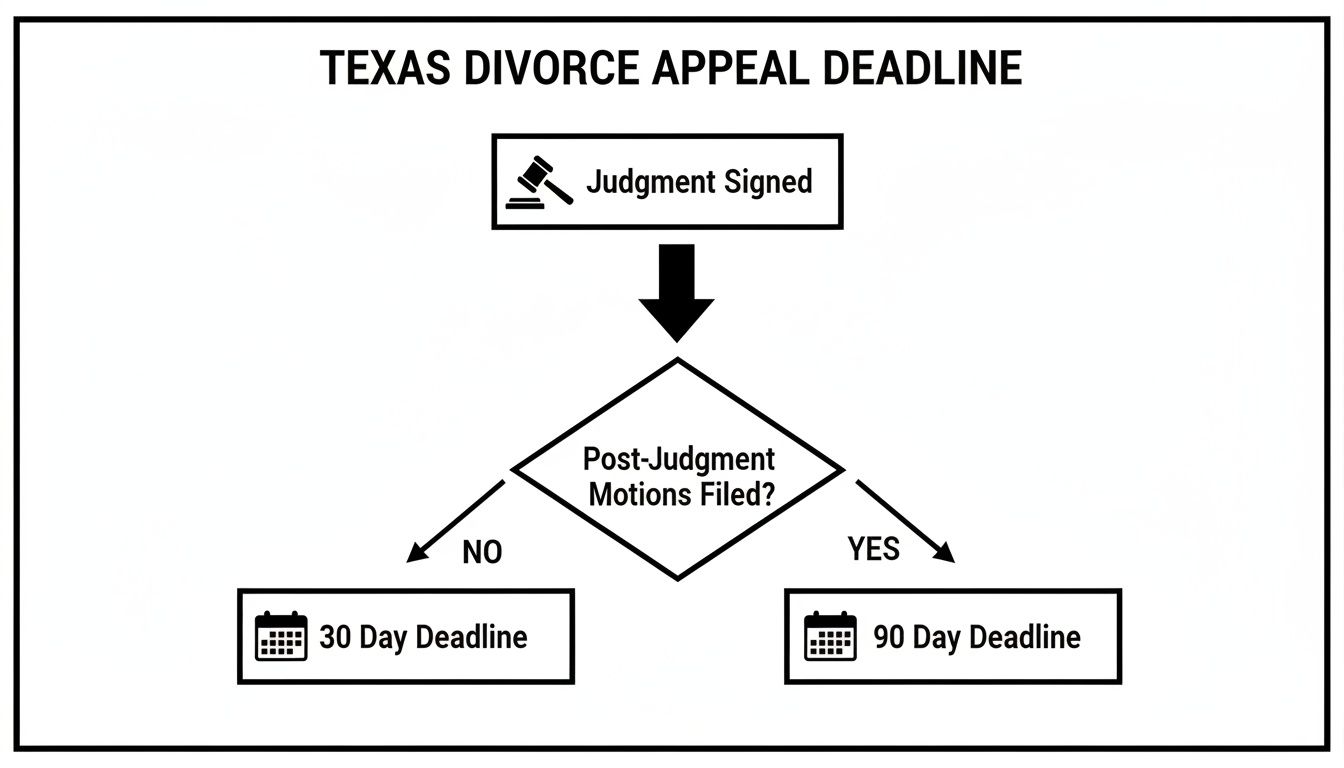
Here is a plain-English breakdown:
The Default 30-Day Deadline: If no further action is taken, your Notice of Appeal must be filed within 30 days from the date the judge signed the decree. This is an extremely tight turnaround to retain an appellate attorney, analyze the case, and make a final decision.
The Extended 90-Day Deadline: The deadline to file your appeal can be extended to 90 days from the signature date. To secure this extension, you must timely file specific post-judgment motions, such as a Motion for New Trial, a Motion to Modify the Judgment, or a formal request for Findings of Fact and Conclusions of Law.
Filing one of these motions is a critical strategic move. It does more than just give you more time. It formally asks the trial judge to reconsider and correct errors, and just as importantly, it provides your appellate team the necessary time to obtain the court reporter's record, meticulously analyze it for reversible errors, and properly prepare the appeal.
To make these timelines crystal clear, here is a simple summary.
Texas Divorce Appeal Deadlines at a Glance
This table outlines the crucial timeframes for starting a divorce appeal in Texas, which hinge on whether you file post-judgment motions.
| Scenario | Post-Judgment Action | Deadline to File Notice of Appeal |
|---|---|---|
| Standard Deadline | No post-judgment motions filed | 30 days from judgment signature date |
| Extended Deadline | Timely filing of a Motion for New Trial, Motion to Modify, or Request for Findings of Fact | 90 days from judgment signature date |
Ultimately, understanding and acting on these deadlines is the single most important first step. It is the key that unlocks the door to the appellate courts and gives you an opportunity to seek a fair and just outcome.
The Critical First Step: Understanding the Notice of Appeal
If you believe the trial court made a mistake in your final divorce decree, your journey toward justice begins with a specific document: the Notice of Appeal. This is not just paperwork; it is the legal key that opens the door to the appellate court, and the deadline for filing it is one of the strictest in Texas law.

A common misconception is that the Notice of Appeal is where you begin arguing your case. It is not. Think of it more like a boarding pass for a flight. You don't argue with the gate agent about why you deserve a different seat; you simply show the pass to get on the plane. The Notice of Appeal functions similarly—it is a formal notification to the court and the opposing party that you intend to challenge the final decision.
What Goes Into a Notice of Appeal
While it is not a lengthy legal brief, the Texas Rules of Appellate Procedure are very specific about what this document must contain. An error here can create serious procedural problems that could jeopardize your appeal before it even begins.
A correctly drafted Notice of Appeal must include:
- The trial court’s name and the case number to ensure it is filed in the correct case.
- The name of each party who is appealing to clarify who is bringing the challenge.
- The date the judgment or order being appealed was signed, which marks the start of the appellate timeline.
- A clear statement that you desire to appeal, serving as your official declaration.
Filing this document correctly is the first procedural test of the appellate process. For a detailed breakdown, you can review our guide on how to file a Notice of Appeal in Texas.
Why This Deadline Is So Incredibly Important
Here is the bottom line: under Texas law, the court of appeals only gains the power—what lawyers call jurisdiction—to review your case after a timely Notice of Appeal has been filed. If you miss that window, the court simply has no authority to help you.
This is one of the most unforgiving deadlines in our legal system. Missing it, even by one day, almost always results in an automatic dismissal of the appeal. The strength of your case becomes irrelevant if this first step is not handled perfectly and on time.
This is why understanding your specific deadline is everything. The standard timeline is 30 days from the date the judge signs the final judgment. However, that can be extended to 90 days if certain post-judgment motions are filed correctly. An experienced appellate lawyer lives by these deadlines, ensuring they are met without fail. Your one chance to correct an unfair outcome in your divorce or protective order case hinges entirely on getting this first, critical step right.
How to Extend Your Appeal Deadline to 90 Days
The standard 30-day window to file an appeal creates significant pressure. It is barely enough time to process a judge’s ruling, let alone hire an appellate attorney and have them begin the deep analysis needed to challenge it effectively.
Fortunately, Texas law provides a well-established strategy to triple that timeline. It is not automatic, but by taking the right legal steps, you can give yourself the breathing room needed to build a powerful appeal. Filing specific post-judgment motions extends the deadline to file a Notice of Appeal from 30 days to a more workable 90 days.

Post-Judgment Motions That Trigger the 90-Day Extension
Think of these motions as asking the trial judge for a second look or an opportunity to correct a mistake. You are essentially giving the judge a chance to fix their own errors before you take the fight to a higher court.
When filed correctly and on time, three key motions will automatically extend your appeal deadline to 90 days from the date the final order was signed.
These are your options:
- Motion for New Trial
- Motion to Modify the Judgment
- Request for Findings of Fact and Conclusions of Law
The rules are incredibly strict. The Texas Rules of Appellate Procedure give you a mere 30 days after the judge signs the final judgment to file your Notice of Appeal. But if you file one of the motions above within that same 30-day period, the clock for your Notice of Appeal deadline resets and extends to 90 days.
Filing one of these is a critical strategic move. It preserves your rights and, just as importantly, buys your legal team the invaluable time needed to obtain the official court record and begin dissecting the case for appealable errors.
Understanding Each Motion's Purpose
While all three motions can extend the deadline, they each have a unique function. A seasoned appellate lawyer will know exactly which tool is appropriate for your situation.
Motion for New Trial: This is the most common of the three. It is a formal request asking the trial judge to set aside the previous judgment and grant a brand-new trial. To succeed, you must argue that a major legal or factual error occurred—one so harmful that it prevented a just result. This gives the judge a direct chance to fix a serious mistake. You can learn more by reading our guide to a Motion for New Trial in Texas Family Law.
Motion to Modify the Judgment: This motion is more targeted. Instead of asking for an entirely new trial, you are asking the judge to change, correct, or reform a specific part of the judgment. For instance, this is the right tool if there was a mathematical error in the property division or a clerical mistake in the final decree.
Key Takeaway: Both a Motion for New Trial and a Motion to Modify the Judgment must be filed within 30 days of the judgment's signature date. Filing on time is the only way to extend your appellate deadline.
- Request for Findings of Fact and Conclusions of Law: This is less of an argument and more of a demand for transparency. It requires the judge to put their reasoning in writing—the specific facts they relied on and the legal rules they applied to reach their decision. This document is essential for building a strong appeal because it exposes the judge’s thought process. A timely request for these findings also extends your appeal deadline to 90 days.
By using these motions strategically, you are not just buying more time. You are laying the essential groundwork for a successful appeal by creating a clearer record and giving your team the runway needed to prepare a compelling argument for the higher court.
What You Can and Cannot Appeal in a Texas Divorce Case
When a judge’s final decision in your divorce feels fundamentally unfair, it's natural to hope an appeal offers a second chance to make your case. Many people think of an appeal as a do-over—a fresh opportunity to tell their story.
However, that is one of the biggest misconceptions in law. A Texas appeal is not a new trial. You cannot introduce new evidence or call new witnesses. Instead, an appeal is a highly technical review of the trial that already happened, where an appellate lawyer searches for specific legal mistakes the judge may have made.
Appealable Issues vs. Non-Appealable Orders
The first rule of appeals is that you can almost always only challenge a final judgment. This means the clock for an appeal starts ticking only after the judge signs the final decree that resolves every issue in your divorce.
Decisions made along the way—often called temporary orders—are typically not appealable. For instance, a judge will issue temporary orders for where children will live or who pays temporary support while the divorce is pending. These are interim rulings to maintain stability. Texas Family Code §105.001(e) is very clear on this, and appellate courts will promptly dismiss any attempt to appeal a temporary order.
Once you have that final decree, the door opens for an appeal. Common reversible errors we see challenged in Texas family courts include:
- Mistakes in Property Characterization: The judge incorrectly labeled separate property (like an inheritance or an asset owned before marriage) as community property, causing you to lose assets you were entitled to keep.
- An Unjust Property Division: The judge’s division of the community estate was so lopsided and unfair that it goes beyond a simple disagreement and constitutes legal error.
- Child Custody Rulings Lacking Evidentiary Support: The judge’s decision about custody or visitation completely ignored the facts presented at trial regarding the child's best interest.
- Errors in Child Support Calculations: The court misapplied the law or used incorrect figures when calculating the child support obligation, resulting in a flawed amount.
- Critical Procedural Mistakes: The judge wrongly admitted or excluded a key piece of evidence, and that decision very likely changed the final outcome of the case.
Defining Reversible Error and Abuse of Discretion
Just because a judge made a mistake does not automatically mean you will win your appeal. The mistake must be a "reversible error"—an error so significant that it probably caused the court to reach the wrong conclusion. Your attorney’s job is to prove that if the judge had not made that specific error, the result of your case would have been different.
In family law, many of these reversible errors fall under a legal standard called "abuse of discretion."
In plain English, abuse of discretion means the trial court made a ruling that was arbitrary, unreasonable, or completely disconnected from guiding legal rules and principles. It’s not just that the appellate court would have decided differently; it’s that the trial judge’s decision was so far outside the bounds of the law that it cannot be allowed to stand.
For example, if a judge heard extensive, credible evidence of one parent’s ongoing substance abuse but still named that parent primary conservator without any explanation, that could be a classic abuse of discretion. The decision would appear to be random and completely untethered from the evidence presented.
Understanding the specific grounds for appeal in a Texas civil case is the first step in evaluating whether you have a viable case. An experienced appellate lawyer knows how to review a trial record, identify these critical errors, and determine if you have a path forward to seek justice.
The Appellate Process After Filing Your Notice
So you have filed your Notice of Appeal. That single document officially gets your foot in the door of the appellate court, but what happens next? Knowing the deadline is just step one. Now, the real journey begins—a highly structured and methodical process governed by the Texas Rules of Appellate Procedure. It is important to understand this is not a do-over of your trial; it is a careful, deliberate review designed to find and fix legal mistakes.
Once the notice is filed, the focus shifts from simply stating your intent to appeal to building the case for why the trial court’s decision was legally incorrect. This process unfolds in two major phases: gathering the official case record and crafting the legal arguments.
Assembling the Appellate Record
An appeal is won or lost on one thing: the appellate record. Think of it as the official, sealed case file from your trial. It is the only evidence the court of appeals will ever review. You cannot introduce new documents or have a witness testify again. The appeal is based entirely on what already happened in the trial court.
The appellate record is made up of two distinct parts:
- The Clerk’s Record: This is a compilation of every document filed in your case. It includes the original petitions, motions, discovery responses, and, most importantly, the final order or judgment you are appealing.
- The Reporter’s Record: This is the court reporter’s official transcript of everything spoken during court proceedings. Every word from the witnesses, the lawyers, and the judge is captured in this document.
Your appellate lawyer will immediately file formal requests for both records. The trial court clerk and the court reporter have their own deadlines to prepare these and send them to the court of appeals. This step is non-negotiable. Without a complete and accurate record, it is impossible to prove to the appellate judges that a legal error occurred.
The Heart of the Appeal: The Briefing Stage
With the complete record in hand, the appeal moves into the briefing stage. This is where the real legal work happens. Your attorney will take the raw materials from the record and weave them into a persuasive, powerful argument for the court of appeals. This argument is presented in a formal document called an appellate brief.
Here is a step-by-step look at the briefing process:
Your Attorney Files the Appellant's Brief: This is your opening argument. Your lawyer will meticulously review every page of the Clerk's and Reporter's Records, searching for reversible errors. The brief they write will explain exactly what the trial court did wrong, supporting each point with specific laws, relevant case precedent, and direct citations to the trial record.
The Other Side Responds: After your brief is filed, the other party (known as the "appellee") gets their turn. They will file an appellee's brief, making their case for why the trial judge's decision was correct and should be upheld.
You Get the Final Word: Finally, your attorney may file a "reply brief." This is a shorter, focused document that directly refutes the arguments the other side made, giving you the last word before the court makes its decision.
What is "Briefing"? In plain English, briefing is the formal process of submitting written legal arguments to the appellate court. These documents—the "briefs"—are where attorneys analyze the trial record, cite relevant laws, and build a persuasive case for why the trial judge's decision was either correct or fundamentally flawed.
Oral Argument and the Final Decision
In some appeals, the court will schedule an oral argument. This is not a new trial but a formal meeting where your attorney and the opposing counsel appear before a panel of three appellate judges. They will present the highlights of their arguments and, more importantly, answer direct, probing questions from the judges. It is an invaluable opportunity to clarify complex points and focus the court’s attention on the most critical issues.
After all briefs have been filed and any oral argument is finished, the case is considered "submitted." At that point, the three-judge panel begins its review. They will read the briefs, examine the record, and research the law before issuing a final written opinion. This is not a fast process and can easily take a year or more from the day the appeal was first filed.
Ultimately, the court can affirm the trial court’s judgment, reverse it completely, or reverse certain parts while leaving others in place.
Why You Need an Appellate Attorney to Secure Your Rights
Trying to handle a Texas appeal on your own is a gamble you cannot afford to take. The question, "how long do you have to appeal a divorce in Texas," is just the tip of the iceberg. You are up against a set of unforgiving rules and procedural traps. One small misstep can be fatal to your case, closing the door on your only chance to correct an unjust outcome.
That’s why having a skilled family law appellate attorney in your corner from day one is so critical. The stakes are simply too high to go it alone. An experienced lawyer’s first priority is to protect your right to appeal, ensuring every deadline is met and every procedural requirement is satisfied.
A Different Kind of Lawyer for a Different Kind of Fight
Appellate advocacy is not just a continuation of your trial; it's a completely different legal battleground. A trial is about telling a story to a judge or jury, using live testimony and evidence to build your case. An appeal, on the other hand, is about deep legal analysis, persuasive writing, and arguing intricate points of law directly to a panel of judges.
An appellate lawyer does not get a second chance to present new evidence or re-try the facts. Their job is to dive into what has already happened and find a critical legal mistake. This involves a unique set of skills:
- Scouring the Official Record: They will meticulously review every page of the court reporter's and clerk's records, hunting for potential reversible errors—legal mistakes made by the trial court that were serious enough to have changed the outcome.
- Mastering the Rules of Procedure: Appellate lawyers live and breathe the Texas Rules of Appellate Procedure. They know the complex filing requirements, deadlines, and formatting rules inside and out, ensuring nothing gets dismissed on a technicality.
- Building a Powerful Legal Argument: Their main tool is the appellate brief. This is a highly structured, compelling document that uses statutes and case law to convince appellate judges that a harmful legal error occurred and that the decision must be corrected for fairness to be restored.
When looking for the right attorney, you want someone who not only has this specific expertise but also uses the best tools for the job. Modern practices rely on secure cloud based law firm software to manage the immense documentation and deadlines that come with complex appellate cases.
Turning a Messy Situation into a Clear Strategy
The moments after receiving an unfair ruling can feel chaotic and stressful. You are likely wrestling with confusing legal terms and the pressure of a ticking clock. Our job is to cut through that noise and provide calm, confident, and strategic direction. We take the overwhelming appellate process and lay it out as a clear, manageable plan.
Our very first step is to analyze your case to see if filing a post-judgment motion can extend the standard appeal deadline from 30 days to 90 days. This is a game-changer, giving us the breathing room needed to build the strongest possible challenge to an unfair property division or child custody order.
We understand. You are not just fighting a legal battle; you are fighting for fairness and a chance to restore balance to your life. We are committed to providing the detailed, experienced, and tenacious advocacy you need to pursue that goal in the appellate courts.
If you believe the court made a mistake in your family law case, our appellate attorneys can help you seek a fair outcome. Contact The Law Office of Bryan Fagan today for a free consultation.
Common Questions About Texas Divorce Appeals
When a judge’s ruling in your family law case feels wrong, it is natural to have a flood of questions about what, if anything, you can do next. Getting straight answers can provide clarity and a sense of control. Here are some of the most common questions we hear from clients who believe their case was decided unfairly and are seeking justice.
What Happens if I Miss the Deadline to Appeal?
This is a critical question, and the answer is unforgiving. Missing the deadline to file your Notice of Appeal is perhaps the single most damaging mistake you can make. That timeline is not a suggestion—it is a strict jurisdictional rule that gives the appellate court the power to even review your case.
If you do not file your notice within the standard 30-day window (or the extended 90-day window if a proper post-judgment motion was filed), the door to the court of appeals closes. It does not matter how unfair the ruling was or how obvious the judge's mistake might have been. Your right to appeal is almost always lost for good.
While a few incredibly rare exceptions exist, you should operate as if these deadlines are absolute. This is precisely why it is so critical to speak with an appellate lawyer the moment the final judgment is signed.
Does Appealing Stop the Judge’s Orders?
This is a very common question, and the answer surprises many people: no, it does not. Filing an appeal does not automatically pause the trial court’s orders. You are still legally required to follow every part of the final decree while the appeal is pending. This means you must continue to make child support payments or follow the new possession schedule.
To have any chance of pausing the enforcement of the judge's orders, your lawyer has to file a separate, complex motion to "supersede" the judgment. This often involves posting a significant bond and is never a guaranteed win.
Can I Appeal Only One Part of My Divorce?
Yes, and this is actually very common. You do not have to challenge the entire divorce decree to fix one part of it. For instance, you might agree with the judge’s decision on child custody, but you believe a serious legal error was made in how your assets were divided in the property division.
Your Notice of Appeal and the arguments in your brief will focus only on the specific issues you are challenging. The parts of the ruling you do not contest will remain in place and become final.
If you believe the court made a mistake in your family law case, our appellate attorneys can help you seek a fair outcome. Contact The Law Office of Bryan Fagan, PLLC today for a free consultation at https://familylawcourtappeals.com.