
When a judge hands down a final order in your family law case that feels deeply unfair, it's easy to believe the fight is over. You may feel your case was handled unfairly, and the result doesn't reflect the truth of your situation. A ruling that misunderstands the facts, misapplies the law, or jeopardizes your family’s future is not the final word. The Texas legal system provides a powerful path for seeking justice in this exact situation: the appellate process.
This guide will walk you through the essential steps and concepts for perfecting an appeal in a Texas family court, providing clear, strategic insights into how you can challenge an unjust outcome and seek a fair resolution.
What You Can Appeal in a Texas Family Law Case
Whether you’re dealing with a devastating child custody decision, an inequitable property division, or a wrongly issued protective order, the path forward is not about re-trying your case from scratch. An appeal isn't a "do-over" where you can introduce new evidence or make arguments you forgot to make in the trial court.
Instead, an appeal is a highly technical, focused review of what has already happened. The goal is to identify a specific type of legal mistake known as a “reversible error.” In plain English, this is not just any minor mistake; it's an error so significant that it likely caused the trial court to reach the wrong conclusion. Finding and proving that error is the entire mission of the appeal.
Understanding Reversible Error: The Key to a Successful Appeal
The core purpose of an appeal is to ensure the law was applied correctly and fairly. To succeed, your appellate attorney must prove to a higher court that the trial judge made a serious mistake. These errors typically fall into one of three categories:
- Abuse of Discretion: This is when a judge acts without reference to guiding rules or principles, making a decision that is arbitrary or unreasonable. For example, if a judge ignores the legally required factors for determining a child’s best interest and instead bases a custody decision on their own personal, unsupported beliefs.
- Legal Error: This occurs when the judge simply gets the law wrong. This is common in complex cases, like those involving intricate property division where the rules for classifying separate versus community property are misinterpreted.
- Procedural Error: This means the court failed to follow the mandatory rules of procedure, which effectively denied you a fair trial. A classic example is a judge improperly excluding crucial evidence that should have been admitted, leaving you unable to fully present your case.
Successfully challenging a family court decision means methodically following the Texas Rules of Appellate Procedure to present these errors to the court of appeals. The process, known as "perfecting the appeal," is a journey that requires absolute precision at every step.
If you believe the court made a mistake in your family law case, our appellate attorneys can help you seek a fair outcome. Contact The Law Office of Bryan Fagan today for a free consultation.
When a Texas family court judge signs a final order, it can feel like the end of the road. But if you believe the ruling was fundamentally wrong, this is actually the starting line for a new, and very different, legal race. The first few steps you take—or fail to take—in the days immediately following the judgment will determine whether you get a chance to challenge it.
This isn't just about being unhappy with the outcome. It's about identifying a potential legal error and moving quickly to preserve your right to appeal.
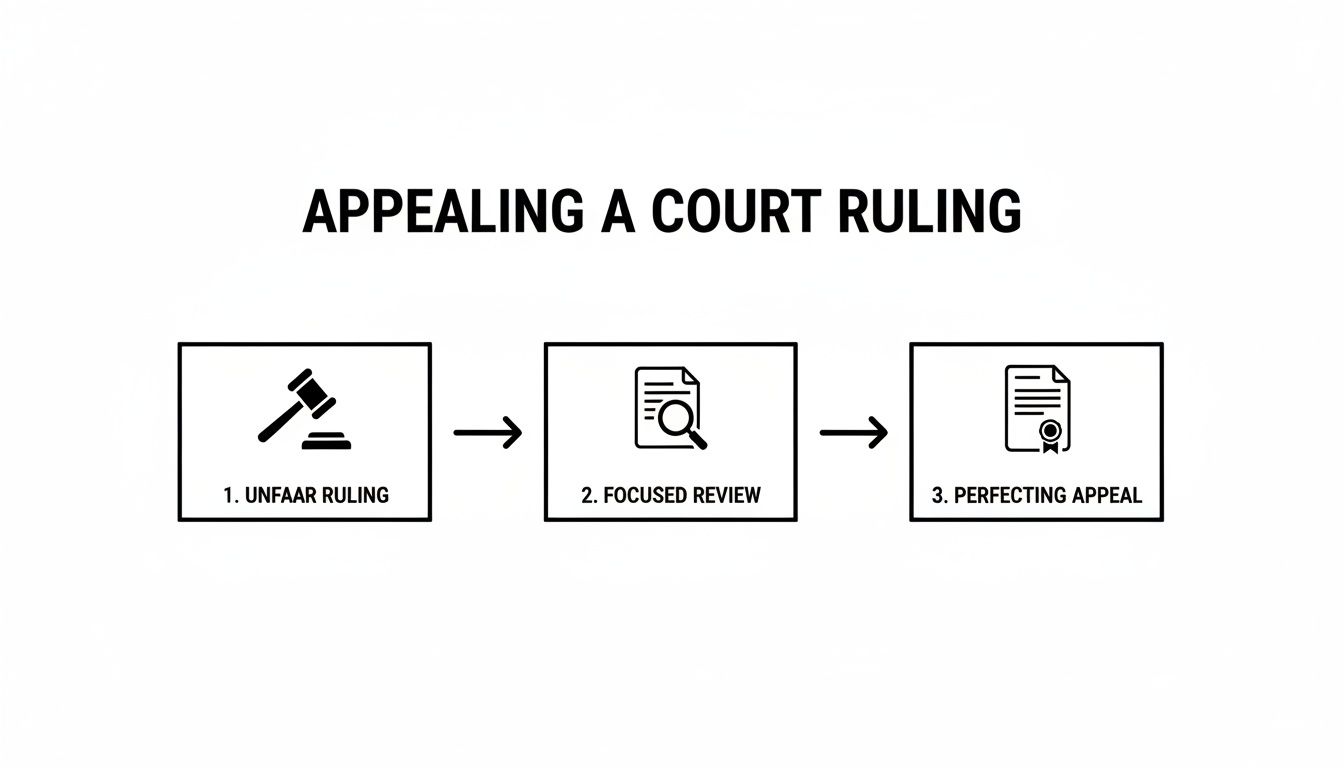
Perfecting an appeal is a meticulous process, but it all hinges on getting these initial moves right.
The Unforgiving Clock: Navigating Your First Deadlines
In the world of Texas appeals, deadlines are not suggestions—they are absolute. The Texas Rules of Appellate Procedure give you a standard window of just 30 days from the day the judgment is signed to file your Notice of Appeal. This simple document officially puts the courts on notice that you are challenging the decision.
Miss that 30-day deadline, and your right to appeal is almost certainly lost forever. It doesn't matter how strong your case is or how wrong the judge was.
There is, however, a crucial strategic tool that can extend this timeline. By filing a post-judgment motion, such as a Motion for New Trial, within that initial 30-day window, you extend your deadline for the Notice of Appeal to 90 days from the date the judgment was signed. While trial judges rarely grant these motions, filing one is standard practice to secure the extra time needed to properly prepare for the appeal.
A Word of Warning: These deadlines are jurisdictional. This is a legal term meaning that if you're even one day late, the court of appeals loses the authority to hear your case. There are very few exceptions, so treating these dates as immovable is non-negotiable.
What Can You Actually Appeal?
A common point of confusion is figuring out which court orders are fair game for an appeal. The key is to look for a “final judgment.” You generally cannot appeal orders made in the middle of a case (known as "interlocutory orders").
In Texas family law, a final judgment is an order that resolves all the issues for everyone involved and is clearly intended to be the court's last word on the matter.
- Appealable: A Final Decree of Divorce that divides your entire estate and sets a final possession schedule for your children is a classic example of a final, appealable order.
- Not Appealable: Temporary orders for child support or a temporary living arrangement signed months before the final trial are interlocutory and typically cannot be appealed.
The distinction is critical. Wasting time and money trying to appeal a non-final order will get you nowhere, all while the clock is ticking on your right to appeal the actual final judgment.
The Most Important Phone Call You Can Make
With such rigid deadlines and procedural traps, the single most critical first step is to contact an appellate lawyer immediately. An attorney who specializes in appeals can look at your order, determine if it's final and appealable, calculate your exact deadline, and ensure the right documents get filed on time. Delaying this call is the easiest way to lose your right to appeal. For a closer look at that first filing, you can learn more about how to file a Notice of Appeal in our detailed article.
Building Your Case From the Court Record

The first thing to understand about a Texas family court appeal is that it’s not a second trial. You don’t get to present new evidence or have witnesses re-tell their stories. Instead, the appellate court acts as a referee, reviewing the game that has already been played.
And what are they reviewing? Only one thing: the official court record. This record is the entire universe of your appeal. Every argument you make and every mistake you point out must be found within its pages. The art of perfecting an appeal in Texas family court is all about mastering this record.
The Two Pillars of Your Appeal
Your appellate case rests on two crucial pillars. Think of them as the "paper" and the "dialogue" of your original trial. Obtaining these two components is one of the very first, and most critical, steps.
- The Clerk’s Record: This is the complete collection of every document filed in your case. It includes the initial petition, all motions and responses, discovery documents, and the final order you're appealing. It’s the official paper trail of your case.
- The Reporter’s Record: This is the word-for-word transcript of everything said in open court. It captures witness testimony, arguments between lawyers, and—most importantly—the judge’s live rulings and comments from the bench. This is often where the most powerful evidence of judicial error is found.
These records aren’t created automatically. After filing your Notice of Appeal, your attorney must formally request them in writing from the trial court clerk and the court reporter. This is a mandatory step with associated preparation fees.
From Paperwork to a Powerful Argument
Once those records arrive, the real work begins. This is where an appellate attorney becomes a detective, meticulously combing through every page looking for reversible error. This isn't a quick read-through; it's a forensic examination. We are searching for specific moments where the trial judge misapplied the law, violated a procedural rule, or abused their discretion.
For instance, say you believe the judge disregarded expert testimony about your spouse hiding assets in a complex property division dispute. The Reporter’s Record would contain the expert’s full testimony, and the judge’s comments might reveal they ignored it without a valid legal reason. That is a potential reversible error.
Or perhaps in a custody modification, the judge refused to let your key witness testify. The transcript would show your attorney’s attempt to call the witness and the judge’s denial, which could be an abuse of discretion.
The record is the battlefield. An appeal is won or lost based on what is—and is not—contained within the Clerk’s and Reporter’s Records. Any argument made that cannot be tied directly back to these documents will be completely disregarded by the court of appeals.
When we write the appellate brief, it will be filled with citations like "(C.R. at 45)" or "(R.R. Vol. II at 112)". These act like footnotes, pointing the appellate judges to the exact line in the record that proves your point. This is how a gut feeling of injustice becomes a structured legal argument that can overturn a bad ruling. For a closer look at how these facts are presented, our guide on how to write a statement of facts provides valuable insight.
Understanding the Standard of Review
When a family court judge issues a ruling that feels fundamentally unfair, the natural impulse is to want a do-over. It's an understandable reaction, but it’s based on a common misconception about what an appeal actually is. An appeal is not a retrial; it's a specific legal challenge focused on proving the trial court made a significant, harmful mistake.
This is what lawyers call reversible error. A reversible error is a blunder so critical that it likely steered the case to the wrong conclusion. Perfecting an appeal in a Texas family court is all about finding that error in the official record and building a powerful legal argument that it corrupted the final judgment.
What is the "Standard of Review"?
The appeals court does not put your case under a microscope and start from scratch. Instead, it examines the trial judge's decisions through a specific legal filter known as the standard of review. This standard determines how much respect, or deference, the appellate justices must give to the original decision.
In the vast majority of Texas family law appeals, from contentious child custody disputes to complex property division cases, that standard is abuse of discretion.
To win on an abuse of discretion standard, you cannot just argue that the appellate court would have made a different choice. You have to prove the trial judge acted unreasonably, arbitrarily, or completely without reference to guiding legal rules and principles.
In plain English, an "abuse of discretion" means the judge didn't just get it wrong; they made a decision outside the bounds of reasonable disagreement. It means their decision was so arbitrary that it amounts to a clear and prejudicial error of law.
For instance, the Texas Family Code gives judges a list of factors to consider when deciding what's in a child's best interest. If a judge ignores those factors and instead bases a custody ruling on a personal bias—like a parent's non-traditional job or religious views—that’s a strong candidate for an abuse of discretion.
What Is a Reversible Error in Practice?
An error only matters if it's "reversible," meaning the mistake actually had a harmful effect on the outcome. A typo in the final decree is an error, but it's a harmless one the court can easily fix. It won't get the judgment overturned. A reversible error is different; it's a mistake that likely caused the judge to issue an improper judgment.
From my experience, here are a few common examples of what reversible error can look like in a Texas family court:
- Misapplication of the Law: The judge incorrectly labels a significant inheritance you received as community property, causing it to be unfairly divided with your ex-spouse.
- Improper Exclusion of Evidence: Your attorney attempts to present bank statements showing your spouse was hiding assets, but the judge wrongly refuses to allow the evidence to be considered.
- Ignoring Statutory Factors: In a spousal maintenance case, the judge orders you to pay an exorbitant amount without properly weighing all the legally required factors, like your own ability to meet your minimum reasonable needs.
- Procedural Errors: The court never sent you proper notice for the final trial, which prevented you from showing up to present your side of the story.
To truly grasp the shift in focus required for an appeal, it’s helpful to see how the two court levels differ.
Trial vs. Appeal: A Fundamental Comparison
The following table breaks down the essential differences between a trial and an appeal. Understanding this distinction is the first step in building a successful appellate strategy.
| Aspect | Trial Court | Appellate Court |
|---|---|---|
| Purpose | To hear evidence, determine facts, and apply the law to those facts. | To review the trial record for legal errors that harmed the outcome. |
| Focus | Witness testimony, new evidence, and factual disputes. | The existing record, legal arguments, and procedural rules. |
| Decision-Maker | A single trial judge or a jury. | A panel of three or more appellate justices. |
| Key Question | "What happened and who should win based on the evidence?" | "Did the trial court make a reversible error in its legal reasoning or procedure?" |
As you can see, the entire game changes on appeal. Success demands a fundamental shift in mindset—from telling a personal story to proving a technical, legal mistake.
If you believe the court made a mistake in your family law case, our appellate attorneys can help you seek a fair outcome. Contact The Law Office of Bryan Fagan today for a free consultation.
Crafting Your Most Powerful Weapon: The Appellate Brief

After gathering records and identifying legal errors, we arrive at the main event: writing the appellate brief. This document is the single most important piece of your entire appeal. It is the formal, written argument where your attorney lays out your case for the appellate justices.
A brief is where legal strategy and persuasive writing come together. It is not a place to vent or complain that the judge was unfair. Instead, it’s a disciplined, logical argument that connects the facts from the record to the precise legal error the trial judge made. This process is known as briefing. Most appeals are won or lost on the briefs alone.
The Anatomy of a Winning Brief
An appellate brief is a highly technical document that must follow the strict formatting and content rules of the Texas Rules of Appellate Procedure. A well-written brief must:
- Tell a Cohesive Story: We start with a Statement of the Case that presents the facts as a clear narrative, guiding the court to see the injustice that took place.
- Frame the Legal Questions: We define the specific issues for the court, phrasing them to zero in on the trial court's mistakes.
- Build the Argument: This is the heart of the brief. Here, we present our legal analysis, cite relevant statutes and past cases, and link every point directly to evidence in the record.
- Demonstrate Harm: It’s not enough to show the judge made a mistake. We must prove that the mistake was harmful and actually led to the wrong outcome.
Every single claim must be backed up by a citation pointing to the exact page in the Clerk’s Record or Reporter’s Record. This shows the appellate court that our arguments are built on a solid foundation of fact.
An appellate brief is a work of precision. It is designed to isolate and expose a specific legal error with undeniable proof from the trial record. It transforms a feeling of being wronged into a powerful, logical argument for justice.
Making Your Case Undeniable: The Appendix
To give our arguments maximum impact, we also compile an Appendix to the brief. Think of this as a curated highlight reel of your most critical evidence. Instead of just referring the justices to "page 734 of the Reporter's Record," we physically put that crucial piece of testimony or that key document right in front of them. This strategy makes it easy for the justices to see the evidence for themselves, making an argument crystal clear and incredibly persuasive. You can learn more about the appellate brief and its components in our detailed guide.
The Final Conversation: Preparing for Oral Argument
While many cases are decided "on the briefs" without a hearing, some are set for oral argument. This is a formal Q&A session, usually lasting about 20 minutes per side, where attorneys appear before the panel of justices. This isn't a do-over of the trial. Oral argument is the court's chance to ask tough questions and get clarity on confusing points of law. Preparing for it is intense and is the final opportunity to speak directly to the decision-makers and leave them with the conviction that your case deserves to be reversed.
Why Appellate Law Is a Specialized Field
After a grueling family court battle, it’s natural to want your trusted trial lawyer to handle the appeal. But thinking of an appeal as just the next round in the same fight is a critical mistake. Appellate law isn’t just another part of the legal process; it’s a completely different discipline. It operates in its own world, governed by the dense and unforgiving Texas Rules of Appellate Procedure.
The Different Skillset of an Appellate Attorney
Think of it this way: a trial lawyer is a frontline surgeon, making split-second decisions in the courtroom. An appellate lawyer, on the other hand, is a forensic specialist working in the lab. Their job is to meticulously analyze the cold, written record of what happened at trial. They aren't re-trying the facts; they're hunting for specific, technical legal errors.
This requires an entirely different set of skills:
- Procedural Perfection: An appellate attorney lives and breathes by a calendar of rigid deadlines. One missed deadline or procedural misstep can get your entire appeal thrown out.
- Deep Scholarly Argument: Success on appeal hinges almost entirely on persuasive legal writing in the appellate brief. This involves deep dives into case law and statutes.
- Finding the Needle in the Haystack: An experienced appellate lawyer sifts through thousands of pages of the Clerk's and Reporter's Records, looking for that one crucial reversible error.
- Strategic Framing: The argument must be framed under the correct “standard of review.” For many family law decisions, this is abuse of discretion, a high bar that requires showing the trial judge acted unreasonably or without reference to guiding legal principles.
The entire appellate process is a minefield of technical requirements. Your best chance at a just outcome depends on having a true appellate expert in your corner who can translate the profound sense of unfairness you feel from a divorce or child custody order into a precise, technical argument.
If you believe the court made a mistake in your family law case, our appellate attorneys can help you seek a fair outcome. Contact The Law Office of Bryan Fagan today for a free consultation.
Common Questions About Texas Family Court Appeals
Once a trial court judge issues a final order, it’s natural to have pressing questions about what comes next, especially if you feel the outcome was wrong. Let's walk through some of the most common concerns clients have when they start thinking about an appeal.
How Long Is This Actually Going to Take?
I'll be upfront: appealing a family court order is not a fast process. You need to be prepared for the long haul. A typical appeal, from the moment you file the notice until you get a final decision, often takes a year or even longer.
This timeline isn't just dead waiting time. It includes the painstaking process of getting the official court records prepared, the back-and-forth of legal briefing where both sides make their written arguments, and then waiting for the panel of appellate justices to thoroughly review everything and write their opinion.
What Are My Real Odds of Winning an Appeal?
This is the million-dollar question, and the honest answer is that winning an appeal is statistically tough. Success isn't about luck or hoping for a more sympathetic judge; it hinges entirely on proving the trial court made a specific, significant legal mistake known as a "reversible error."
An experienced appellate lawyer’s first job is to comb through your case record to see if such an error exists and, just as importantly, if it was harmful enough to have changed the outcome. This detailed analysis gives you a realistic assessment of your chances before you invest the time and money.
Key Insight: An appeal is not a do-over. It's a highly focused legal challenge designed to prove the trial judge made a critical mistake that affected the final result of your case.
Can I Bring in New Evidence or Witnesses?
This is a point of confusion for many, and the answer is a firm no. An appeal is strictly a review of what has already happened in the trial court. The appellate judges are limited to examining the official record—nothing more.
That record consists of the Clerk’s Record (all the documents filed in your case) and the Reporter’s Record (the word-for-word transcript of the hearings and trial). You can't introduce new documents, call new witnesses, or present facts that weren't part of the original trial. The appellate court is essentially reviewing the game tape, not putting new players on the field.
What Does a Family Law Appeal Cost in Texas?
The financial investment for an appeal has a few key components: court filing fees, the often substantial cost of preparing the official records, and of course, the attorney's fees for managing this complex legal journey. Preparing the reporter's record, in particular, can be a major expense.
To create financial certainty, many appellate attorneys, including our firm, handle these cases on a flat-fee basis. This approach ensures you know the full cost upfront without worrying about unpredictable hourly billing. A transparent discussion about every potential cost is a critical part of any initial consultation.
If you believe the court made a mistake in your family law case, our appellate attorneys can help you seek a fair outcome. Contact The Law Office of Bryan Fagan today for a free consultation.