
You may feel your Texas family law case was handled unfairly. When a judge signs a final order that seems unjust, it's easy to believe the fight is over and you’ve lost. But that is not always the final word. Texas law provides a powerful tool to challenge a ruling you believe is wrong: the motion for new trial.
This motion is a formal request asking the same judge who made the decision to take a second look, review a critical error, and restore fairness before the judgment becomes permanent. It is your first step in seeking justice through the appellate process.
Your First Step Toward Correcting an Unfair Ruling
The moments after a final order is signed in your divorce, child custody, or property division case can be deeply frustrating. Perhaps you feel the judge ignored crucial evidence, misinterpreted the law, or reached a conclusion that defies fairness and due process. You have an immediate path forward to seek a fair outcome.

That path begins with a Motion for New Trial. It's a strategic legal filing submitted in the same court that issued the order, designed to correct significant mistakes quickly and efficiently, without the immediate need for a full-blown appeal.
Understanding the Motion's Dual Purpose
A Motion for New Trial is more than a simple request; it serves two vital functions in appellate procedure. Understanding these is crucial for protecting your rights.
- A Chance to Correct the Record: First, it gives the trial judge an opportunity to reconsider and fix their own mistakes. This motion allows them to correct a flawed child support calculation or an unfair property valuation without the time and expense of an appeal. It is often the fastest way to achieve a just result.
- Preserving Your Right to Appeal: Second, filing this motion is often a mandatory step to argue certain types of errors to a higher court. This process is called "preserving error"—creating a formal record of your complaint. Without it, you may permanently lose the right to have an appellate court review some of the most significant mistakes made in your case.
Essentially, you're putting the trial court on notice that a serious legal error may have occurred, giving it a chance to restore balance before a higher court must intervene.
This guide explains the procedure for a motion for new trial, from strict deadlines and valid grounds to its role in your overall appellate strategy. Whether you're challenging an unjust protective order or a lopsided divorce decree, understanding this motion is key to pursuing justice.
What Is a Motion for New Trial in Texas Family Law
When a final order in your family law case seems fundamentally wrong, your first step is often not a direct appeal but a motion for new trial in Texas family law.
This is not a request for a simple "do-over" because you are unhappy with the outcome. Instead, it’s a focused legal tool that identifies a specific, serious error that occurred during your case. It asks the judge who made the ruling to review the decision and correct it based on the law and evidence presented.
Plain English Definition: What is a Reversible Error?
A reversible error is a legal mistake made by the trial court that is significant enough to have likely caused an improper judgment. It's not a minor procedural issue; it's an error that harmed the fairness of the outcome. Identifying these is the core of appellate advocacy.
Why File This Motion? Two Critical Reasons
This motion is a cornerstone of appellate strategy because it accomplishes two vital goals.
- It gives the trial judge a chance to fix their own mistakes. A judge may have miscalculated a child support obligation or incorrectly applied the law to a business valuation in your divorce. This motion allows the judge to correct that mistake efficiently, saving the time and expense of an appeal.
- It preserves your right to appeal certain issues. For many types of errors, the Texas Rules of Appellate Procedure require you to first raise the issue with the trial judge in a motion for new trial. If you skip this step, you legally waive your right to complain about it to the Court of Appeals.
The Clock is Ticking: Key Deadlines and Concepts
The moment a judge signs the Final Judgment, several critical clocks start. The most important for this motion is the 30-day deadline. You must file your motion for new trial within 30 days of the judgment being signed. This deadline is absolute.
Filing the motion on time extends the trial court's plenary power. This is the judge's authority to change the judgment. Normally, this power ends 30 days after the judgment is signed. A timely-filed motion for new trial extends this power, giving the judge more time to consider your arguments and grant a new trial.
Other deadlines run at the same time. For instance, the deadline to request Findings of Fact and Conclusions of Law (the judge’s written explanation for the decision) is 20 days from the judgment. These post-trial steps are critical to a successful Texas family law appeal on Draperfirm.com.
A Motion for New Trial serves as a formal checkpoint, asking the trial court to confirm its ruling is correct based on the evidence and law. This step ensures due process by providing a way to fix errors at the source, preserving your ability to seek justice through an appeal if needed.
The 30-Day Countdown: Your Absolute Deadline for a Motion for New Trial
Once a judge signs the final judgment in your family law case, you have an extremely short and unforgiving window to challenge the outcome at the trial court level. The most important deadline is for filing a motion for new trial, and it is absolute.
Under the Texas Rules of Civil Procedure, you must file this motion within 30 days of the date the judge signed the final judgment. This is a strict rule. If you miss this deadline, your chance to ask the trial judge to correct their own mistakes is almost certainly lost.
Understanding the Court's "Plenary Power"
This 30-day window is tied directly to the trial court's plenary power—its official authority to modify, correct, or vacate its own judgment. In most cases, a trial court's plenary power ends 30 days after it signs a final judgment. Once that power is gone, the judge can no longer make substantive changes to the order.
Filing a Motion for New Trial on time is the only way to keep that window of opportunity open. A timely motion automatically extends the court’s plenary power, usually giving the judge up to 75 days from the judgment date to hold a hearing and rule on the motion. This extension is what provides the time needed to get back before the judge and argue for a second look.
This timeline shows how these deadlines interact and why that first 30-day mark is so critical.
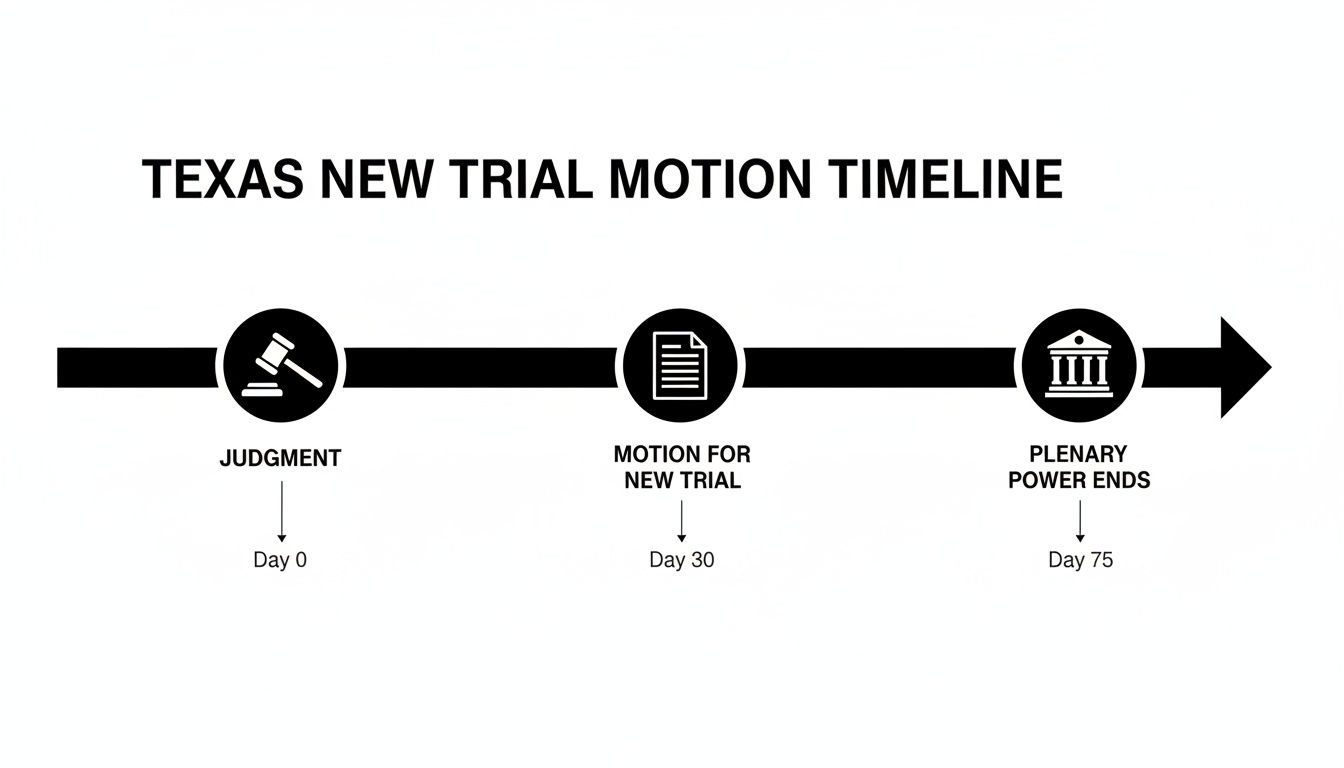
Filing the motion is the key event that extends the court’s power, giving you a chance to seek a fair outcome before the judgment becomes final.
To help you keep track, this table outlines the critical timelines for filing a Motion for New Trial and related post-judgment actions under the Texas Rules of Appellate Procedure.
Key Post-Judgment Deadlines in Texas Family Law
| Action | Deadline After Final Judgment is Signed | Governing Rule |
|---|---|---|
| File Motion for New Trial | 30 days | Texas Rule of Civil Procedure 329b(a) |
| Trial Court Rules on Motion | 75 days | Texas Rule of Civil Procedure 329b(c) |
| Motion Overruled by Operation of Law | 75 days (if no ruling is made) | Texas Rule of Civil Procedure 329b(c) |
| Notice of Appeal (with MNT) | 90 days | Texas Rule of Appellate Procedure 26.1(a)(1) |
| Notice of Appeal (no MNT) | 30 days | Texas Rule of Appellate Procedure 26.1(a) |
These deadlines are unforgiving. Missing one can have severe consequences for your ability to appeal.
What Happens If You Miss the 30-Day Deadline?
The consequences of missing the 30-day deadline are severe. You not only lose the ability to ask the trial judge for a new trial, but you also shorten your timeline for filing an appeal from 90 days to just 30 days.
Critically, failing to file a motion for new trial can mean you waive—or give up the right to make—some of the most powerful arguments on appeal. For instance, you generally cannot argue to an appellate court that the evidence was factually insufficient unless you first raised that complaint in a motion for new trial.
Missing the 30-day filing deadline is often a fatal blow to your ability to challenge an unjust outcome. This is why you must contact an appellate lawyer the moment you receive a disappointing ruling. Every day that passes is a day you cannot get back.
Valid Grounds for Requesting a New Trial
A motion for new trial Texas family law is not for simply disagreeing with the outcome. It is a strategic tool for situations where a significant legal error has undermined a just result.
You must present a specific, legally recognized reason, or "ground," that shows the trial was fundamentally flawed. Understanding these common reversible errors is the first step in evaluating your case for an appeal.

Newly Discovered Evidence
One of the most compelling reasons for a new trial is uncovering crucial evidence after the judge has ruled. This is not for evidence you forgot to present. It must be something you could not have reasonably found before the final order was signed.
To succeed with this argument, we must show the court four things:
- The evidence was discovered after the trial.
- You were not at fault for not finding it sooner (you exercised "diligence").
- The evidence is material and not just cumulative of what was already presented.
- The new evidence is significant enough that it would likely lead to a different result.
An example in a divorce is discovering financial records that prove an ex-spouse was hiding assets during the property division. This can be grounds for a new trial to ensure a just and right division.
Verdict Against the Great Weight of the Evidence
Here, you argue that the judge's decision is so contrary to the overwhelming weight of the evidence that it is clearly wrong and unjust. It is not enough that some evidence supported the other side; you must show the evidence in your favor was far stronger.
For instance, in a child custody case, if multiple professionals testify that your child is thriving with you, but the judge severely limits your possession based on your ex-spouse's unsupported claims, that may be a decision against the great weight of the evidence.
Plain English Definition: What is Abuse of Discretion?
Abuse of discretion is a legal standard of review used in appeals. It means the trial court acted without reference to any guiding rules or principles—in other words, the decision was arbitrary or unreasonable. This is a high standard to meet, but it is a common ground for reversal in family law appeals.
A Reversible Error of Law by the Judge
Judges are human, and they can make legal mistakes. When a judge misapplies the Texas Family Code or other laws in a way that harms your case, it can be a reversible error and grounds for a new trial.
Common examples in family law include:
- Miscalculating Child Support: Using incorrect income figures or failing to apply the statutory formula correctly.
- Improperly Admitting or Excluding Evidence: Allowing prejudicial testimony or refusing to consider a key financial document, which impacted the outcome.
- Mischaracterizing Property: Incorrectly labeling a spouse's separate property as community property, leading to an unfair division of assets.
Misconduct That Harmed the Case
Our justice system depends on fairness. If misconduct by a juror, the opposing party, or an attorney sabotaged your right to a fair trial, you may be entitled to a new one. This could include a party intentionally hiding documents, a juror doing outside research, or an attorney making improper, inflammatory statements.
Building a strong argument requires deep legal research and analysis. Strategies for Maximizing Efficiency in Legal Research are crucial for success. Identifying valid grounds is about ensuring the final judgment is truly just.
Choosing Between a Motion for New Trial and an Appeal
When a judge’s final order feels profoundly unfair, you are at a critical crossroads. The two main paths forward are filing a Motion for New Trial or proceeding directly to an appeal. While both challenge the court's decision, they are different tools used in different forums and follow different procedural rules.
A Motion for New Trial is a formal request to the same judge who just ruled against you, asking them to reconsider and correct a serious error. It is an opportunity to fix a mistake at the trial court level.
An appeal, on the other hand, moves the case to a higher court—the Court of Appeals. You are not asking for a new trial. Instead, you are arguing that the trial judge made a legal error that led to an improper judgment. The appellate justices review the written record to determine if the law was applied correctly.
Plain English Definition: What is a Standard of Review?
The standard of review is the level of deference an appellate court gives to the trial court's decision. For example, an "abuse of discretion" standard is very deferential, meaning the appeal court will only reverse if the trial judge's decision was clearly arbitrary. A "de novo" standard means the appeal court looks at the legal issue fresh, with no deference. Understanding the standard of review is key to appellate strategy.
When Is a Motion for New Trial the Right Choice?
In almost every Texas family law case where an appeal is considered, filing a Motion for New Trial is the correct first step. It is often a legal necessity.
For certain arguments, such as challenging the factual sufficiency of the evidence, you must raise the issue in a Motion for New Trial. If you skip this step, you lose the right to make that argument on appeal forever.
This motion is especially effective when the mistake is clear and correctable, such as:
- Obvious factual errors, like a child support calculation based on the wrong income.
- Newly discovered evidence, like uncovering hidden assets after a divorce is finalized.
- Clear legal mistakes, where the judge misapplied a specific statute.
Presenting these issues gives the judge a quick, efficient path to fix the problem, restoring balance without the significant time and expense of an appeal. A Motion for New Trial also extends your deadline to file a notice of appeal from 30 to 90 days.
Comparing Your Post-Judgment Options
This table compares the main features of a Motion for New Trial and a direct appeal, highlighting how appeals differ from trials.
Motion for New Trial vs. Direct Appeal
| Feature | Motion for New Trial | Direct Appeal |
|---|---|---|
| Court | Filed with the same trial court that issued the judgment. | Filed with a higher court (the Court of Appeals). |
| Decision-Maker | The original trial judge. | A panel of appellate justices. |
| Purpose | Asks the judge to correct their own errors; can introduce new evidence. | Asks the higher court to review the trial record for legal errors. No new evidence is allowed. |
| Key Deadline | Must be filed within 30 days of the judgment. | Notice of Appeal must be filed within 30 days (or 90 days if a Motion for New Trial was filed). |
| Strategic Value | Preserves certain errors for appeal; can be faster and less costly. | A comprehensive review of the case for reversible errors of law based on the established record. |
These two paths are sequential parts of a larger appellate strategy. The Motion for New Trial is the gateway to a stronger appeal. It helps perfect the trial court record, giving the appellate court a clearer picture of the errors that occurred. Learn more in our guide on the Texas family law appeal process.
How Our Appellate Attorneys Can Help You Seek Justice
When a family court ruling feels like a profound mistake, it is easy to feel powerless. However, a trial court's decision is not always the final word. You need a lawyer who understands the unique, technical world of Texas appellate procedure.
Filing a motion for new trial in Texas family law is a complex, time-sensitive legal action that depends on identifying specific, reversible errors. At The Law Office of Bryan Fagan, our experienced appellate team knows how to build a case for a second chance at justice.
A Forensic Review of Your Case
Our first step is to conduct a forensic review of the entire trial record, including transcripts, exhibits, and court filings. We search for the critical mistakes that could have led to an unfair outcome.
We often find grounds for a new trial in areas such as:
- The judge misapplying the Texas Family Code, leading to an incorrect property division or child support award.
- Key evidence being improperly excluded or ignored.
- A ruling made with little to no supporting evidence, which can constitute an abuse of discretion.
Building Arguments That Resonate with Judges
A motion for new trial requires persuading the same judge who made the original ruling to reconsider. This calls for advocacy that is respectful, clear, and grounded in solid legal reasoning.
We construct a compelling argument that calmly shows the judge where the legal error occurred and why it led to an unjust result, providing a well-supported path to correct the mistake. Our dedicated family law appeal attorneys are skilled in handling these complex situations.
Our goal is not to re-litigate the entire case. It is to surgically highlight the legal errors that prevented a fair outcome. We focus on due process and fundamental fairness, using precise legal arguments to restore balance.
The deadlines for these motions are strict. If you believe your case was decided on a mistake of law or fact, let our team review the record. We can help you understand your options and fight for the just result you and your family deserve.
Frequently Asked Questions About a Motion for New Trial
After a judge signs a final order in a family law case, many practical questions arise about your options. Here are plain-English answers to common questions about filing a motion for new trial.
Understanding what this motion does, what it costs, and what happens next will help you make the best decision for your family.
Can We Introduce New Evidence with This Motion?
Yes, but only under strict conditions. A motion for new trial is not a chance to bring in evidence you forgot. You can only introduce "newly discovered" evidence.
This means you must prove two things: first, that you could not have found the evidence before the trial ended, even with diligent effort. Second, you must show this new information is a game-changer that would have likely led to a different result. A classic example is uncovering hidden bank statements that prove an ex-spouse lied about assets during a divorce.
Is the Old Court Order Enforceable While the Motion is Pending?
Yes. The moment a judge signs a final judgment, it becomes a legally binding order. Filing a motion for new trial does not automatically freeze it. You must continue to follow all its terms, including child support payments and possession schedules. If the judge grants your motion, the old judgment is vacated, but until then, the existing order remains in effect.
Plain English Definition: What is Briefing?
Briefing is the process of writing the formal legal arguments submitted to an appellate court. An "appellate brief" is a detailed document that outlines the facts of the case, identifies the trial court's errors, and uses statutes and prior case law to argue why the decision should be reversed.
What Happens if the Judge Doesn't Rule on the Motion?
Under the Texas Rules of Appellate Procedure, a judge has 75 days from the date the judgment was signed to rule on a timely filed motion for new trial. If that window closes without a decision, your motion is automatically denied. This is called being "overruled by operation of law." This is a critical date, as it triggers the deadline to file your notice of appeal.
What if I Can't Afford a Full New Trial?
Filing a motion for new trial does not commit you to the expense of a second trial. Several outcomes are possible:
- You reach a settlement. Filing the motion can bring the other party back to the negotiating table.
- The judge orders a partial retrial. The judge might limit a new trial to one specific issue, like the value of a business, rather than re-litigating the entire case.
- The motion is denied. If the motion is denied, you and your attorney will then decide if pursuing a formal appeal is the right next step.
Talking through these potential outcomes with your lawyer is the first step toward making a sound strategic decision.
If you believe the court made a mistake in your family law case, our appellate attorneys can help you seek a fair outcome. Contact The Law Office of Bryan Fagan today for a free consultation at https://familylawcourtappeals.com.