Skip to content
You usually have 30 days from the date the judge signs the final order to file a notice of appeal in Texas family court. That deadline can extend to 90 days if a qualifying post-judgment motion is filed on time.
If you're reading this after a divorce decree, custody ruling, support order, or property division decision that feels unfair, you're probably dealing with two problems at once. First, the result itself. Second, the pressure of figuring out whether anything can still be done.
That pressure is real, but there is a path. A Texas family law appeal gives a higher court the chance to review whether the trial court made a legal mistake, committed a procedural error, or abused its discretion. It is not a new trial, and it is not a chance to present fresh witnesses or documents. It is a focused legal review of what already happened in the courtroom.
For many clients, the most important part of that process is timing. The answer to how long do you have to file an appeal in texas family court sounds simple at first, but the strategic part is what often gets missed. In the right case, a post-judgment motion can do more than buy time. It can sharpen the issues, improve the record, and sometimes give the trial judge a chance to correct the problem before a full appeal becomes necessary.
If the ruling has affected your relationship with your child, your financial stability, or your safety, don't ignore the calendar while you decide what to do. Emotional support matters too. Some clients benefit from outside counseling support while they sort through the fallout of litigation, and a resource like Interactive Counselling may be helpful for families trying to process conflict and major transitions.
Feeling the Sting of an Unfair Court Order
A family court ruling can leave you feeling like the judge missed something important. Maybe the parenting schedule doesn't reflect what happened at trial. Maybe the property division seems legally off. Maybe a support order was entered after evidence you believe should have been considered differently.
Those reactions don't automatically mean you have a valid appeal. But they do mean it's worth asking a precise question: Did the court make a reversible legal error?
Appeals are about legal mistakes, not starting over
In plain English, an appeal asks a higher court to review the trial court's work. The appellate court looks at the existing record. That includes the filed documents, admitted exhibits, and hearing or trial transcripts. It does not take new evidence and it does not retry the case.
That distinction matters because many people assume an appeal is another chance to tell their story better. It isn't. A strong appeal identifies where the court applied the wrong law, followed the wrong procedure, excluded important evidence, admitted improper evidence, or reached a ruling outside the range of reasonable judicial decision-making.
Practical rule: If your argument depends on evidence that was never presented to the trial court, that issue usually belongs in a different procedural path, not a direct appeal.
Common family court orders that may be appealed
Texas family appeals often involve final orders such as:
- Divorce decrees involving asset division, debt allocation, or spousal maintenance
- Child custody and visitation orders affecting conservatorship, possession, and access
- Child support rulings where the court may have mishandled the legal framework
- Protective orders with serious personal and legal consequences
- Enforcement and contempt-related rulings where procedure matters as much as substance
When clients contact appellate counsel, they usually want to know whether the judge was wrong. The better question is whether the judge was wrong in a way the appellate court can correct.
A better first move than guessing
What works is getting the signed order, confirming the signing date, and having an appellate lawyer review the record path immediately. What doesn't work is relying on memory of what the judge said in court, assuming the hearing date controls, or waiting to see whether things improve on their own.
That shift matters. Once you know the actual deadline and the kind of error the appellate court can review, the situation becomes more manageable.
Understanding the Standard 30-Day Appeal Deadline
The standard deadline is strict. In Texas family court, the core appeal deadline is typically 30 days after the judge signs the final judgment or order, and there may be a limited 15-day extension in some circumstances, but the ordinary rule remains 30 days from signing, as explained in this Texas family appeal deadline overview.
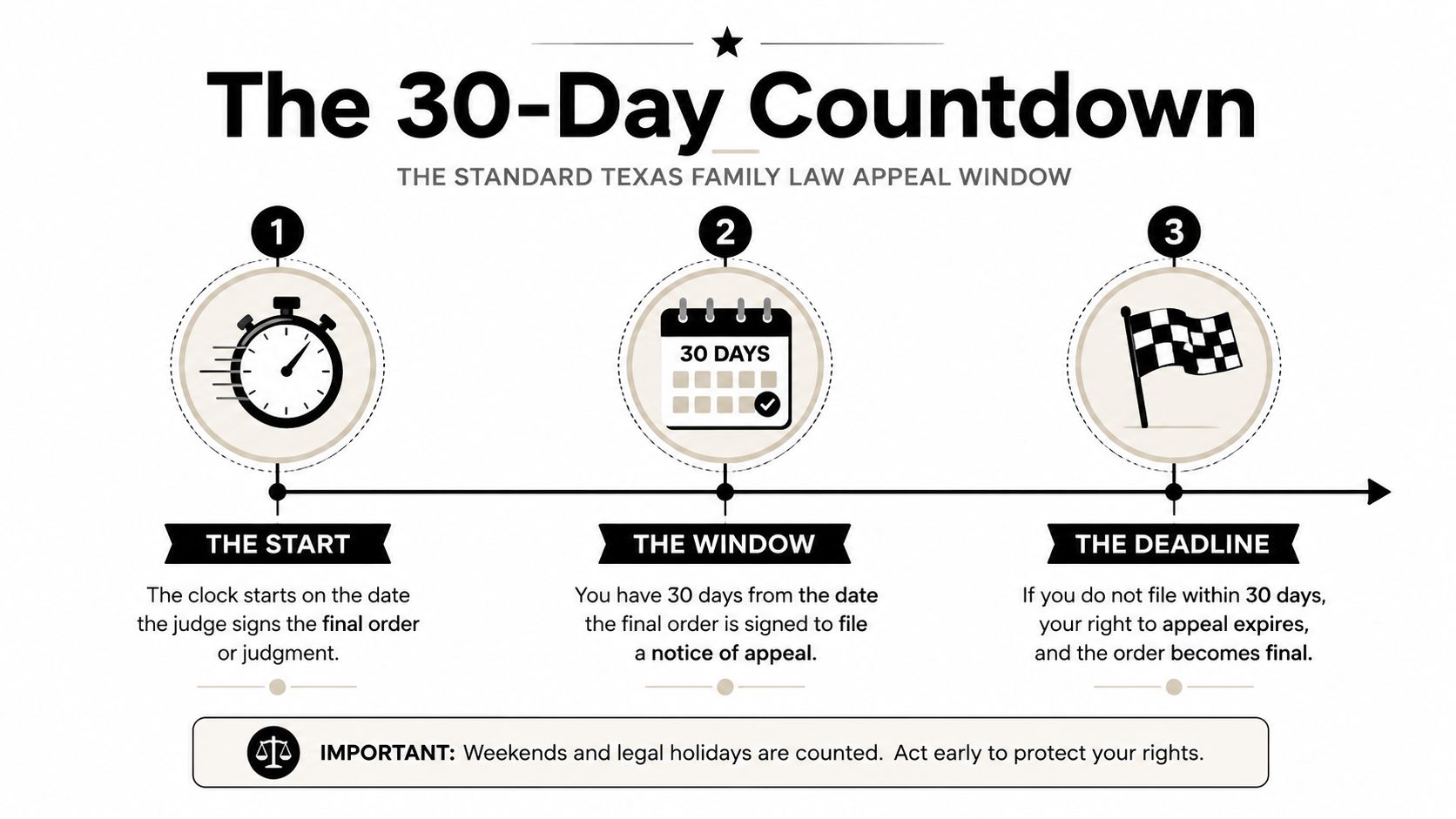
The clock starts when the judge signs
Think of the deadline like a stopwatch. It does not start when the hearing ends. It starts when the judge signs the final order.
That difference causes real problems in practice. A hearing may happen, everyone leaves court, and the written order gets signed later. If you calculate from the hearing date, you may panic too early or, more dangerously, file too late because you never confirmed the actual signing date.
What counts as a final order
A final judgment or final order is the written order that disposes of the issues before the court and is appealable. In family law, that may be a final decree of divorce, a final SAPCR order involving custody and support, or another final signed ruling that ends the case at the trial level.
Temporary rulings often follow different rules. That is one reason it is risky to assume an order is appealable without having counsel review it.
What is a Notice of Appeal
A Notice of Appeal is the document that tells the court and the other side that you are taking the case to the appellate court. It preserves your right to appellate review.
It is short, but it is not optional. If you want a practical overview of that filing step, this guide on how to file a notice of appeal is a useful starting point.
Filing the notice protects the appeal. Building the argument comes after that.
What works and what doesn't
What works:
- Confirm the signing date: Get a file-stamped copy of the final order immediately.
- Treat the deadline as fixed: Put the date on a calendar and work backward.
- Get the transcript process moving: Court reporter timelines can affect the rest of the appeal.
What doesn't:
- Relying on the hearing date
- Assuming oral comments from the judge are the final order
- Waiting for informal clarification from the other side before acting
The appellate timetable rewards early, organized action. It doesn't reward hope.
Extending Your Appeal Deadline to 90 Days
A common call comes in a few days after a divorce decree or custody order is signed. The client wants to appeal, but also wants the trial judge to correct what went wrong. In many Texas family cases, a timely post-judgment motion can do both. It can extend the notice-of-appeal deadline to 90 days and create a better record for the fight ahead.

The strategic value of the 90-day extension
Clients often hear the 90-day rule and treat it like extra calendar space. Used correctly, it is much more than that.
A well-timed post-judgment motion gives counsel time to study the signed order against the evidence, the pleadings, and the court's rulings. That added time can help identify the strongest appellate issues, decide whether findings of fact are needed, and determine whether the trial court can still fix the problem before the case moves to the court of appeals.
Sometimes the best result is not a full appeal. If the judge corrects a drafting error, revises an unsupported provision, or clarifies the basis for the ruling, the appeal may narrow substantially. In some cases, it may no longer be necessary.
That is a practical advantage, not a technical one.
Which motions can extend the deadline
Several post-judgment filings may extend the deadline if they are timely and appropriate to the case:
- Motion for New Trial: Asks the trial court to set aside the judgment and try the case again because of a significant legal or factual problem.
- Motion to Modify Judgment: Asks the court to change a specific part of the judgment without starting over from scratch.
- Request for Findings of Fact and Conclusions of Law: Asks the judge to state the factual and legal basis for the ruling, which can sharpen the issues for appellate review.
The choice is strategic. A motion for new trial may be the right call when the complaint goes to the heart of the result. A motion to modify may fit better when the error is narrower and can be corrected directly in the judgment. Findings can be especially useful when the order leaves too much guesswork about why the court ruled the way it did.
The trade-offs clients need to understand
Filing one of these motions just to get extra time is a mistake. Trial judges recognize boilerplate quickly, and a weak motion can lock you into bad positions or distract from the issues that matter.
Good post-judgment practice is targeted. It should identify the harmful ruling, tie that ruling to the record, and ask for relief that matches the problem. In a custody case, that may mean showing why a discretionary decision is not supported by the evidence the court heard. In a property division case, it may mean isolating a legal error in classification, valuation, or the wording of the decree.
There is also a preservation question. Some complaints become stronger when they are presented first to the trial court in a focused motion. Others do not. The right filing depends on the order, the record, and what relief still makes sense after judgment.
A strong post-judgment motion can buy time, sharpen the appellate issues, and sometimes fix the problem before the appeal becomes more expensive.
If you are weighing that step, this guide on an extension of time to file appeal in Texas family law explains how the deadline extension fits into the larger appellate process.
When Appeal Deadlines Are Shorter or Longer
A parent who assumes every family case follows the same 30 day calendar can lose appellate rights before the strategy conversation even starts. In Texas family court, the first job is to identify the type of appeal. Only then can you decide whether a post-judgment motion buys useful time, helps build the record, or does neither.
Accelerated appeals move on a compressed track
Some family cases are accelerated appeals under the Texas Rules of Appellate Procedure. That often includes parental termination cases and certain DFPS matters. In those cases, the notice of appeal deadline is 20 days.
That timing changes the post-judgment analysis. A Motion for New Trial may still have a purpose. It can preserve complaints, ask the trial court to correct a specific ruling, or frame issues more clearly. It does not extend the notice of appeal deadline in an accelerated case. If counsel treats an accelerated appeal like an ordinary divorce appeal, the notice can be late before the record is even ordered.
That is a hard distinction, and it affects strategy from day one.
Restricted appeals are different, and narrowly available
A restricted appeal gives a longer filing window, up to six months after the judgment is signed, but only for a limited category of cases. Usually, this comes up when a party did not participate in the hearing that led to the judgment, did not timely file certain post-judgment motions or a notice of appeal, and must show error from the face of the record.
The longer deadline does not make this route easier. It makes early case screening more important. If the procedural requirements are not met, the extra time offers no protection. In practice, restricted appeals are won or lost on careful review of the clerk's record, the reporter's record, and the exact procedural history.
Texas family law appeal deadlines at a glance
| Appeal Type | Deadline for Notice of Appeal | Can it be Extended? |
|---|---|---|
| Standard family appeal | 30 days from signed final order | Yes, to 90 days if a qualifying post-judgment motion is timely filed |
| Accelerated appeal | 20 days | No |
| Restricted appeal | Six months | Not in the same way as a standard appeal |
The practical lesson
Clients often ask one simple question: how long do you have to file an appeal in texas family court?
The honest answer depends on what kind of case produced the order. A divorce decree, a SAPCR order, a termination judgment, and a restricted-appeal scenario may all fall under family law, but they do not share one deadline scheme. Early classification of the case is as important as counting days.
This is also where strategic judgment matters. In a standard appeal, a well-grounded post-judgment motion can create time to evaluate issues, improve preservation, and sometimes fix the problem without a full appeal. In an accelerated appeal, that same motion may still be worth filing, but never as a substitute for getting the notice of appeal on file within the shorter deadline.
The Unforgiving Consequence of a Missed Deadline
Texas appellate deadlines are not suggestions. If the notice is not filed on time, the appellate court will usually lack jurisdiction, which means the legal power to hear the appeal.

What jurisdiction means in everyday language
When a court has jurisdiction, it has authority to act. Without it, the judges cannot reach the merits of your complaint, even if your argument might otherwise have been strong.
That is one of the hardest parts of appellate practice for clients to hear. The question may stop being whether the ruling was fair. The question becomes whether the appellate court can review it at all.
Notice problems do not erase the outer limit
There is a narrow rule that can shift certain appellate deadlines if a party did not receive notice or actual knowledge of the signed judgment within 20 days, but the period cannot begin more than 90 days after the judgment is signed, creating a hard outer boundary under Texas appellate procedure, as noted in this Texas appellate notice rule discussion.
That rule helps in limited situations. It is not a strategy to rely on.
What works and what doesn't after a ruling is signed
- Work from the signed order date: That should be your baseline until counsel confirms otherwise.
- Preserve proof of notice issues: If notice was delayed, documentation matters.
- Assume the safer course is immediate action: Texas courts value finality.
What doesn't work is waiting because the result feels obviously wrong. Courts do not give extra time because a ruling had serious consequences. They require compliance with the appellate rules first.
Missing the deadline can end the appeal before the judges ever review the substance of your case.
Your Appeal Is Filed What Happens Next
Once the notice of appeal is on file, the case becomes a record-and-briefing case. That shift catches many family law clients off guard because the next stage is less about telling the court what happened and more about showing, from the existing record, why the trial court committed reversible error.
That is also where earlier strategy starts paying off. A well-timed motion for new trial or other post-judgment motion may have done more than extend the deadline. It may have sharpened objections, clarified the court's reasoning, prompted additional findings, or created a cleaner path for review.
The appellate record
The appellate court decides the case from the record prepared from the trial court. That usually means the clerk's record, which includes pleadings, orders, and filed papers, plus the reporter's record, which contains the testimony and hearing transcripts.
If a complaint was not preserved, or if a key exchange never made it into the record, the appellate court usually cannot use it. In practice, that is why post-judgment motions can matter so much. They sometimes give counsel one more chance to identify a defect, request findings, or frame the issue in a way the appellate court can review.
A strong appeal often begins before the appellate court receives anything.
Briefing
Briefing is where the appeal is won or lost. The brief must do more than say the judge got it wrong. It has to identify the legal issue, point to where the complaint was preserved, cite the controlling law, and explain why the error probably affected the result.
Good briefs are selective. Family cases often generate many frustrations, but appellate courts respond to focused issues tied to the record and the governing standard of review. Part of appellate judgment is deciding which arguments strengthen the case and which ones distract from it.
Standard of review
The standard of review controls how much deference the appellate court gives the trial judge. In family law appeals, abuse of discretion is common, especially in custody, support, and property division disputes.
That standard is demanding. The question is usually not whether another judge could have ruled differently. The question is whether this ruling fell outside the range the law allows on this record.
Some issues get a closer look. Pure legal questions can receive less deference than discretionary calls. That distinction often shapes issue selection from the start.
Enforcement during appeal
Filing an appeal usually does not stop enforcement of the order. If enforcement is an immediate concern, counsel needs to evaluate that problem early and separately from the merits of the appeal. This overview of a supersedeas bond in a Texas family law appeal explains one of the tools that may be available, depending on the order involved.
Common reversible issues in family cases
Appellate courts reverse for legal error that matters to the outcome. In family cases, that often includes:
- Property division errors: mischaracterizing separate property or dividing property on an improper legal basis
- Custody-related legal mistakes: applying the wrong legal standard or failing to make required findings
- Evidentiary rulings that affected the result: excluding admissible evidence or relying on evidence that should not have been considered
- Problems in the final order: signing an order that goes beyond the court's authority or does not match the law
Clients often want to know what this stage looks like in practice and how appellate counsel communicates through it. Reviewing a professional Testimonial page for D Todd Smith can give useful context for what experienced appellate representation often involves.
The Law Office of Bryan Fagan, PLLC is one example of a firm that handles Texas family appeals, including record review, issue selection, and preparation of appellate briefs.
Frequently Asked Questions About Texas Family Court Appeals
Can I introduce new evidence on appeal
Usually, no. Appeals are based on the trial court record. If evidence was never introduced below, the appellate court generally won't consider it.
What does abuse of discretion mean
It means the trial court had room to decide the issue, but the ruling still had to stay within the bounds of reason and law. If no reasonable judge should have made that ruling on that record, that may support appellate relief.
What is briefing
Briefing is the written argument filed in the appellate court. It explains the legal errors, cites the record, and applies the controlling law.
How much does a family law appeal cost
It varies with the size of the record, the number of issues, the need for transcripts, and the complexity of the legal questions. A consultation is the right place to get a case-specific estimate.
Can the original order still be enforced while I appeal
Often, yes. Whether enforcement can be paused depends on the type of order and what additional appellate steps are available.
If you want to understand how experienced appellate lawyers present their work and how clients describe the process, reviewing a professional Testimonial page for D Todd Smith can be a useful way to learn what strong appellate communication looks like.
If you believe the court made a mistake in your family law case, our appellate attorneys can help you seek a fair outcome. Contact The Law Office of Bryan Fagan, PLLC today for a free consultation.