Skip to content
You may feel stunned when the appellate opinion arrives and the result is not what you hoped for. Many parents and spouses read an affirmed decision and immediately think the system never understood what happened in the trial court.
That reaction is normal. Texas family appeals are technical, expensive, and emotionally draining. When you lose, the question usually isn't “Was this fair?” in the everyday sense. The question becomes, “What happens next, what must I do right now, and is there any realistic path still open?”
That's the right place to start with what happens if you lose an appeal in texas family court. A loss on appeal is serious, but it does not mean you should panic, ignore the order, or assume every option has disappeared. It means you need a disciplined plan, fast deadlines, and a clear understanding of what works in appellate practice and what usually does not.
Clients often come to this point after months of briefing, waiting, and hoping the court of appeals would correct what they believe was an unfair custody ruling, support order, or property division. At that moment, good advice matters more than optimistic talk. You need to know what the affirmed judgment means, whether enforcement is about to start, whether rehearing makes sense, and whether a higher court is even likely to look at the case.
If you're still trying to evaluate who should help with that next decision, this guide on how to choose a family law attorney is a useful starting point.
Answering the Difficult News A Guide for What Comes Next
An appellate loss in a family case usually feels personal because the underlying issues are personal. Your parenting time, your support obligations, your home, your retirement, or your safety may all be tied to that judgment. But the next steps are procedural, and procedure now matters as much as emotion.
The first thing to understand is that an appeal is not a new trial. The appellate court reviews the written record from the trial court. It does not hear new witnesses, receive new documents, or decide what arrangement seems fairest based on facts that were never preserved below. That matters after a loss because your remaining options are narrow and deadline-driven.
What the opinion usually means
If the court of appeals affirmed the trial court, the practical message is simple. The original judgment stands unless some further court action changes it. In most cases, daily life now has to adjust to that reality.
That can mean:
- Custody orders control now: pickup times, holiday schedules, exchange locations, and decision-making provisions remain binding.
- Support obligations continue: child support, medical support, or spousal maintenance must be paid as ordered.
- Property terms must be followed: deeds, refinancing steps, account transfers, and turnover obligations can move forward.
- Enforcement risk increases: the other side may decide to act quickly once the appeal is over.
A calm response beats an angry one. The parties who protect themselves after an appellate loss are usually the ones who comply first and analyze second.
What helps and what doesn't
Some post-appeal choices are useful. Others make the situation worse.
| Response | Usually helps | Usually hurts |
|---|---|---|
| Review deadlines immediately | Yes | |
| Keep following the order | Yes | |
| Call appellate counsel quickly | Yes | |
| Stop paying support because “the case isn't over” | Yes | |
| Deny possession or refuse turnover out of frustration | Yes | |
| Assume the Supreme Court will automatically step in | Yes |
You do still have possible next steps. They just have to be measured against real legal standards, not hope alone.
The Immediate Aftermath Judgment Enforcement and Contempt Risks
You read the opinion, see that the judgment was affirmed, and your first instinct is to wait a few days before doing anything. That pause is where many enforcement problems begin. In Texas family cases, the period right after an appellate loss is often less about debating whether the result was fair and more about preventing a bad outcome from turning into a contempt fight.

Once the court of appeals finishes its work and sends the case back, the trial court gets its authority to act on enforcement again. Lawyers often refer to that return of the case as remittitur or mandate, depending on the context and the court. The practical point is the same. The order that was on hold during the appeal is usually back in a posture where the other side can ask the trial court to enforce it.
That matters because affirmance rates in family appeals are high, and prevailing parties often move quickly once the appeal is no longer blocking enforcement. If support is unpaid, possession has been denied, or property transfer steps were ignored during the appeal, those issues can surface fast in a motion for enforcement or motion for contempt.
What this means in practice
Clients sometimes assume a further filing automatically buys more time. It usually does not. Unless a valid stay or supersedeas is in place, the safer working assumption is that the order must be followed now.
For a fuller explanation of that issue, see this discussion of a stay of enforcement pending appeal in Texas.
Practical rule: If the order requires an act, payment, exchange, signature, or turnover, treat it as enforceable unless your lawyer has confirmed a specific legal basis for stopping enforcement.
Where contempt risk shows up fastest
Contempt problems usually start with ordinary violations, not dramatic ones. Common examples include:
- Missing support payments after assuming the appeal bought extra time.
- Refusing possession or delaying exchanges because the result feels wrong.
- Failing to sign deeds, transfer titles, or refinance by the dates set in the decree.
- Ignoring reimbursement, disclosure, or turnover duties that seem minor but are written as clear commands in the order.
In my experience, the strategic question is not just whether the other side can file enforcement. It is whether the order is specific enough for a judge to enforce by contempt, and whether your conduct creates a clean record against you. Some violations lead to money judgments and attorney's fees. Others can expose a party to coercive orders, make-up visitation, license-related consequences, or jail time in the right case.
The smartest first response
Start with documents, not arguments. Pull the appellate opinion, appellate judgment, and every operative trial court order. Then identify each deadline that is still active or about to reactivate, especially support, possession, deed transfers, account turnover, and any injunction-like restrictions.
From there, make a triage plan with counsel. Some obligations should be performed immediately. Others may need clarification before you act. If compliance is impossible, the record should show why, what steps were taken, and what was offered instead. That does not guarantee protection, but it is far better than silence or self-help.
The short-term goal is simple. Avoid giving the other side an easy enforcement case while you evaluate whether any further review is worth the cost and the low odds.
Understanding the High Bar for Reversal in Texas Appeals
A lot of parents and former spouses reach this point expecting the court of appeals to reweigh the testimony and correct what felt plainly wrong at trial. In Texas family cases, that is usually the wrong frame.

Appeals are hard to win because affirmance is more common than reversal, especially where the trial judge had discretion to choose between competing facts, credibility calls, and imperfect options. That matters strategically. A disappointed appellant needs to evaluate the next step based on a realistic chance of changing the result, not just on how strongly the trial court ruling still stings.
Standard of review
The main reason is the standard of review. That is the rule the appellate court applies to decide how closely it will second-guess the trial court.
In family law, many issues are reviewed for abuse of discretion. That standard gives the trial judge a fair amount of room. The question is not whether the appellate justices would have reached a different result on the same record. The question is whether the trial court acted without guiding legal principles, made a decision outside the zone of reasonable choices, or based the ruling on a legal error that affected the outcome.
That distinction drives a lot of results on appeal.
A ruling can feel unfair, incomplete, or even harsh and still be affirmed if the law gave the trial court discretion to make that call.
What usually qualifies as reversible error
A reversible error is not just a bad moment in the hearing or a statement the judge should not have made. It is an error that was preserved in the record and was serious enough to probably matter to the judgment.
In practice, family-law reversals tend to center on legal mistakes with a clear record behind them, such as:
- Using the wrong legal standard on conservatorship, modification, property characterization, or another controlling issue
- Admitting or excluding evidence in a way that was properly preserved and probably affected the result
- Procedural defects that denied notice, a hearing, or a fair chance to present a case
- Signing an order the pleadings, statute, or record will not support
By contrast, complaints built on general unfairness, witness credibility, or the idea that the judge should have believed one side more often are much harder to turn into a reversal.
Why this matters to your next decision
At this point, clients need a clear-eyed cost-benefit analysis. If the opinion shows the court rejected your issues because of deference to the trial judge, the odds of getting a different result on further review are usually low. If the opinion misstates the record, applies the wrong rule, or skips a preserved issue, there may be a narrower and more useful path.
Appellate strategy after a loss is not about chasing every possible filing. It is about identifying whether there is a specific legal problem worth pressing, what that step is designed to accomplish, and whether the likely benefit justifies more time, money, and disruption.
Why specialized appellate analysis matters
Appellate work is record work and writing work. The strongest arguments are usually tied to a precise objection, a clear ruling, a developed record, and a standard of review that gives the appellate court room to act.
Briefing means the written legal argument filed with the appellate court. Good briefing does not retell the relationship history in greater detail. It isolates the legal point that can produce relief and explains why the error matters under Texas appellate rules.
Appeals are won by identifying the right legal error, not by retelling the whole relationship history.
Your First Option A Motion for Rehearing
The opinion arrives, you read the word "affirmed," and the first instinct is often to fight back immediately. There is a tool for that. It is the Motion for Rehearing, and its job is narrow.
A motion for rehearing asks the same court of appeals to correct a specific legal or factual point it overlooked or misunderstood. These motions are rarely granted, so the question is not whether you can file one. The question is whether the opinion gives you a concrete target.
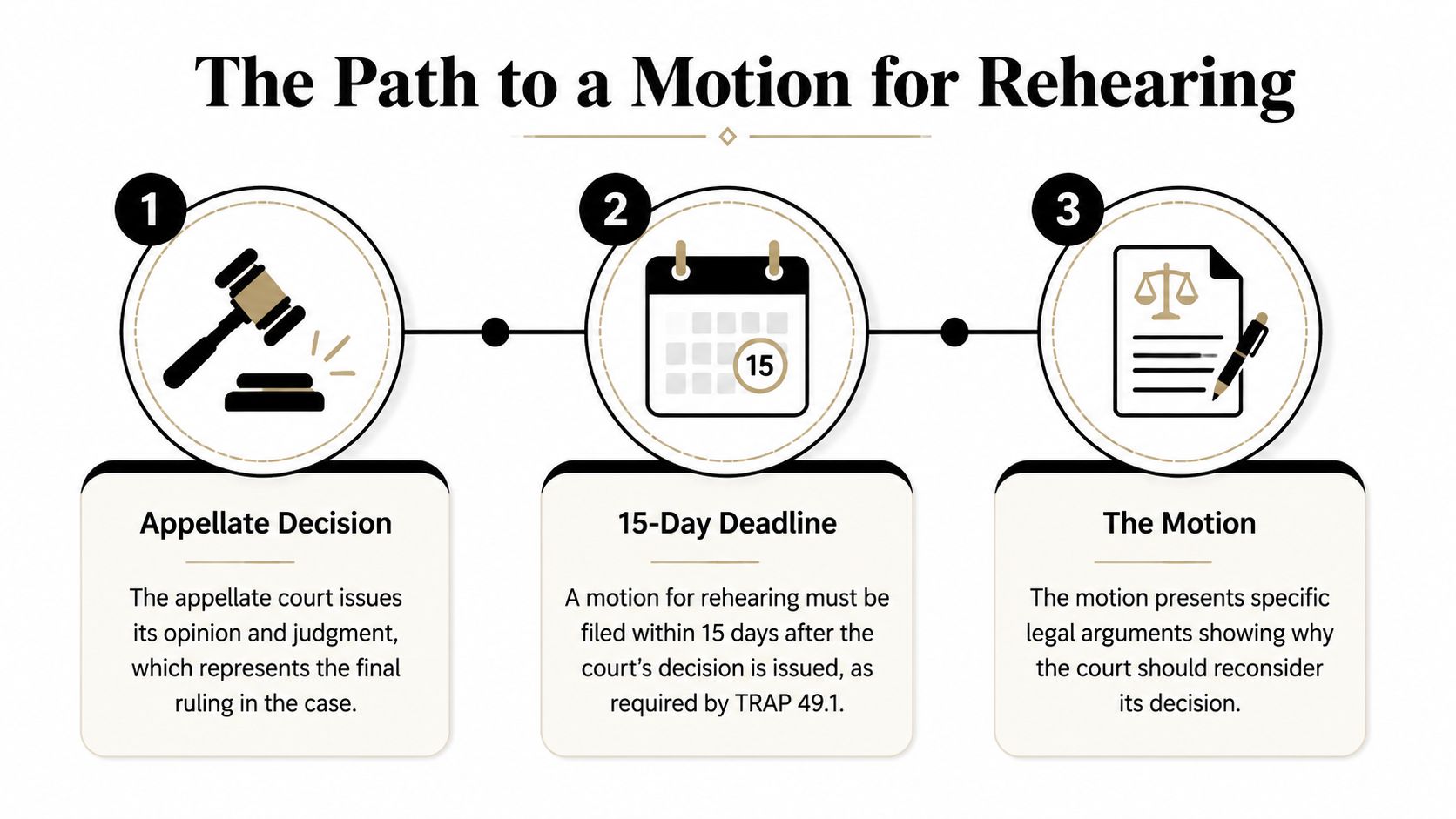
Under TRAP 49.1, the deadline is usually 15 days from the court of appeals' judgment or order. That window is short. In practice, a rehearing motion is worth the time and expense when it serves a defined purpose, such as correcting a record error, addressing a controlling authority the court missed, or sharpening an issue for possible review by the Texas Supreme Court.
What a rehearing motion is actually for
The strongest rehearing motions stay close to the opinion itself. They point to a precise problem and explain why that problem affects the result.
Good examples include:
- The court overlooked a controlling case
- The opinion misstates a material fact shown in the appellate record
- The panel used the wrong legal standard
- The opinion contains an inconsistency that changes the analysis or outcome
A weak rehearing motion usually does the opposite. It reargues the whole appeal, repeats fairness points the court already rejected, or attacks the result without identifying an actual mistake in the opinion.
That difference matters because rehearing is not mainly about persuasion in the abstract. It is about showing the court a correctable error in a form the court can act on quickly.
Rehearing versus en banc rehearing
Some cases also raise the question of en banc rehearing. That request goes to the full court of appeals rather than the original panel. It is usually reserved for unusual situations, such as a conflict within the court's own precedent or an issue of exceptional importance.
In family law, en banc review is the exception, not the plan. Filing it because the matter is significant often adds cost without improving the odds. If there is no conflict, no unusually important legal issue, and no clear reason the full court should step in, the better strategy is often a focused panel rehearing motion or preparing for the next level of review.
How to decide whether it is worth filing
I usually tell clients to answer three questions fast and truthfully:
- Did the court miss something specific in the law or record?
- Can that point be explained clearly within the short deadline?
- Does filing help preserve or sharpen an issue for the next step?
If the answer to the first question is no, filing may still make sense in a limited number of cases, but expectations should stay grounded. The motion then becomes a strategic filing, not a likely path to reversal.
A good rehearing motion is precise, restrained, and tied to the court's reasoning. It does not read like a second opening brief.
What to do right away
Time gets lost fast after an adverse opinion. Do these things immediately:
- Calendar the 15-day deadline
- Get the opinion and judgment to appellate counsel at once
- Compare the opinion against the clerk's record and reporter's record
- Identify any factual misstatements, omitted authorities, or preservation errors
- Decide whether the likely benefit justifies another round of briefing
That last point is the trade-off clients need to hear clearly. A rehearing motion can be the right move, but only if it has a real job to do.
Petitioning the Texas Supreme Court for Review
If rehearing is denied, the next question is whether to seek review from the Texas Supreme Court. Many clients assume this is the next appeal. It isn't. A Petition for Review is a request for the Supreme Court to choose your case.
That distinction matters. The Court controls its own docket. It does not take every family law case where a party believes the lower court got it wrong.
What the Supreme Court usually looks for
A Petition for Review is strongest when the case presents something larger than an individual dispute. Typical reasons for review can include:
- a conflict between the court of appeals' decision and other Texas precedent
- a significant issue involving interpretation of the Texas Family Code
- a legal question with broad statewide importance
- a clear need to correct a serious legal error affecting uniformity in Texas law
This is why many otherwise well-argued family cases never get accepted. The petition must do more than argue error. It must show importance.
How the strategy changes at this stage
Briefing for the Supreme Court is different from briefing in the court of appeals. The audience is different, and the purpose is different.
A good Petition for Review usually does three things at once:
| Task | Why it matters |
|---|---|
| Identify the legal issue cleanly | The Court needs to see the issue fast |
| Show why the issue matters beyond one family | The Court is selective |
| Explain why the lower court's ruling creates a larger problem | Error alone often isn't enough |
Lawyers sometimes weaken a petition by writing it like a motion for rehearing. That is usually a mistake. The petition should highlight the issue and frame it in terms the Supreme Court uses to decide whether to take the case.
Be realistic about the odds
This is a selective process. Historically, acceptance rates for family cases are very low under the verified data provided. That doesn't mean no petition should ever be filed. It means the decision should be strategic.
A petition may make sense when the case presents a genuine legal question with significance outside the immediate parties. It may make less sense when the dispute turns mostly on fact-specific complaints about credibility, weight of evidence, or a trial judge's discretionary call.
What does not improve your chances
Several themes rarely help at this stage:
- attacking the trial judge personally
- rearguing witness credibility
- presenting new evidence that was never part of the appellate record
- assuming the Supreme Court exists to provide a final fairness review in every case
The Court is not there to re-try family disputes. It is there to resolve important legal questions. If your case fits that purpose, a petition can be worthwhile. If it doesn't, counsel should say so plainly.
Navigating Parenting and Finances After a Lost Appeal
The opinion is out. Your appeal lost. Then real life starts pressing in fast. Friday's possession exchange is still on the calendar, support is still due, and any deadline to sign deeds, refinance debt, or turn over property is now a present obligation.

This is the point where many families make costly mistakes. They treat the appellate loss as unfair, which may be true from their perspective, and then act as if compliance can wait while they decide what to do next. In practice, that choice often creates a second problem that is easier for the other side to prove. Enforcement records, missed exchanges, unpaid support, and ignored transfer deadlines can do more immediate damage than the issues raised on appeal.
I tell clients to separate two questions. First, is there any remaining legal step worth considering. Second, what does the order require today. Those are different questions, and the second one usually needs attention first.
Parenting issues require exact compliance
After an affirmance, informal workarounds carry more risk. Parents often rely on old routines, verbal side deals, or last-minute texts. If the order says exchanges happen at a certain time and place, follow that language. If it requires communication through a parenting app or limits contact to certain topics, stay inside those rules.
Small details matter here:
- arrive on time for exchanges
- keep written records of pickup and drop-off issues
- follow the written holiday and school schedule
- make medical and school decisions only within the authority the order gives you
- keep messages short, factual, and child-focused
Good compliance also helps strategically. If the case later returns to court on enforcement or modification issues, the parent who followed the order carefully usually stands in a stronger position than the parent who improvised.
When communication is tense, practical guidance on effective conflict resolution can help reduce avoidable conflict without weakening your legal position.
Financial obligations need proof, not good intentions
Family cases often shift from appellate arguments to disputes about whether money or property was handled correctly. A partial payment, an informal promise to refinance later, or a text saying "I'm working on it" usually does not solve the legal problem.
Build a paper trail immediately. Keep:
- proof of each support payment
- bank or account records showing transfers
- signed deeds, title documents, or closing papers
- written communications about turnover logistics
- delivery confirmations for any required property
That documentation serves two purposes. It lowers the chance of a factual dispute later, and it gives your lawyer something usable if the other side claims noncompliance. In my experience, disciplined recordkeeping does more to protect a client after a lost appeal than emotional explanations ever do.
A lot of families also need a reminder that conflict management is now practical, not philosophical. This video is helpful context for that stage:
A later change in circumstances is a different legal question
A lost appeal does not freeze your family situation forever. Children get older. Jobs change. Parents relocate. Health issues arise. In the right case, those later facts may support a modification in the trial court, but that is not a continuation of the appeal and it is not a way to reargue the same record.
That distinction matters because clients often spend money on the wrong objective. If the complaint is about what the trial court did with the old facts, the direct review process controls. If the problem is that life has materially changed since the order, modification may be the better route. If you are unsure whether any narrow remedy still exists after the appeal, this overview of post-judgment relief in Texas family court is a useful starting point.
The practical rule after a lost appeal is simple. Obey the current order exactly, document everything, and assess any further legal step with clear eyes. That approach does not guarantee a better result later, but it usually protects options and avoids making a hard outcome worse.
Evaluating Post-Appeal Relief and Next Steps
Sometimes clients ask whether anything exists after the direct appeal process is effectively over. In rare situations, yes. But the available options are narrow and highly fact-dependent.
One possible form of extraordinary relief is a Bill of Review. In plain English, that is a separate lawsuit asking the court to set aside a judgment under limited circumstances, often involving things like extrinsic fraud or official mistake. It is not a second chance to reargue issues that were or could have been raised in the appeal.
For some families, the right answer after a loss is not another filing. It is a careful legal audit. That means reviewing whether every appellate deadline was met, whether rehearing or a petition for review still makes sense, whether post-judgment enforcement risks need immediate management, and whether some separate future modification issue may exist.
If you're trying to understand those limited remedies, this page on post-judgment relief in Texas family court is a useful reference point.
What usually works after an appellate loss is honesty, speed, and discipline. What usually fails is delay, anger-driven noncompliance, and spending more money on filings that don't match the legal posture of the case. Even when the answer is that the judgment is now effectively final, knowing that with confidence is valuable. It lets you protect yourself, plan your next move, and stop guessing.
If you believe the court made a mistake in your family law case, the appellate attorneys at The Law Office of Bryan Fagan, PLLC can help you evaluate the ruling, the deadlines, and the options still available. Whether you are dealing with custody, child support, property division, or enforcement risk after an affirmance, a focused consultation can bring clarity fast. Contact The Law Office of Bryan Fagan today for a free consultation.