If you have just been through a Texas custody battle, you may feel that the court's final order was fundamentally unfair. It is a deeply frustrating experience when you believe a judge's decision failed to protect your child's best interests or respect your rights as a parent. This feeling of injustice is the first step toward seeking a better, more balanced outcome through the Texas appellate process.
The legal system has a specific pathway to correct significant legal errors made during a trial. Joint Managing Conservatorship, the Texas term for joint custody, is the starting point for all custody cases, but it is often misunderstood. It is not about a perfect 50/50 split of time; it is about ensuring both parents share the responsibilities and decisions that shape a child's future. When a court order disrupts this balance without a legally sound reason, an appeal may be your only recourse.
Understanding the Foundation of Joint Custody Appeals

If you believe your case was handled unfairly, it is essential to understand how Texas law views custody and where a trial judge might have made a critical mistake. The appeals process is designed specifically to review these kinds of errors and ensure the final order aligns with the law and the evidence presented at trial.
In Texas, family law uses the term conservatorship instead of "custody." The law presumes that naming both parents as Joint Managing Conservators (JMCs) is in the child's best interest. This framework is intended to foster co-parenting and keep both parents involved in major decisions. You can find more details on Texas conservatorship laws and how they apply in contested cases.
However, "joint" does not mean equal. The structure of a joint conservatorship order is often the source of reversible legal errors.
The Role of the Primary Conservator
In nearly all JMC arrangements, the court designates one parent as the primary managing conservator. This is a critical distinction, as this parent gains the exclusive right to determine the child's residence, typically within a specific geographic area. The other parent is named the "possessory conservator" and is usually ordered to pay child support.
This designation is often the most contentious issue in a custody trial. If you believe the judge awarded primary status to the other parent by ignoring critical evidence or misapplying legal standards, that decision could be challenged on appeal.
An appeal is not a second trial or another chance to present your story. It is a meticulous review of the trial record to determine if the judge made a reversible error—a legal mistake so significant that it likely led to an improper outcome. This could be misinterpreting the law or making a decision unsupported by the facts.
Key Aspects of a Joint Custody Order
A Texas joint custody order is a detailed legal document that assigns specific rights and duties. An appellate court will scrutinize this order to ensure it is legally sound.
These orders almost always cover:
- Decision-Making Powers: The right to make decisions regarding the child's education, medical care, and religious upbringing. Many of these rights are shared.
- Possession and Access: A detailed schedule outlining when the child resides with each parent, which often follows the Texas Standard Possession Order.
- Financial Obligations: The requirement for the non-primary parent to pay child support and provide health insurance.
If your court order is imbalanced—perhaps it unfairly restricts your decision-making rights or the possession schedule is unworkable—an appellate attorney can analyze the trial record to determine if a legal error is the cause.
What You Can Appeal: The Child's Best Interest Standard
If you feel the judge's final decision was wrong, it is likely because you believe the outcome is not in the best interest of the child. This is not just a phrase; it is the single most important legal standard in all Texas family law cases involving children.
However, a judge's determination of "best interest" is not based on a personal opinion. It is a legal test guided by a specific set of criteria known as the Holley Factors. A successful appeal hinges on demonstrating that the trial judge improperly applied or ignored these factors based on the evidence presented in court.
The Holley Factors: The Legal Test for Custody
Decades ago, the Texas Supreme Court outlined a non-exhaustive list of factors that judges must consider when deciding what is best for a child. An appellate court's role is to review the trial record and ensure the judge properly weighed these elements.
Common Holley Factors include:
- The emotional and physical needs of the child, now and in the future.
- Any potential emotional or physical danger to the child.
- The parenting abilities of each individual seeking custody.
- The stability of the home each parent can provide.
- Any acts or omissions by a parent that may indicate an improper parent-child relationship.
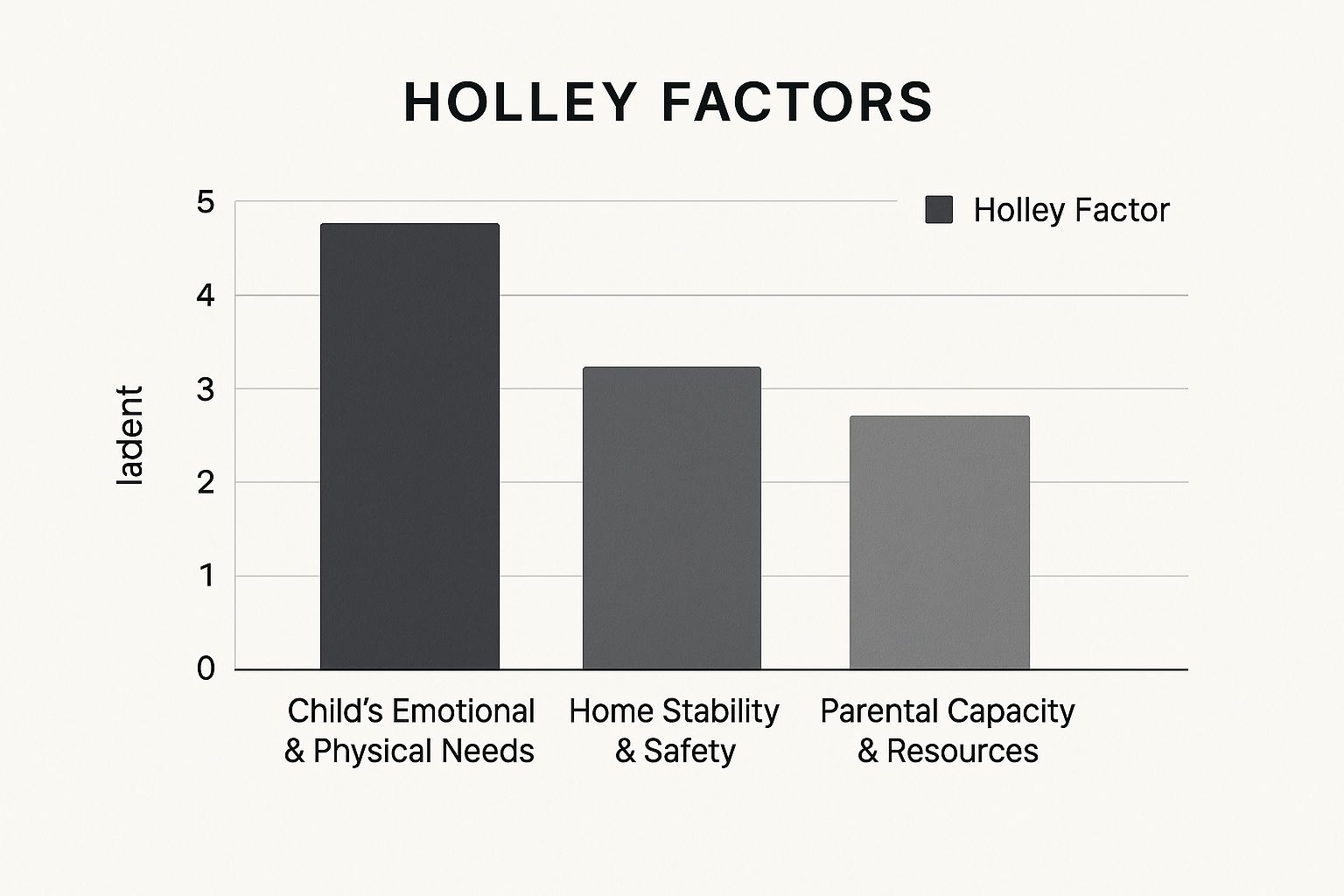
As this chart illustrates, courts place significant weight on the child's immediate needs and the safety of their environment. A strong appeal often highlights a clear error in the judge's analysis of these core factors.
Proving an "Abuse of Discretion"
To win a family law appeal, you must prove the trial judge committed an abuse of discretion. This is a specific legal term that must be understood in plain English.
Abuse of Discretion: This does not mean the judge was malicious. It means the judge made a ruling that was arbitrary, unreasonable, or made without reference to guiding legal principles, like the Holley Factors. In simple terms, it is a decision that cannot be justified by the facts and evidence in the record.
For instance, if a judge named a parent with a documented, untreated history of substance abuse as the primary conservator, that decision would contradict the Holley Factors concerning the child's safety and stability. This would be a potential abuse of discretion. Our appellate attorneys are skilled at analyzing trial records to identify these types of reversible errors in custody and visitation appeals.
Your focus must shift from personal disagreement with the ruling to a precise legal argument. The question is not whether you liked the decision, but whether it can withstand legal scrutiny under Texas law.
Challenging Unfair Parenting Time and Possession Orders

One of the most common sources of injustice in a custody case is the parenting schedule. In legal terms, this is called possession and access. To create predictability, the Texas Family Code provides a default schedule. However, a judge's failure to apply this schedule correctly or to customize it when necessary can constitute a serious legal error.
When parents cannot agree, Texas courts typically implement the Standard Possession Order (SPO). This schedule is legally presumed to be in the child's best interest. From an appellate standpoint, the final possession order must be clear, practical, and legally sound. If the order is too vague to be enforced or unfairly restricts your parenting time without a valid, evidence-based reason, you may have strong grounds for an appeal.
The Texas Standard Possession Order
The SPO is the default schedule for parents who live within 100 miles of each other. Its purpose is to provide a consistent routine. Despite the term "joint custody," the standard schedule is not a 50/50 split.
Data shows that parenting time is divided in Texas family law cases in a way that often results in mothers having the majority of possession, though the law itself is gender-neutral.
A typical SPO includes:
- The non-primary parent has the child on the first, third, and fifth weekends of a month.
- Major holidays like Thanksgiving and Christmas are divided and typically alternate annually.
- The non-primary parent receives 30 days of possession during the summer.
The Expanded Standard Possession Order
To encourage deeper involvement from both parents, Texas law also offers the Expanded Standard Possession Order (ESPO). This option provides the non-primary parent with more time, particularly during the school year.
An ESPO expands the standard weekend. The non-primary parent's possession begins when school is dismissed on Thursday and ends when school resumes on Monday morning. This allows for greater participation in the child's daily school life.
A judge is generally required to order the ESPO if a parent requests it, unless it is proven not to be in the child's best interest. A judge's refusal to grant an ESPO without a clear, evidence-based reason could be an abuse of discretion—a key point for a potential appeal.
Comparing Standard vs Expanded Possession Orders in Texas
This table clarifies the differences between the two schedules. The main distinction is how weekend and holiday periods are defined, with the ESPO giving the non-primary parent more time connected to the school week.
| Provision | Standard Possession Order (SPO) | Expanded Standard Possession Order (ESPO) |
|---|---|---|
| Weekend Possession | Begins Friday at 6 p.m. and ends Sunday at 6 p.m. | Begins when school is dismissed on Thursday and ends when school resumes on Monday. |
| School Involvement | Primarily weekend-focused; less involvement in school nights. | Includes Thursday and Sunday nights, allowing for help with homework and school prep. |
| Holidays | Possession for certain school holidays begins when school is dismissed. | Possession for all school holidays begins when school is dismissed. |
| Total Overnights | Fewer overnights per month compared to ESPO. | Significantly more overnights, leading to a possession split closer to 45/55. |
The ESPO is designed to integrate the non-primary parent more fully into the child’s life, moving beyond the role of a "weekend parent."
When Courts Deviate from the Standard
The SPO and ESPO are defaults, not mandates. A judge can and should create a custom schedule if the standard orders do not fit the family's circumstances. Common reasons for deviation include:
- Child's Age: The SPO is not intended for children under three.
- Distance: The schedule changes if parents live over 100 miles apart.
- Work Schedules: A parent with a non-traditional work schedule may need a custom plan.
- Special Needs: A child's medical or educational needs may require a unique schedule.
On appeal, the central question is whether the judge's scheduling decision was supported by evidence presented at trial. If the final possession order is impractical, harms the parent-child relationship, or deviates from the standard without a good reason documented in the trial record, it may be a reversible error.
Appealing the Unfair Division of Parental Rights and Duties

When a custody order feels unjust, it often involves more than the visitation schedule. A joint custody order, or Joint Managing Conservatorship, divides the fundamental rights and responsibilities that define parenthood.
The law presumes that both parents should share the power to make critical decisions for their child. When a judge strips one parent of these rights without a compelling, evidence-based reason—such as a history of family violence or neglect—it is not only unfair but may also be a reversible error. This is a legal flaw significant enough to justify overturning the trial court’s decision.
Exclusive Rights of the Primary Parent
To avoid parental gridlock, the law assigns certain exclusive rights to one parent, usually the primary managing conservator. The most significant is the right to determine the child's residence, though this is typically restricted to a specific geographic area to keep the child close to both parents.
Other rights often exclusive to the primary parent include:
- Receiving child support payments.
- Applying for the child's passport.
- Consenting to the child's marriage or military enlistment.
If a court grants these rights to a parent despite clear evidence that doing so would endanger the child or violate their best interest, an appeal may be necessary to correct the error.
Rights and Duties Shared by Both Parents
The core of a joint custody arrangement lies in the rights both parents are expected to share. The Texas Family Code promotes co-parenting and requires parents to consult on major decisions affecting their child.
The principle of collaboration is the foundation of joint managing conservatorship. A judge who issues an order that undermines this collaboration or excludes one parent from major decisions without a valid reason may have committed an abuse of discretion.
Shared rights are critical and often require parents to:
- Make joint decisions about the child's education and non-emergency medical treatment.
- Access the child's medical, dental, psychological, and educational records.
- Consult with each other before agreeing to invasive medical procedures.
An appellate attorney will examine the trial record to see if your right to participate in these crucial decisions was improperly removed. An appeal focuses on proving that the judge’s order violated the legal rules set forth in the Texas Family Code.
How Parental Rights Are Divided in Texas Joint Custody
This table illustrates how parental rights and duties are typically divided in a standard order for joint custody in Texas. Understanding this framework helps identify if your order deviates unfairly from the legal standard.
| Parental Right or Duty | Held Exclusively by Primary Parent | Shared by Both Parents | Independent Right of Each Parent |
|---|---|---|---|
| Determine Child's Residence | ✔️ | ||
| Receive Child Support | ✔️ | ||
| Make Educational Decisions | ✔️ | ||
| Consent to Medical Care | ✔️ | ✔️ (during possession) | |
| Access to Records | ✔️ | ||
| Direct Child's Moral/Religious Training | ✔️ |
If your court order differs significantly from this default without a clear, documented reason, it may be legally flawed and subject to appeal.
The Link Between Custody and Child Support Appeals
A common misconception is that joint custody eliminates the need for child support. This is rarely the case in Texas. The court's primary goal is to ensure the child's financial stability, regardless of the possession schedule.
Even when parents are named Joint Managing Conservators, one is typically the "primary" parent who receives child support from the other parent, the possessory conservator. Texas law is clear: both parents have a duty to financially support their child.
How Texas Calculates Child Support
Texas uses a formula-based method to calculate child support based on the paying parent’s net monthly resources. This includes all income sources—salary, commissions, overtime, and self-employment earnings—minus taxes and the cost of the child's health insurance.
The court then applies a percentage based on the number of children:
- 1 Child: 20% of net resources
- 2 Children: 25% of net resources
- 3 Children: 30% of net resources
- 4 Children: 35% of net resources
- 5 or more Children: 40% of net resources
While the formula seems straightforward, calculation errors are common and can be a basis for an appeal.
Challenging Financial Errors on Appeal
A trial judge must follow the guidelines in the Texas Family Code. A significant financial mistake can be considered a reversible error. This could include miscalculating a parent's income by omitting bonuses or applying an incorrect percentage for the number of children. Such errors can result in an unfair support order.
If you believe your child support order is based on a mathematical error or a failure to follow the law, you may have grounds for a child support appeal in Texas. The appellate process exists to correct these fundamentally unfair financial outcomes.
On September 1, 2023, a significant change in Texas law took effect. The maximum net monthly resources subject to child support guidelines increased from $9,200 to $11,700. This adjustment raised the maximum potential child support obligation, making accurate calculations more critical than ever. You can discover more insights about these Texas Family Code changes to understand its impact.
This update underscores that the law is specific, and the numbers matter. When a court uses outdated figures or miscalculates resources, an appeal can enforce the law and restore financial fairness.
Understanding the Texas Appeals Process
After a trial, it is easy to feel defeated if the final order is unjust. However, the Texas legal system provides a specific process for correcting significant legal errors: an appeal. Understanding how this process works is the first step toward challenging an unfair ruling.
It is crucial to know that an appeal is not a new trial. You cannot introduce new evidence or call new witnesses. The focus shifts entirely from the facts of your case to the application of the law. An appellate attorney will scrutinize every document, transcript, and ruling from your trial to identify specific legal mistakes made by the judge.
What Is a Reversible Error?
An appeal's success depends on proving a reversible error. This is not simply a disagreement with the judge's decision. It is a legal mistake so substantial that it likely caused an improper judgment. To succeed, we must show that the judge either misapplied the law or made a decision that the evidence presented at trial does not support.
Common reversible errors in joint custody in Texas cases include:
- The judge incorrectly interpreted a provision of the Texas Family Code.
- The court failed to properly consider the “Holley Factors” when determining the child’s best interest.
- The possession order is vague, unworkable, or legally unenforceable.
- A critical decision was made with no supporting evidence in the trial record.
Key Steps in a Texas Family Law Appeal
The appellate process follows a strict timeline governed by the Texas Rules of Appellate Procedure. While complex, it involves several key stages. For a detailed overview, see our guide to the Texas family law appeals process.
First, your appellate lawyer prepares the appellate record. This includes every document filed in the case and the official court reporter’s transcript of the trial. The court of appeals will only review this record.
Briefing: This is the core of the appeal. Your attorney drafts a persuasive legal argument, known as an appellate brief. This document outlines the case history, cites relevant laws and prior court decisions, and clearly explains how the trial judge committed a reversible error. The opposing party then files a response brief.
Finally, a panel of appellate judges reviews the briefs and the record. In some cases, they may schedule an oral argument. The court then issues a written opinion that can affirm the trial court's decision, reverse it, or send the case back for a new hearing with instructions to correct the error. The standard of review is high, which is why having an experienced appellate specialist is essential.
Frequently Asked Questions About Custody and Appeals
When facing an unfair Texas custody order, it is normal to have questions. The legal system can be complex, but understanding your rights and options is the first step toward restoring fairness.
Here are plain-English answers to some of the most common questions from clients considering an appeal.
Can My Child Tell the Judge Who They Want to Live With?
Yes. Once a child is 12 years or older, they have the right to speak with the judge in private about their preference for which parent should have the exclusive right to determine their residence. If a parent requests it, the judge must conduct this interview.
However, the child's preference is not binding. The judge's decision must still be based on the child's overall best interest. But if a judge refused to interview an eligible child or ignored their wishes without a well-documented, evidence-based reason, this could be a significant error and grounds for an appeal.
What Is the Real Difference Between Joint and Sole Custody?
The default in Texas is Joint Managing Conservatorship (JMC), which is a form of co-parenting where both parents share major rights and responsibilities.
Sole Managing Conservatorship (SMC) is the exception. It is reserved for cases where giving one parent all decision-making authority is necessary to protect the child. A court will only order SMC if there is clear evidence of serious issues, such as:
- A history of family violence
- Child abuse or neglect
- Chronic substance abuse
If a judge awards sole custody without sufficient evidence of such dangers, they have acted against the legal presumption that joint custody is in the child's best interest. This could be a reversible error.
How Much Time Do I Have to File a Custody Appeal in Texas?
Appellate deadlines are extremely strict. In most cases, you have only 30 days from the date the final order is signed to file a "Notice of Appeal."
Certain post-trial motions, such as a Motion for New Trial, can extend this deadline to 90 days. However, if you miss these deadlines, you will likely lose your right to appeal forever. It is critical to consult an appellate lawyer immediately after your trial concludes.
An appeal is a review for legal mistakes, not a second chance to argue the facts. The focus is entirely on proving that the trial court's decision was legally flawed based on the evidence and arguments presented at the time.
What Kind of Mistakes Can Be Overturned on Appeal?
To win an appeal, you must prove a reversible error occurred—a legal mistake that likely caused the wrong outcome. It is not about convincing a higher court that you are the better parent.
Examples of reversible errors include:
- The judge misapplied a key provision of the Texas Family Code.
- The court failed to properly analyze the "Holley Factors" in its best-interest determination.
- A major decision was made without any supporting evidence in the trial record.
- A parent's fundamental rights were terminated without a legally sufficient reason.
An appellate attorney's job is to meticulously search the trial record for these specific legal errors that can persuade an appellate court to reverse the decision or order a new trial.
If you believe the court made a mistake in your family law case, our appellate attorneys can help you seek a fair outcome. Contact The Law Office of Bryan Fagan today for a free consultation.