Skip to content
You may feel your case was handled unfairly. As a father in Texas, you walked into court believing your rights were equal, only to walk out with a child custody order that doesn't reflect your commitment or your child’s best interests. This experience is frustrating and disheartening, but the trial court’s decision is not always the final word. The Texas appellate process was designed to correct legal errors and seek a just outcome when the system gets it wrong.
Our appellate division at The Law Office of Bryan Fagan is dedicated to helping clients who believe their family law case was decided unfairly. We understand that you aren't just fighting a legal battle; you are fighting for your relationship with your child. This guide will walk you through the key principles of appealing a child custody order in Texas, explaining the process in plain English so you can understand your options for seeking justice.
What You Can Appeal in a Texas Child Custody Case

It’s a common and deeply frustrating experience for dedicated dads to walk away from a custody hearing feeling like the decision was based on an outdated bias. You may feel that the judge didn’t truly see your commitment or properly apply the law to the facts of your case.
The good news is that the Texas Family Code is written to be completely gender-neutral. It is designed to focus entirely on parental fitness and the child's well-being. If you believe the trial court strayed from this core principle and made a legal error, you may have a path to challenge that decision through the appeals process. An appeal allows a higher court to review the trial record for mistakes that may have led to an unjust result.
Understanding Key Legal Terms in a Custody Appeal
To effectively challenge an unfair ruling, it is essential to understand the language of the court. An appeal is not a retrial; it is a technical review of the trial court’s actions. Here are some terms you will encounter.
- Reversible Error: This is not just any mistake. A reversible error is a legal mistake made by the trial judge that was so significant it likely caused an improper outcome. Finding this type of error is the primary goal of an appeal.
- Abuse of Discretion: This is the "standard of review" appellate courts use in most family law cases. It means the trial judge made a decision that was arbitrary, unreasonable, or without reference to any guiding legal rules or principles. For example, if the judge ignored substantial evidence of your fitness as a parent without a valid reason, it could be an abuse of discretion.
- Briefing: This is the process of submitting written legal arguments to the appellate court. Your attorney will file a "brief" that details the facts of your case (based only on the trial record), identifies the reversible errors, and uses legal precedent to argue why the trial court's decision should be overturned.
While the law on the books is neutral, the numbers on the ground tell a slightly different story. Fathers still receive primary custody in a minority of cases, highlighting the challenges many face. You can dig deeper into these child custody statistics and the vital role of fathers. If you believe your case was decided unfairly, an appeal provides a structured, legal pathway to seek a fair outcome based on the law, not on bias.
If you believe the court made a mistake in your family law case, our appellate attorneys can help you seek a fair outcome. Contact The Law Office of Bryan Fagan today for a free consultation.
Understanding the Standard of Review in Custody Appeals

It’s a gut-wrenching feeling to sit in a courtroom and realize the judge isn't seeing the full picture of your relationship with your child. You might feel the final decision completely missed what your child truly needs or your ability to provide it. This is where the concept of an appeal becomes critical.
In Texas family law, an appeal is not a new trial. You cannot present new evidence or call new witnesses. Instead, an appellate court reviews the existing trial record to determine if the judge made a significant legal error. The standard used for this review in custody cases is typically "abuse of discretion."
A judge abuses their discretion when they act without reference to guiding rules and principles. In other words, the decision was arbitrary or unreasonable based on the evidence presented. An appeal argues that the judge’s ruling was not just one you disagree with, but one that was legally flawed. This is the foundation for seeking a new, fair hearing.
Common Reversible Errors in a Father's Custody Case
The "best interest of the child" is the guiding principle in all Texas custody cases. This standard is based on a specific set of criteria called the Holley Factors. A judge must consider these factors, and a failure to do so properly can be a reversible error. Common errors that can form the basis of an appeal include:
- Misapplication of the Best Interest Standard: The judge may have relied on an improper gender bias, assuming a mother is the better primary caregiver despite evidence to the contrary. If you presented substantial evidence of your role as an active and fit parent, and the court ignored it without a valid, evidence-based reason, this may constitute an abuse of discretion.
- Improper Exclusion of Evidence: The court refused to allow crucial evidence supporting your case. For example, if the judge blocked testimony from a teacher or coach who could speak to your deep involvement in your child’s life, it prevented you from fully presenting your case.
- Improper Admission of Prejudicial Evidence: The court allowed the other side to introduce irrelevant or highly prejudicial evidence that has no bearing on your current fitness as a parent. This could include a past mistake from years ago that was used to paint you in a negative light unfairly.
- Lack of Sufficient Evidence: The judge’s final decision is not supported by the facts in the record. If the court severely restricts your possession time but there is no evidence in the record to justify such a restriction, the ruling may be an abuse of discretion.
Proving you are the right parent for the job isn't about simply telling the court you're a great dad; it's about showing them with concrete proof. The evidence you present at trial creates the official record—the same record an appellate court will review later. When a judge ignores that evidence or misapplies the law, an experienced appellate attorney can dissect the trial record to build a strong case for why the decision was legally wrong and compromised your child custody rights for fathers.
How Texas Fathers Can Appeal Unfair Child Custody Orders
Receiving a custody order that you know is wrong can feel like a final, devastating blow. For a father who has been deeply involved in his child's life, it can feel as though the court simply didn't listen. However, this is not necessarily the end of the road. The Texas appeals process exists specifically to correct legal mistakes and provide a path toward a just outcome.
It is vital to understand that an appeal is not a do-over of the trial. You will not call new witnesses or present new evidence. The appellate court acts as a reviewer, meticulously examining the official record from your trial—every transcript, every exhibit—to determine if the trial judge made a significant legal mistake, known as a “reversible error.” This is a mistake so critical that it likely led to an unfair result and warrants a new hearing. The process is one of precise legal analysis, not a second chance to tell your story.
The Texas Appellate Procedure: Step-by-Step Insights
The appeals process is governed by the strict Texas Rules of Appellate Procedure. The timelines are firm and missing a deadline can permanently bar your right to an appeal. Here is how the process generally unfolds.
- Step 1: File the Notice of Appeal. This is the first and most critical step. This formal document notifies the courts that you are challenging the final order. You typically have only 30 days from the date the order was signed to file this notice. This deadline is unforgiving.
- Step 2: Prepare the Appellate Record. Your appeal is built entirely on what happened at trial. The appellate record consists of the Clerk’s Record (all documents filed in the case) and the Reporter’s Record (the word-for-word transcript of the trial). Your attorney will ensure this record is properly prepared and filed, as it contains the evidence needed to prove a legal error occurred.
- Step 3: Appellate Briefing. This is the core of the appeal. Your attorney will draft a persuasive legal document, or "brief," that tells the story of your case based only on the record. The brief will identify the specific errors the trial judge made and use legal precedent to argue why the decision should be reversed. The opposing party will then file a response brief, and your attorney may file a final reply.
- Step 4: Oral Argument and Decision. In some cases, the appellate court will schedule an oral argument where attorneys present their case directly to a panel of judges. Afterward, the court will issue a written opinion that either affirms the trial court's decision or reverses it and "remands" the case back to the trial court for a new hearing.
Winning arguments over critical issues, like securing joint custody in Texas, often hinges on proving that the trial court mishandled the evidence or misapplied the law. An appeal is your opportunity to have a higher court review those potential errors and seek a fair and just outcome.
The Texas Appeals Process for a Custody Order
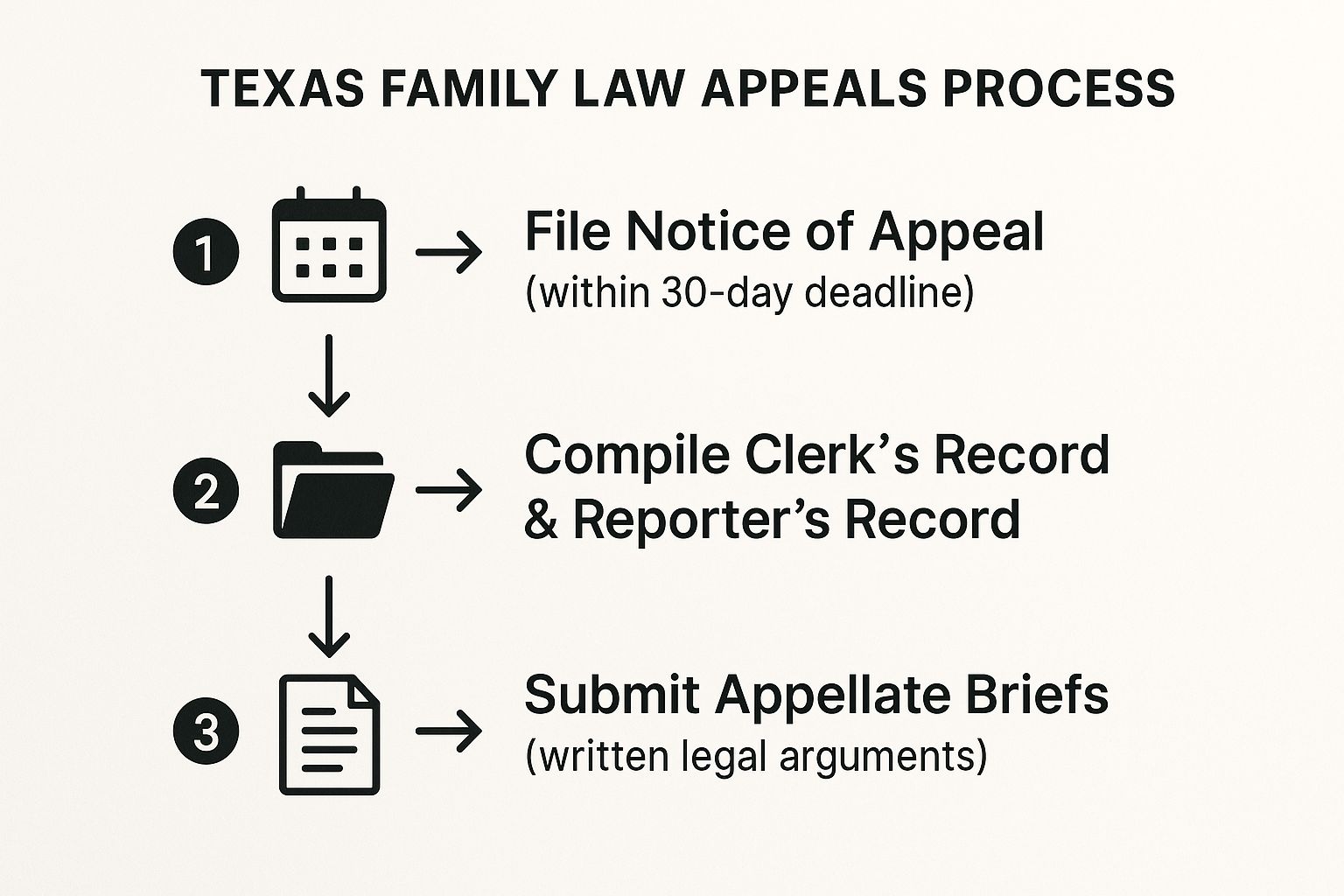
If a custody ruling has left you feeling that the system failed you and your child, it is important to know that the judge’s decision isn't automatically the final word. The Texas appeals process provides a structured pathway to have a higher court review the decision for legal errors. However, this process is very different from a trial and is governed by strict rules and deadlines.
An appeal is not a chaotic courtroom drama but a methodical, academic review of what already happened. The focus is entirely on the written record and legal argument. Understanding this roadmap is the first step toward seeking a different outcome. It all begins with unbendable deadlines and a series of deliberate steps designed to prove one thing: a serious legal mistake was made in your case.
Preparing the Official Record for Appeal
The single most important principle of an appeal is this: you cannot introduce new evidence. No new witnesses, no new documents. The appellate court only looks at the official record from the trial court—the complete collection of papers and transcripts that tells the story of your original case.
This record has two key parts:
- The Clerk’s Record: This is the "paper trail" of your case. It includes every motion, pleading, and discovery response filed, along with the final signed order you're challenging.
- The Reporter’s Record: This is the official, word-for-word transcript of everything said in the courtroom. Every piece of testimony, every objection, and every ruling the judge made is captured here by the court reporter.
Assembling a complete and accurate record is the foundation of the entire appeal. If a piece of evidence or testimony is not in the record, for all legal purposes, it never happened. Your appellate attorney uses these documents as the raw material to build your case.
The Heart of the Appeal: The Briefing Stage
Once the official record is filed, the core of the appeal begins. The briefing stage is where your lawyer presents your entire argument in a formal, written document for the appellate judges. This is where skilled legal research, persuasive writing, and deep analysis come together.
A strong appellate brief accomplishes two critical tasks:
- It presents the facts of your case, sticking strictly to what is contained within the official record.
- It identifies the specific reversible error the trial judge made, supporting the argument with citations to the record, the Texas Family Code, and relevant case law (precedent).
An appellate brief is a technical, logical argument designed to convince a panel of judges that a legal mistake was made and that this mistake was so significant it caused an improper outcome. After your brief is filed, the other side gets an opportunity to file a response. Your attorney may then file a final reply brief. This written exchange is what the appellate court primarily uses to make its final decision. Every court has its own unique procedures, so it's vital to know the specific rules. For example, you can learn more about how this plays out in the 14th Court of Appeals in Texas to see how these rules are applied in practice.
Oral Argument: A Chance for Direct Advocacy
In some appeals, the court will schedule an oral argument. This is not another trial; it is a highly focused question-and-answer session where your attorney stands before a panel of (usually three) judges to argue the most critical points of the case.
These sessions are brief, typically just 20-30 minutes per side. The judges will have already read all the briefs and will use this time to question the attorneys on the weakest or most complex parts of their arguments. It provides a rare chance for your lawyer to address the judges' concerns directly and clarify key points. A sharp, well-delivered oral argument can be the final element needed to restore balance and secure a second chance at justice.
Why You Need a Family Law Appellate Attorney

Navigating a child custody trial is a significant challenge. The appeals process, however, is a completely different undertaking that requires a distinct set of skills. The strategies that lead to success in a trial court are worlds apart from what it takes to win on appeal.
A trial focuses on presenting evidence and telling a compelling story to a single judge. An appeal is an academic deep dive into legal research, procedural rules, and persuasive writing, all centered on identifying specific legal mistakes within the trial record. This is why engaging an experienced appellate attorney is so critical. They specialize in the unique rules and procedures of the appellate courts. Their role is not to retry the case but to meticulously review every page of the trial transcript and court filings, searching for a reversible error that can overturn the unfair outcome.
A Fresh Perspective on Your Case
In the heat of a trial—an emotional and fast-paced environment—it is easy for crucial legal errors to go unnoticed. An appellate lawyer brings a fresh, objective set of eyes. They are not caught up in the history or emotion of the trial; their focus is laser-sharp on the law and the official record.
This strategic distance provides a significant advantage, allowing them to spot issues that may have been missed during the original litigation, such as:
- A judge incorrectly applying a section of the Texas Family Code.
- Crucial evidence being improperly admitted or excluded.
- The judge making a decision that constitutes an "abuse of discretion"—meaning the ruling was not supported by the facts or guiding legal principles.
An appellate specialist serves a different purpose and addresses a different audience. Their entire focus is on crafting a rock-solid legal argument to convince a panel of experienced judges that a serious mistake was made and that it must be corrected to ensure a fair process. Ultimately, hiring the right family law appeal attorney provides your fight for fair child custody rights for fathers with the sophisticated, detail-oriented advocacy required at the appellate level. It gives you the best possible chance to correct a decision that was fundamentally unjust.
If you believe the court made a mistake in your family law case, our appellate attorneys can help you seek a fair outcome. Contact The Law Office of Bryan Fagan today for a free consultation.
Common Questions About Appealing a Father's Custody Order
If you're considering appealing a custody order that feels unjust, your mind is likely filled with questions. The appellate process can seem complex, so let's address some of the most common concerns Texas fathers have when facing this journey.
How Long Do I Have to Appeal a Texas Child Custody Order?
You must act quickly. The clock starts ticking the moment the judge signs the final order. In Texas, you generally have just 30 days to file a Notice of Appeal. This is one of the strictest deadlines in the legal system. If you miss it, you will likely lose your right to challenge the ruling forever. While certain post-trial motions can sometimes extend this window to 90 days, you should never rely on that possibility. It is crucial to consult with an appellate lawyer immediately after receiving a final order to protect your rights.
Does the Custody Order Change While the Appeal is Happening?
No, the trial court's order almost always remains in full effect during the appeal. This can be difficult, but it means you must follow the judge's ruling—including the possession schedule and any other terms you are challenging—while the case is pending before the higher court. In very specific and rare circumstances, an attorney can ask the appellate court to temporarily suspend parts of the order, but this is an extraordinary remedy and is not granted often.
What Happens If I Win My Custody Appeal?
Winning an appeal does not mean the appellate court will write a new custody order for you. Instead, a victory provides something incredibly valuable: a second chance. If the court of appeals finds a "reversible error"—a significant legal mistake that likely affected the outcome—it will typically reverse the trial court's decision and remand the case back to the trial court for a new trial or hearing. Think of it as hitting a reset button. This new hearing is your opportunity to present your case again, this time on a level playing field, free from the error that compromised the first outcome. A successful appeal is about restoring fairness and due process, giving you another shot at securing a just result for you and your child.
If you believe the court made a mistake in your family law case, our appellate attorneys can help you seek a fair outcome. Contact The Law Office of Bryan Fagan, PLLC today for a free consultation at https://familylawcourtappeals.com.