Skip to content
If a Texas judge has issued a child custody order that you believe is fundamentally unfair, it can feel like a devastating and final blow. You may feel your case was handled unfairly, your voice wasn't heard, or the court simply got it wrong. It’s a moment that can leave you feeling lost, but it does not have to be the end of the road. Texas law provides a path to seek justice: an appellate review. This process is not a retrial or a second chance to present your case. Instead, it is a focused, strategic review of the trial court record to determine if the judge made a significant legal error that led to an unjust outcome.

What to Do After an Unfair Custody Ruling
Receiving a custody order that feels deeply unjust can be a disorienting experience. You may feel that critical evidence was ignored, the law was misapplied, or the decision simply does not protect your child's best interests or your parental rights. If you believe the system failed your family, it is important to know that you have options. An appeal is a structured legal process designed to correct errors and restore fairness. It transforms a feeling of helplessness into a concrete plan for action, offering a powerful tool to advocate for a just result.
Understanding the Purpose of an Appeal
It is essential to understand that an appeal is fundamentally different from the trial you just experienced. The focus shifts entirely from presenting facts to proving that the trial judge made a legal mistake.
- At trial, the goal was to build the case. You and your attorney presented evidence, called witnesses, and argued the facts to persuade the judge.
- On appeal, the goal is to review the court’s decision-making process. An appellate lawyer analyzes the trial transcript, evidence, and court orders to determine if the judge correctly followed the rules of law.
This is not a second chance to introduce new evidence or re-argue the facts. To succeed, you must demonstrate that a reversible error occurred—a mistake so significant that it likely caused the judge to reach the wrong conclusion about what was in your child's best interest.
A reversible error is not a minor disagreement with the judge. It is a serious misapplication of the law or legal procedure that undermined the fairness of the outcome. Examples include misinterpreting the "best interest of the child" standard, improperly excluding crucial testimony, or basing a decision on factors the law prohibits.
If you believe a serious legal error was made in your child custody case, the clock is ticking. Our appellate team can help you evaluate your case for grounds for an appeal and fight for the fair outcome your family deserves.
Understanding How a Custody Appeal Works
When a judge’s custody order feels profoundly wrong, it’s natural to want a second chance. But it's critical to understand what a Texas custody appeal actually is—and what it isn't. An appeal is not a do-over. You don't get to present your case all over again with new evidence or fresh testimony.

The appellate court acts like a review official in a professional sport. The officials don't put the players back on the field to replay the game. Their sole job is to review the official "game footage"—the trial record—to determine if the judge on the field made a critical error that changed the outcome.
The Role of the Trial Record
The entire appeal is built upon the trial record. This is the official, closed account of everything that happened in the trial court. The appellate justices are confined to this record; they cannot consider anything outside of it.
The record consists of two key parts:
- The Clerk's Record: This is a compilation of all documents filed in your case, including the original petition, every motion, all responses, and the final order being appealed.
- The Reporter's Record: This is the official, word-for-word transcript of everything said in court, including all witness testimony, attorney arguments, and the judge's statements.
Your appellate attorney's job is to meticulously examine these records to find a specific type of mistake: a reversible error.
What Is a Reversible Error?
Not every error will lead to a successful appeal. To win, you must prove the trial judge made a legal mistake so significant that it likely caused an improper and unjust outcome in your custody case.
A reversible error is a mistake of law or procedure made by the trial judge that is serious enough to justify overturning the original decision. Simply disagreeing with the judge's final ruling is not enough; you must prove the judge made a specific, harmful legal error in the process of reaching that ruling.
Given the volume of cases Texas family courts manage, mistakes can and do happen. For example, a single large county like Tarrant saw over 17,580 new family law cases in one year. Judges handling such dockets are under immense pressure, which increases the potential for legal errors. This reality makes appellate review an essential safeguard. You can learn more about Texas family law case statistics and their implications for appeals. An appeal is not about re-arguing facts; it's about building a disciplined, technical argument to show the legal process was flawed.
Distinguishing Appeals from Trials
Understanding the fundamental differences between a trial and an appeal is crucial. They are two distinct legal proceedings with different rules and objectives.
| Aspect | Trial Court | Appellate Court |
|---|---|---|
| Purpose | To hear evidence, determine facts, and make an initial decision. | To review the trial record for legal errors made by the judge. |
| Evidence | Hears new testimony and reviews new evidence. | Does not consider new evidence; only reviews the existing record. |
| Focus | On the facts of the case and witness credibility. | On the law, legal procedures, and whether the judge made an error. |
| Outcome | Issues a final judgment (e.g., a custody order). | Affirms, reverses, or remands (sends back) the trial court's judgment. |
This distinction is critical. Your strategy must shift from persuading a judge about the facts of your life to persuading a panel of justices about a specific point of law. If you believe a reversible error was made in your divorce or custody case, our team has the specialized experience to analyze the record and build a strong appellate case.
Proving an Abuse of Discretion in Your Appeal
When a custody order feels fundamentally wrong, you cannot win an appeal simply by arguing that another judge would have decided differently. To succeed, you must prove the trial judge committed a specific, serious legal error known as an “abuse of discretion.” Understanding this concept is the first step toward building a strong case and setting realistic expectations for the appellate process. An abuse of discretion is not just a disagreement; it's a decision so disconnected from the rules and facts that it becomes arbitrary and unfair.
What Does “Abuse of Discretion” Mean in Plain English?
In every custody case, a judge must follow the guiding rules and principles of the Texas Family Code. The primary guidepost is the “best interest of the child” standard. A judge abuses their discretion when they make a decision that is arbitrary, unreasonable, or without reference to these guiding legal principles.
Abuse of Discretion: This legal term means a trial judge made a decision that was arbitrary, unreasonable, or without reference to guiding rules and principles. The appellate court does not ask if it would have made the same choice, but whether the trial judge’s choice had a legitimate basis in the evidence and the law.
To win, your appeal must show that the judge did not just weigh the evidence differently than you had hoped. It must prove that the final decision was not a logical result of the facts presented at trial. For a more detailed explanation, review our guide on the abuse of discretion standard in Texas family law.
How Do You Prove It?
Proving an abuse of discretion is a demanding legal task. It requires a skilled appellate attorney to comb through the trial record, looking for specific instances where the judge’s ruling was not grounded in the law or facts.
Here are common examples of what an abuse of discretion might look like:
- Ignoring Key Facts: The judge disregards clear, uncontradicted evidence from a custody evaluator or other expert without a valid reason.
- Applying the Wrong Legal Standard: The court uses an incorrect or outdated legal test when making a decision, such as imposing a geographic restriction without sufficient cause.
- Making a Finding with No Evidentiary Support: The final order states something as fact—for example, that a parent has a substance abuse problem—when no evidence was presented at trial to support that claim.
A case from the Dallas Court of Appeals, In re Interest of N.S.S., illustrates how high this standard is. A mother appealed after a judge gave the father the exclusive right to designate the child's residence. The appellate court reviewed the record and found the trial judge’s decision was supported by substantial evidence, including the child’s special needs, the father’s stable home, and his history of better communication. Because the decision was clearly based on facts in the record and aimed at the child’s best interest, the court found no abuse of discretion. This case underscores a critical point: if the judge had a reasonable basis in the evidence for the ruling, an appellate court will almost always uphold it.
Common Errors That Can Overturn a Custody Order
When you receive a child custody order that seems completely at odds with the evidence presented at trial, the frustration is understandable. However, to win an appeal, that frustration must be channeled into a precise legal argument. Success depends on identifying a specific, legally recognized reversible error—a critical mistake that likely caused an unjust outcome for you and your child.
Misapplying the "Best Interest of the Child" Standard
In Texas, every judicial decision in a custody case must be guided by one principle: the best interest of the child. This is the foundation of family law. A reversible error occurs when a judge deviates from this standard or is influenced by factors the law says are irrelevant.
For example, a judge might commit a reversible error if they:
- Focused on a single detail, such as a parent's new relationship, while ignoring overwhelming evidence about which parent provides a more stable and nurturing environment.
- Allowed a personal bias to influence their decision, rather than relying on the specific facts of your family's situation.
- Failed to properly consider all relevant factors, such as a child’s unique medical needs or a documented history of family violence.
Making a Decision with Insufficient Evidence
A judge's decision cannot be based on a gut feeling or assumptions. The final order must be supported by a foundation of solid evidence presented at trial—the testimony and exhibits that form the official record. When a key part of the judge's ruling has no supporting evidence in that record, it becomes a major issue for an appellate court. For instance, if a judge designates one parent as primary conservator based on "stability" but the trial transcript contains no evidence to support that finding, an appellate court may see it as an abuse of discretion.
Incorrectly Applying Texas Law
While the "best interest" standard provides the overarching framework, the Texas Family Code also contains specific rules for possession schedules, geographic restrictions, and parental rights. A judge commits a reversible error when they misapply these specific rules. A common example is when a judge imposes a strict geographic restriction on a parent without any evidence showing that the restriction is necessary for the child’s well-being, which directly contradicts the requirements of the Texas Family Code.
Appellate courts are not rubber stamps. As you can see from these striking appellate statistics, which show a reversal rate of over 72% in cases reviewed by the Texas Supreme Court in its 2024-2025 term, challenging a trial court's decision is a viable path when clear legal errors exist.
Denying Your Right to Be Heard
Due process is a cornerstone of our legal system, guaranteeing your right to present your case and have your evidence fairly considered. If a judge improperly denies you this fundamental right, it is one of the most serious errors they can make.
A reversible error is not simply a decision you disagree with. It is a specific, harmful mistake in applying the law or procedure that an appellate attorney can pinpoint in the trial record and prove likely led to an unjust custody order.
This can occur when a judge wrongfully excludes critical evidence, such as refusing to hear from a key witness or rejecting a professional child custody evaluation without proper cause. It also happens if a judge cuts short your testimony before you have a fair opportunity to present your side. When the record shows that one party was not given a fair chance to be heard, the integrity of the entire trial is compromised.
If you believe the court made a mistake in your family law case, our appellate attorneys can help you seek a fair outcome. Contact The Law Office of Bryan Fagan today for a free consultation.
A Step-by-Step Walkthrough of the Texas Custody Appeal Process
Considering an appeal of a custody order can feel like navigating an intimidating maze. The process for an appellate review of custody decisions in Texas is governed by strict, unforgiving rules. However, when broken down, the journey follows a clear, predictable path. Understanding this roadmap demystifies the process and highlights why having an expert guide is essential.
Step 1: File the Notice of Appeal
This is the first and most critical step. The Notice of Appeal is a simple document filed with the trial court that officially informs the court and the opposing party that you are appealing the final order. While straightforward, this document is the key that starts the entire appellate process. The deadline is unforgiving: for most family law cases, you have only 30 days from the date the judge signed the final order to file it. Missing this deadline, even by one day, will almost certainly result in the dismissal of your appeal.
Step 2: Prepare the Appellate Record
Once the appeal is filed, the next step is to assemble the official record for the appellate court's review. This Appellate Record consists of two essential parts:
- The Clerk’s Record: A collection of every document filed in your case, including petitions, motions, and the final order.
- The Reporter’s Record: The official, word-for-word transcript of everything said during your trial and other key hearings.
Your appellate lawyer will order these records from the court clerk and court reporter. Assembling the record is a meticulous process that can take several weeks. Understanding the correct procedures is vital; a general overview of how to file court documents can provide insight into the required formalities.
Step 3: Write and File the Appellate Brief
This is where the core legal battle occurs. The appellate brief is a detailed, formal legal argument written by your attorney. This document does not retell your story from an emotional viewpoint; it is a technical argument that identifies the specific, reversible errors the trial judge made. Your lawyer will connect those errors to evidence in the record, cite page numbers from the transcript, and support the arguments with established case law. The goal is to build an undeniable case that the trial court's decision was legally flawed. The other party will then file a responsive brief, and your attorney may file a final reply brief.
What is "Briefing?" In the legal world, "briefing" is the process of writing and filing these formal written arguments. Every brief must follow strict rules for formatting, page limits, and citation style as outlined in the Texas Rules of Appellate Procedure.
The flowchart below provides a high-level view of a typical custody appeal, from filing the notice to receiving a final decision.
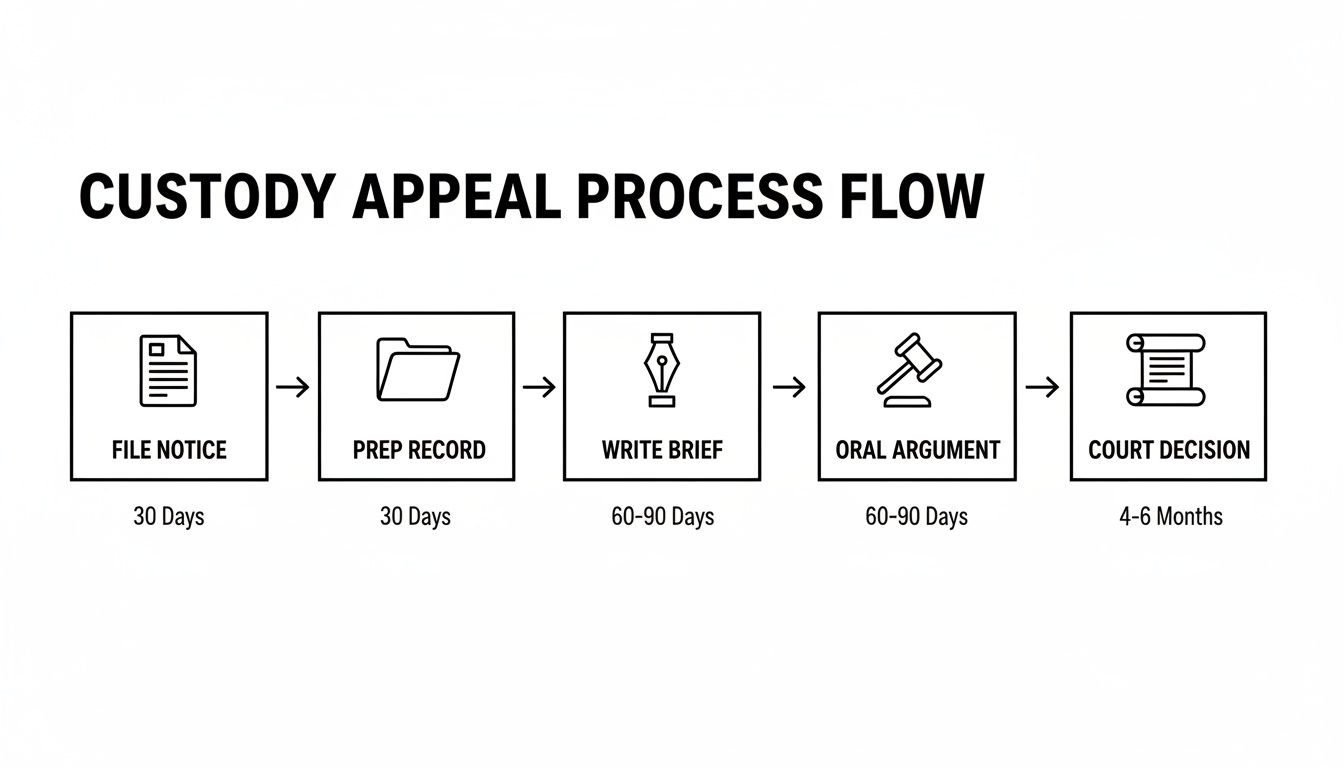
As illustrated, each stage builds on the previous one, highlighting the structured, deadline-driven nature of the Texas appellate process.
Step 4: Oral Argument
In some cases, the court will schedule an oral argument. This is a formal session where your lawyer appears before a panel of three appellate justices to present your case and answer their direct, probing questions. This is not a retrial; no new evidence is allowed. It is a high-level legal debate focused entirely on the issues raised in the briefs. Not every case receives an oral argument, as courts often make their decision based on the written arguments alone. For a deeper look at the rules governing these stages, our dedicated guide on Texas appellate procedure in family law provides a comprehensive breakdown.
Step 5: The Court’s Decision
After all briefs are filed and any oral argument is concluded, the case is "submitted." The justices deliberate in private and then issue a formal written opinion explaining their ruling. This waiting period can last several months. Ultimately, the court will either:
- Affirm the trial court’s judgment, meaning the original decision stands.
- Reverse the judgment, meaning you have won the appeal. The court may "render" a new judgment or, more commonly, "remand" the case back to the trial court for a new trial or other proceedings consistent with the appellate court's opinion.
Why You Need a Dedicated Appellate Attorney
When facing a custody ruling that feels fundamentally unjust, it's natural to want to continue fighting. However, the appellate process is entirely different from a trial and requires a distinct skill set and strategy. Your trial lawyer was a storyteller, building a compelling narrative to persuade a single judge. An appellate lawyer, in contrast, is a legal scholar and strategist focused on law and procedure.
The Detective and the Strategist
An appellate lawyer’s work begins by meticulously analyzing the trial record, searching for legal error. This specialized task requires a unique combination of skills:
- Deep Knowledge of Appellate Rules: Appeals are governed by the Texas Rules of Appellate Procedure, a complex and unforgiving set of regulations. A missed deadline or improperly formatted document can terminate your appeal before it begins. An appellate expert knows this rulebook intimately.
- Exceptional Legal Writing: The most powerful tool in an appeal is the written brief. This document is a masterful legal argument, built on deep research and crafted to persuade a panel of experienced judges.
- A Fresh, Objective Perspective: An appellate attorney brings a crucial outsider's view, free from the emotional investment of the trial. They can identify legal weaknesses that may have been overlooked, focusing purely on what the law and the record support.
Briefing is the heart of an appeal. It's the formal written argument where your attorney demonstrates to the appellate court precisely where the trial judge erred on the law and why that mistake is significant enough to require a different outcome.
Why Your Trial Attorney May Not Be the Right Fit
Even the most brilliant trial lawyers may not be equipped for the unique demands of an appeal. The skills that make them effective in the courtroom—such as persuasive oral advocacy and connecting with a judge on a personal level—are different from the skills needed to win on appeal. Appellate work is scholarly, detail-oriented, and focused on dispassionate legal analysis. The goal is to build an airtight written argument that can withstand the scrutiny of judges who care only about the correct application of the law. It is essential to find the right family law appeal attorney to guide you.
Choosing a firm with a dedicated appellate practice provides a significant advantage. You gain a team that lives and breathes appellate procedure and understands how to frame arguments for a panel of justices. This specialized focus on the appellate review of custody decisions in Texas is often the key to achieving a just outcome.
Answering Your Questions About Texas Custody Appeals
When you’re grappling with a custody ruling that just doesn't seem right, you're bound to have a lot of urgent questions. Here are some straightforward answers to the most common concerns we hear from parents who are considering an appeal.
How Long Does a Custody Appeal Take in Texas?
An appeal is a marathon, not a sprint. From filing the Notice of Appeal to receiving a final decision, the process typically takes a year or more. The timeline reflects the detailed work involved: gathering the official trial record, conducting extensive legal research, writing the appellate briefs, and awaiting the court's deliberation. It is important to enter the process with realistic expectations about the time commitment.
Can I Present New Evidence in My Appeal?
No. This is one of the most critical distinctions for parents to understand. An appeal is not a second trial or a do-over. The appellate court is strictly limited to reviewing the "record" from the original trial court proceedings—the testimony, documents, and exhibits presented at that time. The purpose of the appeal is to determine if the judge made a legal error based on the information they had. This is why building a strong, complete record at trial is so important.
What Are My Chances of Winning a Custody Appeal?
Your chances of winning do not depend on re-arguing the facts or convincing a new set of judges that you are the better parent. Success hinges entirely on one thing: identifying a reversible error. A reversible error is a significant legal mistake made by the trial judge that likely led to the wrong outcome. Winning an appeal means your appellate lawyer has successfully pinpointed that mistake in the record and crafted a powerful legal argument that convinces the higher court it must be corrected. The only way to know if you have a viable case is to have an experienced appellate attorney analyze your trial record.
How Much Does It Cost to Appeal a Custody Decision?
Appealing a custody order is a significant financial investment, reflecting the highly specialized and intensive work required. The process involves a deep analysis of the entire trial record and the meticulous crafting of a persuasive appellate brief. The final cost can vary depending on the complexity of the legal issues and the length of your trial. During a consultation, we can provide a transparent breakdown of the potential costs, allowing you to make an informed decision that weighs the investment against the importance of fighting for a fair result for your child and your family.
If you believe the court made a mistake in your family law case, our appellate attorneys can help you seek a fair outcome. Contact The Law Office of Bryan Fagan today for a free consultation at https://familylawcourtappeals.com.