A bad family court ruling can leave you feeling trapped. The judge may have limited your time with your child, blocked access to critical evidence, or made a temporary decision that changes daily life right away. Your first instinct may be to ask, “Can I appeal this now?”
Sometimes the answer is no. In Texas family law, many harmful rulings happen before a final judgment. That’s where people start hearing a phrase that sounds technical and distant: petition for writ of mandamus texas family court. In plain English, a mandamus asks a higher court to step in during the case and correct a serious legal error that can't be fixed later through an ordinary appeal.
That does not make mandamus a shortcut or a second trial. It is an extraordinary remedy, which means appellate courts reserve it for narrow situations. You must usually show two things: a clear abuse of discretion by the trial court and no adequate remedy by appeal. Abuse of discretion means more than “the judge got it wrong in my view.” It means the ruling departed from controlling law or guiding legal principles in a way the appellate court can recognize from the record.
Clients are often relieved to learn there may be a path forward. They are also frustrated to learn that this path is demanding, technical, and unforgiving. Both reactions are normal.
Your Case Was Decided Unfairly What Now
A parent comes out of a temporary orders hearing stunned. The court changed possession terms with immediate effect. Another spouse leaves a discovery hearing after the judge blocks access to financial records that may matter to property division. A third litigant has a jurisdiction issue hanging over the case, but the court refuses to correct it before the case moves forward.
Those situations feel unfair for a reason. They can affect your children, your finances, and your advantage in the case long before a final order is signed. In family law, waiting until the end can sometimes mean the damage has already happened.
Why ordinary appeals don't always help
A traditional appeal usually reviews a final judgment. It asks whether the trial court committed reversible error, meaning a legal mistake serious enough to justify changing the result. Appeals are not retrials. The appellate court reviews the written record, not new testimony.
A mandamus is different. It targets a ruling made while the case is still active. The request is narrow. You are asking the appellate court to direct the trial court to correct a specific legal error now.
Practical rule: If the problem can be fixed later through a normal appeal, mandamus usually isn't the right vehicle.
Plain-English terms that matter
A few terms come up in nearly every mandamus discussion:
- Abuse of discretion: A ruling that violates controlling law or guiding legal rules, not just a ruling you dislike.
- Reversible error: A legal mistake that affected the case in a meaningful way and can support relief on appeal.
- Briefing: Written legal argument filed with the appellate court, supported by the record and legal authorities.
- Record: The official documents, exhibits, and transcripts that show what happened in the trial court.
When people search for petition for writ of mandamus texas family court, they are usually looking for urgency, not theory. They want to know whether a higher court can stop the harm before it spreads. Sometimes it can. But the right starting point is not outrage. It is analysis.
When a Mandamus is the Right and Only Move
Not every serious family court error belongs in a mandamus petition. Some should be preserved and raised later in a direct appeal. Others need immediate appellate intervention because waiting defeats the point of review.
The two-part test that controls everything
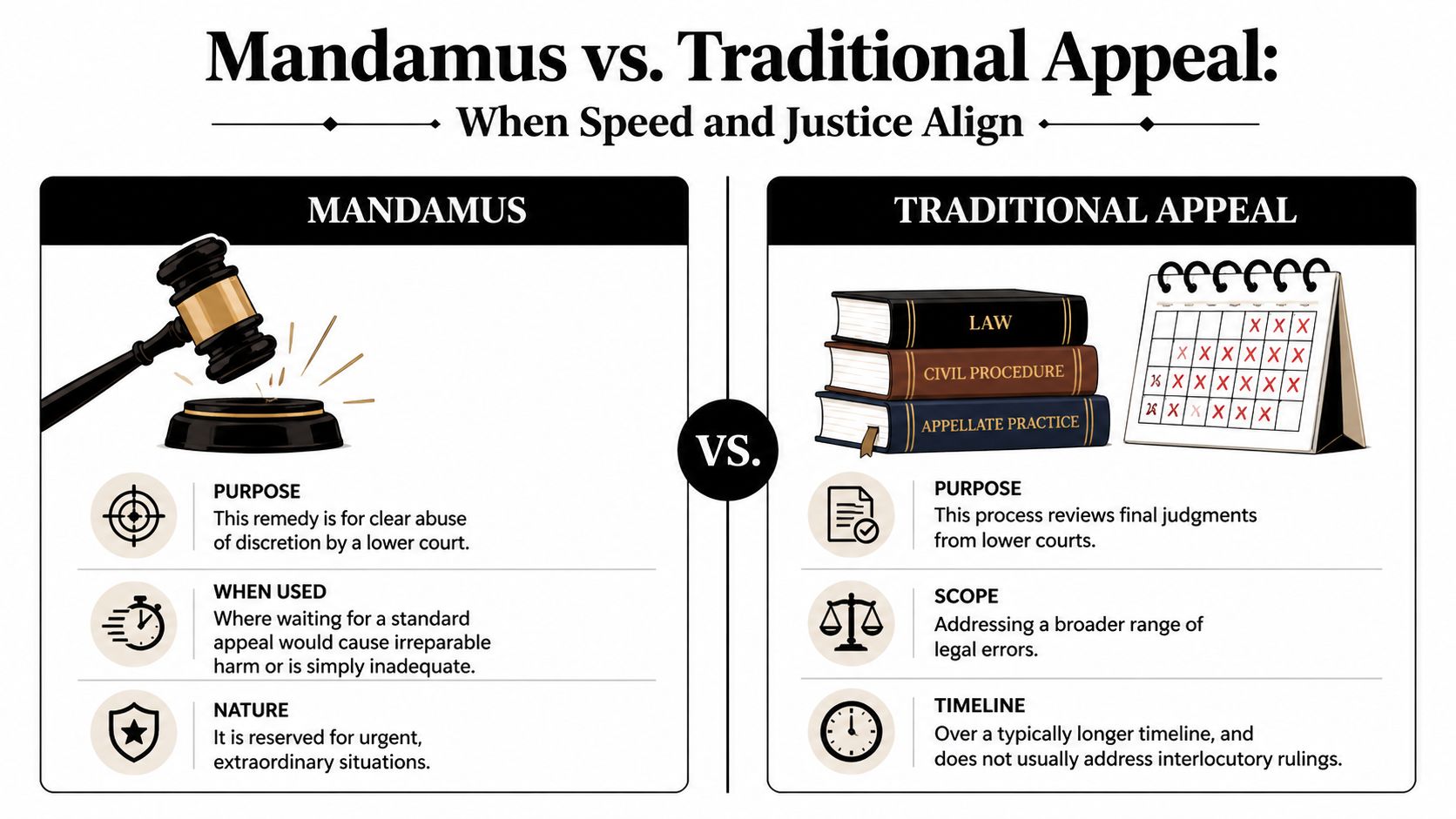
In practical terms, mandamus usually rises or falls on two questions:
- Did the trial court clearly abuse its discretion?
- Is a regular appeal inadequate to fix the harm?
Texas courts treat abuse of discretion as more than a bad call. Texas precedent recognizes that a court has no discretion in determining the law or applying law incorrectly to facts. The same body of family-law mandamus precedent also identifies recurring categories where mandamus may be appropriate, including rulings on jurisdiction, temporary receivership orders, improper discovery rulings, certain modifications affecting a child’s primary residence, and failures to enter orders after oral rulings on the record, as discussed in this overview of Texas family-law mandamus categories.
Family law situations where mandamus often makes sense
Some examples are more likely to justify this remedy than others:
- Jurisdiction or standing errors: If the trial court moves ahead when it lacks authority, forcing the case through final judgment may waste time and money and distort the entire proceeding.
- Critical discovery rulings: If the court blocks access to evidence needed to prove hidden income, separate property, or parenting issues, waiting until after trial may be too late.
- Orders affecting a child’s primary residence: Some temporary rulings change the fundamental structure of a parent-child relationship before final trial.
- Failure to rule or failure to sign an order after an oral ruling: A case can stall, and delay itself can become harmful.
When a traditional appeal is smarter
A direct appeal is often the better route when the error can be corrected after final judgment without permanent loss. That may include evidentiary complaints, many property-division issues, or disputes where the record can be developed fully at trial and reviewed later.
Here is a simple comparison:
| Issue | Mandamus | Traditional appeal |
|---|---|---|
| Timing | During the case | After final judgment |
| Main purpose | Stop serious harm now | Correct final legal errors |
| Typical target | Narrow, urgent ruling | Broader review of final result |
| Key obstacle | No adequate remedy by appeal | Preservation and standard of review |
Some litigants also confuse mandamus with an interlocutory appeal. They are not the same. If you need a quick primer on that distinction, this guide to interlocutory appeal in Texas family law helps frame the difference.
The strongest mandamus cases usually involve a ruling that changes the case in a way no later opinion can realistically undo.
What does not work well
Mandamus is weak when the petition reads like a general complaint about unfairness. Appellate courts want a specific legal error, a tight record, and a concrete explanation of why later review won't help.
These arguments often fail:
- “The judge didn’t believe me.” Credibility disputes are usually poor mandamus vehicles.
- “The ruling is harsh.” Harsh is not the same as legally indefensible.
- “I want the appellate court to reweigh the facts.” That is usually not what mandamus does.
- “We can explain the missing details later.” You usually won’t get that chance.
The strategic question is not whether the trial court made you angry. It is whether the error is legally clear, immediately harmful, and resistant to correction by normal appeal.
The Anatomy of a Powerful Mandamus Petition
A strong mandamus filing is built, not improvised. Rule 52 of the Texas Rules of Appellate Procedure governs the process, and the court expects precision from the first page.

A petition filed in the court of appeals is typically styled “In re [Relator’s Name]” and should include the relief sought, the legal issues, supporting facts, a verified affidavit, a certified appendix or record containing relevant orders and motions, and a certificate of service. No motion for leave is required in the court of appeals, as summarized in this discussion of TRAP 52 mandamus filing requirements.
What the judges need to see quickly
An appellate panel usually reviews the petition before anyone hears oral argument, and often before any response is ordered. That means the petition must do several things fast.
- State the issue cleanly: The court should know the exact ruling challenged in a sentence or two.
- Ground the facts in the record: Every important factual statement should point to an exhibit, transcript, or order.
- Explain the legal duty: Show the rule, statute, or controlling principle the trial court failed to follow.
- Show why appeal is inadequate: This part often decides the case.
The record is the case
Clients often assume the legal argument is the whole battle. In mandamus practice, the record is often the difference between a serious petition and a fast denial.
The record may include:
- The signed order being challenged.
- The motion that led to the ruling.
- Any written response.
- Exhibits presented to the trial court.
- Reporter’s record from the hearing.
- Docket entries or related filings when they matter.
- Proof of what was requested and refused.
A complete record matters because the appellate court cannot rely on your memory, your frustration, or your summary of what happened. It relies on what the official papers and transcripts prove.
A mandamus petition without a clean record is like an appeal without a judgment. The court has nothing reliable to act on.
Appendix versus mandamus record
People often hear both terms and assume they mean the same thing. They do not.
| Term | What it usually does |
|---|---|
| Appendix | Gives the court immediate access to key documents |
| Mandamus record | Supplies the evidentiary foundation for the facts and procedural history |
The appendix is where you place the most important documents for quick review. The mandamus record is broader and supports every factual assertion that matters. If a hearing transcript contains the trial judge’s reasoning, leaving it out can sink the petition. If a motion framed the issue below, omitting it can make the petition look unpreserved or incomplete.
What a persuasive argument sounds like
The best petitions are restrained. They don't accuse. They demonstrate.
A focused mandamus argument often sounds like this:
- The Family Code or controlling case law required the court to take or avoid a specific action.
- The trial court did the opposite.
- The resulting harm cannot be repaired through a later appeal.
- Immediate relief is necessary to protect the client’s legal rights and the integrity of the case.
For family law litigants, this often turns on the abuse of discretion standard. If you want a fuller explanation of that review framework, this article on the abuse of discretion standard in Texas family law is a useful companion.
What clients can do to help
Mandamus is lawyer-driven, but clients still play a major role. The fastest way to strengthen the petition is to help gather what already exists.
- Orders and notices: Every signed order, notice of hearing, and setting notice matters.
- Hearing dates: Build a simple timeline of what happened and when.
- Exhibits given to trial counsel: Financial records, messages, school records, and prior filings may matter if they were used below.
- Questions about what was preserved: If an argument was not clearly presented to the trial court, the petition may face avoidable problems.
Speed matters, but order matters more. A rushed filing with a broken record rarely helps.
Navigating the Mandamus Timeline and Emergency Relief
Mandamus moves faster than a traditional appeal because the problems it targets are usually immediate. That does not mean every petition gets instant action. It means the court may address urgent requests on a compressed schedule.

What happens after filing
Once the petition is filed, the clerk assigns a case number and routes the matter for judicial review. The court may do one of several things:
- deny the petition without requesting a response
- request a response from the respondent
- request input from the trial judge
- issue temporary relief while it considers the petition
- set the matter for oral argument, though that is not guaranteed
Texas procedure does not impose a specific deadline for filing a mandamus petition. But delay can hurt. If you wait too long, the court may question whether the harm is urgent.
Emergency relief and temporary stays
In many family cases, the petition alone is not enough. You may also need a motion asking the appellate court to preserve the status quo while the petition is pending. Lawyers sometimes call this temporary relief, emergency relief, or a stay.
A stay can matter when:
- a child’s living arrangement is about to change immediately
- privileged or confidential material may be produced before review
- property or funds may be transferred in a way that cannot be undone
- the trial court is about to proceed on a legally defective foundation
A stay request must be concrete. The court wants to know what should be paused, for how long, and why immediate intervention is justified. Readers dealing with immediate enforcement issues often benefit from this overview of a stay of enforcement pending appeal in Texas, even though mandamus and appeal are distinct tools.
Here is a helpful video introduction to the broader appellate context:
Realistic expectations
Some clients expect a hearing within days. Sometimes the court acts quickly. Sometimes it does not. Appellate courts vary in how they handle emergency requests, and much depends on the clarity of the record and the seriousness of the claimed harm.
File fast, but file ready. An urgent petition that leaves out the order, the transcript, or the reason appeal is inadequate often loses the advantage of speed.
Counsel should be prepared for rapid response work after filing. If the court requests an answer from the other side, the schedule can move quickly. If temporary relief is denied, that does not always mean the petition itself will fail. It may indicate the panel wants a fuller response before acting.
Strategic Considerations and Common Pitfalls to Avoid
Most mandamus petitions fail because the remedy is narrow and the courts guard it carefully. In fiscal year 2024, the Texas Supreme Court granted 6 percent of petitions for writ of mandamus, consistent with historically low grant rates discussed in this review of Texas mandamus statistics. That single fact should shape how you evaluate risk, timing, and effort.

What experienced appellate lawyers screen for first
Before filing, a careful lawyer asks a few blunt questions:
| Screening question | Why it matters |
|---|---|
| Is the legal error clear? | Mandamus is weak if the law is unsettled or highly discretionary |
| Is the harm immediate and hard to repair later? | This is central to the no-adequate-remedy requirement |
| Is the record complete? | Missing material gives the court an easy reason to deny |
| Was the issue preserved below? | You need proof that the trial court had a fair chance to rule |
If one of those answers is weak, the petition becomes much harder to win.
The mistakes that sink petitions early
The most common failures are practical, not dramatic.
- Waiting too long: There may be no fixed filing deadline, but delay undermines urgency.
- Bringing a fairness argument instead of a legal one: Appellate courts correct legal errors, not general dissatisfaction.
- Skipping key record materials: If the order, hearing transcript, or motion is missing, the court may never reach the merits.
- Ignoring the adequate-remedy problem: Many petitions explain why the trial judge was wrong but do not explain why later appeal won't work.
- Overstating the case: If every dispute is framed as a constitutional crisis, credibility drops.
What works better
A serious mandamus petition usually has three qualities.
First, it is narrow. It attacks one identifiable ruling or failure to act. Second, it is record-driven. Every important fact is anchored to filed materials or transcripts. Third, it is strategic. It does not chase every error. It focuses on the one the appellate court can correct now.
This is especially important in family law because clients are often under emotional strain. They want to challenge everything at once. That instinct is understandable. It is usually not persuasive.
The best mandamus petitions read like a judge could grant them without sorting through noise.
The trade-off clients need to understand
Filing mandamus can protect a client from immediate harm. It can also lock the appellate court into an early look at your case. If the issue is not fully developed, or if the record is thin, that early review may not help.
That doesn't mean mandamus should be avoided. It means it should be chosen deliberately.
A practical framework looks like this:
- Identify the exact ruling.
- Ask whether final appeal could realistically fix the damage.
- Build the record before the window of urgency closes.
- File only when the petition can stand on its papers.
For trial lawyers, this is also a co-counsel issue. Many strong trial attorneys do excellent courtroom work but don't regularly build Rule 52 records with appellate precision. Getting appellate input early can change the outcome before the petition is ever filed.
After the Court Rules on Your Petition
The ruling usually comes as an order. Sometimes it is short. Sometimes it includes reasoning. Either way, the practical question is the same: what changes now?
If the court grants relief
When the appellate court grants mandamus relief, it typically directs the trial court to correct the error. In practice, that may mean vacating an order, entering a ruling the law requires, or revisiting the issue under the correct legal standard.
Granting relief does not end the family case. It usually sends the matter back to the trial court for action consistent with the appellate court’s direction. The litigation continues, but on a corrected procedural or legal footing.
If the court denies relief
A denial is frustrating, but it is not always a merits endorsement of the trial judge’s ruling. A denied mandamus petition does not bar a later appeal on the same issue after final judgment, though it can signal skepticism from the appellate court. It also does not create a precedential merits ruling for trial purposes. Preservation still matters, and issues need to be properly raised under the rules, as explained in this discussion of mandamus denial and later appeal in Texas practice.
What should happen next
After a denial, counsel should usually make a calm assessment of three things:
- Preservation: Is the issue still being raised clearly in the trial court?
- Case posture: Does the case now need to move efficiently toward final judgment?
- Alternative relief: Is there another procedural vehicle or a narrower renewed request if circumstances change?
For clients, the key point is that a denial does not erase the issue. But it does require disciplined planning. Trial strategy and appellate strategy must stay aligned. If the issue may matter in a later direct appeal, the record still has to be protected from that point forward.
Seek a Fair Outcome with Experienced Appellate Counsel
A petition for writ of mandamus in Texas family court can be powerful, but it is not a general-purpose fix for every unfair ruling. It works best when the trial court made a clear legal error, the harm is immediate, and a regular appeal cannot do the job later. It fails when the argument is broad, emotional, unsupported by the record, or filed too late to look urgent.
That is why mandamus requires more than speed. It requires judgment. A good appellate lawyer has to know when to press hard, when to preserve the issue for later appeal, and when a trial-court solution is still the better move.
Family law litigants are often balancing fear, urgency, and exhaustion. Parents worry about time with their children. Spouses worry about property, support, or protective orders. Trial attorneys may need a second set of eyes on whether a difficult ruling should go upstairs now. In each of those situations, strategy matters more than volume.
If you believe the court made a mistake in your family law case, the right next step is a focused review of the ruling, the record, and the available appellate paths. That review should be candid. Sometimes mandamus is the right move. Sometimes a standard appeal is stronger. Sometimes the case needs additional preservation before either option is ready.
If you believe the court made a mistake in your family law case, our appellate attorneys can help you seek a fair outcome. Contact The Law Office of Bryan Fagan, PLLC today for a free consultation.