You may feel like the judge in your family case didn’t listen, didn’t care, or crossed a line. When the order affects where your child lives, how your property was divided, or whether a protective order stays in place, that feeling is hard to separate from the legal reality.
The problem is that Texas law treats two very different complaints in two very different ways. One path challenges the result. The other challenges the judge’s conduct. If you confuse them, you can lose time, miss deadlines, and aim your case at the wrong target.
A strong strategy for a judicial misconduct appeal texas family court matter starts with one question. Are you trying to change the judgment, hold the judge accountable, or both?
Is It Judicial Misconduct or Reversible Legal Error?
Many clients describe the same experience in different words. “The judge was unfair.” “The judge ignored my evidence.” “The judge was clearly on the other side’s side.” Those reactions matter, but appellate strategy depends on translating them into the right legal category.

What judicial misconduct means
Judicial misconduct is an ethical problem. It usually involves a violation of the judge’s duties of impartiality, fairness, or proper courtroom conduct under the Texas Code of Judicial Conduct.
Examples can include:
- Improper bias or partiality toward one side
- Ex parte communication, which means discussing the case with one side without the other side present
- Conflicts of interest that should have been disclosed
- Abusive courtroom behavior that suggests the judge abandoned neutrality
The State Commission on Judicial Conduct does investigate those complaints, but it cannot reverse your custody order, divorce decree, or support ruling. Its FAQ also states that it dismisses over 90% of complaints that lack evidence of willful misconduct, and that wrong custody or support decisions are usually matters for appeal, not discipline, as explained in the Texas judicial conduct FAQ.
What reversible legal error means
A reversible error is a mistake that affected the outcome of the case. This is what appellate courts review.
In plain English, a reversible error is not just something frustrating. It’s a legal mistake serious enough that the appellate court may order relief.
Common examples in family court include:
- Applying the wrong legal standard in a custody or property case
- Admitting or excluding important evidence in a way that harmed the case
- Ignoring required statutory findings
- Entering a ruling without support in the record
- Violating procedure in a way that affected a party’s rights
A related phrase you’ll often hear is abuse of discretion. That means the trial judge acted unreasonably, arbitrarily, or without following guiding legal rules. Family law appeals often rise or fall on that standard. If you want a fuller explanation, review reversible error in Texas family court.
Practical rule: If you want to change the order, you usually need an appeal or, in the right situation, mandamus. If you want discipline for unethical conduct, that points toward a misconduct complaint.
How to sort your own facts
A few examples make the distinction clearer.
If a judge refused to consider testimony that was properly offered and central to a custody dispute, that may be legal error.
If a judge privately communicated with the opposing lawyer about your case, that may be misconduct.
If a judge ruled against you after hearing both sides and you believe the ruling was wrong, that is usually not misconduct. It may still be appealable, but the argument is about legal error, not ethics.
If a judge made comments that show actual bias or treated one side by a different set of rules, the facts may support both tracks at once. One filing seeks review of the judgment. A separate complaint asks the Commission to review the judge’s conduct.
Why this distinction matters early
The first days after a final order matter. Appeals run on strict deadlines. Misconduct complaints do not replace those deadlines.
That’s why the safest approach is to identify the problem with precision. The law does not reward broad accusations. It rewards a clean record, a defined legal issue, and a filing that asks the right court or agency for the right remedy.
Preserving the Record Your Foundation for a Successful Appeal
A parent leaves court convinced the judge ignored key testimony, cut off cross-examination, and signed an order that makes no sense. On appeal, none of those points helps unless the trial record shows exactly what happened, what objection was made, how the judge ruled, and where the harm appears in the file.
That is the hard part many clients do not hear early enough. An appeal challenges the record that already exists. A misconduct complaint to the State Commission on Judicial Conduct serves a different purpose. It can address ethical wrongdoing, but it does not repair a weak appellate record or change the judgment. If the goal is to correct the order, record preservation is the foundation.
What preserving error actually requires
Preserving error means giving the appellate court something it can review under Texas procedure. In most family cases, that takes three things: a timely and specific objection or request, a ruling or refusal to rule, and a record that shows the complained-of event mattered to the outcome.
Details matter here.
If the judge excluded testimony, the record must show what the witness would have said. If the judge admitted objectionable evidence, counsel must state the legal basis with enough precision to preserve the complaint. If findings are required or strategically useful, they must be requested on time and in the correct form.
Appellate courts decide issues from the clerk’s record and reporter’s record, not from a party’s memory of an unfair hearing.
Where family law appeals commonly fail
In practice, record-preservation problems usually show up in a few predictable ways:
- The objection came too late. Once the testimony is in, the complaint may be waived.
- The objection was too general. “Objection” alone often preserves nothing.
- No offer of proof was made. If excluded evidence is not described on the record, the appellate court cannot assess the harm.
- Counsel did not secure a ruling. An unanswered objection is often not enough.
- The brief does not tie the argument to the record. Even a strong legal issue can fail without pinpoint citations and a clear preservation trail.
For a fuller explanation of the mechanics, see preserving error for appeal in Texas family court.
Findings of fact can shape the entire appeal
Bench trials in family court create a recurring problem. The judge may reach a result without clearly stating which facts drove the decision. A timely request for Findings of Fact and Conclusions of Law can narrow that uncertainty and give the appellate lawyer defined targets.
That often matters in custody disputes, property characterization fights, support cases, enforcement proceedings, and protective-order hearings built on sharply disputed testimony. Without findings, the trial court may receive broader deference on appeal. With findings, the legal attack becomes more precise.
I often tell clients that findings do not guarantee a better appeal. They do give the appeal structure, and structure is what allows an appellate court to identify reversible error instead of guessing at the basis for the ruling.
Building a record your appellate lawyer can actually use
A usable appellate file includes more than a transcript. It should contain the pleadings, admitted and excluded exhibits, written motions, objections, temporary orders, requests for findings, final orders, and all hearing records needed to show preservation and harm.
Organization counts, especially in family cases with multiple hearings and heavy exhibit practice. Services that handle court-ready document production, such as specialized legal printing solutions, can help keep large records and briefing materials in a format an appellate team can work with efficiently.
The practical takeaway is simple. If you may need appellate review, start building the record while the trial court still has the case. Once the hearing ends and deadlines start running, there is far less room to fix what was never preserved.
Choosing Your Path Appeal vs Writ of Mandamus
Some family court rulings can wait for review after a final judgment. Others can’t. If a temporary ruling is causing immediate harm, waiting may defeat the point.
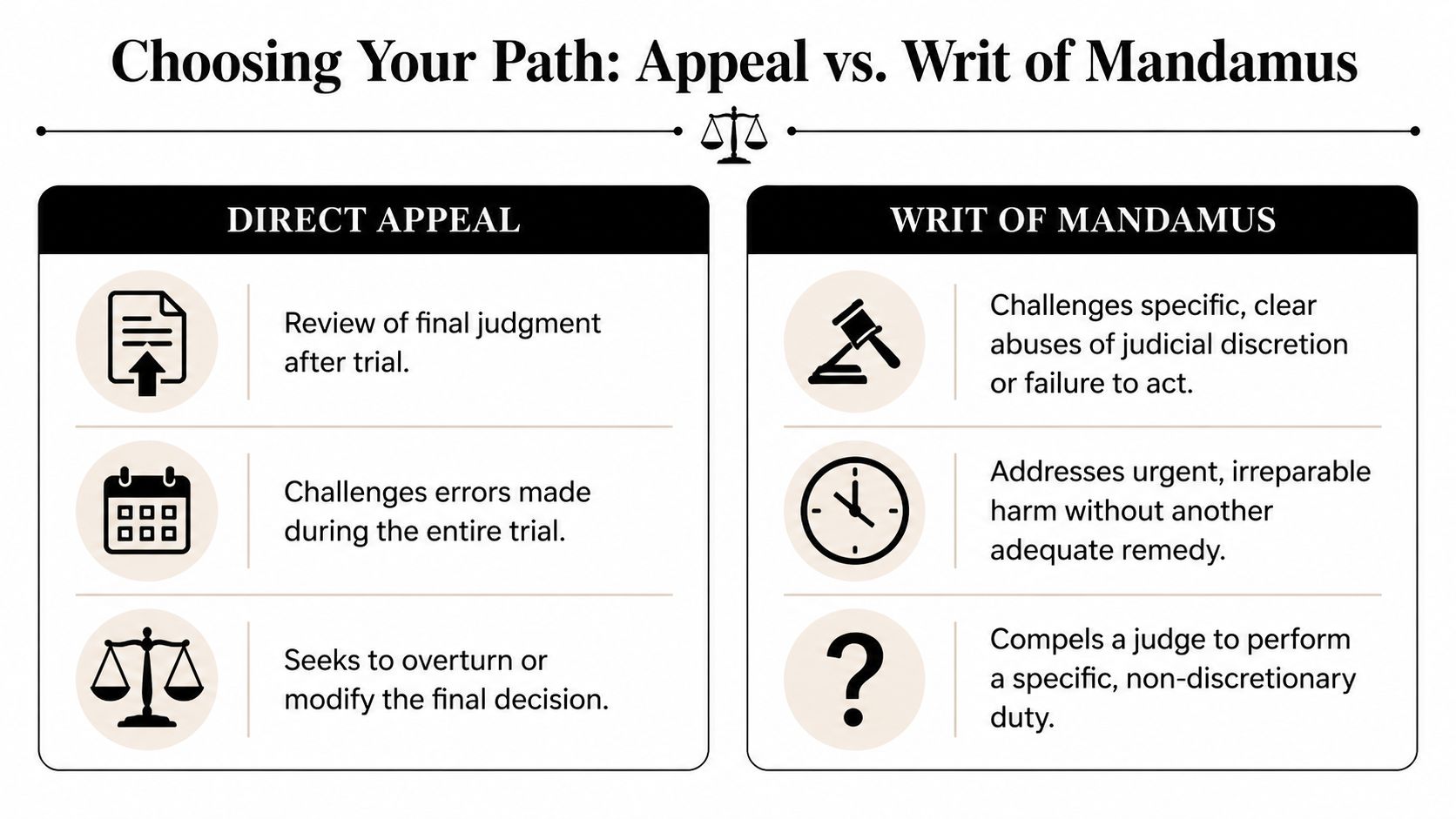
That is where clients often hear two terms at once. Direct appeal and writ of mandamus. They are related, but they are not interchangeable.
Direct appeal
A direct appeal usually challenges a final judgment. In family law, that may be a final divorce decree, a final SAPCR order, a final modification order, or a final enforcement judgment.
The appellate court reviews what happened in the trial court and decides whether reversible error occurred. If it did, the court may reverse, remand, or in some cases render a different judgment.
Writ of mandamus
A writ of mandamus is an extraordinary remedy. It asks the appellate court to correct a clear abuse of discretion or compel the trial court to perform a legal duty when there is no adequate ordinary remedy.
Mandamus often comes up in urgent situations involving:
- severe discovery abuse
- refusal to rule
- certain temporary or interlocutory orders causing immediate harm
- action outside the trial court’s authority
The key question is not whether the order feels unfair. The question is whether waiting for final judgment would leave you without an adequate remedy.
Side-by-side comparison
| Factor | Direct Appeal | Writ of Mandamus |
|---|---|---|
| Typical target | Final judgment | Specific serious ruling or failure to act |
| Timing | After final order is signed | During the case, when urgent review is needed |
| Main purpose | Correct reversible error in the judgment | Stop or correct a clear abuse of discretion with no adequate appellate remedy |
| Record reviewed | Trial court record and briefing | Mandamus record prepared for the appellate court |
| Best fit | Divorce decree, final custody order, final property division | Certain temporary orders, discovery rulings, refusal to perform a duty |
Why the choice matters
Texas appellate courts have been strict about jurisdiction. The Texas appellate jurisdiction discussion in family cases notes a 15% increase in family law interlocutory appeals dismissed for lack of jurisdiction in the past year. That matters because many parents try to appeal temporary orders that are not yet appealable.
A temporary custody ruling, temporary support order, or interim enforcement ruling may feel final in day-to-day life. Legally, though, it often isn’t. Filing the wrong vehicle can waste precious time.
A bad temporary order doesn't automatically create a right to immediate appeal. In some cases the proper tool is mandamus. In others, the issue must wait for appeal after final judgment.
A practical decision lens
Ask these questions:
Is there a final judgment?
If yes, a direct appeal is usually the starting point.Is the harm immediate and hard to repair later?
If yes, mandamus may need to be evaluated.Does the complaint involve the judge refusing to perform a legal duty or entering an order outside proper authority?
That can point toward mandamus.Are you trying to attack a temporary order just because it is unfavorable?
That usually is not enough by itself.
For a closer look at this extraordinary remedy, see mandamus in a Texas family law case.
Navigating the Texas Family Law Appellate Process
A parent leaves the courthouse after a final order, convinced the judge ignored the law, cut off testimony, or favored the other side. The next question is usually the same. "How do I fix this?" In Texas family cases, the answer starts with a hard distinction. An appeal can change the judgment. A misconduct complaint cannot. The appellate process is the path that can set aside, reverse, or send back the trial court's ruling.

The process starts fast
Once the trial court signs a final judgment, appellate deadlines begin running immediately. In the ordinary case, the Notice of Appeal is due within 30 days. Miss that deadline and the court of appeals may never reach the merits, no matter how troubling the hearing felt.
Then the case shifts from live testimony to record assembly. The clerk's record includes pleadings, motions, orders, and filed exhibits. The reporter's record contains the hearing and trial transcripts. If a complaint about judicial conduct affected the result, that problem still has to be shown through this record. Appellate judges do not retry the case from memory or accusation.
Briefing usually decides the case
Clients often expect the turning point to be oral argument. In family appeals, the brief usually carries far more weight.
The written brief has to do several jobs at once. It identifies the legal issues, ties them to the preserved record, applies the right standard of review, and explains why the error probably caused an improper judgment. A weak brief that raises ten scattered complaints usually performs worse than a focused brief built around two or three strong issues.
The sequence is usually:
- Appellant's brief. The party challenging the judgment files the opening argument.
- Appellee's brief. The other side answers and defends the ruling.
- Reply brief. The appellant responds to new points raised in the answer.
As noted earlier, the briefing schedule moves quickly once the record is filed. Good appellate counsel usually starts outlining issues before the record is complete, then refines the argument once every volume and transcript is in hand.
Standards of review control how the court looks at the case
An appeal is not a second chance to argue that the trial judge should have believed one witness over another. The court of appeals asks a narrower question. Did the trial court commit reversible error under the governing standard of review?
That standard often decides the strength of the case before the first brief is filed.
In family law, abuse of discretion appears often, especially in conservatorship, possession, support, and other rulings where trial judges have room to make judgment calls. That does not mean anything goes. A judge still must apply the correct law, consider proper evidence, and stay within the bounds of reasoned decision-making.
Other issues may turn on legal sufficiency, factual sufficiency, statutory interpretation, or procedural compliance. For example:
- Custody and visitation disputes often focus on whether the court misused its discretion or acted without enough evidentiary support.
- Property division issues may involve legal error, valuation problems, or an unequal division unsupported by the record.
- Support and enforcement disputes often rise or fall on statutory procedure, notice, and findings.
- Protective order appeals may focus on evidentiary rulings, due process problems, or the absence of legally sufficient proof.
The real work is issue selection
A strong appeal is rarely the loudest one. It is the one that isolates the rulings that affected the judgment.
That takes discipline. Some clients want every unfair moment included. I understand that instinct. Family court is personal, and many parties leave feeling unheard. But appellate courts do not grade the entire proceeding for fairness in the abstract. They decide identified legal errors based on a written record. Adding weak issues can dilute the strong ones.
This is also where the two-track problem becomes practical. If the concern is that the judge acted improperly, counsel has to ask two separate questions. First, did the conduct create a reversible legal error that can support relief on appeal? Second, does the conduct also justify an administrative complaint to the State Commission on Judicial Conduct? Sometimes the answer is yes to both. Only the first path can change the order in your case.
A short overview of appellate timing and strategy can also help put the process in context.
What the process usually feels like for clients
The pace is slower than trial practice, and the work is more exacting. Months can pass while records are filed, briefs are prepared, and the court reviews the case. Many appeals are decided on the briefs alone.
That slower pace can be frustrating, especially when children, support obligations, or enforcement consequences remain in play. Still, speed is not the only goal. Precision is. Effective appellate work means reading the entire record carefully, checking every preservation point, and building arguments judges can verify line by line.
Strong appeals identify the ruling that changed the outcome, tie it to the record, and show exactly why Texas law requires correction.
Understanding the Remedies What a Successful Appeal Achieves
Winning an appeal does not always mean the appellate court gives you the final result you wanted that same day. In family law, a successful appeal often changes the legal path first. The practical outcome may come later.
That is important in custody cases, property cases, and enforcement disputes where clients understandably want a clean fix.
Reversal and remand
The most common appellate remedy is reversal and remand. That means the appellate court found a significant error and sends the case back to the trial court for further proceedings.
In practical terms, remand can mean:
- a new hearing on a specific issue
- a new trial on part of the case
- instructions for the trial court to apply the correct law
- reconsideration after excluded evidence or missing findings are addressed
For a parent, that may mean another conservatorship hearing. For a divorcing spouse, it may mean a new look at property division or support.
Reversal and rendition
A less common result is reversal and rendition. That means the appellate court not only finds error, but also enters the judgment the trial court should have entered.
This usually happens when the law points clearly to one outcome and the appellate court doesn’t need more fact-finding from the trial court.
Other possible outcomes
Not every appeal ends in a full win or full loss. Depending on the issue, the court may:
- affirm some parts of the judgment and reverse others
- modify a portion of the judgment
- send a narrow issue back while leaving the rest intact
That matters because family cases are often made of separate pieces. A court may uphold the divorce itself but require new proceedings on custody. It may leave most of a property division in place but reverse one component.
What this means for expectations
Clients should think of an appeal as a tool to restore lawful process. Sometimes that produces a different final outcome. Sometimes it produces a new hearing before the proper legal standards are applied.
Appellate success often means a second chance under fair rules, not an instant substitute judgment on every disputed fact.
That can still be a major result. In family law, process and outcome are closely connected. A hearing conducted under the right standard, with the right evidence and required findings, can change everything that follows.
The Parallel Path Filing a Complaint with the SCJC
Some cases involve more than legal error. A judge’s conduct may raise serious ethical concerns. When that happens, families often ask whether they should file a complaint with the State Commission on Judicial Conduct, usually called the SCJC.
The answer is sometimes yes. But it is important to understand what that complaint can and cannot do.

What the SCJC is for
The SCJC handles allegations of judicial misconduct. It is an accountability process, not an appellate court.
In fiscal year 2025, the Commission received 1,281 complaints, which was a 13% increase from the prior year, according to the SCJC fiscal year 2025 annual report. The same report makes clear that the Commission does not have appellate power to correct legal errors in custody, divorce, or similar family rulings. Those have to be challenged through the appellate process.
When a complaint may be worth filing
A complaint may make sense if the concern is ethical rather than merely legal. Examples may include:
- bias or loss of impartiality
- improper courtroom conduct
- communications or relationships that raise fairness concerns
- conduct that suggests the judge ignored ethical obligations
This path can matter even though it won’t change your order. Some clients want the judgment challenged and the conduct reviewed. Those are different goals, and Texas law treats them separately.
What the SCJC cannot do
The SCJC cannot:
- reverse a divorce decree
- change conservatorship
- recalculate child support
- vacate a property division because you think the judge got it wrong
That is the central strategic point in many judicial misconduct appeal texas family court matters. A misconduct complaint may be appropriate, but it is not a substitute for an appeal.
How the two tracks can work together
The legal appeal and the SCJC complaint can run in parallel when the facts support both. One filing asks an appellate court to correct reversible error. The other asks the disciplinary body to evaluate ethics.
That dual-track strategy works best when the facts are specific and documented. General statements that a judge was rude or unfair usually are not enough. Dates, statements on the record, rulings tied to conduct, and transcript support matter.
A calm, strategic approach usually works better than trying to turn every bad ruling into an accusation of corruption. Appellate courts respond to law and record citations. Conduct commissions respond to evidence of ethical breaches.
If you believe the court made a mistake in your family law case, or if a judge’s conduct crossed an ethical line, careful appellate review can help you decide the right path. The Law Office of Bryan Fagan, PLLC helps Texas families evaluate appeals, mandamus options, and related judicial misconduct concerns with a clear, practical strategy. Contact the firm today for a free consultation.