You may feel like the judge’s temporary ruling changed your life in a single hearing. Your parenting time shifted. Support was set at a level you believe the record doesn’t support. A business was put at risk. You walked out of court thinking, “This cannot be right.”
That reaction is common. It’s also where many people get stuck.
Texas family cases often move through a series of temporary rulings before the court signs a final judgment. Some of those rulings feel final in every practical sense, even when the law treats them as temporary. That gap between lived reality and legal procedure is what makes this area so frustrating.
Still, an unfair order is not always the last word. In a narrow set of circumstances, Texas law allows immediate review before the whole case ends. That tool is the interlocutory appeal. It is rare, technical, and strictly limited, but when it fits, it can correct a serious legal mistake before the damage hardens into a final decree.
Those who search for interlocutory appeal texas family law are not looking for theory. They want to know one thing. Is there anything I can do right now?
Sometimes the answer is yes. Sometimes the better answer is mandamus. Sometimes the only sound move is to preserve the issue carefully and prepare for a final appeal. The hard part is choosing the right vehicle early, before a deadline or procedural rule closes the door.
An Unfair Ruling Can Feel Like the Final Word But It May Not Be
A parent comes to appellate counsel after a temporary hearing. The judge changed possession, limited access, and entered support provisions the parent believes were based on incomplete or mistaken information. The parent’s first instinct is simple and understandable. Appeal it now.
In many Texas family cases, that instinct runs into a procedural wall. The law usually requires parties to wait until the trial court signs a final judgment before seeking appellate review. That rule can feel disconnected from the actual harm caused by a temporary order. But Texas courts enforce it because they do not want every interim ruling to stop the underlying case.
What matters now is not how unfair the ruling felt, but what type of order was signed and whether Texas law gives the appellate court jurisdiction to review it immediately. Jurisdiction means the court’s legal power to hear the matter. If jurisdiction is missing, the appellate court will dismiss the case even if the complaint seems compelling.
That is why early strategy matters. A rushed filing can waste time and money. A targeted review of the order, the statute, and the record can identify whether the right path is an interlocutory appeal, a petition for writ of mandamus, or a final appeal after judgment.
A painful ruling and an appealable ruling are not always the same thing.
The legal system does offer tools to correct serious error. The challenge is using the right one at the right time.
What Is an Interlocutory Appeal in Texas Family Law
An interlocutory order is a ruling made while the case is still ongoing. It does not dispose of every claim and every party. A final judgment does. That difference controls whether you can appeal right away.
A simple analogy helps. A final appeal challenges the final score after the game ends. An interlocutory appeal challenges a specific call before the game is over. Texas law allows that only in limited situations because courts do not want constant interruptions during active litigation.

Finality matters more than the order’s impact
Clients often say, “But this order changed everything.” That may be true in practical terms. It may still be interlocutory in legal terms.
In plain English, finality means the court has finished deciding the case. If issues remain pending, the order is usually not final. In family law, temporary orders often govern possession, support, use of property, or day-to-day conduct while the suit continues. Those rulings can be serious, but seriousness alone does not make them immediately appealable.
General rule: In Texas family law, temporary orders during divorce proceedings usually cannot be appealed before final judgment.
Texas Family Code § 6.507 bars interlocutory appeals from temporary orders in divorce cases except for orders appointing a receiver, and one practitioner source states that 90-95% of temporary family law orders are not immediately appealable in practice, forcing parties to wait unless a narrow exception applies, as discussed in this Texas family appellate jurisdiction overview.
What jurisdiction means for your case
If an appellate court lacks jurisdiction, it cannot reach the merits. It doesn’t matter how strong the facts seem. It doesn’t matter how urgent the family situation feels. The court must first decide whether a statute authorizes review.
That point surprises many people because appellate procedure feels backward at first. The first question is not “Was the judge wrong?” The first question is “Can this court review this order now?”
A short checklist helps:
- Identify the order exactly. Read the signed order, not just the hearing result.
- Ask whether the case is over. If not, the order is likely interlocutory.
- Check for statutory authorization. Immediate appeals exist only when a statute allows them.
- Watch for Family Code limits. Family law has its own restrictions that can override broader civil rules.
Why this area is so often misunderstood
Trial hearings move fast. Orders are sometimes signed after emotionally charged disputes about children, money, or control of property. Clients leave court feeling the ruling must be challengeable immediately because the consequences are immediate.
The law doesn’t work that way. In the interlocutory appeal texas family law context, the better approach is disciplined and technical. Determine whether the order falls inside a narrow statutory exception. If it does not, consider whether mandamus is the proper emergency tool. If neither fits, preserve the issue and build the record for final appeal.
The Narrow Gates Permitted Interlocutory Appeals
A parent can walk out of a hearing feeling the case just turned upside down, then learn that immediate appeal is still unavailable. That result feels wrong, but it reflects how Texas appellate jurisdiction works. Interlocutory review is the exception, and in family cases the exception is often narrower than clients and trial lawyers expect.
Texas courts can hear an interlocutory appeal only when a statute authorizes it. In practice, that means the analysis starts with the exact order signed, then moves to the statute that might permit immediate review, and then to any Family Code provision that limits that route. If any part of that chain fails, the court of appeals will dismiss for lack of jurisdiction.
Family law creates some of the hardest calls because the harm is immediate, but the path to review often is not. That is why lawyers must distinguish between a true interlocutory appeal, a petition for writ of mandamus in a Texas family law case, and issues that must wait for final appeal.

Statutory gateways that sometimes matter
Texas Civil Practice and Remedies Code § 51.014 lists categories of interlocutory orders that may be appealed. Some categories matter more often than others in family-related disputes. Orders involving special appearances can be one example. Certain injunction rulings can be another. The label on the order is not enough. Courts look to what the order does.
That distinction matters. A ruling that effectively decides jurisdiction over an out-of-state parent may fit a recognized statutory path. A temporary order about possession, support, or day-to-day case management usually will not, even if the practical effect is severe.
The work here is technical. Read the signed order line by line. Match it to the statute. Then check whether the Family Code closes a door that would otherwise be open in ordinary civil litigation.
The family law limit that surprises many people
Texas Family Code § 6.507 is blunt in divorce cases. Temporary orders are generally not subject to interlocutory appeal, except an order appointing a receiver. That single exception can matter a great deal in cases involving a family business, disputed control of accounts, rental properties, or other income-producing assets.
A receivership order can change who controls property before trial. That is why the statute treats it differently.
Clients often ask whether other temporary property rulings fall into the same category. Usually they do not. The question is not whether the order is serious. The question is whether the order fits the exact statutory authorization.
Urgency does not create appellate jurisdiction. A statute does.
Permissive interlocutory appeals are narrower still
Texas also allows permissive interlocutory appeals under § 51.014(d), but this route is selective and procedurally demanding. The order must present a controlling question of law. There must be substantial ground for difference of opinion. The trial court must sign a certification order. The court of appeals must then agree to accept the appeal.
That tool works best when the dispute turns on a pure legal issue that could materially shape the rest of the case. It is a poor fit for fact disputes, credibility fights, or complaints that the judge weighed the evidence the wrong way. A close look at permissive appeals under Texas law appears in this discussion of interlocutory appeals in Texas.
Recent changes to Texas permissive appeal procedure may increase accountability in how denials are handled, but they do not change the basic reality. Trial court certification is still required. Appellate acceptance is still discretionary. Most family cases still will not qualify.
Signs a permissive appeal may be worth serious review
- The issue is legal on its face. The dispute turns on statutory interpretation, jurisdiction, or another legal question that does not depend on resolving conflicting testimony.
- The answer could materially affect the case. An early ruling could avoid a wasted trial, narrow the issues, or determine whether the case belongs in that court at all.
- The trial judge is prepared to certify the order. Without certification, the process usually ends before it begins.
- The record frames the issue cleanly. Appellate courts are more willing to consider early review when the legal question is sharply presented and not tangled in undeveloped facts.
Interlocutory Appeal vs Mandamus vs Final Appeal
When clients ask about immediate review, they usually mean one of three very different things. An interlocutory appeal is a statutory appeal of a non-final order. A writ of mandamus is an extraordinary request asking the appellate court to order the trial judge to correct a clear abuse of discretion or perform a required duty. A final appeal challenges the judgment after the case is over.
The right choice depends on the order, the harm, and the available remedy.
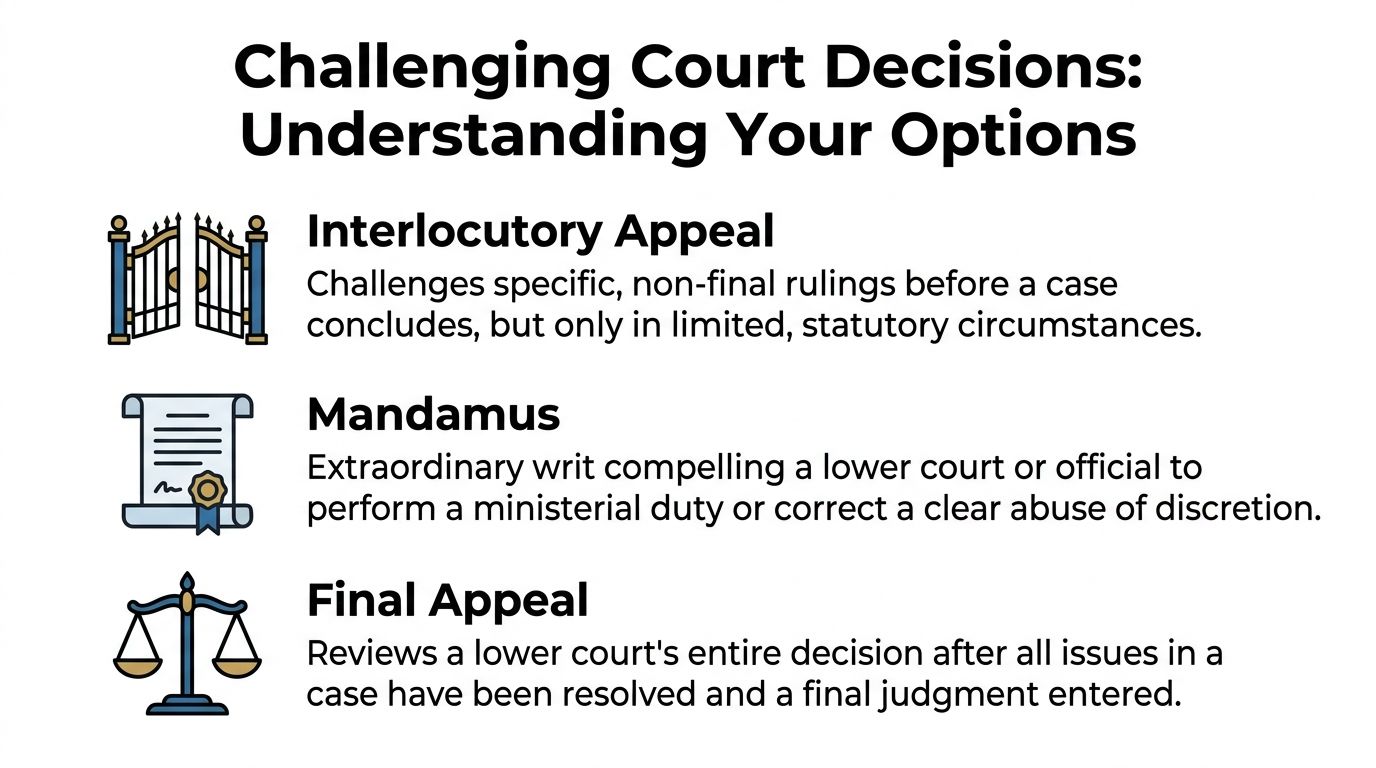
Choosing Your Path to Justice Appeal vs. Mandamus
| Feature | Interlocutory Appeal | Writ of Mandamus | Final Appeal |
|---|---|---|---|
| What it challenges | A non-final order that a statute makes immediately appealable | A clear abuse of discretion or failure to perform a legal duty when no adequate remedy at law exists | The final judgment after all issues are resolved |
| When it is filed | During the case, on a compressed deadline | During the case, when urgent appellate intervention is justified | After final judgment is signed |
| Main hurdle | Proving the order fits a statutory category | Proving no adequate remedy at law and a clear abuse of discretion | Preserving error and showing reversible error in the final judgment |
| Typical use in family cases | Rare and tightly limited | Emergency review of serious temporary-order problems when appeal is unavailable | The standard path for most family-law errors |
| Timeline | Accelerated by rule and statute | Often faster than final appeal | Usually slower because the whole case must finish first |
When mandamus becomes the real option
If an interlocutory appeal is not available, mandamus may be the only route for early review. This is common when a temporary custody or support ruling causes immediate harm but is not statutorily appealable.
Mandamus is not a substitute for ordinary disagreement with the trial judge. It requires a clear abuse of discretion and no adequate remedy at law. In plain English, abuse of discretion means the judge acted outside the range of lawful choices. It does not mean the appellate court would have ruled differently.
According to the Texas Family Code resource discussing temporary-order limitations and alternatives, mandamus in family cases can move faster than a final appeal, with a 4-6 month timeframe compared with 12-24 months for a final appeal, but grant rates are often below 20-30% because the standard is demanding.
For a deeper look at that remedy, see this guide on mandamus in a Texas family law case.
Practical rule: If the order is not immediately appealable by statute, filing a notice of appeal may get you dismissed. The better question is whether the facts support mandamus or whether the issue should be preserved for final appeal.
What usually works and what usually doesn’t
What works is matching the complaint to the correct procedural vehicle. What doesn’t work is trying to force every unfair temporary order into an interlocutory appeal just because the consequences feel immediate.
A strong strategy often looks like this:
- Use interlocutory appeal when a statute clearly authorizes it.
- Use mandamus when the order causes serious harm and ordinary appeal is not an adequate remedy.
- Use final appeal when the issue can be reviewed after judgment and the record needs fuller development.
Real-World Scenarios for Interlocutory Review
A judge signs an order on Friday afternoon that puts a receiver over the family business, keeps an out-of-state parent in a Texas case, or imposes restraints that function like an injunction. By Monday, the client wants to know one thing. Is there any way to stop this now?
Sometimes, yes. But the answer depends less on how unfair the ruling feels and more on what the order is under Texas procedure. That is the discipline in this area. The right tool can correct a serious error early. The wrong tool can waste time, money, and a deadline.
Real cases usually fall into a few recurring patterns.
A receiver is appointed over a family business
This is one of the clearest candidates for interlocutory review in a divorce case. If the trial court appoints a receiver to take control of a closely held business, the consequences start immediately. Payroll, vendor relationships, customer confidence, and day-to-day control can shift before the larger property dispute is ever tried.
Texas family law expressly preserves interlocutory review of some receiver appointments. In practice, the appeal usually focuses on whether the legal basis for receivership was established, whether less drastic measures were available, and whether the order is drawn narrowly enough to protect the estate without handing one side a litigation advantage.
That last point matters. A receiver can preserve assets, but a poorly supported receivership can also change settlement pressure overnight.
The court denies a special appearance
An out-of-state spouse or parent may challenge whether a Texas court has personal jurisdiction at all. If the trial court denies that special appearance, early appellate review may be available because the issue is not only whether the judge made a bad call. The issue is whether the court has authority to make any call against that party.
That distinction changes strategy. If jurisdiction is lacking, waiting for a final appeal can force a party through months of litigation, expense, and intrusive discovery in a court that should never have exercised power over them in the first place. Trial counsel should read the order and the jurisdictional record with care, then compare the case against the available paths under Texas appellate procedure in family law cases.
A temporary order operates like an injunction
Family courts often enter temporary restrictions. Some are ordinary case-management rulings. Others effectively restrain conduct or control property in a way that resembles injunctive relief.
Labels do not decide appealability. Substance does.
If an order freezes accounts, bars business activity, restricts transfers, or imposes conduct restraints that fit a statutory category for interlocutory review, counsel should analyze the order line by line. A court may call something a temporary order, but the appellate question is whether the order falls within a category the Legislature made immediately appealable.
The real problem is due process or a missing legal foundation
Early review questions often turn on a small set of recurring defects. The judge may have applied the wrong statute. A party may have had no meaningful notice of the relief granted. The order may reach beyond the pleadings. The record may not support the remedy imposed. Sometimes the court acts before the factual or jurisdictional foundation is in place.
Those are not abstract appellate complaints. They are often the difference between an order that can stand and one that should be corrected quickly.
Good lawyers also keep the record in mind from the start. Even in emergency conditions, dates, filings, hearing settings, and signed orders have to be tracked with precision. Basic legal docketing discipline often determines whether a strong complaint can be heard at all.
When interlocutory appeal is the wrong vehicle
Some painful rulings still do not qualify for interlocutory appeal. A temporary possession schedule may be highly unfair. A support figure may be unsustainable. A discovery ruling may tilt the case in harmful ways. Those orders may justify aggressive action, but not necessarily this form of review.
That is where strategy matters more than frustration. If the statute authorizes interlocutory appeal, use it. If the harm is immediate and ordinary appeal is not an adequate remedy, mandamus may be the better fit. If the issue needs a fuller record or can be corrected after judgment, preserve it carefully for final appeal.
Clients usually want the fastest path. Sometimes the fastest filing is not the one that gives them the best chance to fix the error.
Navigating the Interlocutory Appeal Process
A parent can leave a hearing feeling blindsided, only to learn that the order signed that afternoon triggered an accelerated appellate clock. By the time trial counsel is still sorting out what happened, the deadline for early review may already be running.

Interlocutory review rewards speed, precision, and restraint. It is not a second chance to argue the whole case. It is a tightly controlled process for correcting a specific ruling now, before the case reaches a final judgment. If the wrong vehicle is chosen, the client loses time and money. If the right vehicle is chosen but the deadline or record is mishandled, the court may never reach the merits.
Step one is protecting the deadline
Many interlocutory appeals run on a much shorter deadline than a standard appeal. In many situations, the notice of appeal is due within 20 days after the order is signed. The signed order matters more than the judge's oral comments. Appellate courts measure jurisdiction from the written order, not anyone's recollection of the hearing.
That is why I tell clients and trial lawyers to get the file organized immediately. The order, the date it was signed, any notice of entry, and any related motions all need to be confirmed the same day if possible. A missed date can turn a strong legal complaint into a dismissed appeal.
A disciplined calendaring system helps avoid preventable losses. For a plain-English explanation of how firms track filing dates and court deadlines, this overview of legal docketing gives useful background.
Step two is building the record the court can actually review
Appellate courts decide interlocutory matters from the trial court record. They do not consider new facts because a party explains them more clearly on appeal. If a key document, objection, or exhibit never made it into the record below, counsel may have little room to repair that problem later.
The record usually includes:
- The clerk’s record. Pleadings, motions, signed orders, filed exhibits, and other papers from the trial court file.
- The reporter’s record. The transcript of the hearing and any admitted exhibits handled by the court reporter.
- Required certifications or findings. In a permissive appeal, that can include the trial court’s statement identifying the controlling legal question.
This is one of the clearest practical differences between interlocutory appeal and mandamus. An interlocutory appeal depends on an appellate record assembled under the rules for appeal. A mandamus petition often requires a mandamus record prepared in a different form and supported by sworn or certified materials. The legal question may overlap, but the procedural setup does not.
Step three is briefing a narrow legal issue
Good interlocutory briefing stays disciplined. The brief should identify the exact ruling under review, explain why the appellate court has authority to act now, cite the governing authority, and tie the argument to the specific pages of the record that matter.
Clients often want the brief to explain every unfair thing that has happened. I understand that instinct. It usually hurts more than it helps. Early review works best when the issue is framed as a clean legal error the court can correct without trying the whole family case from paper.
A few terms matter here:
- Briefing is the written argument filed in the appellate court.
- Standard of review is the rule the court uses to evaluate the trial court's decision.
- Abuse of discretion means the ruling exceeded the range of choices the law permits.
- Preservation of error means the complaint was raised properly in the trial court so the appellate court can review it.
For a fuller procedural roadmap, see this guide to Texas appellate procedure in family law.
A concise explanation from a practitioner can also help before deadlines start moving:
Step four is understanding what happens while review is pending
Filing an interlocutory appeal does not automatically freeze the entire family case. Some orders remain in effect. Some deadlines in the trial court continue. In some situations, a stay may be available by statute, by rule, or by separate request. In others, the client must keep complying with the order while the appellate court considers whether it was legally sound.
That creates a two-track problem. Trial counsel still has to protect the client in the trial court, and appellate counsel has to press the accelerated review without overstating the issue. If a stay is necessary, it should be addressed directly and quickly. If a stay is unlikely, the client needs honest advice about compliance, risk, and next steps.
Step five is matching the procedure to the problem
The process only works if the remedy fits the ruling. An interlocutory appeal is usually the best tool when a statute expressly allows immediate appeal, or when a permissive appeal has been properly certified and accepted. Mandamus is often the better option when the harm cannot be repaired through ordinary appeal and no statutory interlocutory appeal is available. A final appeal remains the right course when the issue needs a fuller record, when the order is not immediately reviewable, or when waiting does not destroy the client's rights.
That framework keeps the analysis grounded. The question is not whether the ruling feels wrong. The question is which procedure gives the appellate court lawful authority to correct it in time to matter.
Strategic Considerations When Seeking Early Review
The smartest time to involve appellate counsel is often before the order is signed, or at least immediately after the hearing. That is not about gamesmanship. It is about preserving options.
An appellate lawyer looks for problems trial counsel may be too busy to isolate in real time. Was the objection specific enough? Did the court rule on it? Is the complained-of issue legal or factual? Is there a statutory opening for immediate review, or would a mandamus petition be more realistic? Those questions shape the next move.
Early review has costs and benefits
Seeking early review can protect rights, but it also changes the rhythm of the case. It may require a fast transcript order, accelerated briefing, and intensive legal work while the underlying dispute is still active. In some cases, that cost is justified because the order affects children, control of assets, or jurisdiction itself. In other cases, the better investment is building a stronger record for final appeal.
A few strategic questions usually matter most:
- Will early review resolve a meaningful issue? If the answer would not change the practical course of the case, waiting may be wiser.
- Is the issue cleanly legal? Interlocutory review works best when the question is narrow and legal.
- What happens in the trial court while review is pending? Counsel should assess whether the order remains in effect and what must still be done.
- Has error been preserved? If not, the focus may need to shift immediately to record protection.
Preservation often decides everything
Many appeals are lost before they begin because the issue was not properly preserved in the trial court. Preservation means the party clearly raised the complaint, asked for relief, and obtained a ruling or refusal to rule.
If you want to understand that problem in practical terms, this discussion of objections required to preserve appeal in Texas is worth reading.
Strong appellate strategy starts in the trial court. The record is built there, not later.
Clients sometimes worry that pursuing review will anger the trial judge. That concern is understandable, but appellate rights exist for a reason. A respectful, well-grounded challenge is part of the legal system. The answer is not to avoid review. The answer is to pursue it carefully, selectively, and with sound judgment.
Frequently Asked Questions About Texas Family Law Appeals
Can I appeal a temporary custody order right away
Usually, no. Most temporary family-law orders are not immediately appealable. Whether there is any early-review option depends on the exact order and the statute that applies. Sometimes mandamus is the more realistic path.
How much does an interlocutory appeal cost
It depends on the record, the urgency, the complexity of the legal issue, and whether transcripts must be prepared quickly. Early appeals are often labor-intensive because the deadlines are compressed. The best way to evaluate cost is through a case-specific review.
Will the trial judge be angry if I seek review
Judges expect lawyers to use lawful procedures. A respectful appeal or mandamus petition is not misconduct. The key is choosing a challenge that has a real legal basis, not filing something that is clearly outside the court’s jurisdiction.
What are my chances of winning
No honest lawyer should promise an outcome. The answer depends on the order, the legal issue, the record, and the standard of review. Some appellate issues are strong because they involve jurisdiction or a clear legal mistake. Others are weaker because they depend heavily on disputed facts.
Can I recover attorney’s fees if I win
Sometimes fee issues can be addressed by statute, contract, or later trial-court proceedings, but there is no universal rule that a successful appeal guarantees fee recovery. That question has to be evaluated in the context of your specific case and the relief sought.
If you believe the court made a mistake in your family law case, the appellate attorneys at The Law Office of Bryan Fagan, PLLC can help you evaluate the right path forward. Whether the issue involves an interlocutory appeal, mandamus, or a final appeal, a careful review of the order, the record, and the deadlines can make all the difference. Contact the firm today for a free consultation.