You may feel your case was handled unfairly. A judge may have signed a custody order that doesn't fit the evidence, a property division may seem legally wrong, or an enforcement order may have gone too far.
That feeling matters, but so does the next step. In Texas, a final order isn't always the final word. Several forms of post judgment relief texas family court practice can correct legal error, address changed circumstances, enforce what the court already ordered, or repair a judgment entered in the wrong way.
When the Final Order Feels Unfair Understanding Post-Judgment Relief

A final order can leave people stunned. That happens in divorce cases, custody suits, child support disputes, protective order matters, and enforcement hearings. Sometimes the problem is a clear legal mistake. Sometimes the order is valid when signed, but life changes afterward and the order no longer works.
Texas law gives families more than one way to respond. The key is choosing the right tool. An appeal asks a higher court to review whether the trial court made a legal error. A modification asks the trial court to update an existing order because circumstances have changed. Enforcement asks the court to require compliance with an order already in place.
This is not unusual. In Tarrant County family courts, 20,995 post-judgment cases were disposed against 17,580 new filings in 2025, a 119.4% clearance rate, and post-judgment child support matters made up over 40% of the Title IV-D docket, according to Tarrant County family court reporting on post-judgment activity. Families often need court action long after the original decree is signed.
What post-judgment relief really means
Post-judgment relief is not one single motion. It is a category of remedies that includes:
- Appeals: Used when the trial court may have misapplied the law, excluded important evidence, made an unsupported ruling, or violated procedure.
- Motions for new trial: Used shortly after judgment to ask the same judge to reconsider.
- Modifications: Used when custody, possession, or support orders need to change because real life changed.
- Enforcement actions: Used when the other party isn't following the order.
- Clerical corrections and equitable remedies: Used in narrower situations, such as a judgment that contains a clerical mistake or a judgment affected by fraud.
Practical rule: The wrong post-judgment remedy can waste time you don't have. The legal issue must match the procedure.
What this process can and cannot do
Many clients first ask whether they can "retry" the case. Usually, the answer is no. An appeal is not a second trial. Appellate courts do not hear live testimony again or let parties start over with better evidence that could have been offered the first time.
What appellate work can do is powerful, though. It can identify legal error in the record, challenge an abuse of discretion, and seek a fair correction through the courts. When that path isn't the right one, modification or enforcement may be.
The First 30 Days Your Most Critical Window for Action

The first month after a final order is signed is often the most dangerous period for a family law case. Important deadlines run quickly. Some remedies are available only in this short window. If you wait while deciding whether the ruling "feels wrong," you can lose options that would have been available days earlier.
One of the most important tools in that period is a motion for new trial. This asks the same trial judge to revisit the judgment. It is not the same as an appeal. You are not going to a higher court yet. You are asking the judge who signed the order to correct a serious problem.
Why this window matters so much
A motion for new trial can serve several strategic purposes. In some cases, it gives the trial judge a chance to fix an error without the expense and delay of a full appeal. In others, it helps develop issues that may later matter on appeal. In still others, it extends certain appellate deadlines when properly filed.
Grounds vary by case, but common examples include:
- Newly discovered evidence: Evidence that could not reasonably have been obtained in time for trial.
- Significant legal error: The court applied the wrong law, excluded critical evidence, or entered a judgment unsupported by the record.
- Procedural unfairness: A party did not receive a fair opportunity to present the case.
- Problems affecting the integrity of the trial: In the right setting, this can include misconduct or other serious irregularities.
For many families, the practical question is simple. Should you ask the trial court to fix the problem first, or should you move directly into appeal work? The answer depends on the nature of the error, the state of the record, and the deadline calendar.
What works and what doesn't
Some motions for new trial are detailed, targeted, and tied to the record. Those can be useful. Others merely say the ruling was unfair. Those usually don't help much.
A strong post-judgment filing should identify the exact problem, connect it to the evidence or procedure, and explain the legal consequence. Vague frustration is not a legal argument. Precision is.
A short deadline changes the quality of decision-making. Waiting for emotions to settle may feel reasonable, but legally it can close doors.
Immediate steps after the order is signed
If a final order has just been signed, move quickly:
- Get the signed order immediately. Don't rely on memory from the hearing.
- Confirm the signing date. Deadlines usually run from the date the judgment or appealable order was signed.
- Preserve the file. Save exhibits, hearing notices, emails from counsel, and any draft orders.
- Request the reporter's record if needed. If testimony matters, the transcript matters.
- Evaluate whether a motion for new trial fits. This requires legal analysis, not guesswork.
If you're evaluating that option, our discussion of a motion for new trial in Texas family law explains how this remedy works and when it can support a broader appellate strategy.
The mistake people make most often
People often assume they can "come back later" if the order still seems wrong. That is risky. Some issues can still be raised later through other mechanisms, but some cannot. Delay can turn a strong procedural position into a much harder case.
The safest approach is early review by counsel who understands both trial-level post-judgment motions and appellate deadlines.
Correcting Errors vs Changing Circumstances Appeals and Modifications
A parent leaves court convinced the order is wrong. Two months later, the child’s schedule has changed, school issues have surfaced, and support no longer fits the household finances. That client often asks one question in several forms: do we appeal, or do we file to modify?
The answer depends on what went wrong, and when it went wrong.
An appeal addresses error in the original case. A modification asks the court to update an existing order because facts changed after the order was signed. Those paths can overlap in timing, but they do very different jobs. Choosing the wrong one can waste resources and, in some situations, give up a remedy that cannot be recovered.
When an appeal is the right path
An appeal is the right tool when the problem is tied to the trial court’s ruling itself. The reviewing court looks at the record already made and decides whether the judge committed legal error that affected the outcome.
That may involve issues such as:
- applying the wrong legal standard
- admitting or excluding evidence improperly
- making findings the record does not support
- signing an order the court had no authority to enter
In family cases, the standard is often abuse of discretion. That does not mean the appellate court asks whether it would have made a different call. It asks whether the trial court stayed within the range of choices the law permits.
That distinction matters. A client may have strong feelings about the result and still have a weak appeal. I often tell clients that appellate courts do not retry the case. They review the legal work reflected in the record. If error was not preserved, or if the ruling was harsh but still legally permissible, an appeal becomes much harder.
If a deadline problem is already developing, review the rules on an extension of time to file an appeal in Texas family law immediately. Timing problems sometimes can be addressed, but only within narrow limits.
When a modification is the right path
A modification starts from a different premise. It does not argue that the original judge got it wrong based on the facts then available. It argues that the current order no longer fits current circumstances.
Common modification grounds include:
- a parent’s relocation
- a significant change in income
- new medical, educational, or behavioral needs affecting the child
- a possession schedule that no longer works in practice
The legal burden is different too. The moving party usually must prove a material and substantial change in circumstances. If conservatorship, possession, or access is at issue, the court also looks closely at the child’s best interest.
That is forward-looking relief. It changes what happens next. It does not correct a legal mistake in the original judgment.
Why the distinction matters strategically
A critical trade-off often overlooked is this: appeals can correct a legal wrong, but they are confined to the existing record. Modifications allow proof of new facts, but they do not erase an earlier judicial error.
Here is the practical framework:
| Question | Appeal | Modification |
|---|---|---|
| What problem are you addressing | Legal error in the original proceeding | Changed circumstances after the order |
| What evidence controls | The trial record | Current facts and updated evidence |
| Who decides it | Appellate court | Trial court with continuing jurisdiction in most cases |
| What relief are you seeking | Reversal, remand, or other appellate relief | A revised order going forward |
Clients mix these up for understandable reasons. The same order can feel unfair and also become unworkable later. But those are separate legal problems. If the judge misapplied the law at trial, modification is not a substitute for appeal. If life changed after judgment, appeal is usually not the vehicle that solves the present-day problem.
Sometimes both remedies need to be considered at the same time. For example, a parent may pursue appellate review of an erroneous conservatorship ruling while also evaluating whether later developments justify a modification request. That takes careful sequencing. The right strategy depends on deadlines, preservation issues, and whether the new facts arose after the order rather than being evidence that should have been presented earlier.
Navigating Your Legal Options After a Texas Family Court Judgment
Once the order is signed, the right question isn't "Can I fight this?" The better question is "Which remedy matches my problem?"
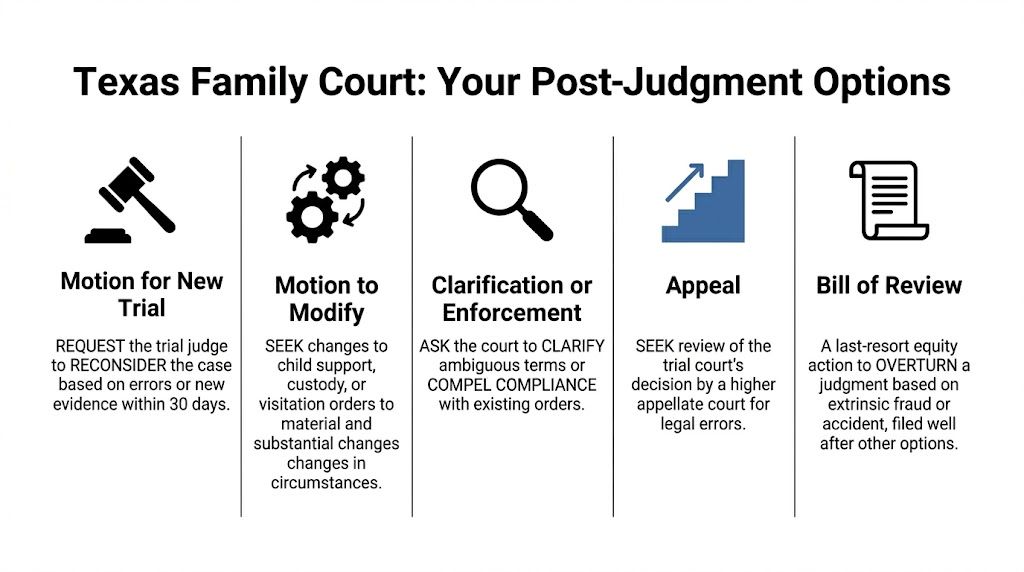
Texas family law offers several post-judgment tools. Each one serves a different purpose, uses a different legal standard, and carries different timing concerns. Choosing correctly can make the difference between a focused legal challenge and a filing that never reaches the core issue.
Texas Post-Judgment Relief Options at a Glance
| Remedy | Purpose | Typical Deadline | What You Need to Prove |
|---|---|---|---|
| Motion for New Trial | Ask the trial judge to reconsider the judgment | Very short post-judgment deadline | A serious trial problem such as harmful legal error, unfair procedure, or qualifying new evidence |
| Motion to Modify | Change custody, support, or possession orders going forward | Depends on the type of order and facts | A material and substantial change in circumstances, plus best interest where required |
| Enforcement or Contempt | Require compliance with an existing order | Often filed after a violation occurs | Specific order language, specific violations, and proof of noncompliance |
| Clarification | Clarify an order that is too vague to enforce | Used when order language creates enforcement problems | Ambiguity or lack of enforceable specificity in the existing order |
| Judgment Nunc Pro Tunc | Correct a clerical mistake in the written judgment | Depends on the nature of the clerical error | A mismatch between what the court actually rendered and what the written judgment says |
| Bill of Review | Challenge an older judgment in limited equitable circumstances | Used after ordinary deadlines have passed | A narrow showing, often involving fraud, accident, or wrongful prevention from presenting a meritorious claim |
| Appeal | Seek review by a higher court for legal error | Strict appellate deadlines apply | Reversible error shown through the record |
Modification works when life changed, not when the court simply got it wrong
For custody and support orders, modification is one of the most common forms of post-judgment relief. But courts don't modify orders just because one side is unhappy. The moving party must prove a material and substantial change in circumstances. That may involve relocation, a significant income change, or changes affecting the child.
That point is central in this explanation of how post-judgment motions work in family court, which also notes that enforcement requires precise allegations and requested relief.
Here are situations where modification may fit:
- Custody and possession issues: A work schedule changed, the child moved schools, or one parent's home circumstances shifted in a meaningful way.
- Child support issues: Income changed in a substantial way, or the child's needs are materially different.
- Geographic restrictions: A requested move may justify revisiting where the child primarily resides.
When modification does not fit is just as important. If the complaint is that the judge ignored evidence already presented at trial, that is usually an appellate issue, not a modification issue.
Enforcement works when the order is valid but not being followed
Enforcement asks the court to act because someone is violating an order already in place. In practice, success often turns on the quality of the drafting and the quality of the proof.
A strong enforcement case usually includes:
- Precise order language: The court must be able to identify exactly what duty existed.
- Specific violation facts: Dates, missed payments, denied exchanges, or other concrete failures to comply.
- Requested relief that matches the violation: Contempt, make-up possession, money judgment, or clarifying language when needed.
Orders are enforced one line at a time. If the violated provision isn't clear enough, the case may need clarification before contempt becomes realistic.
Other tools that matter in the right case
Some remedies don't fit most cases, but they matter a great deal when they do.
Judgment nunc pro tunc
This is used to fix a clerical error, not to rewrite the court's decision. If the judge rendered one thing but the written order says something else because of a drafting or entry mistake, this tool may be available. It is not a backdoor appeal.
Bill of review
A bill of review is a narrow equitable remedy used after ordinary deadlines have passed. It can arise when a party was prevented from presenting a valid claim or defense because of fraud, accident, or official mistake. These cases are technical and fact-specific.
Clarification
Some family orders are too vague to enforce cleanly. Clarification can help when a possession provision, payment term, or property directive lacks enough detail for practical enforcement.
A practical decision framework
When clients are deciding among these remedies, these questions usually narrow the field quickly:
- Was the order legally wrong when signed? That points toward appeal or, in some cases, a motion for new trial.
- Did circumstances change afterward? That points toward modification.
- Is the other side ignoring the order? That points toward enforcement.
- Is the order too vague to enforce? That points toward clarification.
- Is there a clerical mistake in the written judgment? That points toward nunc pro tunc.
- Did something extraordinary prevent a fair result long ago? That may point toward a bill of review.
If a deadline issue is part of your problem, our discussion of an extension of time to file appeal in Texas family law addresses one narrow but important piece of appellate timing.
Where legal counsel adds value
The difficult part isn't identifying labels. It is matching facts, deadlines, and the record to the proper vehicle. Trial counsel, new counsel, and appellate counsel may all play different roles here. In some cases, firms such as The Law Office of Bryan Fagan, PLLC handle appellate evaluation alongside broader family law post-judgment work involving custody, divorce decrees, and property issues.
That kind of review is most useful when done early, before a procedural option disappears.
For readers dealing with related trial-level problems, these pages on child custody matters, divorce appeals, and property division appeals show how the remedy often depends on what kind of final order was entered.
The Language of Appeals Standards of Review and Reversible Error
Appellate law has its own vocabulary. Clients often hear phrases like standard of review, abuse of discretion, and reversible error without getting a clear explanation of what those terms mean in plain English.
The simplest way to understand an appeal is this. The appellate court is not deciding the case from scratch. It is reviewing the trial court's work through a defined legal lens.
Standard of review means the lens the court uses
A standard of review is the rule that tells the appellate court how much deference to give the trial judge. Different issues get different standards.
In family law, the most common is abuse of discretion. That doesn't mean the trial judge acted unfairly in an ordinary sense or made a decision someone dislikes. It means the ruling was arbitrary, unreasonable, or made without proper reference to guiding legal principles.
Examples may include:
- A court dividing property based on a legal misunderstanding of what counts as community versus separate property.
- A court restricting possession without adequate support in the record.
- A court refusing to consider controlling legal requirements in a support or conservatorship ruling.
Reversible error means a mistake that mattered
Not every trial mistake will justify reversal. A party must usually show reversible error, which means the error probably caused an improper judgment or prevented a party from properly presenting the case on appeal.
That distinction is important. Judges and lawyers can disagree on close calls. Appellate relief usually depends on showing a harmful error, not just a debatable one.
An appellate brief doesn't argue that the trial was imperfect. It argues that a specific legal error changed the result in a way the law cannot ignore.
Briefing is where the case is often won or lost
Briefing is the written argument filed in the appellate court. It ties together the facts from the record, the preserved objections, the legal authorities, and the requested relief. Good briefing is disciplined. It cites the record carefully, frames the issue correctly, and avoids scattering weak arguments around a stronger one.
Many family appeals become harder because the issue was not preserved clearly at trial. If no one objected, requested a ruling, or created a record of the problem, the appellate court may have little to work with.
That is why appeals are so technical. The legal question is only part of the job. The other part is proving, through the actual record, that the issue was preserved and harmful.
Appeals succeed, but not by accident
Appellate review is real. It is not symbolic. Texas Supreme Court data for the 2024 to 2025 term shows the court reversed or vacated 72.3% of the argued state court cases it heard, as reflected in Texas appellate court statistics and reporting. That does not mean every family appeal has those odds, and it does not guarantee success. It does show that appellate courts actively correct lower court error.
For a closer look at the kind of mistake that can support relief, our article on reversible error in Texas family court explains how harmful error appears in real family law records.
Building a Winning Strategy When to Consult an Appellate Attorney

An appeal is built from the record, not from memory. Clients often remember exactly what felt unfair in court, but appellate courts decide cases based on transcripts, admitted exhibits, objections, rulings, and written orders. If something important happened but never made it into the record, the appellate lawyer may not be able to use it.
That is why appellate counsel should often be consulted as early as possible, sometimes while post-judgment motions are still being considered.
Preserving error is not a technicality
Preserving error means the trial lawyer made the right complaint at the right time and obtained a ruling or refusal to rule. Without that step, even a strong legal issue can be lost.
Common preservation problems include:
- No objection made: The evidence came in, or the ruling happened, and no legal complaint was stated.
- Wrong objection stated: The trial court was not alerted to the actual legal problem.
- No ruling obtained: The issue was raised, but the record does not show the judge ruled.
- Offer of proof missing: Evidence was excluded, but the record does not show what the evidence would have been.
A client may have a valid sense that the outcome was unjust, yet the appeal may still depend on these procedural details. That is not a flaw in the system. It is how appellate courts ensure trial courts had a fair chance to address alleged errors first.
What an appellate attorney actually does first
The first phase of serious appellate work is review, not argument. Counsel studies the clerk's record, the reporter's record, exhibits, docket entries, pleadings, findings, and the final judgment. The point is to identify legal issues that are both preserved and potentially outcome-changing.
A careful review often asks:
- What order can be appealed now
- What deadlines control
- What objections and rulings appear in the record
- What standard of review applies
- What remedy makes sense if error is found
The strongest appellate issue is not always the issue the client feels most strongly about. It is the issue the record can actually prove.
A simple timeline for the appellate process
Every case differs, but the process usually follows a sequence like this:
| Stage | What happens |
|---|---|
| Notice of appeal | The appealing party invokes appellate jurisdiction by filing on time |
| Record preparation | The clerk's record and reporter's record are requested and filed |
| Issue selection | Counsel identifies preserved, viable appellate points |
| Briefing | The parties submit written arguments with record citations and legal authorities |
| Possible oral argument | The court may ask counsel to answer focused questions |
| Decision | The appellate court affirms, reverses, remands, modifies, or grants other relief |
The timeline can feel slow, especially to a parent living under a difficult order. But careful pacing often helps the case. Weak issue selection, poor record citations, and rushed briefing do real damage.
Why specialized review matters
Family appeals sit at the intersection of procedural law and emotionally charged facts. A lawyer who tries cases well may still not focus on standards of review, preservation doctrine, and appellate writing day to day. Those are different skills.
Qualitatively, statewide post-judgment family matters still number in the tens of thousands even after decline trends noted in Texas court reporting. That volume means many families face decisions about whether a final order can be challenged, enforced, or changed. The success of an appeal depends on whether counsel can spot reversible error in the actual record, not just whether the result feels harsh.
If your case involves issues tied to child custody, support, protective orders, contempt, or property division, an early appellate consultation can help answer the question that matters most. Is there a legally viable path forward?
Take the First Step Toward a Fair Outcome
An unfavorable family court ruling can feel final. In many cases, it isn't. Texas procedure provides several ways to seek relief after judgment, but each path serves a different purpose and follows different rules.
The hard part is not finding a legal term that sounds right. The hard part is matching your facts to the correct remedy before a deadline passes or the record problem becomes impossible to fix. Appeals, modifications, enforcement actions, and other post-judgment tools each have value when used at the right time and for the right reason.
If you believe the court made a mistake in your family law case, our appellate attorneys can help you seek a fair outcome. Contact The Law Office of Bryan Fagan today for a free consultation.
If you believe the court made a mistake in your family law case, a focused review can tell you whether an appeal, modification, enforcement action, or another form of relief makes sense. The appellate team at The Law Office of Bryan Fagan, PLLC evaluates Texas family court judgments with close attention to deadlines, the trial record, and the rules that control post-judgment strategy. Schedule a free consultation to discuss your options and the strongest path toward a fair outcome.