You may feel your case was handled unfairly. Whether a protective order was wrongfully issued against you or denied when you needed it most, a court's decision can feel like a profound injustice. When a judge makes a mistake in a protective order Harris County, Texas case, the Texas appeals process offers a path to seek a fair and legally sound outcome.
This guide explains how protective orders work in Harris County and, more importantly, how the appellate process can be used to correct reversible errors made by the trial court.
Understanding the Purpose of a Protective Order

Needing legal protection is overwhelming, and being subjected to a court order you believe is unjust is equally distressing. The core purpose of a protective order in Harris County, Texas is to prevent harm before it happens by legally prohibiting specific actions and contact. These are powerful civil court orders defined by the Texas Family Code, designed to shield individuals from family violence, stalking, and harassment.
A judge must be convinced by evidence that family violence has occurred and is likely to occur again. This is a structured legal safeguard, not a simple process. The need is significant—the Harris County District Attorney’s Office handles an astounding 16,000 to 17,000 new domestic violence cases each year, underscoring how frequently local courts are tasked with making these critical decisions. When a court gets it wrong, the consequences can be devastating.
Different Orders for Different Situations
It's a common misconception that all protective orders are the same. Texas law provides for several types, each tailored to specific circumstances and durations. Understanding these distinctions is crucial, whether you are seeking protection or challenging an order that was unfairly granted.
Here is a brief overview of the main types of protective orders available in Texas.
Types of Protective Orders Available in Texas
| Type of Order | Purpose | Typical Duration |
|---|---|---|
| Temporary Ex Parte Order | Provides immediate, emergency protection. Granted without the other party present to create a safe period before a full hearing. | Up to 20 days |
| Final Protective Order | Issued after a full hearing where both sides present evidence. It is a long-term solution to prevent future violence. | Typically up to 2 years, but can be extended. |
| Magistrate's Order of Emergency Protection (EPO) | Issued in a criminal case after an arrest for family violence, stalking, or sexual assault to protect the victim during criminal proceedings. | 31 to 91 days, depending on the offense. |
Each order serves a distinct purpose, from creating a temporary "cooling-off" period to establishing a long-term legal boundary.
A protective order is more than a directive to stay away; it's a court-mandated boundary that carries serious legal consequences if violated. Its purpose is to interrupt a cycle of violence or harassment and provide a period of safety and stability.
Because these orders can dramatically impact child custody, property rights, and personal freedom, a judge's decision must be based on solid evidence and a correct application of the law. If you are navigating a case involving a protective order in Harris County, Texas, the details matter. Our appellate attorneys have deep experience with the nuances of family law appeals in this jurisdiction. The stakes are incredibly high, and ensuring the final outcome is both fair and legally sound is our primary focus. Learn more about our appellate services in Harris County.
Qualifying for a Protective Order in Texas
It is completely understandable to feel uncertain about whether a situation meets the legal criteria for a protective order. In Texas, the standard is specific: a judge requires evidence that family violence has occurred and is likely to occur again. Let's clarify what this means under the law.
The term "family violence" is defined broadly in the Texas Family Code and encompasses more than just physical conflict. It includes any act intended to cause physical harm or injury, as well as credible threats that place a person in genuine fear for their safety. If an individual's actions or words would cause a reasonable person to fear for their safety or their family's, it likely meets the court's standard.
The Legal Standard for Family Violence
To obtain a protective order in Harris County, the most critical element is proof that family violence has occurred. This requires more than a feeling of being unsafe; it demands evidence showing that a violent act or a credible threat has already taken place.
This standard ensures these powerful orders are reserved for situations with a real, documented danger. A vague, angry comment is unlikely to suffice. However, a detailed threat, particularly from someone with a history of aggressive behavior, is viewed differently. The court looks for a pattern of conduct or a significant incident that demonstrates a clear and present risk.
The image below outlines the three primary grounds for seeking a protective order in Texas.
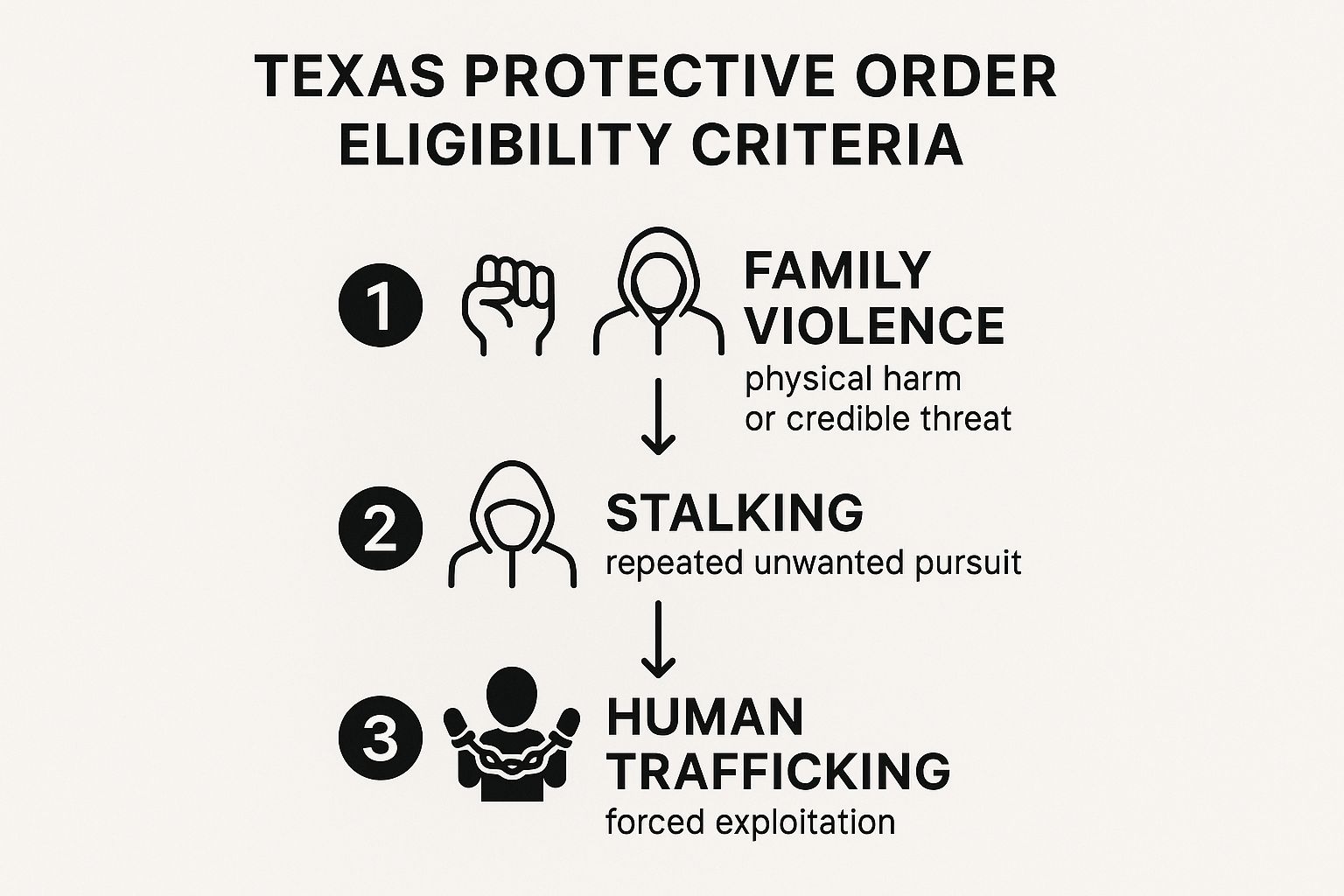
As you can see, the law provides protection for more than just what is commonly considered domestic abuse.
Beyond Family Violence: Other Grounds for Protection
While family violence is the most common basis for these orders, it is not the only one. Texas law recognizes other dangerous situations where legal intervention is necessary.
Two other key grounds for a protective order include:
- Stalking: This is not a single event but a pattern of harassing or threatening behavior that would cause an ordinary person to feel intimidated or scared. This can include constant unwanted phone calls, appearing at a person's work or home, or persistent following.
- Human Trafficking: Survivors of human trafficking can also use the protective order process to obtain legal protection from their traffickers.
Abuse of Discretion: This is a key legal term in appeals. It occurs when a trial judge makes a decision without following established legal rules. In a protective order case, this could mean ignoring clear evidence of stalking or misinterpreting the definition of family violence, leading to a legally flawed and unjust verdict.
Ultimately, whether you are seeking a protective order or defending against one, the outcome depends on the evidence presented and the judge's application of the law. If you believe the judge in your Harris County case overlooked crucial facts or misapplied the law, an appeal may be the appropriate step to seek a just resolution.
How to File for a Protective Order Step by Step

Navigating the court system while under significant stress can feel overwhelming. Fortunately, the process for filing for a protective order in Harris County, Texas, follows clear, defined steps. Knowing what to expect can provide confidence and reduce anxiety.
The process begins with an application that formally presents your case to the court. An emergency order may be sought for immediate safety. Next, the other party must be formally notified, and finally, both parties prepare for a hearing where a judge will make a final decision.
Let's break down the process.
The Initial Application and Finding Assistance
The first step is to complete and file an "Application for Protective Order," which can be obtained from a district courthouse or the Harris County District Attorney's office. This document is your official account of what occurred. You must include specific details about the family violence or stalking, including dates, locations, and a clear description of the incidents.
You do not have to go through this process alone. Harris County offers resources to assist individuals in your situation. For survivors of family violence, stalking, and other serious threats, these orders are a critical lifeline. You can learn more about the dedicated Harris County Protective Order Court and the support they provide.
Understanding the Temporary Ex Parte Order
If you are in immediate danger, you can request a Temporary Ex Parte Order. "Ex parte" is a legal term meaning the judge can grant the order based solely on your side of the story, without the other person (the respondent) being present. It functions as a legal emergency brake, designed to implement safety measures immediately.
A judge will only grant this order if there is a clear and present danger of family violence. This order is temporary, typically lasting up to 20 days, providing a crucial shield of protection until a full court hearing can be held.
Serving the Respondent and Preparing for the Hearing
After the application is filed and a temporary order is or is not issued, the next step is "service." This is the formal legal process of ensuring the respondent receives copies of all court documents. It is a fundamental part of due process, ensuring the other person is officially aware of the case and knows when to appear in court.
Once service is complete, the focus shifts to the hearing. This is your opportunity to present your case. The judge will hear evidence from both you and the respondent to decide whether a Final Protective Order is warranted. Because a final order can last up to two years, thorough preparation is essential.
A common procedural mistake that can lead to a reversal on appeal is improper service. If the respondent was not notified of the hearing according to the strict requirements of the Texas Rules of Civil Procedure, any order issued from that hearing can be challenged and overturned.
If you suspect a procedural error like this led to an unfair outcome in your protective order Harris County, Texas case, you may have grounds for an appeal. Adherence to these procedural rules is essential to ensure the process is fair for all parties involved.
Navigating Your Protective Order Hearing in Harris County, Texas

The final hearing for a protective order in Harris County, Texas is the decisive moment. This is when a judge listens to both sides, reviews the evidence, and makes a ruling with lasting consequences. Whether you are the applicant seeking protection or the respondent defending against an order, understanding what to expect in the courtroom is vital.
The hearing is a formal proceeding where the judge acts as a neutral decision-maker. Both the applicant and the respondent have the opportunity to present their side of the story, submit evidence, and call witnesses. The judge's role is to ensure fairness, follow legal rules, and apply the law to the facts presented.
The Power of Evidence in Your Case
In a protective order hearing, testimony is important, but evidence is paramount. A judge needs tangible proof to make a legally sound decision. Therefore, evidence is your most critical asset. Strong evidence tells a compelling story and helps the judge understand the reality of the situation.
The most persuasive cases are built with a variety of evidence that work together to create a clear and complete picture. Your objective is to show the judge what happened, not just tell them.
Some of the most effective types of evidence include:
- Written Communications: Text messages, emails, and social media direct messages are powerful because they provide a direct, timestamped record of threats, harassment, or admissions.
- Photographs and Videos: Visual evidence can be incredibly persuasive. Photographs of injuries, damaged property, or video recordings of stalking behavior can be compelling proof.
- Official Reports: Documents like police reports and medical records carry significant weight because they are objective, third-party accounts.
- Witness Testimony: Testimony from someone who witnessed the abuse firsthand can corroborate your story and enhance your credibility.
This evidence forms the basis of the judge’s decision. Without it, cases can devolve into a "he said, she said" scenario, making it difficult for a judge to issue a definitive ruling.
Understanding the Standard of Review
The phrase "beyond a reasonable doubt" is famous from criminal trials, representing a very high standard of proof. Protective order hearings, however, are civil cases and use a different standard called "preponderance of the evidence."
This legal term means the applicant must show that their claims are more likely true than not true. Imagine a set of scales: if your evidence tips the scales even slightly in your favor—just 51% or more—you have met your legal burden. It is not about absolute certainty but about what is most probable based on the evidence presented.
A common reversible error occurs when a judge makes a decision without sufficient evidence to meet this "preponderance of the evidence" standard. If the final order was based more on a judge's feeling than on factual proof, it may be considered an abuse of discretion and can be grounds for a successful appeal.
If you believe the judge in your Harris County hearing failed to consider key evidence or made a ruling unsupported by the facts, you may have grounds to challenge it. An appeal is not about getting a second opinion; it is about determining whether the judge's decision was legally and factually sound. Understanding this standard is the first step in evaluating whether an appeal is the right path to a fair outcome. You can learn more about this process by reading our insights on protective order appeals.
Challenging an Unfair Protective Order Ruling
Sometimes, trial court judges make mistakes. You may walk away from court feeling that the decision in your protective order Harris County, Texas case was fundamentally unjust. Perhaps you were denied necessary protection, or an order was issued against you based on insufficient or misleading evidence. When the outcome is a clear injustice, the Texas appellate process provides an opportunity to restore fairness.
It is crucial to understand that an appeal is not a retrial. You cannot introduce new evidence or witnesses. Instead, an appellate court conducts a technical review of what happened in the original hearing. Its sole function is to examine the trial court record—transcripts, evidence, and rulings—to determine if a significant legal mistake, known as a reversible error, occurred. If such an error is found, the appellate court has the authority to correct it.
Common Grounds for an Appeal
An appeal cannot be based simply on dissatisfaction with the result. The appellate court is looking for specific legal errors that were serious enough to have likely affected the outcome. Simply disagreeing with the judge’s judgment is not sufficient grounds for an appeal.
Common examples of reversible errors in Texas family courts include:
- Insufficient Evidence: The judge's decision was not supported by the facts presented. They granted or denied the order without enough evidence to meet the "preponderance of the evidence" standard.
- Improper Admission or Exclusion of Evidence: The court erred by allowing evidence that should have been excluded or by refusing to consider crucial evidence that was admissible.
- Misapplication of the Texas Family Code: The judge misunderstood or incorrectly applied the law, such as the legal definitions of family violence or stalking.
- Procedural Errors: A fundamental mistake was made in the handling of the case, such as improper service, which denied a party their right to be heard and present a defense.
These are the types of errors that undermine a fair hearing and are precisely what the appeals process is designed to remedy.
Understanding Key Legal Concepts in Appeals
The language of appeals can seem complex, but the core concepts are straightforward. When challenging a protective order, two of the most important terms are “abuse of discretion” and “reversible error.”
Abuse of Discretion: A judge commits an abuse of discretion when they make a decision that is arbitrary, unreasonable, or without reference to any guiding legal rules or principles. It is more than just being wrong; it is a ruling so far outside the bounds of reasonable disagreement that it cannot be justified. For example, if a judge ignores clear, undisputed evidence of stalking and denies a protective order, that could be an abuse of discretion.
Reversible Error: This is a legal term for a mistake so significant that it likely caused the wrong outcome. Think of it as a faulty ingredient in a recipe—if the mistake changes the final dish, it's reversible. If it doesn't, it might be considered a 'harmless error' and won't be enough to overturn the decision. The goal of an appeal is to identify a reversible error.
The stakes in these cases are incredibly high. The tragic reality is that in just one year, Harris County saw 38 homicides related to intimate partners or stalking, contributing to a statewide total of 205 such deaths. These numbers, from data compiled by the Texas Council on Family Violence, highlight the critical importance of courts applying the law correctly to ensure safety.
When you believe the court failed in its duty, an appeal may be your only path forward. It is a complex process, but it exists to ensure that life-altering decisions about safety and liberty are based on a fair evaluation of the facts and a correct application of the law. If the verdict in your case feels wrong, it is worth investigating whether a reversible error occurred. Our appellate attorneys specialize in identifying these critical mistakes. For a deeper dive, take a look at our guide on protective order appeals.
How an Appellate Attorney Can Restore Fairness
When a protective order case results in an unjust ruling, it can feel like a final, unchangeable outcome. This is where a family law appellate attorney can make a critical difference. Their role is distinct from that of a trial lawyer.
Appellate attorneys do not present new evidence or re-argue the facts of the case. Instead, they act as legal strategists, meticulously reviewing the existing court record—every transcript, piece of evidence, and judicial ruling—to identify a specific legal mistake that led to an incorrect outcome.
Step-by-Step Insights on How Appeals Differ from Trials
The primary goal is to pinpoint a reversible error. This is a flaw in the original trial's legal foundation so significant that the final decision cannot be upheld. It is not about disagreeing with the judge's opinion but about proving a fundamental error was made according to the Texas Rules of Appellate Procedure.
Once a potential error is identified, your attorney begins the briefing process. This involves drafting a comprehensive legal argument in a formal document called an appellate brief. This brief explains to the higher court exactly how the trial judge erred, citing established laws and previous court decisions (precedent) as support. The entire argument is built on a solid foundation of the Texas Family Code and the Texas Rules of Appellate Procedure. For anyone considering an appeal, engaging a skilled family law appeal attorney is the crucial first step.
The Tyranny of the Clock: Appellate Timelines
The appeals process is governed by strict timelines. After a judge signs the final ruling in your protective order Harris County, Texas case, a critical deadline begins to run.
In most Texas civil cases, including protective order appeals, you must file a "Notice of Appeal" within 30 days of the final order being signed. Missing this deadline typically forfeits your right to appeal permanently.
The Value of a Fresh Perspective
Perhaps the most significant advantage an appellate lawyer brings is an objective, fresh perspective. They were not present for the emotional dynamics of the original hearing. This emotional distance allows them to review the case with strategic, logical precision, spotting legal errors that might have been overlooked by someone more involved in the initial trial.
Ultimately, an appellate attorney's purpose is to ensure the legal system functions as intended. They hold the trial court accountable to the law, ensuring that life-altering decisions about your freedom, family, and reputation are made correctly and fairly.
Common Questions We Hear About Protective Orders
When you're dealing with a protective order in Harris County, Texas, it's natural to have a lot of questions. Whether you're the one seeking safety or you've been served with an order, the legal process can feel overwhelming. Let's walk through some of the most common concerns we hear from clients to give you a clearer picture.
How Long Does a Protective Order Last in Texas?
The duration of a protective order depends on its type. A Temporary Ex Parte Order is an emergency order granted for immediate protection. It serves as a temporary shield for up to 20 days, allowing time to prepare for a formal court hearing.
Following the hearing, if the judge determines that long-term protection is necessary, a Final Protective Order is issued. These typically last for two years. In cases involving serious felonies or extreme violence, a judge has the discretion to extend that period, sometimes even for life.
What Happens If Someone Violates a Protective Order?
A protective order is a direct command from the court, not a suggestion. If the person named in the order (the respondent) violates it in any way—by contacting you, coming to your home or work, or breaking any other provision—you should call the police immediately.
Violating a protective order is a criminal offense that can lead to immediate arrest and new criminal charges. The penalties, which often include fines and jail time, reflect the seriousness with which the law treats these orders.
Any finding of family violence has a direct and significant impact on other legal matters. It creates a legal presumption that it is not in a child's best interest for the offending party to have certain custody rights, which can dramatically alter the outcome of a child custody case.
Can a Protective Order Impact Child Custody Arrangements?
Yes, absolutely. A protective order can significantly alter the dynamics of a child custody case. The Texas Family Code contains a powerful provision: a judicial finding of family violence creates a "rebuttable presumption."
In plain English, the court automatically assumes it is not in the child's best interest for the person who committed violence to be a joint managing conservator or to determine the child's residence. This places the burden on the respondent to prove to the court that they do not pose a risk to their child's physical or emotional well-being. This often results in supervised visitation or other significant restrictions on their parental rights.
If you believe the court made a mistake in your family law case, our appellate attorneys can help you seek a fair outcome. Contact The Law Office of Bryan Fagan today for a free consultation at https://familylawcourtappeals.com.