When a judge finalizes your child custody case, you expect the outcome to be fair, stable, and legally correct. In Texas, the court's starting point is usually the Standard Possession Order (SPO)—a schedule designed to give children consistent time with both parents. You may feel your case was handled unfairly if the final order seems wrong. If you suspect the judge misapplied the law or overlooked crucial facts, leaving your family with an unjust ruling, you are right to seek a path toward justice.
What to Do When a Custody Ruling Doesn’t Seem Right
It is a deeply frustrating experience to walk away from court with a custody schedule that feels fundamentally unfair, especially when your child’s well-being is at stake. An unjust ruling, however, is not always the end of the road. The Texas legal system provides a specific process for challenging decisions that are based on significant legal mistakes: an appeal.

This guide is for parents who believe a serious error was made in their final standard possession order in Texas. It is important to understand that an appeal is not a second chance to re-argue the facts of your case. Instead, it is a focused review to determine if the trial court committed a "reversible error." In plain English, this means the judge made a legal mistake so significant that it likely led to the wrong outcome.
Understanding the Role of a Custody Appeal
An appeal is a critical safeguard in our justice system. It ensures judges apply the law correctly and base their decisions on the evidence presented in court. For parents, this process provides an opportunity to correct specific types of legal errors that may have occurred in a ruling on a standard possession order in Texas. Common reversible errors include:
- Ignoring a legal presumption (like the SPO being in the child's best interest) without a documented reason.
- Misinterpreting or misapplying rules from the Texas Family Code.
- Creating a possession schedule so vague it is impossible to follow.
- Making a ruling that qualifies as an "abuse of discretion"—a legal term meaning the judge’s decision was arbitrary, unreasonable, or made without regard for guiding legal principles.
The SPO is the bedrock of most Texas custody arrangements, providing a structured schedule that balances a child’s need for stability with each parent’s right to involvement. As outlined in the Texas Family Code Section 153.312, the SPO typically gives the non-primary parent possession on the first, third, and fifth weekends of a month, along with alternating holidays and extended summer time. You can see how this works over a year with a Texas Standard Possession Order calendar. When a judge deviates from this standard without a legally sound justification, it can be grounds for an appeal.
Key Elements of the Texas Standard Possession Order at a Glance
To understand what a judge might deviate from, it's helpful to see the core components of a standard order. This table breaks down the baseline schedule for the non-custodial parent.
| Possession Component | Non-Custodial Parent's Time (General Rule) |
|---|---|
| School Year Weekends | First, third, and fifth weekends of the month. |
| Holiday Possession | Alternating major holidays like Thanksgiving and Christmas/Winter Break. |
| Summer Possession | 30 days of possession (or 42 if they live over 100 miles apart), often broken up. |
| Child's Birthday | A few hours with the child on their birthday, even if it's not their scheduled day. |
| Parents Live < 100 Miles | Weekend possession typically runs from school dismissal on Friday to school resumption on Monday. |
| Parents Live > 100 Miles | The non-custodial parent can often choose to have possession every spring break and all 42 days of summer. |
This table provides a snapshot, but the full order contains many more specifics. If your court order looks drastically different from this without a clear, evidence-based reason, it might signal a legal error.
A successful appeal can lead to the appellate court reversing the trial judge's decision and sending the case back for a new hearing. This gives you another chance to seek a fair and just outcome for your child.
Navigating the appellate process requires deep knowledge of both family law and the specific procedures that govern appeals. The process is built on meticulous legal arguments, not emotional pleas. If you believe your custody order is legally flawed, your first step should be to consult an experienced appellate attorney who can evaluate your case.
Understanding Standard vs. Expanded Possession Orders in Texas
When a Texas court issues a custody order, it considers the unique circumstances of each family, especially the distance between parents' homes. The Texas Family Code provides two primary versions of the Standard Possession Order (SPO): the traditional version and the Expanded Standard Possession Order (ESPO). Understanding this distinction is critical, as it can dramatically change your time with your child and often becomes a key issue on appeal.
The traditional SPO provides the non-primary parent with a baseline schedule, usually the first, third, and fifth weekends of a month. The Expanded Standard Possession Order, however, offers significantly more time. It typically allows the weekend to begin when school is dismissed on Thursday and end when school resumes on Monday morning, adding two extra overnights each time.
The Legal Presumption for Expanded Orders
The choice between an SPO and an ESPO almost always comes down to geography. For parents living in close proximity, Texas law has a very strong preference. There is a legal presumption that an Expanded Standard Possession Order is in the child's best interest if the parents live 50 miles or less apart.
What is a "legal presumption"? It is the court's required starting point. A judge must assume the ESPO is the correct schedule unless one parent presents clear evidence proving it is not in the child's best interest.
This presumption is a powerful tool designed to ensure children have meaningful, consistent time with both parents. A judge cannot simply disregard it. If a judge deviates from the ESPO for parents living within 50 miles without explaining why it is not in the child’s best interest—with evidence in the trial record to support that finding—it can be a reversible error and a common reason for a successful appeal.
Key Differences in Schedules
Moving from a standard to an expanded order fundamentally reshapes the parenting calendar. A major change in the law on September 1, 2021, made the ESPO the official default for parents living within 50 miles of each other. Before then, many orders were limited to a Friday-to-Sunday schedule. Now, the ESPO can add up to 52 extra nights with your child each year.
Here is a quick look at how the schedules compare for a non-primary parent living nearby:
- Standard SPO Weekend: Possession typically starts at 6:00 p.m. on Friday and ends at 6:00 p.m. on Sunday.
- Expanded SPO Weekend: Possession starts when school is dismissed on Thursday and ends when school begins on Monday morning.
- Standard SPO Midweek: May include a short, two-hour dinner visit on a Thursday during the school year.
- Expanded SPO Midweek: The brief visit is replaced by the much longer Thursday-to-Monday weekend, creating a more natural rhythm for the child.
If your final order imposed a traditional schedule even though you live within the 50-mile radius, and the judge did not provide a legally valid reason, that ruling may be legally incorrect. Our attorneys can review your case to determine if the court's failure to order the presumed schedule was an abuse of discretion. To learn more, see our detailed guide on what an expanded standard possession order in Texas should include.
How Geographic Distance Shapes Your Custody Schedule
In a Texas custody schedule, the distance between parents’ homes is a defining factor. The Texas Family Code legally requires courts to consider this distance, and a trial court's failure to do so can unfairly reduce a parent's time with their child, creating strong grounds for an appeal. The law recognizes that a schedule for parents living across town will not work for parents living hours apart and establishes a tiered system to match the geographic reality of the family.
The Critical 50 and 100 Mile Rules
In Texas custody law, 50 and 100 miles are critical distances that dictate which version of the Standard Possession Order a court should presume is appropriate. When a judge fails to apply the correct schedule based on these distances, it can be a serious legal error.
Here’s how it breaks down:
- Under 50 Miles: If parents live 50 miles or less from one another, the law presumes an Expanded Standard Possession Order (ESPO) is in the child's best interest. This schedule provides the non-primary parent the most time, including Thursday overnights during the school year.
- Over 50 Miles (but under 100): Once the distance exceeds 50 miles, the legal presumption shifts back to the traditional Standard Possession Order (SPO), as the extra travel could make a Thursday overnight too disruptive on a school night.
- Over 100 Miles: For parents living far apart, the SPO adapts again. The non-primary parent may choose between their regular first, third, and fifth weekends or opt for one weekend a month. To compensate, their summer possession increases from 30 to 42 days, and they automatically receive the child for Spring Break every year.
This flowchart illustrates the decision-making process a court is meant to follow.
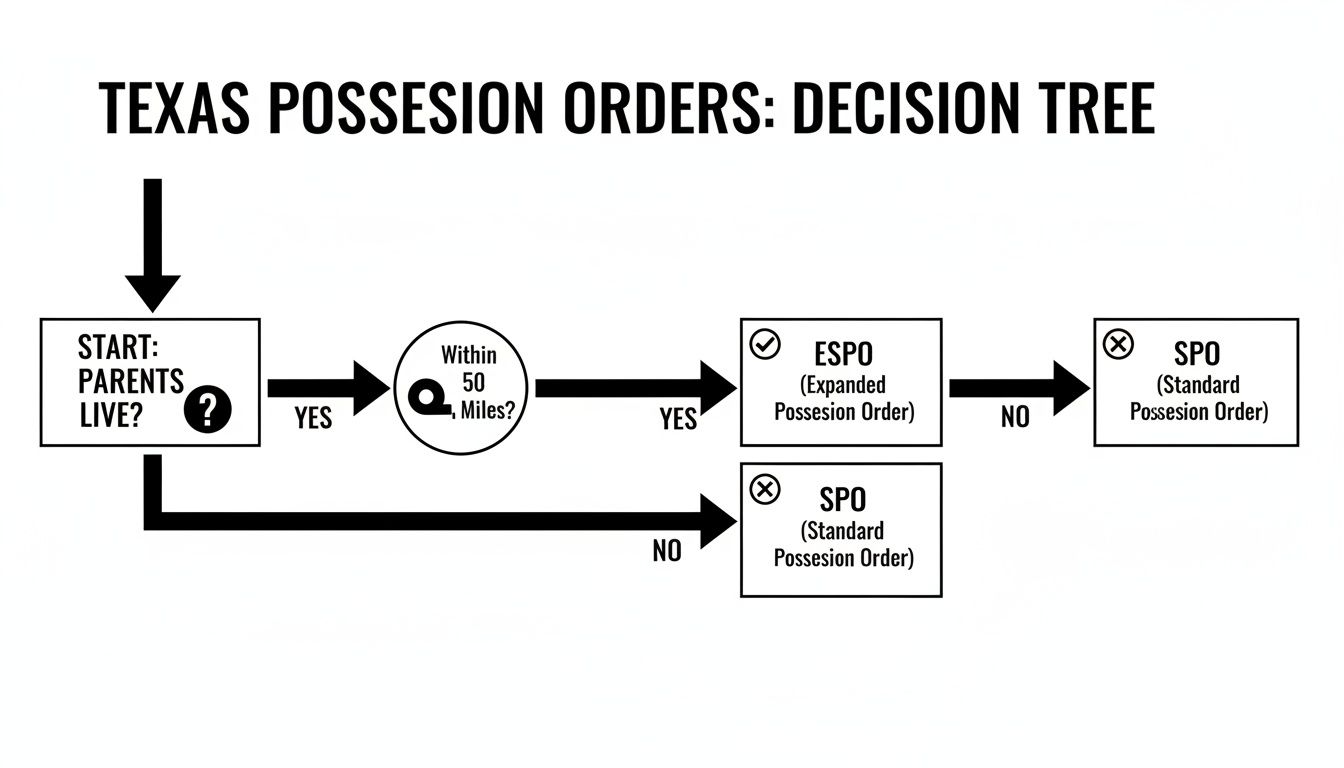
As you can see, the 50-mile mark is the critical point that determines whether the court begins its analysis with an ESPO or a regular SPO.
Why Distance Calculation Errors Lead to Appeals
These mileage rules are not mere guidelines; they are core components of the law. A trial court error—such as calculating distance "as the crow flies" instead of using the actual driving distance—can amount to an abuse of discretion, a key standard for winning an appeal. You can get more details about how distance affects the Texas possession calendar and what it means for your family.
A judge cannot ignore geography. If your custody order contains a schedule that does not align with the distance between the parents—and the judge did not provide a specific, evidence-based reason for the deviation—that ruling may be legally defective.
This is exactly the kind of reversible error that the appeals process is designed to correct. We scrutinize the trial record to see if the court correctly applied the distance-based rules. If a mistake was made, it can form the foundation of a powerful argument that the possession order is unfair and must be overturned.
Common Reversible Errors in Texas Family Courts
While it is natural to feel frustrated with a final custody order, an appeal cannot be based on disagreement alone. The purpose of an appeal is to correct specific legal mistakes—or "reversible errors"—that may have produced an unfair result. Determining whether such an error occurred in your case is the first step toward restoring balance.
Many of these errors happen when a trial court mishandles the standard possession order in Texas, either by applying it incorrectly or deviating from it without a solid legal reason. Identifying these issues requires a thorough review of the trial record and a deep understanding of the Texas Family Code.
Abuse of Discretion: A Key Standard of Review
One of the most common grounds for a family law appeal is an "abuse of discretion." This legal term means the judge made a decision that was unreasonable, arbitrary, or completely disconnected from established legal rules. The question is not whether the appellate court would have made a different decision, but whether the trial judge’s ruling lacked support from the facts or the law. We explain this in detail, but you can learn more about how courts apply the abuse of discretion standard in our article.
In a standard possession order case, an abuse of discretion might look like this:
- The judge ignores the legal presumption that an Expanded Standard Possession Order (ESPO) is in the child's best interest when parents live within 50 miles of each other.
- The court alters the standard schedule but fails to state on the record a specific, evidence-backed reason why the change is in the child's best interest.
- The ruling appears to be based on the judge's personal bias rather than the evidence presented at trial.
Specific Examples of Reversible Errors
A successful appeal must be built on clear, identifiable mistakes. These are the types of concrete, reversible errors our appellate attorneys look for in cases involving a standard possession order in Texas:
- Misapplying Geographic Rules: The judge orders a traditional SPO even though parents live only 25 miles apart, ignoring the legal presumption that the ESPO should apply.
- Creating Vague or Unenforceable Terms: The order states exchanges will happen at a "mutually agreed-upon time" but provides no default time if parents cannot agree, making the order impossible to enforce.
- Improperly Restricting Access: A judge orders supervised possession for a parent without any finding of family violence or other evidence showing that unsupervised time would endanger the child.
- Ignoring the Child's Best Interest Standard: The court deviates from the SPO and states the reason is "for the mother's convenience." The only valid reason for a deviation is the child's physical or emotional well-being.
Sometimes, legal errors arise from disorganized case files. This is why good document management for law firms is so critical at the trial level—it helps prevent administrative issues from becoming grounds for an appeal. Distinguishing between dissatisfaction and a genuine legal error is key.
Frustration with an Order vs. Grounds for an Appeal
| Common Frustration (Disagreement) | Potential Reversible Error (Legal Mistake) |
|---|---|
| "I wish my summer possession started a week earlier." | The judge failed to grant the standard 30 days of summer possession and provided no evidence-based reason for the deviation. |
| "I don't like the other parent's new partner." | The judge restricted possession based on the new partner without evidence that this person posed a danger to the child. |
| "I think I should have been named the primary parent." | The judge made the custody determination without considering all the required 'best interest' factors outlined by law. |
| "The exchange location is inconvenient for me." | The order fails to specify any exchange location at all, making it vague and impossible to enforce. |
If your situation aligns more with the right-hand column, you may have a valid basis for an appeal. An experienced appellate lawyer can review your trial record to pinpoint these errors and build a strong case for reversing the decision.
How to Challenge an Unfair Custody Order: The Appeals Process
When a judge signs a custody order you believe is legally wrong, the path forward is not a new trial but an appeal. The appellate process can feel intimidating, but it is a highly structured review. An appeal does not involve new evidence or witnesses. Instead, an appellate court examines the existing trial record—everything said and filed—to determine if the judge made a critical legal mistake.
This entire process is governed by the Texas Rules of Appellate Procedure, a complex set of rules with strict, non-negotiable deadlines. Missing even one deadline can result in losing your right to challenge the order. This is where strategic, detailed legal work becomes essential.
Step-by-Step Insights on How Appeals Differ from Trials
An appeal follows a predictable sequence of events, with each step building a comprehensive legal argument for the higher court. Here is a step-by-step look at the process:
Filing the Notice of Appeal: This is the first official step. It is a formal document filed in both the trial and appellate courts, announcing your intent to challenge the order. You typically have only 30 days from the date the judge signs the final order to file it.
Record Preparation: The appeal is decided only on what happened in the original trial. Your appellate lawyer will order the "clerk's record" (all documents filed in your case) and the "reporter's record" (the official, word-for-word transcript of all hearings). No new testimony or exhibits are allowed.
Briefing: This is the core of your appeal. Your attorney drafts a persuasive legal document known as a "brief." This document identifies the specific legal errors the trial judge made, supports the argument with case law and statutes, and explains why the appellate court must correct the mistake.
Oral Argument: In some cases, the court of appeals schedules a hearing where lawyers argue their points before a panel of judges. This is a high-level legal discussion where judges can ask questions about the arguments presented in the briefs.
Plain-English Definitions of Key Appellate Terms
As you enter the world of appeals, you will encounter new legal terms. Understanding them will help you follow your attorney's strategy.
- Reversible Error: Not just any minor mistake. A reversible error is a legal blunder so significant that it likely caused the judge to reach the wrong decision. Proving this is the goal of the appeal.
- Standard of Review: This determines how much deference the appellate court gives the trial judge’s original decision. For most custody issues, the standard is "abuse of discretion," meaning your lawyer must show the judge’s ruling was arbitrary or unreasonable.
- Briefing: This term refers to the entire process of writing, filing, and responding to the legal briefs submitted by both sides.
The appellate process is a check and balance on the system, ensuring the law is applied correctly. It focuses on a methodical examination of legal procedure, using the law itself to restore the fairness that was lost in the initial ruling.
Challenging a flawed standard possession order in Texas requires a different skillset than a trial. It demands meticulous legal research, persuasive writing, and deep knowledge of appellate procedure. If you are weighing your options, you can learn more about how to change a custody agreement through various legal avenues. Our team is focused on navigating this complex process to seek the just outcome your family deserves.
What Are the Next Steps After an Unfair Ruling?
It is a difficult experience to leave court with a custody order that seems legally flawed. It can feel as though the system has failed you. However, the trial court's decision is not always the final word. The legal system provides a path for correcting judicial errors: the appeal. If you believe the judge made a serious legal mistake in your standard possession order in Texas, you have the right to ask a higher court for a review. Acting quickly and strategically is key.

The actions you take in the days following a bad ruling can determine your ability to fix it. This is a time to pivot from the emotional aspects of the trial to identifying the specific legal errors that led to the unjust outcome.
A Checklist for Moving Forward
A structured approach can bring clarity to the overwhelming process of an appeal. This checklist will help you prepare for a productive discussion with an appellate lawyer and protect your legal options.
Here’s what you need to do:
- Act Immediately: Appellate deadlines are unforgiving. In most Texas family law cases, you have just 30 days from the date the judge signs the final order to file a Notice of Appeal. Missing this deadline means losing your right to challenge the ruling.
- Gather All Your Documents: Collect every document related to your case: the final order, temporary orders, all motions filed, and correspondence from your lawyer and the court. Organization will help an appellate attorney get up to speed quickly.
- Avoid Damaging Actions: Do not discuss your case on social media or send angry messages to the other parent. Frustration is understandable, but such actions can harm your case. You must comply with the current order—even the one you are appealing—unless a court says otherwise.
- Consult with a Specialist: Trial and appellate work require different skills. You need an attorney who specializes in family law appeals. They know how to review a trial record for a reversible error and navigate the intricate Texas Rules of Appellate Procedure.
Your most critical move is to get a professional evaluation from an attorney who understands the appellate process. They can provide an objective assessment of whether a true legal error occurred and what your realistic chances are on appeal.
While the feeling of being wronged is valid, a successful appeal must be built on a foundation of solid legal arguments. By taking these deliberate steps, you give yourself the best possible chance to challenge a flawed order and seek a fair path forward for your family.
If you believe the court made a mistake in your family law case, our appellate attorneys can help you seek a fair outcome. Contact The Law Office of Bryan Fagan today for a free consultation.
Answering Your Questions About Custody Appeals
When facing a complex custody order you believe is wrong, it is natural to have questions. As appellate attorneys, we often hear the same concerns from parents who feel the system has let them down. Here are answers to some of the most common questions.
Can I Appeal Just Because I Don’t Like the Schedule?
Generally, the answer is no. An appeal is not a "do-over" where you can re-argue your case or introduce new evidence. To succeed on appeal, we must identify a specific legal mistake the trial judge made—a "reversible error." This could be ignoring a key part of the Texas Family Code or making a ruling with no evidence to support it. Our role is to prove the legal process was flawed, not just that the result was unfavorable.
How Long Do I Have to Appeal a Custody Order in Texas?
The timeline is incredibly strict. You must file a Notice of Appeal within 30 days from the date the judge signed the final order. Missing this deadline is almost always fatal to your case. Once a final order is signed, the clock starts ticking. It is critical to speak with an appellate lawyer immediately to protect your rights.
An appeal is a technical legal process governed by the Texas Rules of Appellate Procedure. It is not about re-telling your story; it is about methodically proving that a significant legal error occurred at trial and that this error likely caused the wrong outcome.
What Is an “Abuse of Discretion”?
This is a legal term used when a judge's decision was completely unreasonable, arbitrary, or made without considering the guiding laws and principles. It is not about whether the appeals court would have made a different decision, but whether the trial judge’s ruling was so far outside the bounds of reason that it became legally indefensible. Proving this requires a deep analysis of the trial record.
Should I File an Appeal or a Modification?
These are two different legal tools for two different situations. Choosing the correct one is vital.
- An Appeal is for correcting a legal error that happened in the past during your original trial. If the foundation of your order is flawed because of a judge’s mistake, an appeal is the proper remedy.
- A Modification is for addressing a problem that exists in the present. It is used when a valid order needs to be changed because circumstances have changed significantly since the order was issued. This requires showing a "material and substantial change in circumstances."
We can review your situation and advise whether you should challenge a past mistake with an appeal or address a new reality with a modification.
If you believe the court made a critical error in your family law case, our appellate attorneys are here to help you fight for a just result. Contact The Law Office of Bryan Fagan, PLLC today for a free consultation at https://familylawcourtappeals.com.