You may feel your case was handled unfairly if your divorce decree resulted in a division of your 401k that puts your financial future at risk. When years of savings are on the line, a court’s ruling that misapplies Texas law can be devastating. These are valid concerns, and you have a right to seek a just outcome.
Fortunately, the Texas appellate process was designed to correct significant legal errors. Understanding how the law should have been applied is the first step toward restoring balance and protecting the retirement you worked so hard to build.
How Texas Law Should Handle Your 401k
Texas is a community property state, which has a massive impact on how a 401k is divided. The law presumes that nearly everything you and your spouse acquired from the date of marriage until the date of divorce belongs to the marital "community."
However, a fair division is rarely as simple as splitting the total account balance down the middle. The critical work lies in correctly identifying which portion of the 401k is community property subject to division and which portion is untouchable separate property. A court’s failure to get this right is a common reversible error.
Distinguishing Community from Separate Property
The key to a just outcome is accurately separating community property from separate property within the 401k. This distinction is legally required and can protect a significant portion of your assets.
-
Community Property: This is the portion the court can divide. It includes all contributions, employer matches, and investment growth that occurred during the marriage.
-
Separate Property: This part is legally protected from division. It includes the account balance that existed before the marriage, plus any growth on those specific pre-marital funds. This portion belongs solely to the employee spouse.
Mistakes in this calculation are not minor—they are significant legal errors that can justify an appeal. To understand these rules more deeply, review our guide on how Texas community property law works.
Community Property vs. Separate Property in a 401k
| Asset Component | Classification | Subject to Division? |
|---|---|---|
| Pre-Marital Balance (as of wedding date) | Separate Property | No |
| Growth on Pre-Marital Balance | Separate Property | No |
| Employee Contributions During Marriage | Community Property | Yes |
| Employer Matches During Marriage | Community Property | Yes |
| All Investment Gains During Marriage | Community Property | Yes |
Accurately tracing the separate property portion is absolutely essential. A trial court that fails to do so, or that uses a flawed valuation method, commits a legal error that can and should be challenged.
A court's failure to correctly characterize property as separate or community is a classic example of reversible error. If you believe your separate property was improperly included in the marital estate and divided, you may have strong grounds for an appeal.
Understanding the QDRO: The Key to Dividing Your 401k
After a judge signs the final divorce decree outlining the dividing a 401k in a divorce, the process is not over. The decree alone cannot transfer funds from a retirement account. To execute the division, a second, highly specific court order is required: a Qualified Domestic Relations Order (QDRO).
A QDRO is a detailed set of instructions for the 401k plan administrator. It tells the financial institution exactly who receives funds, how much they receive, and when. Without a valid QDRO, federal law prohibits the plan administrator from distributing funds to an ex-spouse.
This flowchart illustrates how the divisible portion of a 401k is determined before a QDRO can be drafted.
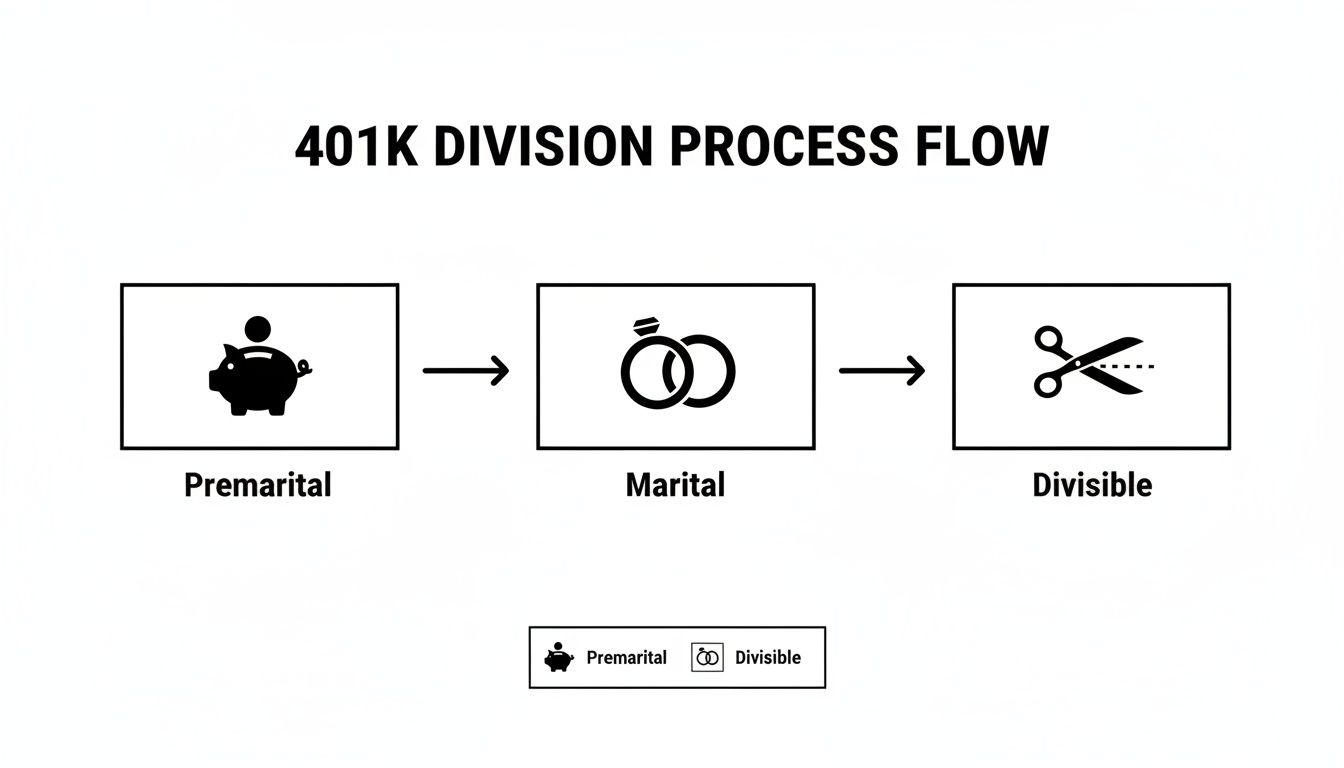
The QDRO is the legal instrument that takes the final "divisible" amount determined in the decree and puts it into action.
The Critical Role of Accurate QDRO Drafting
Drafting a QDRO is a technical and detail-oriented task. Each retirement plan has its own unique rules, and a poorly drafted QDRO will be rejected by the plan administrator, causing significant delays and additional legal fees.
This rejection sends you back to court to amend the order, have it re-signed by the judge, and resubmit it. This frustrating cycle can be avoided, but it highlights the importance of precision.
A QDRO must perfectly mirror both the divorce decree and the retirement plan's internal rules. Any mismatch can trigger a rejection. More importantly, if the divorce decree itself contains a reversible error, the QDRO will enforce that unjust outcome, making an appeal necessary to correct the underlying mistake.
Common errors that lead to QDRO rejection include:
- Incorrect Names: Using nicknames or abbreviations for the plan, participant, or alternate payee.
- Missing Details: Omitting full legal names, last known addresses, or other required identifiers.
- Ambiguous Instructions: Failing to clearly define the division method, whether it is a specific dollar amount or a percentage as of a certain date.
- Forbidden Requests: Asking the plan to do something it does not permit, such as paying a benefit in a form the plan does not offer.
If the trial court’s initial order was flawed—for example, by miscalculating the community property share—that mistake gets baked into the QDRO. This is a textbook example of a reversible error, a legal mistake significant enough to be challenged and overturned on appeal.
Common Reversible Errors in 401k Division Cases
When you receive a final divorce decree that unfairly divides your retirement assets, it may be due to a significant legal mistake. In the appellate world, these are known as reversible errors—mistakes serious enough to justify taking the case to a higher court to seek a more just result.

Spotting these errors is the first step toward correcting an unjust outcome through an appeal. Certain mistakes appear frequently in cases involving the division of a 401k, and they can cost you a substantial portion of your separate property.
Understanding the Standard of Review: “Abuse of Discretion”
In Texas, we don't appeal a judge’s ruling simply because we disagree with it. To succeed, an appellate attorney must prove the trial court committed an "abuse of discretion."
Abuse of Discretion: This legal term means the trial court’s decision was unreasonable, arbitrary, or made without reference to guiding legal rules and principles. It is not an accusation of bad faith but rather an argument that the ruling was so far outside the bounds of Texas law that it became fundamentally unfair.
A clear example of this is a trial court treating an entire 401k as community property, despite clear evidence of a large pre-marital balance. This is a direct misapplication of the Texas Family Code and is prime grounds for an appeal.
Using Incorrect Valuation Dates
Timing is critical when valuing a 401k. To achieve a "just and right" division as required by law, the valuation must be based on a date as close as possible to the date of divorce.
A reversible error occurs if the court uses a stale account statement. For instance, if a court values a 401k at $400,000 based on a year-old statement, but its true value at trial is $500,000, the entire property division will be skewed. This unjust result can and should be challenged on appeal.
Failure to Properly Trace Separate Property
This is perhaps the most common and damaging error in these cases. The funds in a 401k before marriage, plus the growth on those specific funds, are your separate property and cannot be divided.
The spouse claiming separate property has the burden to prove it through a process called tracing, which requires clear and convincing evidence like historical account statements and often an expert financial report.
A reversible error occurs when:
- The court ignores a solid tracing report presented as evidence.
- The court uses an incorrect legal formula, such as the simplistic "subtraction method," which illegally awards the growth on separate property to the community estate.
- The court improperly shifts the burden of proof to the non-employee spouse.
If you provided clear evidence tracing your separate property and the court divided it anyway, that is a classic abuse of discretion. The law exists to protect your separate assets, and an appeal is the mechanism to enforce that protection. The division of retirement funds in a divorce requires precision, and appellate review ensures that standard was met.
The Long-Term Financial Impact of an Unfair 401k Division
Dividing a 401k is more than a transaction; it's an event that can fundamentally alter your financial future. For many Texans, a 401k is their largest asset. When that nest egg is unfairly split due to a court error, the path to a secure retirement can become much more challenging.
You are left to rebuild with less time and fewer resources. This is not a minor setback; it introduces instability and uncertainty at a critical time in your life.

This is why getting the property division right is non-negotiable. If the trial court made an error that threatens your security, the appellate process is there to help set things right.
Rebuilding Your Nest Egg After Divorce
Starting over with retirement savings is a formidable challenge, especially for those nearing retirement age. Consider a common scenario: a 55-year-old on track to retire at 65 with a $1 million 401k is left with $500,000 after a divorce. To reach the original goal in just ten years would require an almost impossible savings rate.
This reality demonstrates why every dollar matters. A court error that mischaracterizes $50,000 of your separate property as community property is not a small mistake—it is a direct blow to your future financial independence. It is crucial to understand how major life changes like divorce can impact your taxes as you navigate this new financial landscape.
Why the Appellate Process Is Your Safety Net
When a trial court's ruling jeopardizes your retirement, it is natural to feel the system has failed you. You may be convinced the judge misunderstood the evidence or misapplied the law, resulting in a division that was not "just and right."
This is precisely why the appellate process exists. It is not a retrial but a focused review designed to correct significant legal mistakes made by the trial court.
An appeal is your opportunity to ensure the law was applied correctly. It holds the trial court accountable for handling complex financial details, like tracing separate property within a 401k, with the precision and fairness that the Texas Family Code demands.
If your divorce decree contains a reversible error, you have the right to fight for a fair outcome. Protecting the retirement you worked for is a fight worth having, and the appellate system provides the path to do so.
How to Appeal an Unfair Property Division in Texas
If a judge has divided your 401k in a way that is fundamentally wrong, the fight is not over. The Texas appellate process offers a pathway to correct significant errors made by the trial court.
An appeal is different from a trial. It is a highly focused, technical review of the court record to identify where the judge misapplied the law and how that mistake led to an unjust result. You cannot introduce new evidence; the case is built on what has already been presented.
Step-by-Step Insights on the Appeals Process
Appeals are governed by strict procedures and deadlines under the Texas Rules of Appellate Procedure. The process involves several key steps that differ significantly from a trial.
1. Filing the Notice of Appeal: The clock starts ticking the moment the judge signs the final decree. The first step is filing a Notice of Appeal. Under the Texas Rules of Appellate Procedure, you generally have only 30 days to file this notice. Missing this deadline will likely forfeit your right to appeal forever.
2. Preparing the Appellate Record: The court of appeals makes its decision based solely on the appellate record. This record consists of two parts:
- The Clerk’s Record: All official documents filed in your case, such as the original petition, motions, and final orders.
- The Reporter’s Record: The word-for-word transcript of everything said during your trial hearings.
Your appellate attorney will meticulously review this record to pinpoint where the reversible error occurred.
3. Briefing: The core of your appeal is the briefing. This is the formal written legal argument submitted to the appellate judges. It persuasively lays out the trial court’s errors, supports the arguments with citations to statutes and relevant case law, and explains why the original decision must be overturned.
The appellate process is governed by inflexible deadlines. A procedural misstep can be as fatal to your case as a weak legal argument. Strategic, experienced appellate counsel is essential to navigate this complex timeline successfully.
Research shows that divorce is a major driver of premature 401k withdrawals, with divorced households being 9.5% more likely to dip into retirement funds early. You can read more about how divorce impacts retirement savings on 401kspecialistmag.com. Protecting your financial stability through a well-executed appeal is more than a legal strategy; it's about securing your future. You can also explore the bigger picture of whether you can appeal a divorce decree in our comprehensive guide.
FAQs About Splitting a 401k in a Texas Divorce Appeal
When you are facing an unfair division of your 401k, you likely have many questions. The process involves a complex interplay between Texas community property law and federal regulations. Understanding the answers can help you identify whether a reversible error occurred in your case.
Are there tax penalties for splitting a 401k in a divorce?
Generally, no, but only if the division is executed perfectly using a Qualified Domestic Relations Order (QDRO). When a 401k is divided via a properly drafted QDRO, the non-employee spouse can roll their share into their own IRA or another retirement plan without triggering immediate income taxes or the 10% early withdrawal penalty.
If that spouse cashes out instead of rolling it over, they will owe ordinary income tax on the distribution. The 10% penalty is typically still waived in this divorce-related scenario, but the tax bill can be significant.
From an appellate perspective, this is critical. If the court’s order or the resulting QDRO was drafted incorrectly, it can create a massive, unintended tax liability. This damaging financial outcome could be the direct result of a reversible legal error. For a deeper dive, you may find this comprehensive guide to finance and divorce helpful.
What happens if there is an outstanding loan on the 401k?
A 401k loan is a marital debt and must be factored into the court's division of the community estate. The final decree and the QDRO must specify how the loan will be handled. Typically, the loan remains with the employee spouse, and only the net value of the 401k is divided.
For example:
- Total 401k Value: $200,000
- Outstanding Loan: $40,000
- Net Value for Division: $160,000
A trial court that ignores the loan and divides the full $200,000 commits an abuse of discretion. This miscalculation unfairly burdens the employee spouse with the entire debt while giving the other spouse half of the gross value. This is a substantive error that can be corrected on appeal.
Can I get my share of the 401k immediately after the divorce?
No, this is a common misconception. Receiving your funds is a multi-step process that often takes months after the final decree is signed. The timeline depends entirely on the QDRO process: drafting, judicial signature, submission to the plan administrator, and final approval and execution. Any errors in the court’s order or the QDRO will cause significant delays. When these delays stem from a flawed court order, it highlights the need for an appeal to protect your rights and obtain a fair and enforceable division.
If you believe the court made a mistake in your family law case, our appellate attorneys can help you seek a fair outcome. Contact The Law Office of Bryan Fagan today for a free consultation.