If you are facing the aftermath of a divorce, you may feel your case was handled unfairly, especially regarding the court’s decision on spousal support. In Texas, what many call alimony is legally known as spousal maintenance, and it is governed by some of the strictest eligibility rules in the country. A trial court’s order can feel final, but if you believe the judge made a legal mistake, the appellate process offers a path to seek a just outcome.
Understanding the law is the first step toward seeking fairness. Texas law views spousal maintenance not as a long-term entitlement, but as a temporary, rehabilitative measure. It is designed to be a short-term bridge, helping a lower-earning spouse become financially self-sufficient after a divorce. This philosophy is why the law sets a high bar for eligibility. Before a court can even consider awarding maintenance, the requesting spouse must prove they lack sufficient property—including their share of assets from the divorce—to provide for their "minimum reasonable needs." This is the foundational requirement. You can find more detailed information on the specifics of spousal maintenance on TexasLawHelp.org.
What You Can Appeal in a Texas Spousal Maintenance Case
After establishing that you cannot meet your basic needs, you must also fit into one of the specific scenarios defined by the Texas Family Code. This is where many cases are won or lost, and where judicial errors can occur. If a trial court misinterprets the evidence or misapplies the law, an appeal may be necessary to correct the mistake.
The primary grounds for eligibility include:
- The marriage lasted 10 years or more, and the requesting spouse has made diligent efforts but is unable to earn sufficient income to cover their basic living expenses.
- The requesting spouse is unable to work due to an incapacitating physical or mental disability.
- The requesting spouse is the primary caregiver for a child of the marriage with a disability that requires substantial and continuous care, which prevents them from working.
- The other spouse was convicted of or received deferred adjudication for an act of family violence during the divorce or within two years of its filing.
These rules are precise, leaving room for reversible errors. A common mistake we see is a trial judge miscalculating a spouse's earning potential or failing to give proper weight to documented evidence of a disability or diligent job search.
Reversible Error: A legal mistake made by a trial court that is significant enough to have affected the outcome of the case. An appellate court can reverse or modify the trial court’s decision if it finds a reversible error.
If you presented clear evidence that you met these strict requirements and the court still denied your request, that decision may be legally incorrect and grounds for an appeal.
Quick Guide To Spousal Maintenance Eligibility In Texas
To make it a bit clearer, let's break down the main paths to qualifying for spousal maintenance. Think of this table as a quick reference for the major scenarios where a court might consider an award.
| Eligibility Category | Key Requirement |
|---|---|
| Long-Term Marriage | The marriage lasted 10+ years, and the requesting spouse lacks the ability to earn sufficient income to provide for their minimum reasonable needs. |
| Family Violence | The paying spouse was convicted of (or received deferred adjudication for) an act of family violence against the other spouse or their child. |
| Personal Disability | The requesting spouse has an incapacitating physical or mental disability that prevents them from earning sufficient income. |
| Child's Disability | The requesting spouse is the custodian of a child of the marriage who requires substantial care due to a physical or mental disability, preventing the spouse from working. |
Remember, proving you fit into one of these categories is just the starting point. The court will still look at many other factors to decide if maintenance is appropriate, and if so, how much to award and for how long.
How to Prove You’re Eligible for Spousal Maintenance
If a judge denied your request for spousal maintenance and you feel the decision was unfair, the first step in exploring an appeal is to understand exactly what the court needed to see. The reality is, qualifying for maintenance in Texas is an uphill climb. The law puts the burden of proof squarely on the shoulders of the spouse asking for support.
It’s a two-part test. First, you must prove that you won’t have enough property after the divorce to provide for your “minimum reasonable needs.” This is a critical threshold. It’s not about preserving the lifestyle you enjoyed during the marriage—it’s about covering the basics like housing, food, and utilities. To do this, you need to present a clear financial picture with income statements, budgets, and a full inventory of the assets you'll be left with.
The Four Paths to Qualification
Once you've established genuine financial need, you must prove that your situation fits into one of the four specific scenarios laid out in the Texas Family Code. Each pathway has unique evidence requirements, and a trial court's misstep in evaluating this evidence can be grounds for an appeal.
-
The 10-Year Marriage Rule: This is the most common path. You have to show the marriage lasted at least 10 years and that you've diligently tried but are unable to earn enough to meet your basic needs. Strong cases often involve testimony from a vocational expert, detailed job search logs, and a clear presentation of your work history.
-
The Family Violence Conviction: You may qualify if your spouse was convicted of—or received deferred adjudication for—an act of family violence. You need the court records of the conviction, and the act must have occurred within two years of filing for divorce or while the case was ongoing.
-
Spousal Disability: If you have an incapacitating physical or mental disability, you must provide solid medical evidence, like physician testimony and comprehensive medical records.
-
Caring for a Disabled Child: This path applies if you are the primary caregiver for a child of the marriage with a significant disability. You’ll need to present the child’s medical records and clear evidence showing the demands of your caregiving role.
This flowchart gives you a high-level look at how a court works through these eligibility questions.
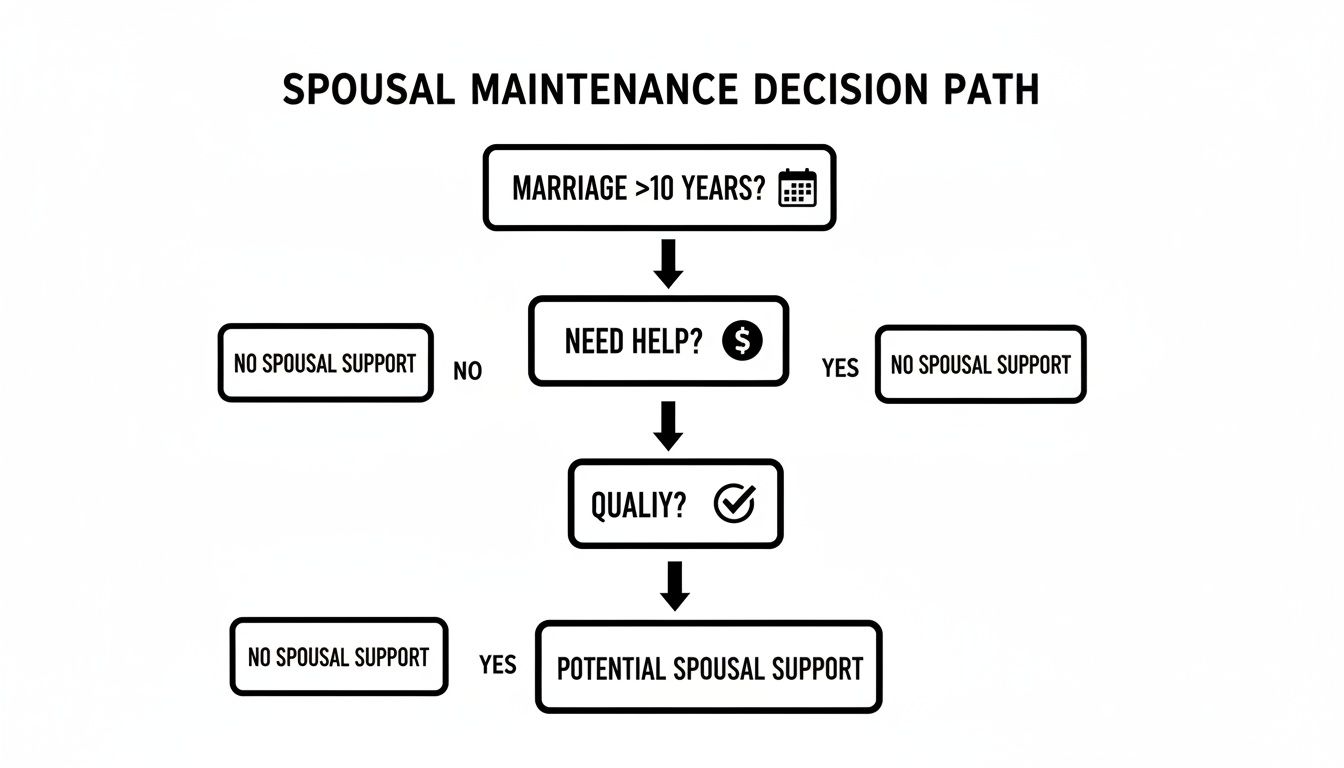
As you can see, the length of the marriage is often the first gate to pass through, followed by a hard look at financial need. You can dive deeper into these requirements in our guide explaining what spousal support is in Texas.
If you presented compelling evidence for one of these pathways and the trial court simply ignored it or got the law wrong, that could be a reversible error—exactly the kind of mistake an appellate court is there to fix.
How Courts Calculate Maintenance Amounts And Duration
Even if a spouse proves they need financial support, it’s not a blank check. Texas law puts strict, non-negotiable limits on both the amount of the payments and how long they can last. If you're looking at a court order that feels unfair, understanding these legal caps is the first place to start. It's often where we find a reversible error—the kind of clear mistake an appellate court can step in and fix.
The math for the payment amount is straightforward. The law gives a simple formula: monthly spousal maintenance can't be more than $5,000 or 20% of the paying spouse's gross monthly income, whichever is less. This creates a hard ceiling that a trial judge simply cannot go over.

Applying The Statutory Caps
So, what does this look like in reality? Let's take a couple of examples.
Imagine one spouse earns a gross monthly income of $10,000. The maximum maintenance they could be ordered to pay is $2,000 per month (20% of $10,000), because that figure is well under the $5,000 cap.
Now, consider a higher earner making $30,000 a month. While 20% of their income is $6,000, the court can only award up to the $5,000 statutory limit. A judge ordering payments above these caps has made a clear legal error.
Spousal Maintenance Duration Caps In Texas
The duration of payments is just as tightly controlled, and it’s tied directly to how long the marriage lasted. It's crucial to remember that these are maximums, not automatic entitlements. The table below breaks down the absolute longest a court can order maintenance.
| Length of Marriage | Maximum Duration of Maintenance Payments |
|---|---|
| 10 up to 20 years | 5 years |
| 20 up to 30 years | 7 years |
| 30 years or more | 10 years |
The law goes a step further, telling judges they must order payments for the shortest reasonable period that allows the receiving spouse to get on their feet financially. A judge can't just hand out the maximum duration without a very good, evidence-based reason.
Grounds For An Appeal
These hard limits aren't just guidelines; they are the law. When an appellate attorney reviews a divorce decree, one of the first things we do is check if the maintenance order breaks these rules.
If your final divorce decree orders maintenance payments that are too high or last too long, it is not just unfair—it is legally incorrect. This type of error is often a strong foundation for a successful appeal.
The property you walk away with also matters. The court is required to look at the assets you received in the divorce when deciding if you truly need support. To see how that works, you might be interested in our guide that explains whether Texas is a community property state. An order that ignores the property you were awarded could be another clear example of a judge abusing their discretion.
Appealing An Unfair Spousal Maintenance Order
You may feel your case was handled unfairly if a judge made a serious mistake in a spousal maintenance ruling. An appeal might be your only path to a fair outcome, but it is important to understand how an appeal differs from a trial.
An appeal is not a second trial. You cannot introduce new evidence or re-argue your case from scratch. Instead, an appellate court conducts a careful review of the trial record—the transcripts, exhibits, and rulings from the original case—to determine if a legal error occurred. Your appellate attorney’s role is to identify those errors and explain how they led to an unjust result.
Understanding the Standard of Review
When it comes to spousal maintenance, appellate courts operate under a standard called abuse of discretion.
Abuse of Discretion: This legal standard means an appellate court will only overturn a trial judge’s decision if it was arbitrary, unreasonable, or made without reference to guiding legal principles. It is a high bar to meet, requiring proof that the decision was not just wrong, but legally unsupported by the facts or the law.
To succeed on appeal, you must prove the judge made a decision that was not supported by the evidence presented in court or the Texas Family Code.
Common Reversible Errors in Maintenance Orders
To win an appeal, your attorney must identify a reversible error—a mistake so significant that it likely caused an improper judgment. In spousal maintenance cases, these errors often fall into a few key categories:
- Exceeding Statutory Caps: The judge ordered payments that go beyond the legal limits—the lesser of $5,000 or 20% of the paying spouse's gross monthly income. We cover this calculation in our guide on how much spousal support is in Texas.
- Misapplying Eligibility Rules: The court awarded maintenance to a spouse who did not meet the strict legal requirements or, conversely, denied it to a spouse who clearly proved a qualifying disability or other eligibility factor.
- Ignoring Key Evidence: The judge failed to properly consider crucial evidence, like a spouse’s earning capacity, education, skills, or the property they were awarded in the divorce.
- Ordering an Improper Duration: The court ordered maintenance payments for a period longer than the law allows for the specific length of the marriage.
The appellate process is meticulous. It begins with preparing the official trial record and then drafting a detailed legal document called a brief.
Briefing: The process of writing and submitting a formal legal argument (an “appellate brief”) to the court of appeals. The brief outlines the facts of the case, cites relevant laws, and explains why the trial court’s decision was legally incorrect.
A strong appellate brief is focused on restoring fairness by ensuring the law was applied correctly.
Common Arguments Against A Spousal Maintenance Claim
If you're the spouse being asked to pay maintenance, it's critical to understand that a judge won't just rubber-stamp the request. The spouse asking for support has a steep hill to climb, and Texas law provides several solid defenses you can raise. Knowing these arguments is your first line of defense against an unfair spousal maintenance order.
Sometimes, a trial court might not give these defenses the weight they deserve, leading to an unjust outcome. This is often where a strong appeal comes into play. A skilled appellate lawyer can meticulously review the trial record, looking for instances where the judge may have overlooked key evidence that should have either prevented the maintenance award or significantly reduced it.
Key Defenses in a Maintenance Case
The most direct way to challenge a maintenance claim is to prove the requesting spouse simply doesn't meet the strict eligibility criteria laid out in the Texas Family Code. This isn't about arguing—it's about presenting concrete evidence that refutes their claims.
Here are some of the most common and effective legal arguments:
- Sufficient Property: You can show that the requesting spouse already has enough separate property, or will be awarded enough community property in the divorce, to cover their own “minimum reasonable needs.” If their financial resources are adequate, the need for maintenance disappears.
- Failure to Seek Employment: The law requires the person asking for support to make a genuine effort to become self-sufficient. If you can demonstrate they aren't actively looking for a job or taking steps to develop marketable skills, you can effectively counter their claim.
- Inflated Expenses: It’s not uncommon for a spouse's list of "needs" to be exaggerated. A strong defense involves scrutinizing their claimed monthly expenses and arguing that they are unreasonable or include wants, not true necessities.
- Sufficient Earning Capacity: Even if the spouse isn't currently working, you can present evidence that they could be. This often involves testimony from a vocational expert who can assess their education, skills, and the local job market to establish their ability to earn a sufficient income.
A judge is required to weigh all the relevant factors. When a court ignores compelling evidence against maintenance, it may be considered an abuse of discretion—a legal standard that is fundamental to winning an appeal. If the trial court ordered you to pay maintenance despite strong evidence supporting one of these defenses, that decision could be a reversible error.
Frequently Asked Questions About Texas Alimony
When you’re questioning a court's decision on spousal maintenance, the legal jargon can feel overwhelming. It’s natural to have a lot of questions. Let's clear up some of the most common ones we hear from people trying to make sense of a Texas alimony order.
Can I Get Alimony If My Marriage Was Shorter Than 10 Years?
Usually, the answer is no. The 10-year marriage rule is a hard-and-fast legal line in most cases.
But there are a couple of very specific exceptions. A court might grant maintenance in a shorter marriage if you can prove your spouse was convicted of family violence. Another exception is if you have a disability—or you're caring for a child with a disability—that keeps you from earning enough to support yourself. Without one of those narrow circumstances, Texas courts simply don't have the power to order maintenance for marriages under 10 years.
Does Adultery Affect The Alimony Decision?
This is a common misconception. While a judge might consider adultery when splitting up your property, it is not a direct path to getting alimony.
First, you have to prove you’re eligible for maintenance based on the strict legal requirements, like the 10-year rule and showing you can't meet your minimum reasonable needs. Only after you’ve proven eligibility can a judge look at things like adultery to decide how much to award and for how long. It's a factor, but it won't unlock the door for you.
Can A Spousal Maintenance Order Be Changed Or Terminated?
Absolutely. A maintenance order isn't set in stone forever. If either person has a "material and substantial change" in their situation, the order can be modified. This could be anything from losing a job to getting a major promotion or facing a new health crisis. For personalized legal guidance concerning spousal maintenance, it is often advisable to consult with specialized family law firms.
The payments also stop automatically under certain conditions. The obligation ends if either person dies, if the receiving spouse remarries, or if they move in and begin a dating relationship with a new romantic partner.
If you believe the court made a mistake in your family law case, our appellate attorneys can help you seek a fair outcome. Contact The Law Office of Bryan Fagan today for a free consultation at https://familylawcourtappeals.com.