Yes, you can appeal a divorce decree in Texas, but it is essential to understand what the appellate process entails. An appeal is not a second chance to re-argue your case or introduce new evidence. Instead, it is a formal legal procedure designed to correct significant errors made by the trial court judge that led to an unjust outcome. If you believe your divorce case was decided unfairly, the Texas appeals process may be your path to seeking justice.
Your First Steps After an Unfair Divorce Ruling
Receiving a final divorce decree that feels fundamentally wrong can be a disheartening experience. You may feel that the judge ignored key evidence, misinterpreted the law, or issued a ruling that jeopardizes your financial security or your relationship with your children. While the trial has concluded, the fight for a fair and just result is not necessarily over.

It is vital to recognize that an appeal is very different from a trial. No witnesses will testify, and no new evidence can be presented. A panel of appellate judges will meticulously review the existing trial record—every transcript, motion, and exhibit—to determine if a “reversible error” occurred. A reversible error is a legal mistake so significant that it likely caused the trial court to reach the wrong decision. Your appellate attorney’s role is to identify these errors and construct a compelling legal argument demonstrating why the original judgment was flawed and should be overturned.
The Critical Importance of Time
In the world of appeals, the calendar is unforgiving. The Texas Rules of Appellate Procedure establish strict deadlines that must be met. Generally, you have only 30 days from the date the judge signs the final decree to file a Notice of Appeal.
This 30-day window can be extended to 90 days if you file certain post-judgment motions. Filing a Motion for New Trial is often a strategic first step. This motion asks the trial judge to reconsider the ruling and gives your appellate team more time to prepare. You can learn more about how a motion for new trial in Texas works and its importance in preserving your right to appeal. Missing these deadlines will result in the permanent loss of your right to appeal.
Preparing for the Path Ahead
Pursuing an appeal is a document-intensive process. Your legal team must gather and organize the entire case file, including every filing, hearing transcript, and piece of evidence admitted at trial. This is a substantial undertaking where organization is key; effective document management for law firms is essential for preparing a complex case for review by a higher court. Understanding this from the start helps ensure you take the correct steps to protect your future.
What Qualifies as Grounds for an Appeal?
When you receive a final divorce decree that feels deeply unjust, your first instinct may be to seek a do-over. However, an appeal is not an opportunity to re-litigate your case or simply express dissatisfaction with the outcome.
To succeed on appeal, you must demonstrate that the trial court made specific, legally recognized errors. The appellate court will not reweigh evidence or hear new testimony. Its role is to review the official record of your trial and determine if a significant legal or procedural mistake—a reversible error—occurred and led to an improper judgment.
Understanding the Standard of Review: “Abuse of Discretion”
One of the most common grounds for appealing a Texas family law case is “abuse of discretion.” This is a legal term that defines the standard of review the appellate court uses. It does not mean the judge acted maliciously; rather, it means the judge made a decision that was arbitrary, unreasonable, or without reference to guiding legal rules and principles.
A trial judge has a certain “zone of reasonable disagreement” within which they can make decisions. An abuse of discretion occurs when a ruling falls so far outside that zone that it is clear the judge misapplied the law or made a decision without sufficient factual support.
For example, an abuse of discretion may have occurred if the judge:
- Ignored critical evidence, such as a child custody evaluator’s report or documented proof of a parent’s substance abuse.
- Committed an error in property division by classifying your separate property, like an inheritance, as community property subject to division.
- Refused to allow a key witness to testify without a valid legal reason, preventing crucial information from being heard.
These are not minor procedural issues. They are fundamental errors that can profoundly impact your financial future and your relationship with your children.
What Is a Reversible Error?
Not every mistake made during a trial justifies an appeal. To win an appeal, the mistake must be a reversible error—an error so significant that it probably caused the court to issue an improper judgment. A simple typo in a court filing is not a reversible error. However, a miscalculation of child support by thousands of dollars because the judge used incorrect income data could be.
The appellate court asks a central question: "If this mistake had not occurred, is there a high probability the outcome would have been different?" If the answer is yes, you may have strong grounds for an appeal. You can learn more by exploring common grounds for appeal in Texas family law.
The heart of an appeal is not about re-arguing facts. It is about proving the legal process was flawed, leading to an unjust result that the higher court must correct to restore fairness.
Common Grounds for a Divorce Decree Appeal
While every case is unique, certain types of reversible errors appear frequently in Texas divorce appeals. A skilled appellate lawyer will meticulously review the trial record—transcripts, evidence, and rulings—to identify these mistakes.
Common grounds for appeal include:
- Incorrect Property Characterization: A judge misidentifies separate property (such as a business owned before marriage) as community property, leading to an unfair division.
- Improper Child Support Calculations: The court misapplies the Texas Family Code guidelines, deviates from them without proper justification, or fails to consider a child's special needs.
- Procedural Defects: A violation of your right to due process, such as not receiving proper notice of a hearing or being denied the right to cross-examine a key witness.
- Erroneous Custody Rulings: The judge’s final custody decision is not supported by the evidence presented regarding the child's best interest.
Identifying these errors requires a deep understanding of the Texas Family Code and the Texas Rules of Appellate Procedure. It is a meticulous, detail-oriented process focused entirely on the law and the official record created in your case.
Navigating the Strict Deadlines for a Texas Divorce Appeal
When appealing a family law case in Texas, time is of the essence. The process is governed by a series of strict, non-negotiable deadlines. Missing a deadline can result in the permanent loss of your right to appeal.
These deadlines are established by the Texas Rules of Appellate Procedure and are strictly enforced by the courts to ensure the legal system operates efficiently and fairly. Let's break down the timeline.
This visual provides a clear overview of the critical first steps, beginning the moment your divorce decree is signed.
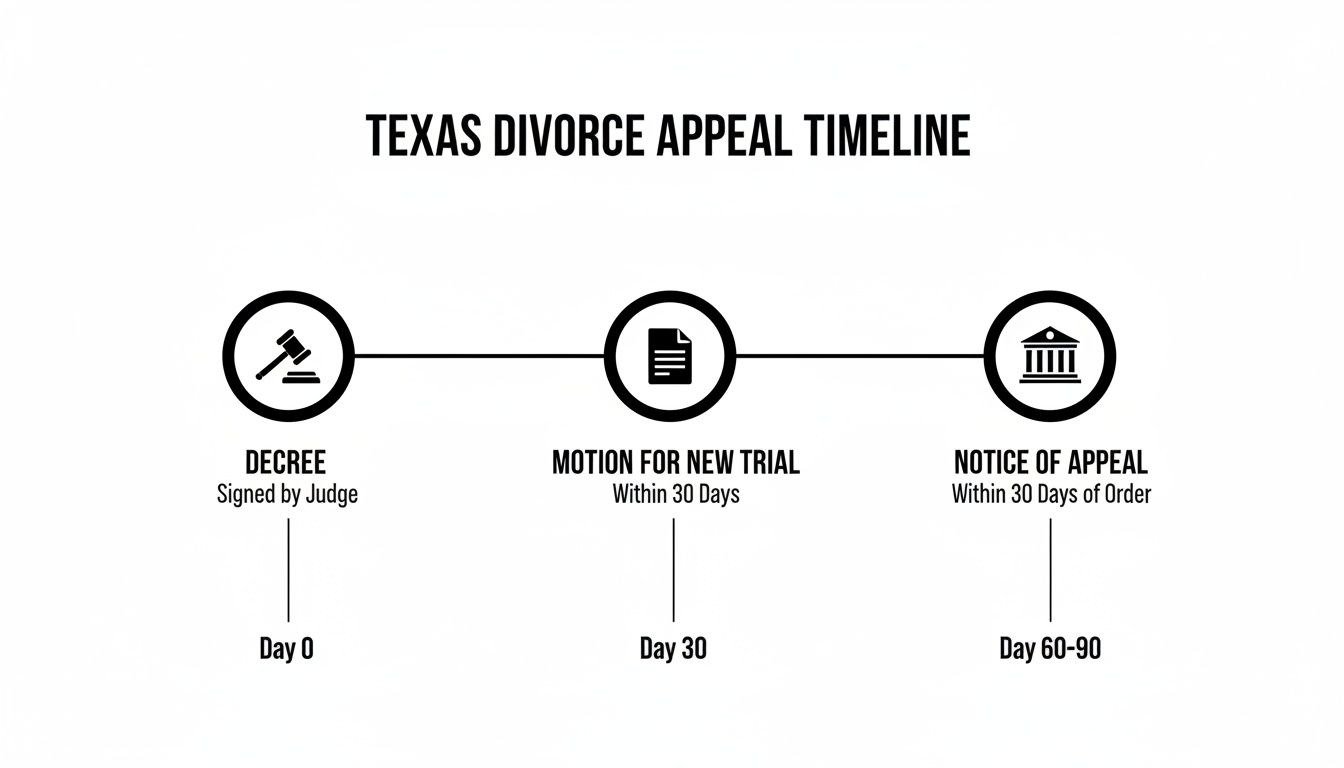
As you can see, you must act strategically and swiftly from the very beginning.
The First 30 Days After the Final Decree
The moment the judge signs your Final Decree of Divorce, a 30-day clock begins to run. This is the most critical window in the appellate process. You must take formal action within these 30 days to preserve your right to appeal.
One of the most effective first steps is filing a Motion for New Trial. This is a formal request asking the trial judge to reconsider the ruling and correct specific errors. This motion is crucial for two primary reasons:
- It provides the trial judge an opportunity to correct a mistake without the need for a full appeal.
- Critically, it extends your deadline to file an appeal from 30 days to a more manageable 90 days from the date the decree was signed.
This extension provides your appellate attorney the time needed to thoroughly review the trial record, identify legal errors, and prepare a strong case for the higher court.
Filing the Notice of Appeal
Whether you are working within a 30-day or 90-day window, the process culminates in filing a Notice of Appeal. This is the official document that informs the trial court and the opposing party that you are formally challenging the decision in a higher court.
The Notice of Appeal is a straightforward but essential document, and filing it correctly and on time is non-negotiable. In Texas, you must file it within 30 days of the decree being signed, or within 90 days if you filed a Motion for New Trial or another qualifying post-judgment motion. Missing this deadline will almost certainly end your case.
Once the notice is filed, the court of appeals assumes jurisdiction over your case, and the next stage of the process begins. To better understand this step, you can learn more about a Notice of Appeal in Texas and its significance.
Preparing the Appellate Record and Briefing
After the Notice of Appeal is filed, the next task is to assemble the appellate record. This is the complete case file that the appellate judges will use for their review. It includes every document filed and every word spoken during your original case.
The record consists of two main parts:
- The Clerk’s Record: This contains all documents filed in your case, such as the original petition, motions, orders, and the final decree.
- The Reporter’s Record: This is the official word-for-word transcript of all testimony and arguments made in court during hearings and the trial.
Your appellate attorney will use this record to build the legal arguments for your appeal. These arguments are presented in a detailed written document called an appellate brief. The court sets a strict schedule for filing these briefs, which serve as your attorney’s opportunity to persuasively explain to the appellate judges what errors the trial court made and why its decision should be overturned.
An Appeal Isn't a "Do-Over" of Your Trial
When a judge finalizes a divorce decree that feels deeply unfair, it is natural to want a second chance to argue your case from the beginning. However, it is a common misconception that an appeal provides this opportunity. An appeal is an entirely different legal proceeding.
An appeal is not a new trial. The appellate court will not hear from witnesses, and you cannot submit new evidence. The time for presenting facts and telling your story has passed. Instead, an appeal is a technical legal argument focused on one issue: whether the trial court made a serious legal mistake in handling your case.
The Case is Locked: Understanding the Appellate Record
The entire appeal is based on the appellate record. This is the official, unchangeable account of your original trial. It is a complete collection of everything that was filed and said in the trial court, and nothing new can be added.
The record includes two key components:
- The Clerk's Record: The official paper trail of your case, including every document filed, from the initial petition to the judge's final orders.
- The Reporter's Record: The official, word-for-word transcript of everything said during court proceedings, including witness testimony, attorney arguments, and the judge's rulings.
Once this record is compiled and transmitted to the court of appeals, the panel of appellate judges can only consider what is contained within it. Their role is not to second-guess the facts but to identify significant legal errors the trial judge may have made based on the information presented at that time.
Why the "Standard of Review" Is Everything
One of the most significant challenges in any appeal is the standard of review. This is the specific legal lens the appellate court must use when examining the trial judge's decisions. It determines how much deference is given to the original judge's rulings.
An analogy from sports can be helpful:
- For judgment calls, like whether a receiver maintained control of a football, a replay official will only overturn the call on the field if there is a clear and obvious mistake. This is similar to the "abuse of discretion" standard used for most family law issues, such as property division and child custody. The appellate court affords the trial judge considerable latitude in making these decisions.
- However, if a referee on the field misapplies a rule—for instance, enforcing the wrong penalty for a foul—the replay official will correct that mistake without deference. This is akin to a "de novo" review, where the appellate court examines a pure question of law with fresh eyes.
The standard of review is critical because it defines what you must prove to win. For many key decisions in a divorce, you must not only show the judge was wrong, but that the decision was so arbitrary and unreasonable that it constituted a clear abuse of discretion.
This is the fundamental difference between a trial and an appeal. Your appellate lawyer is not re-litigating facts or attempting to persuade a new set of judges with your story. Their job is to construct a meticulous legal argument, citing specific points in the record, to prove that the trial judge committed a reversible error under the correct standard of review. It is a disciplined, technical process, but it is the only path to challenging an unjust divorce decree.
Understanding the Possible Outcomes of Your Appeal
Winning an appeal does not always mean achieving the exact outcome you desire. The appellate court's function is to correct legal mistakes made by the trial court, not to provide a "do-over." Understanding the potential results is essential for setting realistic expectations and deciding if an appeal is the right course of action for you.

After reviewing the briefs and hearing any oral arguments, the court of appeals will issue a written opinion. The decision will fall into one of three primary categories, each with a distinct impact on your case.
Outcome 1: Affirming the Trial Court’s Decision
The most common outcome is for the appellate court to affirm the trial judge's decision. This means the higher court reviewed the entire record and concluded that no reversible legal error occurred.
If your appeal is affirmed, the original divorce decree remains in full effect. While this can be a frustrating result, it provides a definitive end to the legal challenge, confirming that the trial court acted within its legal authority.
Outcome 2: Reversing and Rendering a New Judgment
A less common but highly favorable outcome is a reverse and render. This is a decisive victory. It means the appellate court not only found a significant error in the trial court’s decision but also determined that the existing record contains all the information needed to correct the mistake immediately.
The court essentially states, "The trial judge was wrong, and this is the correct judgment." It overturns (reverses) the flawed portion of the decree and issues (renders) the correct one, eliminating the need to return to the trial court on that issue.
For example, if a trial judge mischaracterized your separate property inheritance as community property, the appellate court could reverse that ruling and render a new judgment declaring it your sole property. This outcome offers a final, corrected resolution.
A "reverse and render" decision is often the most sought-after outcome in an appeal. It provides a clear, corrected judgment directly from the higher court, eliminating the need for further litigation on that specific issue at the trial level.
Outcome 3: Reversing and Remanding for Further Proceedings
The most complex result is a reverse and remand. In this scenario, the appellate court agrees that the trial judge made a serious error but concludes that the record is insufficient to fix the problem directly.
The court reverses the incorrect ruling and sends the case back (remands it) to the trial court with specific instructions. This is similar to a professor returning a paper with detailed notes on what must be corrected and resubmitted.
A common example is when a judge improperly excludes crucial evidence in a custody dispute. The appellate court might reverse the custody order and remand the case, instructing the trial judge to hold a new hearing and properly consider that evidence. This provides a second opportunity to present your case on that specific issue but requires returning to the trial court.
If you believe the court made a mistake in your family law case, our appellate attorneys can help you seek a fair outcome. Contact The Law Office of Bryan Fagan today for a free consultation.
How to Move Forward with Your Appeal
Understanding that you can appeal your divorce decree is the first step. Taking action is the next. If you are convinced that a serious legal error led to an unjust result in your case, you need a clear strategy to move forward.
The path ahead requires a careful evaluation of the legal merits of your claim, the financial considerations, and the unique procedures of appellate law. This is not a journey to undertake alone.
Finding the Right Legal Partner
A skilled trial lawyer is not necessarily a skilled appellate lawyer. The two roles require distinct skill sets.
Your trial attorney focused on presenting evidence and advocating for you before a single judge. An appellate lawyer’s work is confined to the written record. Their role is to conduct an exhaustive review of that record, identify reversible errors, and build a persuasive legal argument based solely on what has already occurred.
You need an attorney who specializes in this area of law. They must be able to:
- Meticulously analyze every page of the trial record.
- Identify subtle legal errors that may not be apparent to others.
- Author a powerful, technically precise appellate brief that complies with all court rules.
- Understand the legal reasoning that persuades appellate justices, which differs from what influences a trial judge.
Evaluating the Practical Realities
Beyond the legal analysis, it is important to be realistic about the time and financial commitment involved. An appeal is not a quick process; it can easily take a year or more from the date the notice of appeal is filed until a decision is issued.
It is also a separate financial undertaking, with costs for preparing the official court record, court filing fees, and attorney's fees for the intensive research and writing required.
A reputable appellate attorney will provide a candid assessment of your case, outlining the potential costs against the likelihood of success so you can make a fully informed decision.
While the right to appeal is a cornerstone of our legal system, procedures can vary significantly. Divorce is legal in all but two of the world's 195 countries, but this global context only underscores the need for local expertise. The rules for challenging a divorce decree in Texas are specific, and you need a guide who knows this terrain. You can learn more about how divorce proceedings are handled across the globe to appreciate the differences between legal systems.
If you believe the court made a mistake in your family law case, our appellate attorneys can help you seek a fair outcome. Contact The Law Office of Bryan Fagan today for a free consultation.
Your Questions About Divorce Appeals, Answered
When a judge signs your final divorce decree, it may feel like the end of a long road. But if you believe the outcome was unjust, you likely have many questions about what comes next.
Here are answers to some of the most common questions we receive from clients considering an appeal.
How Long Do I Have to Decide to Appeal?
This is the most critical time-sensitive question. In Texas, the clock starts the moment the judge signs the final decree. From that date, you generally have only 30 days to file a Notice of Appeal.
While filing certain post-judgment motions, like a Motion for New Trial, can extend this deadline to 90 days, the initial steps must be taken almost immediately. Any delay can forfeit your right to appeal.
Can I Bring in New Evidence or Witnesses for My Appeal?
The answer is a firm no. An appeal is not a new trial where you can present new evidence or introduce new witnesses.
The appellate court acts as a reviewer of the trial that has already occurred. Its role is to examine the appellate record—the official transcripts, evidence, and documents from your original trial—to determine if the trial judge made a legal error based on the information available at the time.
What’s the Difference Between a Trial Lawyer and an Appellate Lawyer?
Think of a trial lawyer as the quarterback on the field, presenting facts, questioning witnesses, and making real-time strategic decisions to persuade the judge. Their focus is on building the factual narrative of your case.
An appellate lawyer is like the coach analyzing the game film. They meticulously review the written record and transcripts to identify legal errors. Their work involves deep legal research and crafting persuasive written arguments (briefs) to convince a panel of appellate judges that the trial court misapplied the law. They possess distinct and specialized skill sets.
Is Appealing a Divorce Decree Expensive?
It is important to be realistic about the costs. An appeal is an entirely new legal proceeding with its own set of expenses. These include court filing fees, costs for preparing the official trial record (which can be thousands of pages), and your attorney's fees.
An ethical appellate attorney will provide a transparent breakdown of the potential costs and help you weigh that investment against the likelihood of a better outcome, allowing you to make an informed financial decision.
What Are My Real Chances of Winning an Appeal?
Appeals are challenging. Trial court decisions are generally given significant deference, and statistically, most are upheld.
Winning an appeal is not about disagreeing with the judge's decision. You must prove that a specific, prejudicial legal error occurred—what the law calls an abuse of discretion or a reversible error. Your chances of success depend entirely on whether such an error exists in your case record. An experienced appellate lawyer can review your file and provide an honest assessment of your odds.
If you believe the court made a mistake in your family law case, our appellate attorneys can help you seek a fair outcome. Contact The Law Office of Bryan Fagan today for a free consultation at https://familylawcourtappeals.com.