A Texas family law appeal typically takes 12 to 24 months from start to finish, and you usually have only 30 days from the date the judge signs the final judgment to begin. If you miss that deadline, your right to appeal is permanently lost.
If you're reading this, there's a good chance you're sitting with a court order that feels very wrong. Maybe the custody ruling doesn't reflect what happened in court. Maybe the property division seems legally flawed. Maybe the judge made a ruling that left you feeling unheard. Those reactions are real, and they matter.
But an appeal isn't a second trial. It's a structured legal review focused on whether the trial court made a legal or procedural mistake. That difference shapes every step in the step-by-step texas family law appeal process timeline. The strategy isn't to re-argue everything. It's to identify the error, preserve the issue, build the record, and present a precise argument under the Texas Rules of Appellate Procedure and the Texas Family Code.
Determining if a Texas Family Law Ruling Can Be Appealed
The first question isn't whether the result felt unfair. The first question is whether the ruling is appealable now.
In most Texas family cases, you can appeal a final order. That usually means an order that resolves the case and leaves nothing significant for the trial court to decide. A final divorce decree is the common example. A final order in a suit affecting the parent-child relationship may also be appealable if it fully disposes of the issues before the court.
By contrast, many temporary orders are not immediately appealable on their own. A temporary custody arrangement entered while the case is still pending often doesn't qualify as a final appealable order. That distinction matters because clients often call after a painful temporary hearing, ready to appeal immediately, only to learn the law doesn't allow that route yet.

Final order versus temporary ruling
A simple way to think about it is this:
| Type of ruling | Usually appealable | Practical example |
|---|---|---|
| Final judgment or decree | Yes | Final divorce decree dividing property and setting conservatorship |
| Temporary order during the case | Usually no | Temporary possession schedule entered before trial |
| Partial ruling with issues still pending | Usually no | Court decides one issue but leaves support or property unresolved |
The label on the document doesn't always control. Courts look at what the order does. If the case is still open and major issues remain unresolved, an ordinary appeal may not be available yet.
What counts as a real appellate issue
Appeals focus on reversible error. In plain English, that means a mistake by the trial court that likely mattered to the outcome. Not every bad ruling qualifies. Not every frustrating hearing creates an appellate issue. And not every unfair feeling translates into legal error.
Practical rule: An appeal asks, "Did the court make a legal mistake that affected the judgment?" It doesn't ask, "Would another judge have handled this differently?"
Examples of rulings that may raise appellate concerns include:
- Misapplication of the law: The court applies the wrong legal standard in a custody or property issue.
- Procedural unfairness: The court excludes evidence it should have considered, or admits evidence in a way that affected the outcome.
- Failure to support the judgment: The final ruling doesn't line up with the evidence and legal framework that governed the case.
Families trying to understand where a case fits often benefit from broader resources on family law practice management, especially when they want to see how case organization, court filings, and litigation strategy interact over time.
Orders people commonly want to challenge
Family law appeals often arise from disputes involving divorce, conservatorship, child support, spousal maintenance, property division, protective orders, and enforcement rulings. Some of those are clearly final. Some are not.
That is why the first serious appellate task is to read the signed order carefully, compare it to the live pleadings, and determine whether the case is procedurally ready for appeal. If it isn't, a different remedy may be needed. If it is, the clock is already running.
Understanding the Legal Grounds for an Appeal
Individuals often start with a conclusion: "The judge got it wrong." Appellate law starts one step earlier: why was it legally wrong?
In Texas family law appeals, the most common ground is abuse of discretion, which accounts for the majority of appellate challenges, and the court of appeals generally has four possible outcomes: affirm, reverse and render, reverse and remand, or modify the judgment, as discussed in this overview of appeals in divorce and family cases.

What abuse of discretion really means
This phrase confuses many clients because it sounds personal. It isn't. It doesn't mean the judge acted maliciously or unfairly in a casual sense. It means the judge acted arbitrarily, unreasonably, or without following guiding legal rules.
Think of it this way. Trial judges have room to make judgment calls. Appellate courts usually won't interfere just because they might have decided the issue differently. But that discretion has boundaries. If the judge steps outside those boundaries by applying the wrong law, ignoring required factors, or making a ruling the record doesn't support, the appellate court can step in.
Reversible error versus simple disagreement
Not every disappointing result is reversible error. That distinction is where many appeals are won or lost.
A few common examples help:
- Likely appellate issue: A court misclassifies property and treats separate property as community property under the wrong legal framework.
- Likely appellate issue: A custody ruling ignores a legal requirement the court had to consider.
- Likely appellate issue: The court excludes critical evidence, and the exclusion likely affected the result.
Now compare those to weaker complaints:
- Usually not enough by itself: "The judge believed the other side."
- Usually not enough by itself: "I think the schedule is unfair."
- Usually not enough by itself: "Another judge might have ruled differently."
That's why strong appellate work depends on identifying the legal flaw, tying it to the record, and showing why it mattered. Technology can help with issue spotting and record review. For lawyers and clients curious about research support tools, How AI assists legal professionals offers a useful look at that process.
For a closer look at what qualifies as a viable appellate issue, review these grounds for appeal in civil cases.
A short explanation can also help frame the difference between trial and appeal:
Plain-English appellate terms
A strong appeal isn't built on outrage. It's built on the record, the rule that was broken, and the harm that followed.
Here are three terms clients need to know:
| Term | Plain-English meaning |
|---|---|
| Abuse of discretion | The trial court made a decision outside the range the law allows |
| Reversible error | A legal mistake that likely affected the judgment |
| Briefing | Written legal arguments filed with the appellate court |
Family appeals are not broad fairness reviews. They are error-correction proceedings. That sounds narrow because it is narrow. But when a trial court applies the wrong rule or ignores required procedure, that narrow path is exactly how unfair outcomes get corrected.
The Critical First 30 Days Your Appeal Timeline Starts Here
The judge signs the order on Friday. By Monday, you're still dealing with the shock of the ruling, and the appellate clock is already running. That is how this process works in Texas family cases. The first month rewards prompt, disciplined decisions, and it punishes delay.
Texas appellate deadlines usually begin when the final judgment is signed. In some cases, a timely post-trial motion extends the timetable. The strategic question is not merely how many days remain. The critical question is what needs to happen during that window to preserve every viable issue without creating new problems.
The first decisions that shape the appeal
The opening steps are simple on paper and high-stakes in practice.
Confirm the exact date the order was signed
The deadline usually runs from the signing date, not from the day a party reads the order, receives a copy, or realizes how serious the ruling is. Lawyers should verify that date immediately and confirm that the order is final and appealable.Decide whether a post-trial motion serves a real purpose
A motion for new trial or another qualifying motion can buy time, but extra time is not always the main benefit. Sometimes the better reason to file is to give the trial court a chance to correct an error, clarify a ruling, or preserve a complaint that may be harder to present later. Sometimes filing a motion adds cost without improving the client's position. The choice should be tied to the issues in the record, not made by reflex.File the notice of appeal on time and in proper form
The notice of appeal preserves the right to appellate review. It does not argue the case, but missing it can end the case. For a practical overview of that step, review this guide on how to file a notice of appeal in a Texas family law case.
Why this window matters so much
Clients often assume the appeal starts with briefing months later. In reality, many of the most important appellate decisions are made in these first weeks.
Counsel should consider requesting Findings of Fact and Conclusions of Law in many family cases, especially bench trials. Those findings can narrow the issues, show what the trial court decided, and help frame the standard of review. They can also expose whether the judgment rests on a ground that is difficult to challenge or on reasoning that is legally vulnerable. That is a strategic advantage, not a paperwork exercise.
A rushed filing can preserve the deadline but miss the bigger picture. Waiting too long can do worse. It can forfeit arguments that might have been preserved with a timely post-judgment motion or request.
Client guidance: The best appellate planning often starts before the final hearing is over, because preservation problems rarely get easier after the order is signed.
What clients should do immediately
The useful work in this period is practical and focused:
- Get the signed order and all related filings together
- Confirm every hearing date that may matter to preservation
- Identify possible legal errors, not just unfair results
- Ask whether any post-trial request would clarify or strengthen the appeal
- Calendar every deadline from the signing date, not from memory or assumption
This stage requires calm judgment. Family rulings are personal, and clients are often angry for good reason. But appeals are governed by deadlines, preservation rules, and standards of review. The first 30 days are where strategy begins to separate a frustrated reaction from a workable appeal.
Assembling the Official Record for the Appellate Court
A client often reaches this stage feeling that the hard part is over because the notice of appeal has been filed. In practice, at this stage, many appeals are strengthened or weakened. The court of appeals decides the case from the record made in the trial court. It will not hear new witnesses, accept new exhibits, or sort out disputed facts from affidavits filed later.
The record usually has two main parts. The Clerk's Record contains the filed documents, including pleadings, motions, orders, and the judgment. The Reporter's Record contains the testimony, objections, rulings, and arguments that were transcribed from hearings or trial.
That distinction matters for strategy, not just terminology.
A family law appeal often turns on a very specific question: Did the trial court apply the wrong legal rule, exclude evidence it should have admitted, make a finding unsupported by the record, or rule within a zone of discretion the appellate court must respect? Each of those arguments depends on different parts of the record. If the appellate court cannot see what was filed, what was offered, what was admitted, or what objection was made, the argument may fail before the court ever reaches the merits.
What needs to be in the record
The right record is the one that matches the issues being raised. That usually means confirming the file includes:
- The signed order or judgment being challenged
- The live pleadings, relevant motions, and responses
- Exhibits admitted, refused, or offered for the record
- Transcripts from every hearing tied to the appellate issues
- Any findings of fact and conclusions of law, if they were requested and filed
- Post-judgment filings and rulings that affect preservation or the scope of review
For a more detailed explanation of what belongs in the file, see this guide to the appellate record in a Texas family law case.
Missing material does not merely weaken an appeal. It can keep the court from reviewing the issue at all.
The real decision is scope
Clients understandably ask whether they can save money by ordering only part of the reporter's record. Sometimes that is a sound choice. If the appeal involves a clean legal issue decided on written filings, a narrower record may be enough. But in many family cases, especially conservatorship, support, property characterization, or evidentiary disputes, a limited record creates risk.
The trade-off is straightforward. Ordering less can reduce upfront cost and delay. It can also hand the other side an argument that the omitted material supports the judgment. That is not a technical nuisance. It can shape the presumptions the appellate court applies.
Record preparation also takes time. The clerk must compile the file, the court reporter must prepare transcripts, and any dispute about exhibits or omissions can slow the process further. The practical question is not whether the record costs money. It does. The question is whether saving money now will undercut the issues worth briefing later.
The best approach is issue-driven. Start with the appellate points that have a realistic chance of success, then build a record that lets the court decide those points on a complete and fair basis.
Navigating the Briefing Schedule and Oral Argument
The briefing phase is the center of the appeal. It brings together legal theory, factual precision, and record citations. The appellate judges usually learn the case first through the briefs, not through oral argument.
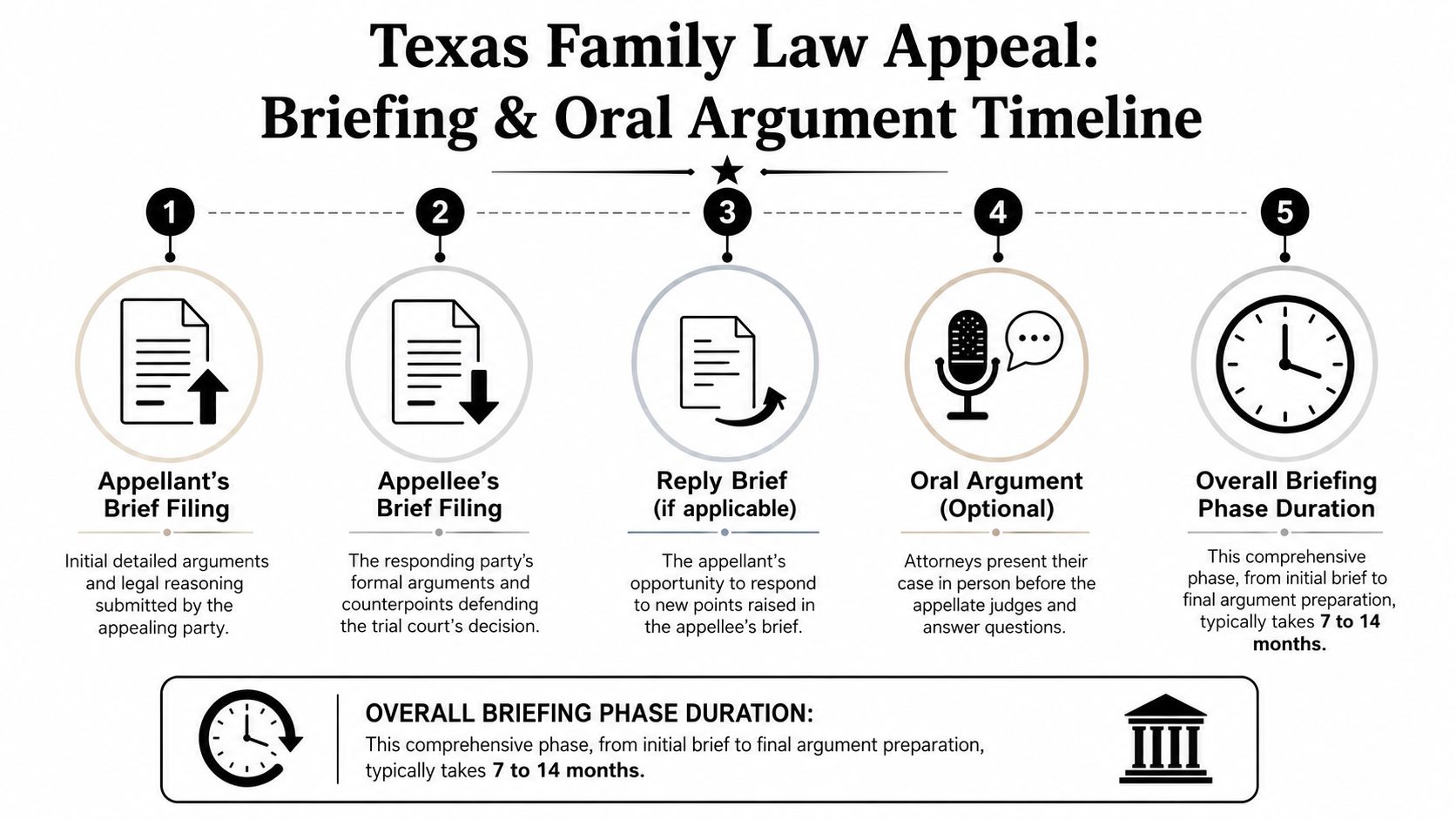
Standard Texas family law appeals span 7 to 14 months from notice to opinion, according to this discussion of how long a Texas appeal may take. That span includes more than waiting. It includes building and testing the written argument.
What a brief is and why it matters
A brief is a formal written legal argument filed with the court of appeals. It explains what the trial court did, what legal standards apply, where the error occurred, and why the error requires relief.
A strong brief does four things well:
- States the issue clearly: The court should understand the legal question quickly.
- Uses the record carefully: Every important factual point must tie back to the actual record.
- Applies the right standard of review: Family appeals often turn on whether the court abused its discretion.
- Explains harm: It's not enough to show a mistake. The brief must show why the mistake mattered.
One common reason appeals fail is that the appellant doesn't show sufficient harm from the alleged error. The same source notes that this problem dooms roughly 60% of abuse-of-discretion challenges. That reflects a basic appellate truth. Error without harm often isn't enough.
The usual order of filings
The briefing sequence usually unfolds like this:
| Filing | Who submits it | Purpose |
|---|---|---|
| Appellant's brief | The party appealing | Identifies error and asks for relief |
| Appellee's brief | The responding party | Defends the trial court's ruling |
| Reply brief | The appellant | Answers points raised in response |
The reply brief is often underestimated. It shouldn't just repeat the opening brief. It should tighten the issues, answer the strongest counterarguments, and redirect the court to the controlling parts of the record.
Oral argument isn't guaranteed
Not every case receives oral argument. Many family appeals are decided on the written briefs alone. That catches some clients off guard, especially if they expect a dramatic courtroom presentation before the appellate panel.
When oral argument is granted, it is usually a focused exchange with the judges. The lawyers answer questions, address weak points, and clarify the practical consequences of the ruling the court is considering.
Oral argument rarely rescues a weak brief. It can, however, sharpen a strong one.
What effective appellate advocacy looks like here
This phase rewards discipline. The best briefing doesn't sound angry. It sounds inevitable.
That usually means:
- choosing fewer, stronger issues instead of attacking every ruling
- quoting the record accurately and sparingly
- addressing the standard of review properly
- showing the court a practical remedy that fits the law
The hardest strategic choice is often deciding what not to argue. A cluttered appeal can weaken a strong point. A focused appeal gives judges a clear reason to act.
Appellate Court Decisions and What Happens Next
After briefing closes, and after oral argument if the court grants it, the court of appeals issues its opinion. This is the point where legal language starts to have direct consequences for your family, your finances, or your parental rights.
The possible outcomes are familiar in appellate practice but not always intuitive to clients. Understanding them helps set realistic expectations.

The four main outcomes
Texas appellate courts generally have four options in family cases:
Affirm
The trial court's judgment stands. The appellate court found no reversible error requiring change.Reverse and remand
The appellate court sends the case back to the trial court for further proceedings. In family law, this is often the most practical appellate remedy because the trial court may need to reconsider an issue under the correct legal standard.Reverse and render
The appellate court replaces the trial court's judgment with the judgment that should have been entered. This is less common in family cases unless the law points clearly to one result.Modify
The appellate court changes a limited part of the judgment and leaves the rest in place.
What those outcomes mean in real life
An affirmed judgment usually means the original custody, support, or property ruling remains in effect.
A remand means the fight isn't over. The case returns to the trial court, often with instructions. That can lead to a new hearing, additional findings, or a fresh ruling on a narrower issue.
A rendered judgment is more decisive. It means the appellate court concluded the legal outcome should be changed without sending the matter back for more trial-level work.
Rehearing and further review
The same source discussing Texas appeal timelines notes a 15-day window for filing a motion for rehearing after the appellate opinion. That motion asks the court of appeals to revisit a point it may have overlooked or misapplied.
After that, some litigants consider a petition for review in the Texas Supreme Court. That review is discretionary, not automatic. It isn't the next routine step in every case. It is a specialized decision based on the issues, the opinion, and the broader legal significance of the case.
The appellate opinion is not always the final practical chapter. But it usually defines what can happen next and what cannot.
The mandate
The mandate is the appellate court's formal order making its judgment effective and returning authority to the trial court where needed. Until the mandate issues, the process may not be fully concluded at the trial court level.
That final procedural step matters because clients often assume the opinion alone immediately changes everything. In practice, implementation follows the appellate court's formal process.
Common Questions About the Texas Appeals Process
A common client scenario looks like this. The judge has signed the order, the result feels wrong, and the first questions are practical. Can anything new be added? Does the order still control? Is an appeal worth the cost?
Those are the right questions. An appeal is not just a second round of argument. It is a rule-driven review of what happened in the trial court, and each decision should be made with the likely return in mind.
Can I present new evidence in my appeal
No. The court of appeals decides the case from the record made in the trial court.
That rule shapes strategy more than many people expect. If the problem is a missing witness, an exhibit that was never admitted, or facts discovered after judgment, a standard appeal may not solve it. In that situation, the better question is whether some other post-judgment remedy fits the problem. The right vehicle matters.
What are my chances of winning
The answer turns on error, preservation, and harm.
A client may be completely justified in feeling that the trial result was unfair. That feeling alone does not create a strong appeal. The appellate court asks narrower questions. Did the trial court make a legal mistake? Was that complaint properly preserved? Did the mistake probably affect the outcome?
The strongest appeals usually involve a specific ruling, a clean legal standard, and a record that shows why the error mattered. The weakest ones often ask the appellate court to reweigh credibility or reconsider a broad sense of unfairness. That is rarely how reversal happens.
Do I have to keep following the trial court's order while the appeal is pending
In many cases, yes.
Filing a notice of appeal does not automatically suspend the order. That issue can become urgent in child support, possession, enforcement, and protective-order matters. Some orders can be suspended under the rules. Others effectively continue unless a court grants relief, and family-law cases often have limits that surprise people.
The strategic point is simple. Do not assume the appeal puts the case on hold. A wrong assumption here can create enforcement problems fast.
How much does a family law appeal cost in Texas
Costs vary with the size of the record, the number of issues, and whether the case reaches oral argument or further review. The expense usually includes filing fees, preparing the clerk's and reporter's records, and attorney time for researching, writing, and responding to procedural motions.
The Texas judiciary's appellate fee schedules show that filing fees are only a small part of the overall cost. The larger expense is usually the legal work required to identify viable issues and brief them well. See the Texas Judicial Branch appellate fee information.
That is why cost cannot be evaluated in isolation. The question is whether the probable benefit justifies the investment. If the order has serious long-term consequences and the record shows a real appellate issue, the expense may be justified. If the complaint is diffuse and difficult to tie to reversible error, an appeal may consume time and money without changing the outcome.
Is oral argument part of every appeal
No. Many appeals are decided on the briefs.
That does not mean the court gave the case less attention. It usually means the panel concluded the written submissions adequately addressed the issues. Good briefing carries most appeals. Oral argument matters most when the court has specific questions, the legal issue is unusually close, or the record creates a point that benefits from direct clarification.
Can I handle the appeal without a lawyer
You can try, but family-law appeals are technical in ways that are easy to underestimate.
The hard part is not just writing a persuasive story. The hard part is spotting the issues that are reviewable, matching them to the correct standard of review, citing the record precisely, and following the Texas Rules of Appellate Procedure. A self-represented party can care intensely about the case and still lose on avoidable procedural mistakes.
That is the trade-off I explain to clients. An appeal is not the place for improvisation. It is a specialized process, and the quality of the issue selection often matters as much as the quality of the writing.
If you believe the court made a mistake in your family law case, The Law Office of Bryan Fagan, PLLC can help you seek a fair outcome. Our appellate attorneys handle Texas family law appeals involving child custody, divorce, property division, support, protective orders, and enforcement matters, and we can evaluate whether the record supports a viable path forward. Contact The Law Office of Bryan Fagan today for a free consultation.