Skip to content
You may feel your case was handled unfairly. After months, or even years, of navigating the family court system, the final ruling feels deeply wrong. Whether it's an unjust child custody decision or a skewed division of your property, the feeling of injustice can be overwhelming. You may be wondering what comes next.
The judge’s signature on that final order is not always the last word. You have the right to seek justice through an appeal. However, it's crucial to understand that an appeal is not a do-over. You don’t get to present new evidence or re-argue your case from scratch.
Instead, the entire fight for a fair outcome hinges on something called the appellate record.

Understanding the Appellate Record in a Texas Family Law Case
So, what exactly is the appellate record in a Texas family law case? Think of it as the official game film from your trial. It’s the complete collection of everything the court of appeals is allowed to see: every document filed, every piece of evidence admitted, and every word spoken in the courtroom.
If something was not properly presented and included in the record during your trial, then for the purposes of an appeal, it simply does not exist. Our job as appellate attorneys is to comb through this record, piece by piece, to prove the trial judge made what’s known as a reversible error.
Plain-English Definition: Reversible Error
This isn't just any minor slip-up. A reversible error is a legal mistake so significant that it likely caused the judge to reach the wrong conclusion. It’s an error that was harmful to the outcome of your case, and finding it within the record is the only path to winning an appeal.
How Appeals Differ from Trials
Understanding the core differences between a trial and an appeal is the first step toward seeking justice. In a trial, the main event is establishing facts with evidence and testimony. In an appeal, the focus shifts entirely to a legal review of the trial itself for mistakes.
This table breaks down the key distinctions.
| Aspect | Trial Court | Appellate Court |
|---|---|---|
| Purpose | To hear evidence, determine facts, and make an initial ruling. | To review the trial record for legal or procedural errors. |
| Evidence | New evidence and witness testimony are presented. | No new evidence is allowed; review is limited to the appellate record. |
| Decision-Maker | A single judge (or a jury) who decides the facts of the case. | A panel of judges (justices) who review how the law was applied. |
| Outcome | A final judgment (e.g., divorce decree, custody order). | A decision to affirm, reverse, or remand (send back) the trial court's judgment. |
As you can see, an appeal isn't a second chance to tell your story—it's a chance to show that the first telling was handled incorrectly under the law. This guide will walk you through exactly how that appellate record is built and how a skilled appellate team uses it as the primary tool to fight for the fair outcome you were denied.
The Two Parts of the Appellate Record
If you believe a family court judge made a critical error in your case, your entire fight for a different outcome hinges on the official story—the appellate record. Think of it as the "black box" from a flight; it’s the only source of information the court of appeals will use to figure out what went wrong in the trial court.
The appellate record is not a single file. It is a carefully assembled collection of two distinct parts that, together, tell the complete story of your case from start to finish.
The Clerk’s Record: The Official Paper Trail
First, you have the Clerk’s Record. This is the formal paper trail compiled by the district court clerk. It’s a bundle of every single document officially filed with the court during the entire life of your case.
Some of the most common documents you’ll find in a Clerk’s Record are:
- The initial petition that started the divorce or child custody case.
- Every motion filed by you or the other side (like motions for temporary orders or motions to compel discovery).
- The formal answers and any counter-petitions.
- All the evidence that was accepted as an exhibit, such as bank statements, property appraisals, emails, or photos.
- The final judgment or order that you are appealing.
This collection of paperwork provides the written foundation and legal context for all the arguments and rulings that happened along the way.
The Reporter’s Record: The Spoken Word
The second, and equally vital, part is the Reporter’s Record. This is the official, word-for-word transcript of everything said out loud during your hearings and trial, all typed up by the court reporter.
It captures every spoken detail: witness testimony, your lawyer's arguments, the other side's objections, and—most importantly—the judge's own comments and rulings from the bench. This is often where we find the "smoking gun" for an appeal, like a judge misapplying the law or wrongly admitting evidence over a proper objection.
Here's the absolute golden rule of appeals: If it didn't happen "on the record" in the trial court, it doesn't exist for the court of appeals. An argument that was never made, an objection that wasn't raised, or evidence that wasn't formally offered and admitted might as well have never happened.
This is precisely why your trial lawyer’s role is so critical. Every move they make—every objection, every exhibit they introduce, every legal point they argue—is about building the raw material for a potential appeal. A solid, detailed record gives an appellate attorney the evidence needed to prove a legal mistake was made. The strength of the record is everything. Statewide data from the Texas Supreme Court consistently shows that trial court errors are frequently corrected when the record clearly demonstrates the mistake. You can see an analysis of Texas Supreme Court reversal rates to understand just how often this happens.
When the record is built correctly, our attorneys can use that transcript and those documents to point to the exact moments the trial went off track. It provides the undeniable proof we need to ask the appellate court to restore fairness in your case.
Assembling the Record: A Step-by-Step Process
Knowing what the appellate record contains is one thing. Understanding how it’s actually put together—and why every single deadline is critical—is where a successful appeal truly begins. The entire process kicks off the moment your attorney files the Notice of Appeal, a formal document that starts a series of strict timers under the Texas Rules of Appellate Procedure.
Once that notice is filed, your appellate lawyer must immediately request the two parts of the record from the court officials who manage them. This means sending written requests to both the court clerk and the court reporter, asking them to prepare their respective pieces of the official appellate record in your Texas family law case.
The Request and Designation Process
The first request goes to the district clerk for the Clerk’s Record, the official collection of all the paperwork—pleadings, motions, and orders—filed in your case. At the same time, we send a request to the official court reporter for the Reporter’s Record, the word-for-word transcript of everything said during your hearings and trial.
You will need to make payment arrangements directly with the court reporter to prepare the transcript. The cost is based on the length of the proceedings.
This is also a moment for strategy. Your attorney won't just ask for "everything." Instead, we "designate the record," meaning we strategically select only the portions of the trial record essential for the appeal. It's not about volume; it's about precision.
For example, if your appeal centers entirely on a mistake the judge made when dividing your property, there's no reason to pay for a transcript of three full days of testimony about child custody. A smart designation saves you money, shortens the preparation time, and keeps the appellate court focused on the specific errors we need them to see.
This flowchart shows how these two separate streams of information—the paper trail and the spoken word—come together to form the complete record.
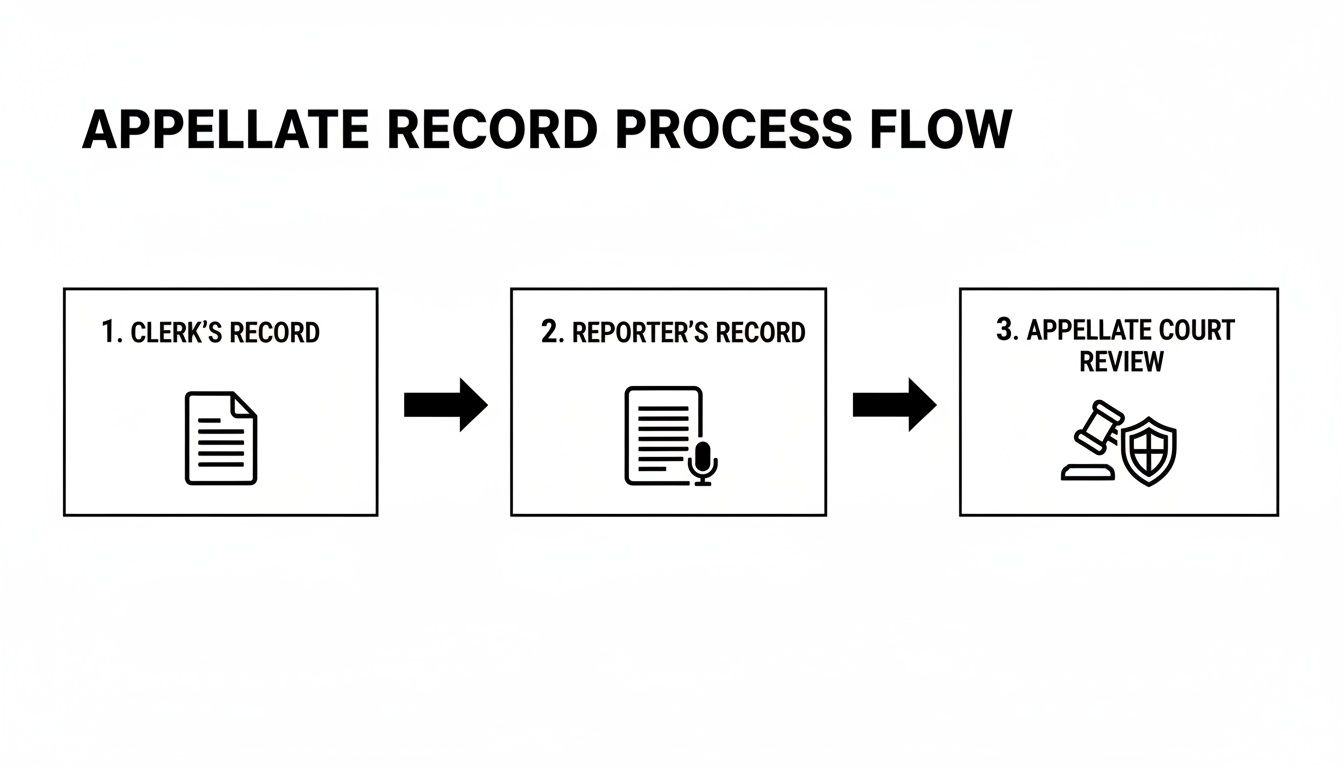
As you can see, the documents from the clerk and the testimony from the reporter are compiled separately before being combined into the one official record the court of appeals will review.
Strict Deadlines and Critical Procedures
The Texas Rules of Appellate Procedure are unforgiving when it comes to deadlines. From the moment the final judgment is signed, a series of timers start, and failing to act within those windows can be fatal to your appeal.
Key Deadlines to Watch:
- Notice of Appeal: Generally due within 30 days of the final judgment being signed. If a proper post-judgment motion (like a motion for new trial) is filed, that deadline can extend to 90 days.
- Record Request: To prevent delays, we request the record and ensure payment arrangements are in place immediately after filing the Notice of Appeal.
- Record Filing: The clerk and court reporter have their own deadline to file the record with the appellate court, typically 60 days after the judgment was signed, but this can change depending on the circumstances.
An experienced appellate lawyer lives by these timelines. A simple misstep, like not paying the reporter’s fee on time, can lead the appellate court to dismiss your appeal. That would mean your case is over before a panel of justices ever gets to hear why the trial court’s decision was wrong. Following these procedural rules perfectly is the only way to protect your right to be heard. You can get a better sense of how we build our arguments by reading our guide on how to write a statement of facts.
Using the Record to Prove Reversible Error
Once the record is prepared, the real work begins for your appellate lawyer. Think of this next phase as a forensic investigation. We shift from managing deadlines to acting as legal detectives, hunting for the critical mistakes that can turn a case around.
Our job isn't to simply argue that the judge’s decision was unfair. Instead, we must pinpoint specific, provable legal errors—mistakes so significant they likely changed the final outcome of your case.
Searching for an Abuse of Discretion
In Texas family law, trial judges have a great deal of leeway, or “discretion,” on major decisions like property division and child custody. But that power is not a blank check. A judge must follow established legal rules and principles; they cannot act on a whim or make a decision that is completely arbitrary. When a judge steps over that line, it’s known as an abuse of discretion.
Plain-English Definition: Abuse of Discretion
An "abuse of discretion" occurs when a judge's decision is so illogical, unfair, or out of sync with the law that no reasonable judge would have made the same call. It's a ruling that falls completely outside the zone of reasonable disagreement.
We dig through the record to find evidence of this. For example, the Reporter’s Record might contain a direct quote where the judge admits to ignoring a specific part of the Texas Family Code. Or, we might find a document in the Clerk's Record that proves the judge completely miscalculated the value of a business. These are the "gotcha" moments an appeal is built on.
Common Examples of Reversible Error
Spotting a mistake is just the starting point. To win an appeal, we have to prove that the mistake was a reversible error, meaning the error was harmful and likely caused the trial court to make the wrong call. The appellate record is the only evidence we can use to make this case. Common reversible errors we find buried in the record include:
- Misapplying the Law: The transcript shows the judge using the wrong legal test for determining what's in a child's best interest or for classifying separate vs. community property.
- Improperly Admitting Evidence: The Reporter's Record proves your trial lawyer correctly objected to something (like hearsay from a witness), but the judge let it in anyway and then based the ruling on that flawed evidence. This highlights the importance of preserving error for a Texas appeal.
- Insufficient Evidence: The record is completely empty on a key point. For example, the evidence presented at trial simply does not contain the facts legally required to support the judge’s order.
This careful review is more important than ever. While Texas saw a 3% spike in new family law cases filed in 2025, the number of post-judgment actions actually dropped by 11%. As you can discover more insights about Texas family law statistics, this trend highlights just how critical a solid appellate record in a Texas family law case is. With fewer post-judgment motions being filed, the initial appeal is often the one and only chance to challenge a final order.
Ultimately, your appellate attorney’s goal is to weave together a powerful story for the court of appeals. We use direct quotes from the Reporter's Record and specific exhibits from the Clerk's Record to show, with irrefutable proof, exactly what went wrong and why justice demands a different result.
Common Problems With the Record and How to Fix Them
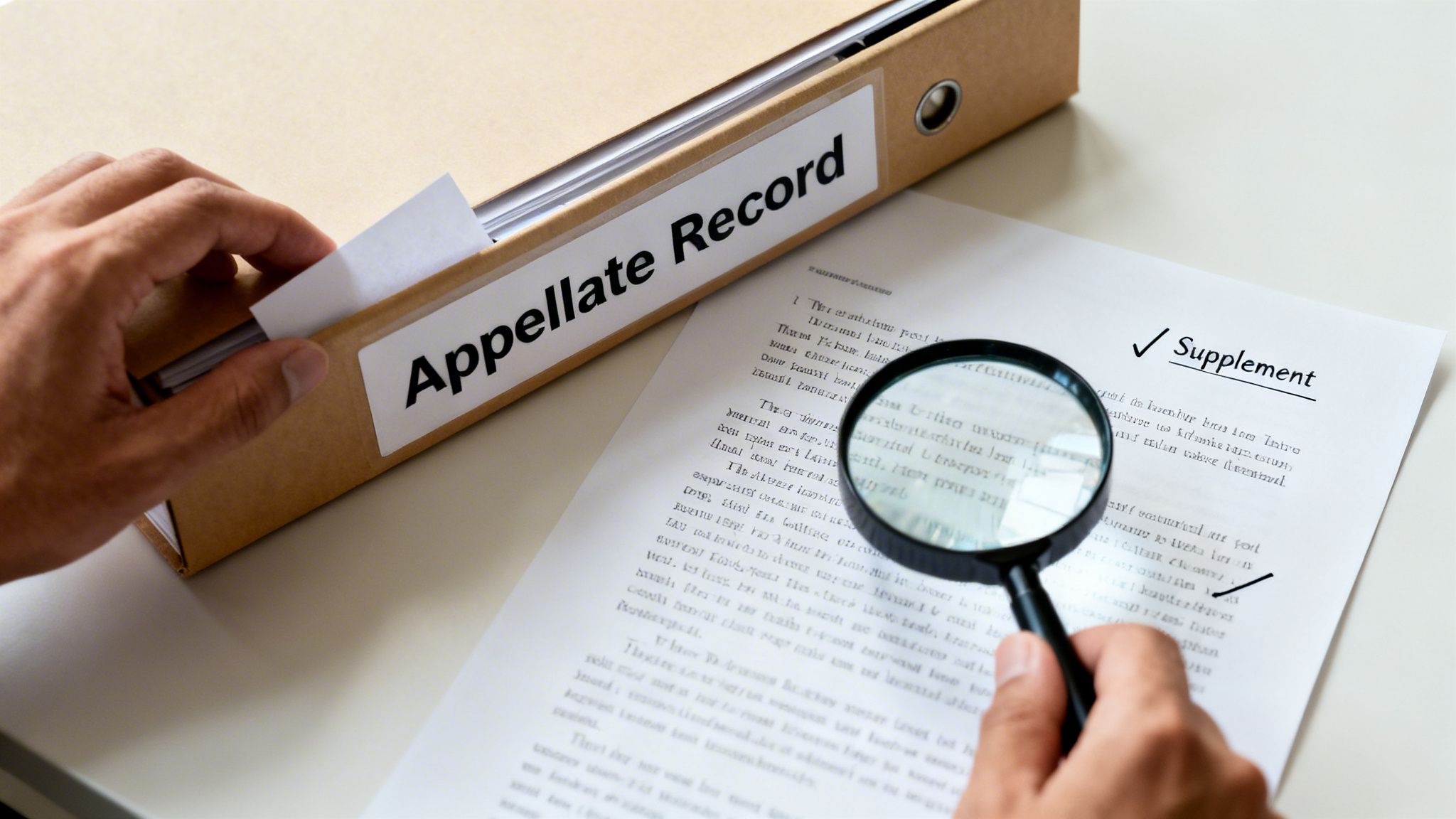
What happens when the official story of your case—the appellate record—isn't quite right? A critical exhibit might be missing from the Clerk's Record, or a typo in the Reporter's Record could twist the meaning of crucial testimony. When your entire appeal hangs on the appellate record in your Texas family law case, these kinds of mistakes can feel overwhelming.
The good news is that a successful appeal doesn't require a perfect record right out of the gate. An experienced appellate attorney anticipates these issues and has remedies provided by the Texas Rules of Appellate Procedure. Our first job is to hunt down any inaccuracies and ensure the record is complete before we build our legal arguments.
Correcting What's Wrong and Filling in the Gaps
When we spot an error or a missing piece, we move quickly. A simple clerical error shouldn't be the reason your appeal fails. The fix we use depends on the nature of the problem.
We frequently encounter a few common issues:
- Missing Exhibits: A crucial bank statement or property appraisal admitted at trial was somehow left out of the Clerk’s Record.
- Inaccurate Transcripts: The court reporter’s transcription contains a clear typo—like "can" instead of "can't"—that completely changes what a witness said.
- Incomplete Records: A key portion of a hearing was simply never transcribed or was omitted from the final record.
For every one of these problems, there's a procedural fix. We can file formal motions with the court to either correct the existing record or supplement it with missing information. This ensures the appellate justices see the full, accurate picture of what happened in the trial court.
How We Make the Record Right
Our team uses specific procedural tools to get the record into shape before we ever file your main brief. It's a non-negotiable step that keeps the appellate court from reviewing a skewed or incomplete version of your case.
The goal is to make the record speak the truth. If an exhibit is missing or a date is wrong, we have a duty to correct it. This diligence ensures the appellate court’s decision is based on what actually happened, not on a clerical error.
Here’s a look at how we tackle these problems in practice:
- Supplementing the Record: If a document is missing, the most common fix is to file a motion to supplement the record. This is a formal request asking the court clerk to locate the missing item and add it to the official record for the appellate court's review.
- Stipulating to a Correction: For straightforward mistakes like a typo in the transcript, the fastest route is often a stipulation. This is a formal agreement between the lawyers on both sides that points out the error and states what the correction should be.
- Requesting a Hearing: If there's a major disagreement over what was said or what happened, and the attorneys can't agree on a fix, we can ask the trial judge to hold a hearing. The judge will then settle the dispute and order the record to be officially corrected.
These corrective measures are another perfect example of why you need a specialist who lives and breathes the Texas Rules of Appellate Procedure. We make sure the very foundation of your appeal is solid before we even start crafting the legal arguments.
After the Record Is Filed: The Briefing Process
Once the appellate record is certified as complete and filed, the process shifts from gathering documents to building the legal argument. This next phase is called briefing, and it’s where the raw material of the record is transformed into the powerful, persuasive legal argument presented to the court of appeals.
Think of the appellate record as all the ingredients. The briefing is where your appellate attorney uses those exact ingredients to craft a compelling case for why the trial court's decision should be overturned.
Weaving the Story in the Appellant's Brief
The first and most critical step is drafting the Appellant's Brief. This document is the cornerstone of your entire appeal. It is our chance to tell your story to the appellate justices, frame the issues, and explain precisely where the trial court went wrong.
Using only the evidence and testimony contained within the official record, our job is to:
- Lay out a clear and concise history of the case.
- Pinpoint the specific legal errors or moments where the judge abused their discretion.
- Connect those errors to established Texas law and prior appellate decisions, showing why they are significant enough to require the higher court to step in and reverse the outcome.
Every assertion we make must be tethered directly to a page in the Clerk’s Record or a line in the Reporter’s Record. The brief is all about the record.
The Response and Our Final Word
After we file the Appellant's Brief, the other party will file an Appellee's Brief, which is their attempt to defend the trial court's actions.
Once we receive their arguments, we usually have the opportunity to file a Reply Brief. This is our final written word. We use it to dismantle the other side’s points, correct any mischaracterizations they may have made, and refocus the court’s attention on the key errors that justify a reversal. This back-and-forth is a fundamental part of the Texas appellate procedure for family law cases.
Don't assume a trial court's judgment is set in stone. In a recent term, for example, the Texas Supreme Court reversed an incredible 72.3% of the cases it chose to review. As you can learn more about these appellate court statistics, this figure shows that appellate courts are not shy about correcting mistakes when a well-argued brief clearly demonstrates reversible error.
Oral Argument
In some appeals, the court will schedule an oral argument. This isn't a new trial; it's a focused question-and-answer session with the panel of justices who have already read the briefs. It’s a crucial opportunity for your attorney to address their specific concerns, emphasize the most critical points from the brief, and make a final, direct case for why you deserve a fair outcome. The process is designed to give your case the thorough and fair review it deserves.
Your Questions About The Appellate Record, Answered
If you're thinking about an appeal, you probably have a lot of questions. The process can feel overwhelming, especially when the outcome of your family law case is on the line. Let's walk through some of the most common questions we hear from clients about the appellate record.
Can I Tell The Appeals Court Something New?
This is a big one, and the answer is almost always no. An appeal isn't a do-over or a second trial. Think of the appellate judges as referees reviewing the game film from your original trial. Their only job is to watch that film—the appellate record in your Texas family law case—and decide if the trial judge made a game-changing legal mistake.
They can't look at anything that wasn't on the field during the original game. This is precisely why it's so critical that everything is presented and recorded correctly the first time around. What happened in the trial court is all the appeals court gets to see.
How Long Does It Take To Get The Record Ready?
The timeline really depends on the length and complexity of your case. A transcript from a short, one-day hearing can be prepared relatively quickly, while a two-week trial with multiple witnesses will naturally take much longer.
The Texas Rules of Appellate Procedure give the court clerk and the court reporter specific deadlines. Generally, they have around 60 days from the date the final judgment was signed to get their respective parts of the record compiled. Sometimes extensions are needed, but don't worry—your appellate attorney will stay on top of these deadlines to keep your case moving forward without any unnecessary delays.
What Does It Cost To Prepare The Appellate Record?
The cost is directly tied to the size of the record itself. The district clerk charges a fee for the Clerk’s Record, which is a collection of all the documents filed in your case.
The Reporter's Record, however, is usually the more significant expense. This is the word-for-word transcript of everything said in court, and court reporters charge a per-page fee to produce it. While the cost for a long trial can be considerable, it's an absolutely essential investment. More often than not, the proof needed to win an appeal is found right there in the spoken testimony.
What If My Trial Lawyer Didn't Object To An Error?
This is a tough but very common situation. In the world of appeals, there's a crucial concept called “preserving error.” To complain about a mistake on appeal, your trial lawyer generally had to have made a specific and timely objection right when the mistake happened in the trial court.
If no objection was made, the appellate court typically considers the issue "waived," which means you've lost the right to raise it. There are a few rare exceptions for "fundamental errors" that are so serious they break the foundation of the case. A skilled appellate lawyer is needed to comb through the record and determine if any of these narrow exceptions could apply to you.
If you believe the court made a mistake in your family law case, our appellate attorneys can help you seek a fair outcome. Contact The Law Office of Bryan Fagan today for a free consultation to evaluate your case.