You may feel like the judge got it wrong. Maybe the custody schedule doesn’t fit your child’s routine. Maybe property you believe was separate property got folded into the marital estate. Maybe the court shut down evidence you thought mattered. After a hard family court trial, that kind of outcome can leave you frustrated, confused, and desperate for a second look.
That second look is what an appeal is for.
But it’s important to reset expectations right away. An appeal is not a new trial. It isn’t a chance to bring in new witnesses, add missing documents, or ask a new panel of judges to make a better call. It is a focused legal review of what already happened in the trial court.
When people search for what happens after you file an appeal in texas family court, they usually want two answers at once. First, they want to know the legal steps. Second, they want to know what happens to real life while those steps unfold. Do you still have to follow the custody order? Can support still be enforced? Can you move, change jobs, or make major decisions while the case is pending?
Those practical questions matter because an appeal often moves much more slowly than family life does. Children still go to school. Exchanges still happen. Bills still come due. Parenting conflicts don’t pause just because a notice of appeal was filed.
A strong appeal starts with clarity. You need to know what the appellate court can review, what deadlines control the process, what errors are significant, and how to live carefully under the existing order while the case is pending. That’s how you shift from feeling powerless to making smart decisions.
Your Case Is Over but the Fight for Fairness Has Just Begun
A final order can feel like the end of the road. In trial court, you told your story, introduced evidence, and waited for the judge to decide. When the ruling lands badly, it’s natural to think the next court will hear everything again and fix it.
That’s not how appeals work.
The court of appeals acts more like a careful reviewer than a replacement trial judge. It studies the written record from the trial court and asks a narrower question. Did the trial court make a legal or procedural mistake that affected the outcome? If the answer is yes, the appellate court may step in. If the answer is no, the order usually remains in place.
What an appeal is really asking for
An appeal asks a higher court to review the trial court’s work for error. In family law, that can include issues tied to divorce decrees, child custody, visitation, support, property division, spousal maintenance, protective orders, and enforcement rulings.
That focus matters because many disappointed litigants aren’t dealing with appealable error. They’re dealing with a result they strongly disagree with. Those are not always the same thing.
Practical rule: An appeal is strongest when you can point to a specific ruling, a specific part of the record, and a specific legal reason the ruling was wrong.
Common points of confusion
Here is where many clients understandably get tripped up:
- “The judge didn’t believe me.” Appellate courts usually won’t re-weigh witness credibility.
- “I have new evidence now.” New evidence usually doesn’t come into a direct appeal.
- “The other side lied.” That may matter, but the question is whether the record shows legal error and whether that error affected the judgment.
A better way to think about an appeal is this. Trial is the live performance. Appeal is the review of the official recording, the script, and the rulebook. The court of appeals isn’t deciding whose story it likes more. It’s deciding whether the rules were followed and whether the result can legally stand.
That distinction can feel frustrating. It can also provide a sense of clarity. Once you understand the rules of appellate review, you can stop chasing arguments that won’t work and start focusing on the ones that might.
The First 90 Days Critical Deadlines and Assembling the Record
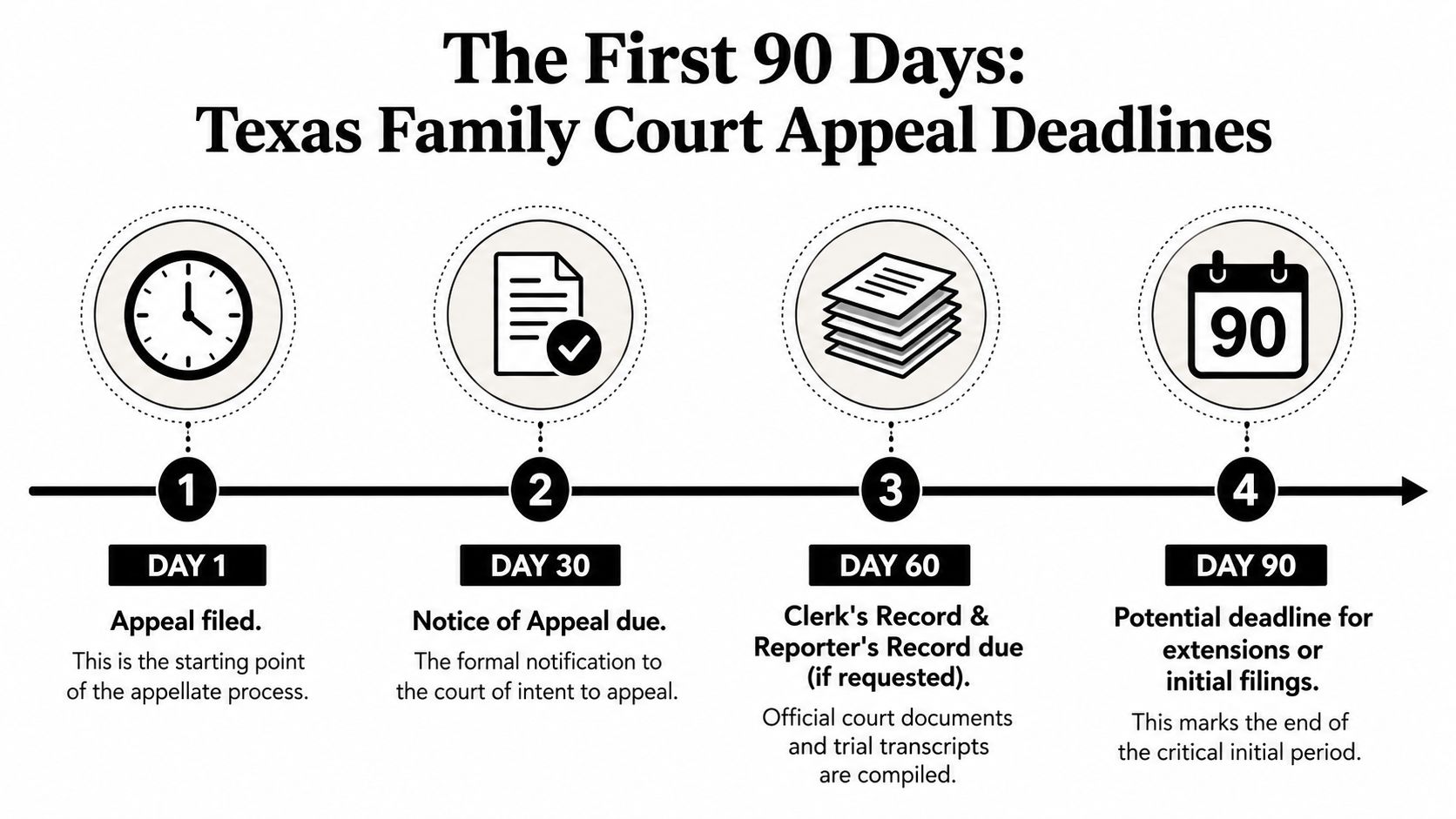
The first phase after judgment is unforgiving. Texas family court appeals follow strict deadlines, and the earliest decisions often shape everything that follows. According to this discussion of Texas family court appeal timing, a party generally has 30 days after the final judgment is signed to file a Notice of Appeal, though that period can extend to 90 days if certain post-trial motions are properly filed. The same source notes that requests for Findings of Fact and Conclusions of Law in non-jury cases must be made within 20 days of judgment, and missing that deadline can make an appeal significantly harder.
The early deadlines that matter most
These dates come fast:
Findings of Fact and Conclusions of Law
In a non-jury family case, this request asks the trial judge to spell out the factual findings and legal reasoning behind the decision. If you don’t request them on time, the appellate court may assume the trial judge had enough support in the record.Notice of Appeal
This is the document that formally starts the appeal. It doesn’t contain your full argument. It preserves your right to seek appellate review.Post-trial motions
In some cases, motions such as a motion for new trial or motion to modify can extend the appellate timetable. That doesn’t mean you should wait. It means your lawyer should calculate deadlines immediately and conservatively.
For a focused explanation of those filing windows, see how long you have to appeal a divorce in Texas.
The record is the whole universe of the appeal
After filing comes the assembly of the appellate record. This is the material the court of appeals will read. Nothing outside it counts.
The record usually includes two core parts:
Clerk’s record
Pleadings, motions, orders, exhibits admitted through the clerk, and other filed papers.Reporter’s record
The transcript of testimony, objections, rulings, and what happened in court.
Think of the record as the sealed box the appellate judges receive. If something important isn’t in that box, the judges usually can’t use it.
Missing parts of the record can turn a potentially strong complaint into a weak one because the appellate court can only evaluate what the official record shows.
For trial teams preparing for that review, clean transcripts matter. Tools like transcription solutions for legal teams can help organize spoken proceedings into usable text for internal analysis, especially when counsel needs to locate objections, testimony, and rulings quickly.
Why strategy starts before briefing
The record often arrives before clients fully realize what the appeal will and won’t include. That’s why the earliest stage is not clerical busywork. It is strategy. Appellate counsel should be identifying possible error, checking preservation issues, and mapping arguments while the record is being prepared.
A missed deadline can end an appeal. A thin record can restrict one. The first stretch after judgment is where careful lawyering protects the path forward.
Understanding the Standard of Review Why an Appeal is Not a Do-Over
The hardest concept for many clients is also the most important one. The appellate court does not ask, “Would we have decided this case differently?” In many family law issues, it asks a stricter question. Did the trial judge abuse discretion or commit another reversible legal error?

According to this review of Texas appeal outcomes and standards, Texas appellate courts affirm trial court rulings in roughly 70 to 80% of civil cases, and the affirmance rate is often high in family law because many issues are reviewed under a deferential abuse of discretion standard. The same source explains that success on appeal depends on showing a specific, reversible legal or procedural error that affected the outcome, not merely re-arguing the facts.
Abuse of discretion in plain English
Here’s the plain-language version.
A judge has discretion when the law gives room to choose among reasonable options. In custody, visitation, and property division, the trial court often has that room. An appellate court usually won’t reverse just because another judge might have reached a different result.
A useful analogy is instant replay in sports. The reviewing official doesn’t ask, “What call would I have made live?” The official asks whether the call on the field was clearly outside the bounds of a reasonable decision under the rules and the available replay.
That is why abuse of discretion is not the same as “I think the judge was unfair.” It means the ruling was legally unreasonable, unsupported under the governing rules, or based on a serious misstep.
Why new evidence doesn’t come in
Clients often say, “If the appellate judges could just hear this one extra fact, they’d understand.” The problem is that appeals are tied to the trial record.
The appellate court isn’t a fresh fact-finding court. It doesn’t hear new live testimony. It doesn’t watch new witnesses. It generally does not decide who seemed more believable. The trial judge did that job.
That deference exists for a practical reason. The trial judge sat in the courtroom, heard the tone of testimony, saw body language, and handled objections in real time. Appellate judges review the written and recorded history of that process.
What this means for expectations
A strong appeal usually sounds less emotional and more precise. It says something like this:
- the court applied the wrong legal standard
- the court admitted or excluded evidence in a way that likely affected the judgment
- the court mischaracterized property under Texas law
- the court entered an order that the record cannot support
The most persuasive appellate argument is rarely “the judge was wrong.” It is “the record shows this legal mistake, and that mistake changed the result.”
That shift in thinking is essential. It turns an appeal from a general protest into a disciplined legal argument.
Crafting the Appellate Brief Your Written Argument for Justice
By the time briefing starts, many parents are already living two lives at once. One life is ordinary and demanding: school drop-offs, support payments, work schedules, therapy appointments, and co-parenting exchanges. The other lives on paper. That paper record now has to persuade three appellate judges that a legal mistake in the trial court changed the outcome.

The briefing stage is where that paper case gets built. The appellant usually files first, the other side answers, and the appellant may file a shorter reply. As explained in this overview of the appellate briefing cycle, those deadlines arrive quickly once the record is on file. For families, that means the legal work becomes intense during a period when daily life has not slowed down at all.
What the brief is really doing
An appellate brief works like a trial notebook rewritten for judges who were never in the courtroom. They did not hear the witnesses live. They did not watch the judge make evidentiary calls in real time. They learn the case through the record and the briefing.
A strong brief usually has four jobs:
- identify the specific rulings being challenged
- tell the relevant facts accurately, with exact citations to the record
- connect those facts to the governing law
- explain the remedy being requested, such as reversal, remand, or modification
That structure matters because appellate judges are not looking for a full retelling of the marriage, the custody fight, or every frustration from trial. They are looking for a clear map. Which ruling was wrong, why was it wrong under Texas law, and why did that error matter enough to require a different result?
For a closer look at formatting, required sections, and record citations, see these Texas family law appellate brief requirements.
Why good briefs feel selective
Many clients arrive at this stage wanting every unfair moment included. That reaction is understandable. Family cases are personal, and trial records often contain dozens of moments that feel harmful.
Appellate strategy requires sorting those moments into two piles. The first pile contains painful facts that explain why the client is upset. The second contains legal errors the court of appeals can fix. The second pile is where the brief needs to stay focused.
A useful comparison is packing for a long trip with one carry-on bag. If you try to bring everything, the bag stops being useful. A persuasive brief does the opposite. It chooses the points that matter most and leaves out the ones that add emotion without adding legal force.
Reversible error, in plain language
The core question is usually simple: did the trial court make a mistake that probably affected the judgment?
That is what lawyers mean by reversible error.
In family cases, that can show up in several ways:
| Issue | What the error can look like |
|---|---|
| Property division | Separate property is treated as community property despite the record and the governing rules |
| Child custody | The ruling rests on the wrong legal standard or skips part of the required child-focused analysis |
| Evidence rulings | The court excludes important evidence or admits improper evidence in a way that may have shaped the result |
| Procedure | A required step is missed, limiting a party’s opportunity to present a claim or protect a right |
The practical point is this. The brief must connect the legal error to a real consequence. If the mistake did not likely change the outcome, the court may call it harmless and leave the judgment in place.
Why drafting takes so much discipline
Good briefing is part writing and part engineering. Every factual statement needs support in the clerk’s record or reporter’s record. Every legal argument needs authority. Every citation must be accurate. If one part is loose, the whole presentation loses credibility.
That is why appellate teams spend so much time checking the record, refining issue statements, and cutting weak arguments. In busy appeals, document systems that boost law firm efficiency can help legal teams manage drafts, exhibits, and record references without losing track of what supports each argument.
Some clients also hire appellate counsel at this point, even if trial counsel handled the hearing below. That is common in Texas family appeals because the work changes here. Trial advocacy is about witnesses, exhibits, and courtroom judgment calls. Appellate advocacy is about precision on paper, careful framing, and choosing the arguments that give the court a sound reason to act. The Law Office of Bryan Fagan, PLLC handles that kind of record review and briefing in Texas family appeals.
A persuasive brief earns trust by showing restraint. Judges tend to give more attention to three well-supported issues than to ten complaints competing for space.
For families, that restraint can feel unnatural at first. You may be living with the order every day, and every day may feel like proof that the trial result was wrong. The brief serves a narrower purpose. It turns the parts of your story the appellate court can use into a focused written argument with a realistic chance of changing the result.
Navigating Daily Life While Your Appeal Is Pending
The legal process may be abstract. Daily life isn’t. Children still need consistency. Rent or mortgage payments still have to be made. School pickup still happens whether the appeal is fully briefed or not.
That’s why one of the most important truths about family appeals is this: filing an appeal usually does not pause the trial court’s order.

A 2023 survey of Texas family law practitioners reported that roughly 80% of divorcing spouses continue living under unfavorable trial-order terms for at least 6 to 12 months while an appeal is pending. That practical reality surprises many parents, but it shapes nearly every strategic decision after filing.
What that means for custody, support, and enforcement
If the trial court ordered a possession schedule, child support, spousal support, or other obligations, you should assume those terms remain enforceable unless the court says otherwise.
In some cases, a party may seek a stay or other relief from enforcement. In plain English, a stay is a request to pause the effect of some part of the judgment while the appeal proceeds. That relief can be difficult to obtain, especially in orders involving children, because courts usually want stability and continuity.
For a focused discussion, see stay of enforcement pending appeal in Texas family law.
A practical roadmap for the waiting period
The families who handle appeals best usually become very disciplined about routine and documentation.
Follow the current order carefully
Even if you believe the order is wrong, violating it can create new problems, including enforcement claims and credibility issues.Document key events calmly
Keep records of exchanges, missed payments, school issues, medical decisions, and communication problems. Don’t editorialize. Just preserve facts.Avoid major unilateral changes
Big moves, sudden schedule changes, or unsupported decisions about the child can complicate both the appeal and the trial court relationship.Protect the child’s routine
Appeals are stressful for adults. Children usually do better when school, activities, and exchange logistics remain predictable.
A common real-world example
Suppose a parent appeals a custody ruling because the judge limited parenting time based on a legal framework the parent believes was applied incorrectly. During the appeal, that parent still needs to show up on time, follow exchange terms, communicate appropriately, and avoid pulling the child into the conflict.
The appeal argues about the past ruling. Your conduct during the appeal shapes the court’s view of your judgment going forward.
That is why appellate strategy is partly legal and partly behavioral. You are preserving rights in the courthouse while preserving stability at home.
The Final Stages Oral Argument and the Court's Decision
After briefing closes, many clients expect a dramatic courtroom event. Sometimes that happens. Sometimes it doesn’t.
Oral argument is a formal session where the lawyers appear before the appellate judges and answer questions. It is not a new trial. No witnesses testify. No new exhibits come in. The judges already have the briefs and the record. Oral argument is usually a focused conversation about the hardest legal points in the case.
What oral argument feels like
If trial is live storytelling, oral argument is closer to a rigorous question-and-answer session. The judges may ask about preservation of error, the wording of the order, the governing statute, or what remedy makes sense if they agree with one side.
That can surprise clients because the judges may spend most of their time testing the legal limits of both positions, not listening to long speeches. That is normal. It often means the court is narrowing in on the issues that matter most.
The four outcomes most clients need to know
When the appellate court rules, the result usually falls into one of these categories:
| Outcome | What it means |
|---|---|
| Affirm | The trial court’s judgment stands |
| Reverse | The appellate court overturns the ruling under review |
| Remand | The case goes back to the trial court for more proceedings |
| Modify | The appellate court changes part of the judgment itself |
An affirmance means the appellate court found no reversible error requiring relief. A reversal means the appellate court concluded the trial court got something legally significant wrong. A remand means more work remains in the trial court, often because further proceedings are needed to apply the appellate court’s ruling. A modification means the appellate court can correct part of the judgment without sending everything back.
What clients often misunderstand at this stage
Winning an appeal does not always mean the entire case disappears. Sometimes you win on one issue and return to the trial court for a narrower fight. Sometimes only part of an order changes.
Losing an appeal does not mean your concerns were trivial. It may mean the record, the preservation issues, or the standard of review limited what the appellate court could do.
Either way, the decision usually brings needed clarity. The uncertainty of “what happens next” finally narrows into an answer.
After the Decision Your Path to a Fair and Final Outcome
You may read the court’s opinion on a Tuesday and still have to get the kids to school on Wednesday, make support payments on Friday, and answer a co-parent’s text that weekend. That is what makes this stage so hard. The legal answer has arrived, but family life does not pause while everyone figures out what the opinion means in practice.
The next step usually turns on the mandate, which is the document that sends the appellate court’s decision back to the trial court for action. Until then, the existing order often remains the rule everyone lives under. If the judgment was affirmed, that usually means the trial court’s order stays in place. If the court modified part of the order, your job is to understand exactly what changed and when those changes take effect. If the case was remanded, the file goes back to the trial court, but only for the issues the appellate court left open.
A remand works like a case returning to a teacher with notes in the margin. The teacher does not regrade the whole semester. The teacher addresses the marked parts. Trial courts operate the same way after an appeal. The opinion sets boundaries, and good strategy starts with reading those boundaries carefully.
That matters in daily life. Parents often want to know whether exchange schedules stay the same, whether support must still be paid, whether a child can change schools, or whether a planned move has to wait. Those answers usually depend on the current order, the wording of the appellate decision, and whether the trial court must hold more hearings. The practical question is not only "Did we win?" It is "What do we do on Monday morning?"
Clarity helps families make better choices.
If the appeal ends with an affirmance, the focus often shifts from fighting the old order to deciding whether any future change belongs in a new modification case. If the appeal ends with a remand, preparation starts again, but on a narrower field. You gather updated facts, identify what the trial court can still decide, and avoid rearguing issues the appellate court already settled.
This is also the point where expectations need to be steady and realistic. A strong appellate result may correct a legal error without solving every conflict between parents. A disappointing result may still give you a clearer path for the next step. Either way, the opinion usually turns uncertainty into a set of decisions you can make, one by one, with less guesswork.
If you believe the court made a mistake in your family law case, our appellate attorneys can help you evaluate the ruling and the next practical step. Contact The Law Office of Bryan Fagan, PLLC today for a free consultation.