You may feel that the judge in your divorce, custody, support, or property case got it wrong. Maybe key evidence was brushed aside. Maybe the court applied the law in a way that didn't fit the facts. In Texas, that kind of frustration often leads to the same urgent question: can this be appealed before it's too late?
It can, sometimes. But the answer depends less on how unfair the ruling felt and more on whether the right steps are taken on time. That is why understanding what deadlines can destroy your texas family law appeal matters so much. In family appeals, timing is not just paperwork. Timing is what preserves the court's power to review the case at all.
An Unfair Ruling Is Not the Final Word
A family court ruling can change where your child lives, how property is divided, whether support is owed, or whether a protective order stays in place. When the result feels wrong, many people assume the next step is to “file an appeal.” In practice, the path is narrower than that.
Appeals work on a strict calendar. A missed deadline can block review even when the trial court made a serious mistake. That is one of the hardest parts for clients to hear. The legal system does provide a way to challenge unfair outcomes, but it expects fast, precise action.
What clients often face right after judgment
In the days after a final order, people are usually dealing with several problems at once:
- Emotional overload: You're still processing what happened in court.
- Practical confusion: You may not know whether the order is temporary, final, or immediately enforceable.
- Conflicting advice: Friends and family may say “just appeal,” without understanding how Texas appellate procedure works.
- Lost time: The clock may already be running from the date the judge signed the order, not the hearing date.
Practical rule: If you think the judge made a legal mistake, treat the signed order as the start of an immediate legal review, not as a document to revisit later.
That shift matters. The strongest appellate cases usually start with quick file review, careful calendaring, and a realistic assessment of what can still be preserved. Waiting to “see what happens” rarely helps. A clear plan does.
The right question is not only whether the ruling was wrong
The better question is this: what error can be identified, preserved, and presented under the rules?
That approach changes everything. It turns the conversation from raw frustration into strategy. It also helps clients understand that appellate work is disciplined. The issue is not merely disagreement with the judge. The issue is whether the record shows a legal basis for reversal and whether the required deadlines are still open.
That is where a calm, chronological approach helps most.
Appeals Are Not Retrials Understanding the Process
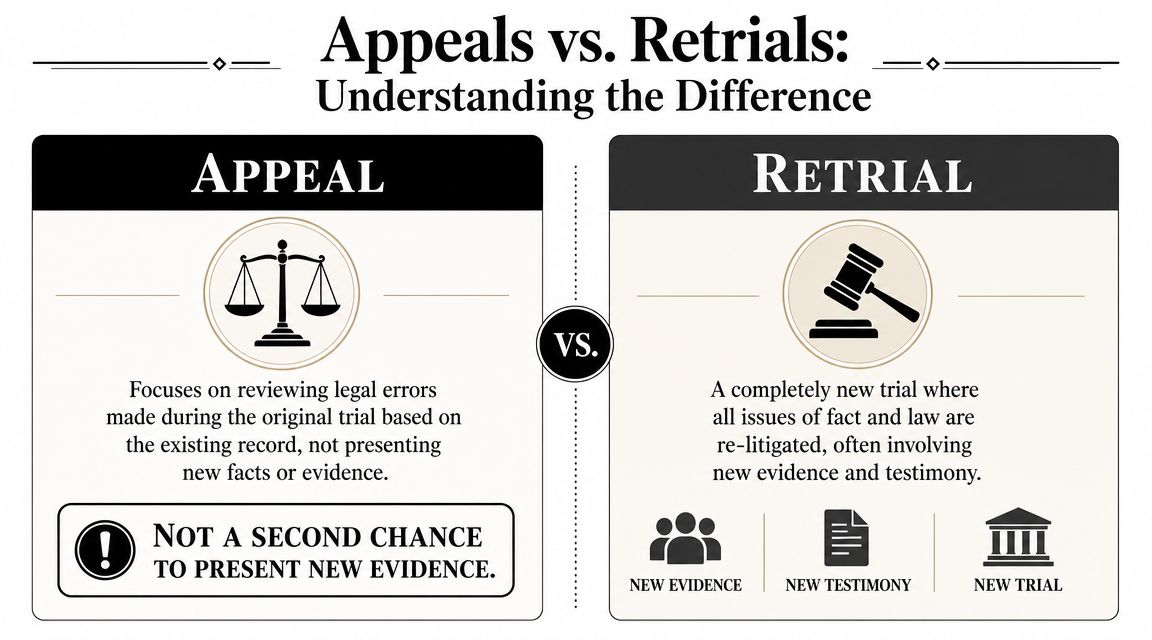
A Texas family law appeal is not a second trial. You don't get to bring in new witnesses, add fresh text messages, or rebuild the case with better preparation. The appellate court reviews what already happened in the trial court and decides whether the judge made a reversible legal mistake.
What the appellate court actually reviews
The appellate court studies the record. That usually includes the written filings, admitted exhibits, orders, and the reporter's transcript of what happened in court. The judges are not deciding the facts from scratch. They are deciding whether the trial court acted within the law.
That distinction matters in family cases because many rulings involve discretion. A trial judge has room to decide custody, support, and property issues within legal limits. An appeal asks whether the judge crossed those limits.
Plain-English definitions that matter
Here are the terms clients hear most often:
| Term | Plain-English meaning |
|---|---|
| Reversible error | A mistake serious enough that the appellate court may change the result or send the case back |
| Abuse of discretion | The trial judge made a decision outside the range the law allows |
| Standard of review | The rule the appellate court uses to evaluate the trial court's decision |
| Briefing | The written legal argument filed in the appellate court |
An abuse of discretion doesn't mean the appellate judges would have ruled differently. It means the trial court acted unreasonably, ignored governing law, or made a ruling the record does not support.
A reversible error is not every mistake. Some errors do not change the outcome. Appellate courts focus on whether the error affected the judgment in a meaningful way.
An appeal is a legal review, not a do-over.
Not every family court order can be appealed right away
Texas appellate jurisdiction is generally limited to final judgments that dispose of all claims and all parties. Interlocutory family-law orders usually are not appealable unless a statute specifically authorizes immediate review. In practice, that means temporary custody orders, temporary support orders, and other mid-case rulings often cannot be appealed on the same timeline as a final decree, as explained in this Texas family law appeal process overview.
That is why order classification matters at the front end. If you appeal a non-appealable order, or wait for a final order when a special rule required faster action, the case can go off track before the arguments are even written.
Common reversible issues in family cases
Not every disappointing result is appealable, but these issues often deserve close review:
- Misapplication of the law: The court used the wrong legal standard.
- Evidentiary error: The court admitted or excluded important evidence in a way that affected the result.
- Procedural unfairness: A party was denied notice, a fair hearing, or a meaningful chance to present the case.
- Unsupported findings: The ruling doesn't match what the admitted evidence could support.
Appeals are technical, but they are not mysterious. They follow rules, records, and deadlines.
The First Hurdle Filing Your Notice of Appeal
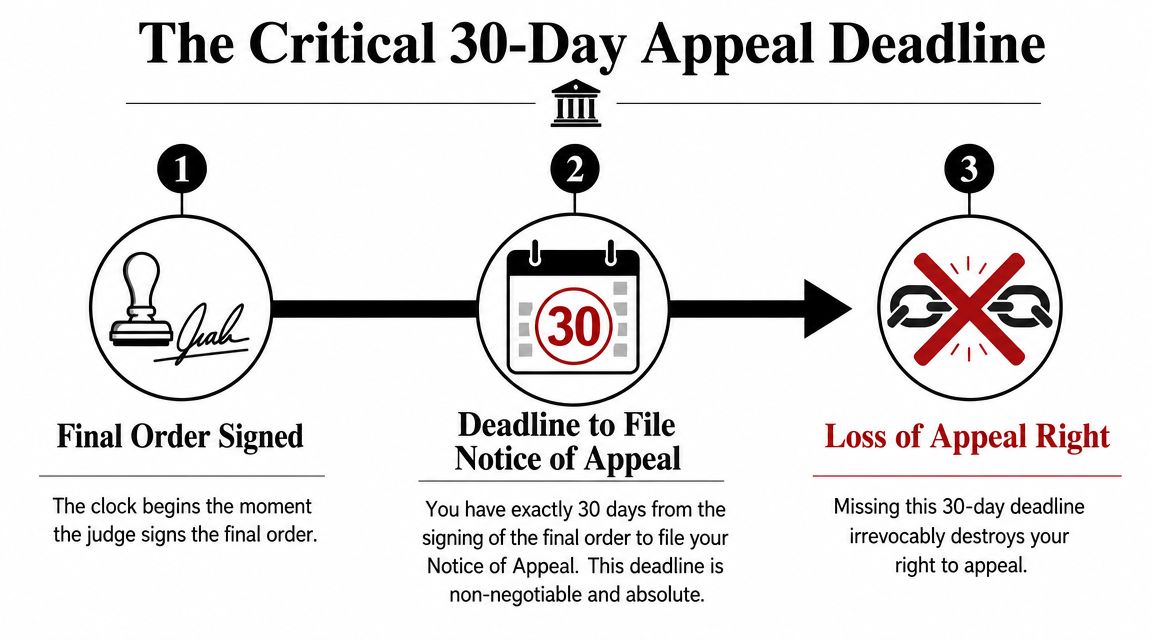
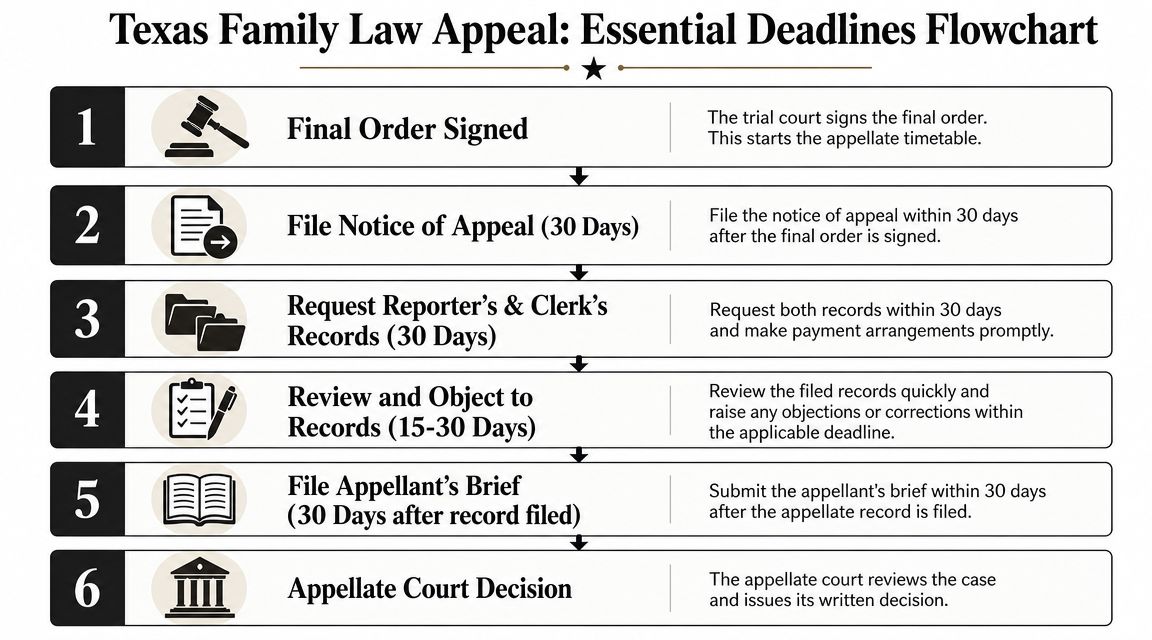
The most common deadline that destroys a Texas family law appeal is the deadline to file the notice of appeal. In ordinary circumstances, a party typically has 30 days after the trial judge signs the final judgment or final order to file that notice, and if that deadline is missed, the appellate court usually loses the ability to review the case, as noted in this Texas family-law appeals guide.
What starts the clock
The critical date is usually the date the order is signed. Not the hearing date. Not the day the judge announced a ruling from the bench. Not the day you received a copy in the mail.
That distinction causes real problems in family cases. A hearing may happen on one day, but the final written order may be signed later. If a client or trial lawyer calendars from the wrong event, days can disappear without anyone realizing it.
Why this deadline is different from most others
Some deadlines affect strategy. This one affects power. If the notice is late, the court of appeals generally can't proceed. That means even a strong issue, such as a serious custody error or a flawed property division, may never get reviewed.
This is why appellate planning starts with one question: has the notice-of-appeal deadline been preserved?
For readers wanting a practical overview of the filing step itself, this guide on how to file a notice of appeal is a useful starting point.
The law doesn't pause while you decide whether the ruling feels final enough to challenge. The deadline runs while that decision is being made.
A short explanation from counsel can also help clarify the issue:
What counts as a final order
In family law, a final order is generally one that disposes of the issues and parties before the court. In a divorce, that may be the final decree. In a suit affecting the parent-child relationship, it may be the final order on conservatorship, possession, or support. In a modification or enforcement setting, the analysis can be more nuanced.
The practical point is simple: don't guess. A party who assumes an order is “probably temporary” or “probably final” can lose valuable time.
What works and what does not
What works
- Immediate review of the signed order
- Same-day or next-day deadline calculation
- Early appellate consultation
- Confirming whether the case is on a standard, accelerated, or specialized track
What does not
- Calendaring from the hearing date
- Waiting for the other side to act first
- Assuming unfairness alone preserves appellate rights
- Treating the notice as a formality that can be handled later
When clients ask the fastest way to protect an appeal, the answer is usually the same: identify the signed order, classify it correctly, and calendar the filing deadline immediately.
Extending Your Timeline with Post-Judgment Motions
The initial appeal deadline is not always the end of the story. Under Texas Rule of Appellate Procedure 26.1, the notice-of-appeal deadline is ordinarily 30 days after the judgment is signed, but it expands to 90 days only if a qualifying post-judgment motion is timely filed, such as a motion for new trial or motion to modify the judgment, as explained in this discussion of deadlines in a Texas appeal.
That extension can be valuable, but only if the motion is both proper and timely.
Why post-judgment motions matter
A post-judgment motion can do two things at once.
First, it can extend the deadline to perfect the appeal. Second, it gives the trial judge a chance to correct a problem before the case goes up to the court of appeals. Sometimes the issue is legal. Sometimes the written order doesn't match the court's actual ruling. Sometimes a narrow correction can avoid a full appeal.
That is why these motions are strategic tools, not delay tactics.
Common motions that may affect the timeline
Some of the most common qualifying motions include:
- Motion for new trial: Used when the party contends the judgment should be set aside and reconsidered.
- Motion to modify the judgment: Used when the written judgment needs substantive correction.
- Other qualifying post-judgment filings: In some circumstances, a properly filed request related to findings or conclusions can affect the appellate timetable.
The key is not the label alone. Courts look at timing and substance. A motion filed too late does not create the extension a party hoped for.
The trade-off clients need to understand
More time can help. It allows appellate counsel to review the file, assess preservation issues, and study the record plan. But more time is not always better if the motion is weak, unfocused, or filed without a clear objective.
A good post-judgment motion should answer one practical question: what are we trying to fix or preserve?
Here is where lawyers often separate useful motions from unhelpful ones:
| Strategic use | Poor use |
|---|---|
| Correcting a specific legal or procedural problem | Filing a generic motion just to “buy time” |
| Creating a clear record of the complaint | Repeating trial arguments without identifying error |
| Giving the trial judge a concrete chance to fix the ruling | Filing late and assuming the extension still applies |
A timely motion can extend the path. An untimely motion often gives false comfort.
For a more focused discussion of this timing issue in family appeals, review this page on an extension of time to file appeal in Texas family law.
What clients should do immediately after judgment
If the final order has just been signed, a practical first response is:
- Get the signed file-stamped order.
- Identify the exact signing date.
- Decide whether a post-judgment motion is appropriate.
- Calendar both the motion deadline and the notice-of-appeal deadline.
- Make sure one filing plan does not accidentally undermine the other.
This is one of the most important interaction points in the appellate process. Done well, it preserves options. Done casually, it closes them.
Building Your Case Record and Preservation Deadlines
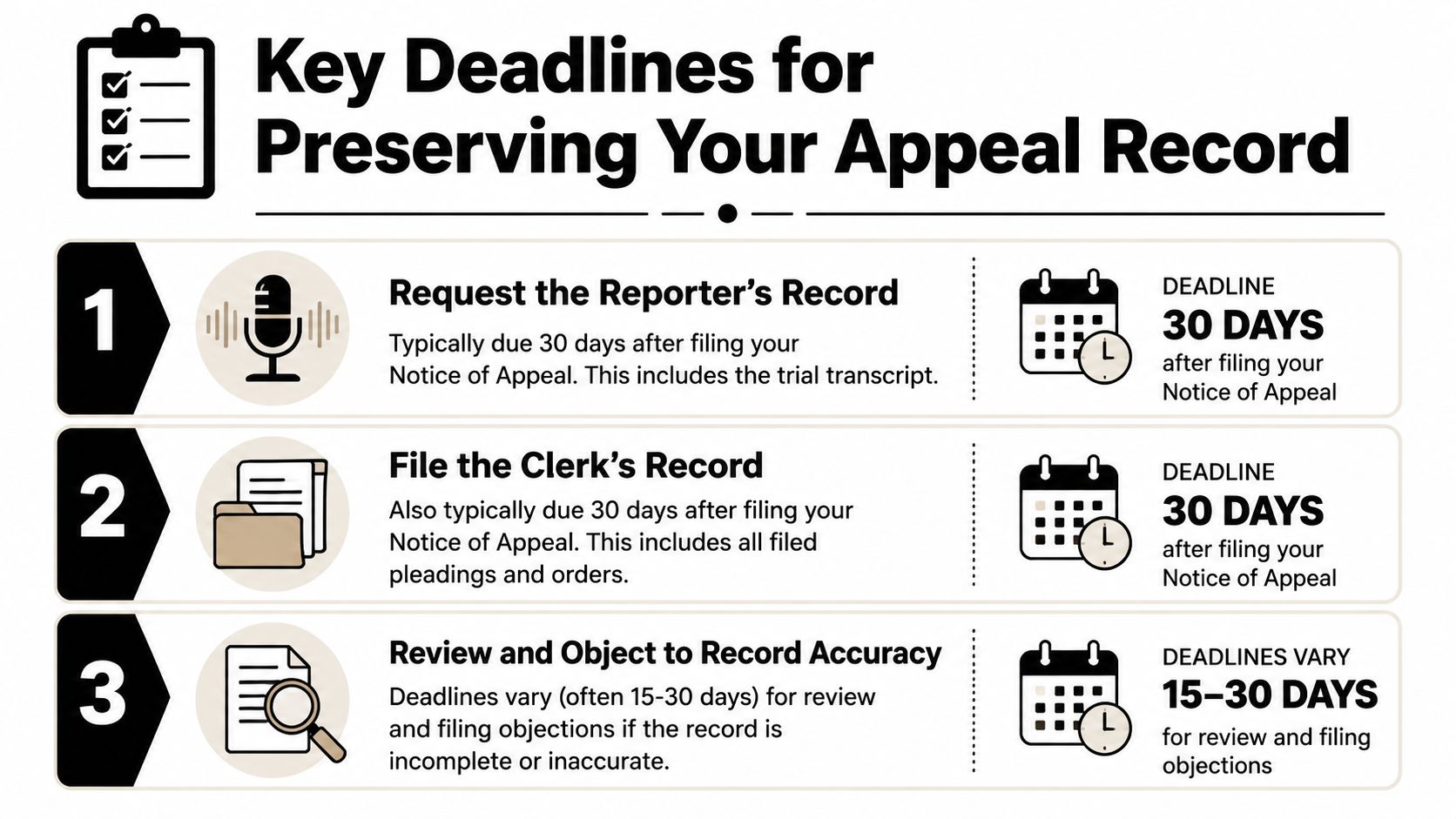
A filed notice of appeal does not, by itself, create a winning appeal. The appellate court reviews the record from the trial court. If the right complaints were not preserved, or if the right materials are not part of the record, the appeal can weaken quickly.
One of the most important preservation deadlines is the request for findings of fact and conclusions of law. In Texas family-law appeals, that request must be made within 20 days of the signed judgment, and that deadline cannot be extended. Missing it can be fatal because the appellate court may have to affirm if the judgment can be upheld under any legal theory, as explained in this article on the importance of findings of fact and conclusions of law for appeals.
Why findings matter so much in family cases
Many family cases are tried to the judge rather than a jury. In those bench trials, written findings can show what facts the court found and what legal reasoning supported the decision. That can shape how the appellate court reviews the case.
Without findings, the appellate court may give the judgment broader support. In practical terms, that can make it harder to challenge rulings in:
- Divorce decrees
- Custody modifications
- Property division disputes
- Support rulings decided after a bench trial
Preservation is more than one filing
Clients often think of an appeal as one deadline. It isn't. It is a chain of preservation steps.
Some errors must be raised in the trial court when they happen. Others depend on post-judgment filings. Others require a clear and complete appellate record. If one link is missing, the issue may be unavailable later.
For a practical discussion of preservation principles, this resource on objections required to preserve appeal in Texas gives a good overview.
The record your appellate lawyer needs
An appellate lawyer usually needs more than the final order. The core record often includes the clerk's papers, relevant exhibits, hearing transcripts, and any findings or post-judgment motions that frame the issues.
A useful way to think about the record is this:
| Part of record | Why it matters |
|---|---|
| Clerk's record | Shows the pleadings, motions, orders, and filed papers |
| Reporter's record | Shows testimony, objections, rulings, and oral statements in court |
| Findings and conclusions | Shows the judge's reasoning in bench-tried matters |
If the complaint is that the judge excluded evidence, the transcript matters. If the complaint is that the decree awards relief no one pleaded for, the filed pleadings matter. If the complaint is that the judge's reasoning was legally flawed, findings may matter a great deal.
The appellate court can only work with what the record shows. It cannot assume missing objections, missing documents, or missing reasoning.
What works in real practice
Strong record-building usually looks like this:
- Early transcript planning: Counsel identifies which hearings matter and requests the necessary portions.
- Targeted findings requests: The request is timely and aligned with the likely appellate issues.
- Issue-based review: The lawyer studies the record for preserved, reviewable errors, not just frustrating moments.
- Accuracy checks: The filed record is reviewed for completeness and consistency.
What does not work is assuming the court reporter, clerk, or trial file will automatically tell the full story in the right form. Appellate records require active management.
Keeping the Appeal Alive Briefing Schedules and Other Dates
Once the appeal is perfected and the record is underway, the case enters a different phase. At that point, the question is no longer only whether the appeal exists. The question becomes whether it is being properly prosecuted.
The brief is the center of that work. Briefing means the written argument filed in the court of appeals. It identifies the issues, states the governing law, cites the record, and explains why the trial court committed reversible error. A late, incomplete, or poorly supported brief can put the entire appeal at risk.
Why post-filing deadlines still matter
Texas family appeals can fail long before the notice-of-appeal deadline if a party misses an earlier preservation or perfection deadline, and deadlines also continue after the appeal is underway. Some termination cases require a statement of points within 15 days, and all cases require filing the brief on time or risk dismissal, as described in this article about perfecting the appeal.
That principle shows up in ordinary appeals too. Courts expect parties to meet briefing schedules, respond to clerk notices, and comply with procedural requirements. If that doesn't happen, the court can dismiss for want of prosecution or treat issues as waived.
Common late-stage trouble spots
These deadlines do not all carry the same consequence, but each can damage the case:
- Appellant's brief due date: If the opening brief is not filed on time, the court may issue warnings and then dismiss.
- Fee and filing compliance: Administrative problems can create avoidable delays.
- Special deadlines by case type: Termination and other specialized family matters can involve unique preservation rules.
- Reply and response timing: Even when optional, these filings can shape how clearly the issues are framed.
What a solid appellate calendar looks like
A workable appeal plan usually includes:
- A master calendar keyed to the signing date and all later notices.
- Separate tracking for record preparation and briefing dates.
- A case-specific review for accelerated or specialized rules.
- Internal checkpoints before each filing deadline.
- Time reserved for editing, cite-checking, and record verification.
That last point matters more than clients often realize. Good appellate briefing takes time because it must connect legal authority to exact places in the record. Strong arguments are written. They are also built.
Some clients ask whether filing the notice means the hard part is over. Usually, it means the disciplined part has begun.
Your Texas Family Law Appeal Checklist and Next Steps
A common turning point comes a few days after the judge signs the order. The hearing is over, the result feels wrong, and the first question is simple: what has to happen now so the right to appeal is not lost?
Start with the calendar, then make decisions in order. In a Texas family law appeal, each deadline affects the next one. A missed early step can cut off options that would otherwise stay open.
A practical appeal checklist
- Confirm the signed order date: Most appellate deadlines run from the date the order was signed, not the date of the hearing or the date you received a copy.
- Classify the order correctly: Determine whether the order is final, interlocutory, accelerated, or controlled by a special rule. That classification changes the timetable.
- Identify the notice of appeal deadline immediately: Put that date on the calendar first. Then work backward for everything else.
- Evaluate post-judgment motions early: A timely motion may ask the trial court to correct error, and in some situations it also extends the deadline to file the notice of appeal.
- Request findings of fact and conclusions of law if they fit the case: In a bench-tried family case, the 20-day deadline can matter to both issue framing and appellate timing.
- Review preservation while the record is still fresh: Confirm what objections, offers of proof, requests, and rulings appear in the trial record.
- Order and monitor the record: The clerk's record and reporter's record must match the issues you plan to raise.
- Track notices from the appellate court: Briefing deadlines, fee notices, and clerk notices can still put the appeal at risk if they are ignored.
The strategic question to ask right now
Ask two questions at the same time. What deadline is running today? What decision does that deadline force?
That is the practical way to handle an appeal. For example, deciding whether to file a post-judgment motion is not just about asking the trial court to reconsider. It can also affect the deadline for the notice of appeal. Deciding whether to request findings is not just procedural housekeeping. It can shape how the appellate issues are framed and how the court reviews the ruling.
A good plan reduces risk. It also makes the case easier to evaluate objectively. Some appeals turn on legal error. Others turn on preservation, an incomplete record, or a timetable problem that has to be addressed before any argument on the merits can succeed.
Prompt review helps. Delay narrows choices.
If you believe the court made a mistake in your family law case, prompt review can preserve options that delay can destroy.