Skip to content
A Texas judgment usually must be appealed within 30 days after the judge signs the final judgment, and that deadline can extend to 90 days if a timely post-trial motion is filed. For many families, that means the question isn't only how long after trial can a judgment be appealed in Texas, but what needs to happen immediately after the order is signed to keep every option open.
When a family court ruling feels wrong, the days after trial can feel like a blur. You're reading a final order about your children, your home, support, or your finances, and you're trying to understand whether the judge made a hard call or made a legal mistake that can be corrected.
That distinction matters. An appeal is not a second trial. It is a focused review of whether the trial court followed the law, applied the right legal standard, and made rulings supported by the record. The process is structured, deadline-driven, and often manageable when you act early.
The Fight for Fairness After a Final Judgment
A lot of clients reach out after the same kind of moment. The hearing is over. The courtroom is quiet. Then the signed order arrives, and something about it doesn't match what happened in court, what the evidence showed, or what Texas family law requires.
Sometimes the concern is custody. A parent believes the court overlooked key facts affecting the child's best interest. Sometimes it's property division, where one spouse believes separate property was swept into the community estate. In other cases, the problem is procedural. A party may not have had a fair chance to present evidence, respond to a claim, or challenge a late-filed exhibit.
That sense of unfairness is real, but appeals work best when they move from emotion to analysis. Even in situations that draw public attention, facts and procedure still control outcomes. If you're trying to understand how legal events can quickly become high-stakes and highly scrutinized, a straightforward example is this report covering Details of Ross Vollmer's arrest. Different area of law, same lesson. Once a court process starts, timing and record-building matter.
An appeal is a review, not a retrial
Texas appellate courts don't hear witnesses again. They don't start over and decide which side they personally believe. They review the written record from the trial court, including the clerk's record, the reporter's record, the final order, and the briefs filed by the parties.
That changes the strategy.
Instead of asking, "Was the result upsetting?" the appellate court asks questions like these:
- Did the trial judge apply the correct law
- Did the court abuse its discretion
- Did an error probably affect the outcome
- Was the issue preserved in the trial court
Practical rule: A strong appeal is built on a specific legal error tied to the record, not a general feeling that the case turned out badly.
Why calm action matters right away
The first days after a signed judgment are often the most important. This is when counsel evaluates whether the order is final, whether post-judgment motions should be filed, and whether the appellate timetable has already started.
In family law, that can affect parental rights, possession schedules, support obligations, and division of assets or debts almost immediately. The process has strict rules, but it isn't random. When handled strategically, there is a clear path forward.
Calculating Your Initial 30-Day Appeal Deadline
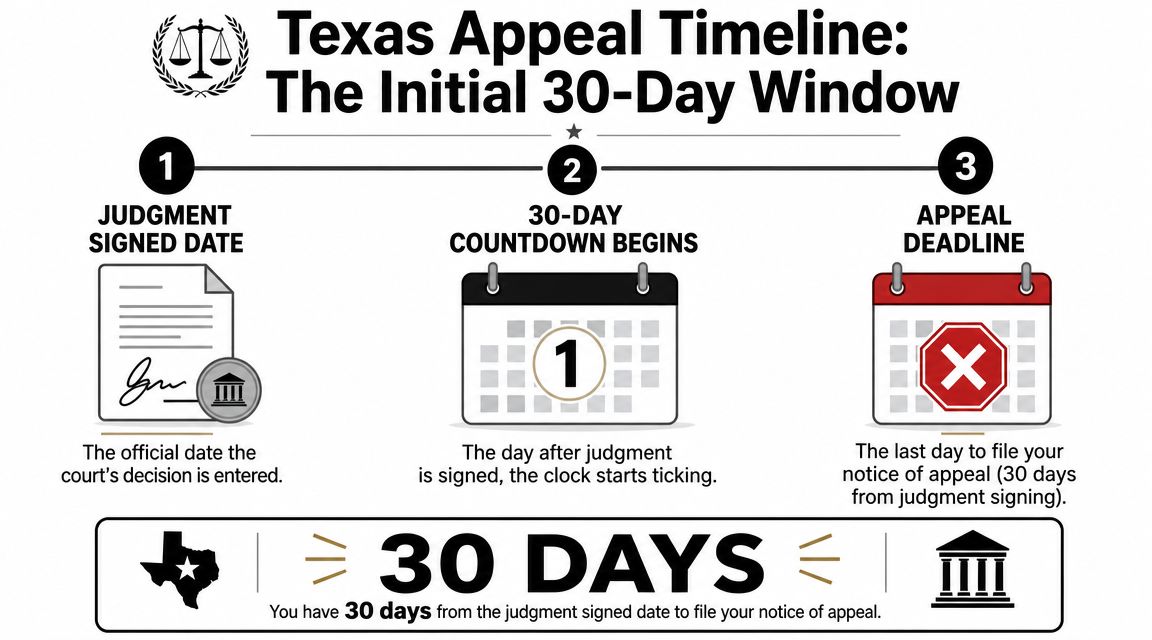
The basic rule in Texas civil appeals is straightforward. A notice of appeal is generally due within 30 days after the trial court signs the final judgment, according to Texas appeal timing guidance discussed here.
That sounds simple until people start counting from the wrong event.
The date that matters most
The key trigger is usually the date the judge signs the final judgment. Not the last day of testimony. Not the day everyone left court expecting a ruling. Not the day a proposed order was circulated by email.
In plain English, a final judgment is the written order that ends the trial-court phase of the case on the issues being decided. In many divorce and SAPCR matters, that may be a final decree of divorce or a final order affecting the parent-child relationship.
If you're unfamiliar with the first filing that starts the appellate process, this overview of a Texas family law notice of appeal gives a practical explanation of what that document does and why filing it on time matters.
A simple way to count it
Think of the signed judgment date as day zero. Once the judgment is signed, the appeal clock starts running under the Texas rules.
A practical checklist looks like this:
- Confirm the signed date on the final order.
- Verify finality so you know the order starts the appellate clock.
- Calendar the deadline immediately and have someone double-check it.
- Review whether any post-judgment motion should be filed before assuming the 30-day deadline controls.
The most common deadline mistake is not misunderstanding the law. It's counting from the hearing date instead of the signing date.
For many clients, seeing the process helps more than reading about it. This short video walks through the timeline in a client-friendly way.
What does and doesn't work
What works is getting the signed order, confirming whether it's final, and calendaring the notice-of-appeal deadline the same day. What doesn't work is waiting to "see what happens," assuming your trial lawyer will automatically handle the appeal, or relying on informal conversations about whether the judge might reconsider.
A family law appeal usually begins long before the brief is written. It begins with accurate deadline control.
How Post-Judgment Motions Extend Your Appeal Window to 90 Days
The most important exception to the initial deadline is this one. In Texas civil appeals, the deadline can expand from 30 days to 90 days if a timely post-trial motion is filed, such as a motion for new trial or a motion to modify the judgment, as explained in this discussion of when an adverse Texas judgment may be appealed.
That can make a major difference in a family case.

Which motions usually matter in family cases
The most common qualifying motions are familiar to family-law practitioners:
- Motion for new trial. This asks the trial court to set aside the judgment and hold a new trial.
- Motion to modify the judgment. This asks the court to change specific parts of the signed order.
- Other timely post-trial motions that qualify under the rules. The exact label matters less than whether the motion falls within the rule and is filed on time.
A motion for new trial in Texas family law often serves two purposes at once. It gives the trial court a chance to fix an error, and it can preserve or extend appellate deadlines.
Why this strategy often works
A post-judgment motion can be useful when the order contains a clear drafting problem, omits relief announced in court, mishandles property characterization, or rests on a legal ruling that needs to be challenged directly in the trial court.
It also creates room to think strategically.
Without that motion, the appeal timetable may move quickly. With it, counsel may have more time to evaluate the record, identify preserved issues, and decide whether the better route is correction by the trial court, review by the court of appeals, or both.
Filing a post-judgment motion isn't automatic. It has to fit the case, the error, and the record. A weak motion filed without strategy can waste time. A well-targeted one can protect the appeal and sharpen the issues.
A side-by-side comparison
| Situation | Likely appeal window |
|---|---|
| Final judgment signed, no qualifying post-trial motion | Standard deadline applies |
| Final judgment signed, timely qualifying post-trial motion filed | Extended deadline may apply |
That difference is why experienced appellate counsel often gets involved immediately after judgment, not months later.
What these motions are not
They are not magic reset buttons. They don't guarantee that the trial judge will reverse course, and they don't turn a weak appellate issue into a strong one.
They also don't help if they're untimely.
In practice, the most effective use of post-judgment motions is selective. Use them when they can preserve error, correct a meaningful flaw, clarify the record, or extend the timetable in a case where appellate review is seriously being considered.
What Counts as a Reversible Error in Texas Family Law
A parent leaves the courthouse convinced the result was wrong. That feeling is real, but it is not the legal standard on appeal. Texas appellate courts reverse family-law judgments for harmful legal error, not only because the trial judge made a hard call.
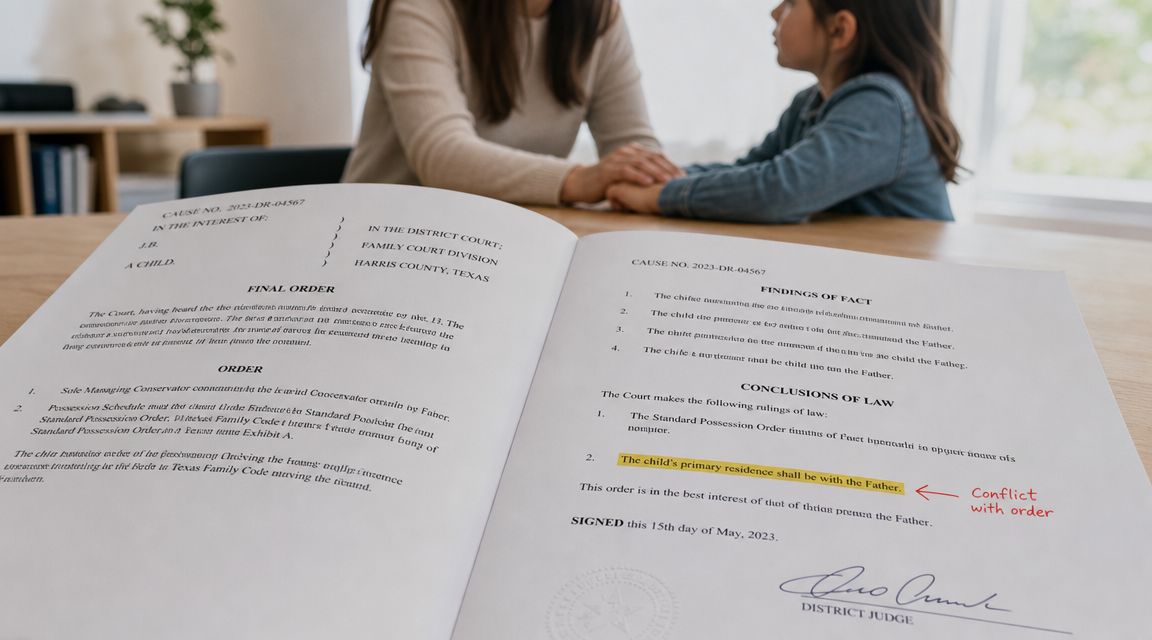
The first question is always the same. What, exactly, did the court do that violated a rule, ignored required procedure, or produced a result the law does not permit?
Plain-English terms that matter
Abuse of discretion means the trial court had room to decide the issue, but chose an outcome outside the bounds the law allows. Family judges get latitude on many issues, especially conservatorship, possession, support, and property division. That latitude has limits.
Reversible error means the mistake probably affected the outcome or prevented a fair presentation of the case. Appellate courts do not reverse for every misstep in the record.
Briefing is the written argument filed in the court of appeals. Good briefing does more than complain about what felt unfair. It ties a specific ruling to the record, the governing rule, and the relief the appellate court can grant.
What reversible error often looks like in family cases
In practice, family-law appeals usually turn on a few recurring categories of error:
- Applying the wrong legal standard in a custody ruling. If the court used the wrong framework, misunderstood the best-interest analysis, or imposed restrictions without the findings the law requires, that can create a serious appellate issue.
- Mischaracterizing property. If separate property was treated as community property, the entire division may rest on a legal mistake. In a close property case, one classification error can affect the whole judgment.
- Making support rulings that do not follow the statute or the evidence admitted at trial. That may involve incorrect income calculations, improper exclusions from net resources, or a refusal to consider evidence the court should have heard.
- Denying basic procedural fairness. Notice problems, limits on testimony, refusal to allow a party to present a claim or defense, and other due-process defects can support reversal.
- Signing an order that does not match the ruling or the pleadings. That happens more often than clients expect, especially after a contested hearing with multiple issues still in dispute.
Clients often say, "The judge did not listen to me." Sometimes that is just frustration. Sometimes it points to a reviewable problem, such as excluded evidence, a refused continuance, or a ruling made under the wrong statute. An appeal starts getting traction when that frustration can be translated into a specific legal error shown in the record.
A bad result and a reversible error are not the same thing
This distinction matters. A judge can hear two believable witnesses and choose the other one. A possession schedule can feel unfair to a parent and still fall within the court's discretion. A property division can be disappointing without being unlawful.
That is why strategy matters after judgment.
Before filing a notice of appeal, counsel should identify whether the complaint is really about discretion, or whether it is about a preserved legal mistake that likely affected the result. That review also shapes whether a motion for new trial, a motion to modify the judgment, or a request for findings and conclusions should be used to sharpen the issues while the appellate deadline is still open.
The record decides most appeals
Appeals are won and lost on the record from the trial court. No new witnesses appear in the court of appeals. No one gets to add documents later because they would have helped.
That creates a real trade-off in family cases. Some errors are obvious from the final order. Others only become usable appellate points if trial counsel made the right objection, obtained a ruling, offered excluded evidence, or requested findings that expose the court's reasoning. If those steps did not happen, a client may still have concerns worth examining, but the path to reversal gets narrower.
The strongest appellate issues usually share three traits. There is a clear legal rule. The record shows the rule was violated. The violation mattered to the judgment that was signed.
Special Cases Interlocutory Restricted and Late Appeals
A parent may call my office believing the appeal deadline is gone, only to find the judgment was a default, the order was temporary, or notice of the signed order arrived late. Those facts can change the analysis quickly. They can also shorten the time to act.

The usual final-judgment timetable does not fit every family-law case. Some orders are appealable on an accelerated schedule. Some default judgments may be challenged through a restricted appeal. In a smaller group of cases, late notice of the judgment can support a different deadline calculation or a request for more time. If you are already close to the edge, this guide on a possible extension of time to file an appeal in Texas family law explains the narrow situations where extra time may still be available.
Restricted appeals
A restricted appeal is a specific remedy, not a fallback for any missed deadline. It may apply when a party did not participate in the hearing that produced the complained-of judgment, filed no timely post-judgment motions or notice of appeal, and can show error from the face of the record.
That last requirement matters. The court of appeals will not hear new evidence about what happened. The problem has to appear in the clerk's record or reporter's record as they already exist. In practice, restricted appeals are most useful in default situations where service, notice, or the form of the judgment presents a clear legal problem.
Interlocutory and accelerated appeals
Some orders are reviewed before the entire case is over. Those are interlocutory appeals, and they exist only when a statute allows them. In family cases, temporary and specialized orders sometimes create confusion because clients assume every harmful ruling can wait for review after the final decree. That assumption can cost time.
The strategic question is straightforward. Is the order final, or is it one of the limited orders that must be challenged on a faster track? A lawyer needs to answer that early, because accelerated deadlines usually leave much less room for post-judgment motion practice.
Late notice of the judgment
Late notice creates a different problem. The order may have been signed on time, but a party did not learn about it until days or weeks later.
When that happens, the first job is to pin down dates and proof:
- The date the judge signed the order
- The date notice was received
- Whether the clerk's record supports that timeline
- Whether the rules provide a restarted or extended timetable
This is a rule-driven issue, not an equity argument. Courts want a clear record showing when notice was missing and when it was received.
Lower-court family-related matters
Some family-related disputes start outside district court, and the deadline can be much shorter there. Texas law library guidance on the Texas small claims appeal guide explains that justice-court and eviction deadlines run on a much tighter schedule than district-court appeals.
That difference creates a real trap. Clients often hear "Texas appeal deadline" and assume the same timetable applies across the board. It does not. The right deadline depends first on what court signed the order, then on what kind of order it is, and only after that on whether any post-judgment motion or exception changes the clock.
The Finality of Missing an Appellate Deadline
Appellate deadlines are often described as jurisdictional. In plain English, that means the court's power to hear the appeal depends on a timely filing.
If the deadline passes and no rule-based exception applies, the court of appeals will usually lack authority to review the case. The trial court's judgment then remains in place, even if you strongly believe it was wrong.
That is why waiting is rarely neutral. Delay doesn't preserve options. It usually narrows them.
What clients should do immediately
A practical first response is simple:
- Get the signed order
- Confirm the signing date
- Preserve every calendar deadline
- Ask whether an extension-related motion is still available
If you're already worried that time is short, this guide on a possible extension of time to file an appeal in Texas family law is a useful starting point for understanding whether any room remains.
Missing the deadline doesn't just create a procedural problem. It can end the court's ability to correct the error.
The point isn't to create panic. It's to treat the timetable with the seriousness Texas appellate courts do.
Let Us Evaluate Your Case for a Fair Outcome
The order is signed. You are home from court, reading the language again, and one question keeps coming up. Is there still a realistic way to challenge what happened.
That question deserves a prompt, careful answer. In a Texas family law appeal, timing matters, but so does strategy. I often tell clients that the first review is not just about counting days. It is about identifying where the judgment became final, whether any post-judgment motion changed the deadline, what the record shows, and whether the best next step is an appeal, a trial-court correction, or a narrower form of review.
Early case evaluation should be concrete. We review the signed order, the date it was signed, any motion for new trial or motion to modify, correct, or reform the judgment, and the clerk's and reporter's records that may support reversible error. We also look at the practical side. An appeal takes time and expense. In some cases, that cost is justified because the error affected custody, property division, support, or another outcome that matters long term. In other cases, the better course is to focus on a remedy the trial court can still grant.
If you believe the court got it wrong, a prompt evaluation can tell you whether an appeal is still available and what must happen next. The Law Office of Bryan Fagan can assess the deadline, the procedural posture, and the strength of the issues so you can make a clear decision about the next step.