You may feel your case was handled unfairly if you are facing a large amount of past-due child support, legally known as child support arrears. In Texas, this is a formal debt that collects interest, turning a difficult situation into a heavy financial weight. Often, this happens because the original court order was based on a mistake, setting you up with a payment you could never realistically afford.
When you believe a court made a reversible error that created this debt, seeking justice through the appeals process is a critical step. An appeal isn't about avoiding responsibility; it's about ensuring the court's judgment was fair, accurate, and followed Texas law.
Understanding Child Support Arrears in Texas
Staring at a mountain of child support debt can feel completely overwhelming, especially if you believe the original court order was flawed from day one. The first step to restoring balance is to understand exactly what arrears are and how a legal error during your trial could have created them.
Arrears are a legally recognized debt owed either to the other parent or, in some cases, directly to the state. This debt can accumulate for many reasons, but when it stems from a court's mistake, you have the right to challenge it.
How Arrears Start and Snowball from a Flawed Judgment
It all begins with the court judgment that sets your monthly child support payment. Any time a payment is missed, that amount is officially added to your arrears. While this can happen due to job loss or illness, it often starts with a reversible error by the trial court, such as:
- The initial support order was calculated using incorrect or incomplete financial information.
- The judge misapplied Texas child support guidelines when setting the amount.
- The court ignored valid evidence showing your inability to pay the ordered amount.
- You simply misunderstood the details of a confusing or poorly written court order.
Once an arrearage exists, Texas law adds six percent (6%) annual simple interest to it. This means the debt constantly grows, making it harder to catch up. Unlike a credit card bill, child support debt cannot be discharged in bankruptcy. It remains until paid in full, often long after your child is an adult.
In Texas, a child support order is a judgment. Each missed payment automatically becomes its own final judgment, carrying the full force of the law behind it.
If you are in this position because you believe the original judgment was fundamentally flawed, it’s critical to know your options. An unjust support order can stem from a court miscalculating your income or ignoring important evidence. Exploring a Texas child support appeal with a skilled appellate attorney is a vital step toward seeking a fair resolution. An appeal allows a higher court to review the trial judge's work for legal mistakes—known as reversible errors—that may have created your financial hardship in the first place.
The Financial Weight of Unfair Support Orders
If you’re struggling with child support debt, it’s crucial to understand you aren't alone. Millions of parents across Texas are in the same position, often because the original support order was unfair or unrealistic from the start. When a court sets a payment amount without a full and accurate picture of your finances, it can lock you into a cycle of debt that feels impossible to break.
This isn't just a personal problem; it's a systemic issue. The national scale of child support arrears is staggering. A deep dive into years of credit data showed that a shocking 66% of delinquent child support payments are still past due 12 months later. What's worse, an overwhelming 95% of those who are behind for a year will stay behind for at least three years. You can read more about these family law statistics and see how they impact parents facing enforcement.
The Source of Unfair Financial Burdens
So, how does an unfair support order happen in the first place? In family law, a reversible error is a mistake made by the trial judge that is serious enough to have changed the outcome of the case. Common examples in child support cases include:
- Abuse of Discretion: The judge makes a decision that is arbitrary or unreasonable, such as ignoring clear evidence of a parent's disability or job loss.
- Miscalculation of Resources: The judge incorrectly calculates a parent's net income, leading to an inflated support amount.
- Failure to Follow Procedure: The court does not adhere to the Texas Family Code or the Texas Rules of Appellate Procedure, denying a parent their right to a fair hearing.
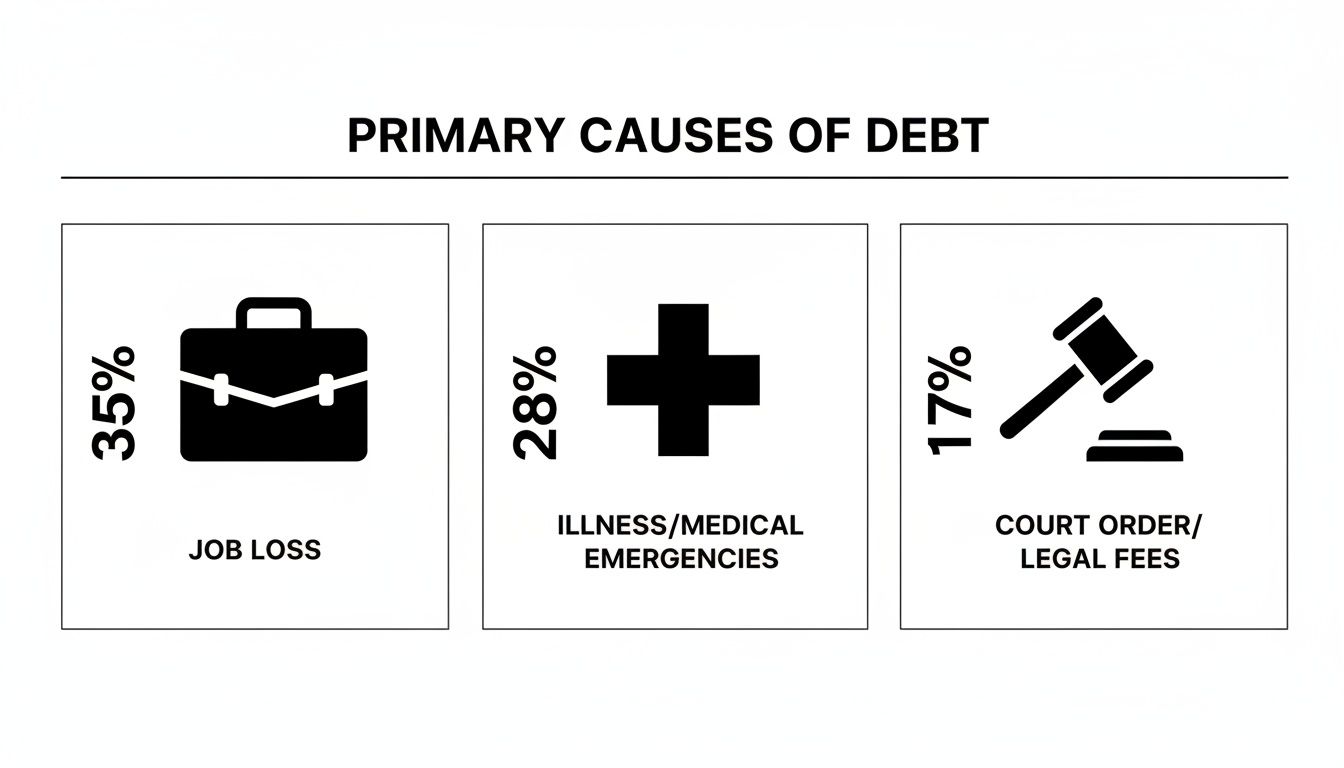
As you can see, flawed court orders are a major reason parents fall behind. This debt spiral doesn't just hurt the paying parent; it ultimately harms the entire family. An unrealistic payment plan can trigger harsh enforcement actions, making it even tougher for a parent to get back on their feet and provide for their children.
An appeal isn't about dodging responsibility. It's about making sure that responsibility is fair, based on the facts, and correctly applies Texas law.
When the very foundation of your child support order is wrong, the original judgment is the problem. This is why having a skilled appellate attorney review your case is so important. An appeal offers a chance to pinpoint and correct the legal mistakes that caused the financial hardship, creating a path toward a just and manageable outcome.
How Texas Enforces Child Support Arrears
Falling behind on child support is a stressful situation, made worse by the state's powerful enforcement tools. In Texas, the Office of the Attorney General has a wide array of legal methods to collect this debt. Understanding these enforcement actions is key to preparing your legal strategy.
Once a court finalizes a judgment for child support arrears, it gives the green light for serious collection activities that can impact nearly every area of your financial and personal life.

Common Enforcement Actions
The Attorney General can use several methods at the same time to enforce a child support order. These are legally-backed actions, not optional requests.
Here are some of the most common tools in their collection toolkit:
- Wage Garnishment: A court orders your employer to withhold a portion of your paycheck and send it directly to the state's child support unit.
- Bank Account Levies: The state can seize funds directly from your checking or savings accounts to satisfy the arrears judgment.
- Property Liens: A lien can be placed on your property—your house, land, or car. This legal claim means you can't sell or refinance it until the child support debt is paid.
- Interception of Funds: The state can intercept money like tax refunds, lottery winnings, or insurance settlements and apply them to your arrears.
- License Suspension: The state can suspend your driver's license, as well as professional licenses (for doctors, realtors, contractors) and even recreational licenses for hunting and fishing.
To help you see how these tools work, here’s a quick breakdown of the most common enforcement methods used in Texas.
Common Child Support Enforcement Methods in Texas
| Enforcement Method | What It Means in Plain English | What Can Be Targeted |
|---|---|---|
| Wage Garnishment | Your employer is ordered to take money directly out of your paycheck. | Your salary, wages, and other employment income. |
| Bank Levy | The state freezes and seizes money directly from your bank account. | Checking accounts, savings accounts, and other financial assets. |
| Property Lien | A legal claim is placed on your property, blocking its sale or refinance. | Your home, land, vehicles, and other real estate or personal property. |
| Interception of Funds | The state takes money that was supposed to come to you. | Federal tax refunds, lottery winnings, and insurance payouts. |
| License Suspension | Your licenses are suspended until you address the arrears. | Driver's licenses, professional licenses, and recreational permits. |
Challenging the Foundation of Enforcement
While those enforcement tools are formidable, they all depend on one critical thing: a valid, legally sound judgment. If the court order that created the arrears was based on a reversible error, then the entire foundation for collection could be flawed.
For example, what if the trial court miscalculated your income, ignored evidence about your inability to pay, or violated your due process rights during the hearing? If any of those things happened, the arrears judgment is fundamentally unfair. This is where an appeal becomes so important.
Enforcement actions are the consequence of an underlying judgment. An appeal attacks the judgment itself, aiming to correct the legal errors that led to an unjust outcome.
Filing an appeal doesn't automatically stop enforcement, but it is the only legal path to challenge and potentially overturn the flawed order that created the debt. If you believe the court made a mistake, exploring your appellate options is the crucial next step. A successful appeal can correct the record and provide real relief from an unjust financial burden.
How an Appeal Can Correct an Unfair Judgment
If a trial court made a serious mistake in your case that resulted in an unfair child support arrears judgment, an appeal is the designated path to seek correction. An appeal is not a new trial or a second chance to argue facts. Instead, it is a formal review process where a higher court examines the trial judge's decisions for specific legal errors, guided by the Texas Rules of Appellate Procedure.
This review is handled by an appellate court, a panel of judges whose job is to scrutinize the official trial record. This record contains every document filed, piece of evidence presented, and word spoken during your original case. The appellate judges will not hear new testimony or consider new evidence. Their focus is on one key question: Did the trial court follow Texas law and procedure correctly?
Understanding the Standard of Review
For an appeal to succeed, your attorney must identify a "reversible error"—a mistake so significant that it likely caused an improper judgment. In Texas family law, the most common standard for evaluating these errors is “abuse of discretion.”
In plain English, abuse of discretion means the trial judge made a decision that was arbitrary, unreasonable, or without reference to any guiding rules and principles. It does not imply the judge acted with bad intent, but rather that their ruling was legally incorrect based on the facts presented.
What might this look like in a child support arrears case?
- The judge refuses to consider definitive proof of a parent's involuntary job loss.
- The court misapplies the Texas Family Code guidelines for calculating net resources, leading to a wildly inflated support obligation.
- The judge ignores medical records showing a parent has a disability that prevents them from earning their previous income.
How the Appellate Process Works
The core of an appeal is briefing, where your appellate attorney drafts a persuasive legal argument known as an appellate brief. This document methodically analyzes the trial record, citing Texas law and prior case decisions to demonstrate precisely where and how the judge committed a reversible error.
An appeal isn't about re-arguing the facts. It’s about arguing the law—showing how the judge misapplied it based on the evidence already presented in court.
The opposing side will file a brief in response, and your attorney will have an opportunity to reply. The appellate court then reviews all briefs and the trial record to make a final decision. The entire process follows a strict timeline set by the Texas Rules of Appellate Procedure.
It is also important not to confuse an appeal with a modification. If your financial situation changes, you may need to file a motion to modify child support to change your future payments. However, an appeal is the only way to challenge a flawed judgment that has already been entered, giving you a chance to correct past arrears and restore fairness.
Common Grounds for Appealing a Child Support Judgment
To win an appeal, you must prove the judge made a specific, significant legal mistake. These mistakes are called "reversible errors," and they are the foundation of any successful child support appeal. If an arrears judgment feels fundamentally wrong, understanding what qualifies as a reversible error is the first step toward seeking justice.
Your appellate attorney must be able to pinpoint the exact moment in the trial record where the court's decision departed from the facts or a correct application of Texas law.

Examples of Reversible Errors in Support Cases
An appellate attorney's job is to meticulously review the trial record for these critical missteps. Here are some of the most common reversible errors we see in Texas child support and arrears judgments:
-
Incorrect Calculation of Net Resources: The court’s math was flawed. For example, it may have included income it shouldn’t have or refused to deduct legitimate expenses from your gross income, leading to an unfairly high support order.
-
Ignoring Evidence of Inability to Pay: A judge committed an abuse of discretion by disregarding clear proof of your inability to pay. If you presented solid evidence of an involuntary job loss, a documented disability, or another valid reason you couldn't earn your previous income, and the judge ignored it, that may constitute a reversible error.
-
Misapplication of Texas Family Code Guidelines: The court must follow the child support guidelines. If a judge deviates from these guidelines, they must state the specific reasons in the court order. Failing to provide this legally required justification can make the order arbitrary and grounds for an appeal.
-
Violation of Due Process: Your fundamental right to a fair hearing was violated. This can occur if you were not properly notified of a hearing, were denied the opportunity to present evidence, or were not allowed to cross-examine witnesses.
The Systemic Impact of Unfair Orders
These judicial errors are not just isolated problems; they contribute to a much larger issue. Flawed child support orders create a cycle of debt that strains families and public resources. The numbers show that a staggering 66% of child support delinquencies persist after 12 months, suggesting many orders are unsustainable from the start.
This cycle burdens the paying parent while states sometimes end up keeping a portion of collections intended for children. You can learn more by reviewing findings from the Center on Budget and Policy Priorities.
An appeal provides a critical check on the trial court's power. It ensures that judicial decisions are grounded in evidence and the correct application of the law, not guesswork or unsupported assumptions.
If any of these situations sound like what happened in your case, the court may have committed an abuse of discretion. The only way to know for sure if a reversible error occurred—and if an appeal is the right path for you—is to have an experienced appellate lawyer review every detail of your case record.
Frequently Asked Questions About Texas Child Support Arrears
When you're dealing with child support arrears, many questions can arise. Getting clear, accurate answers based on Texas appellate procedure is the first step toward making an informed decision about your case. Let's address some of the most common questions we receive.
Can Child Support Arrears Be Forgiven in Texas?
No, child support debt is almost never "forgiven" by the state and cannot be discharged in bankruptcy. Texas law treats it as a priority obligation that remains until it is paid in full, including all accrued interest.
While the receiving parent can sometimes agree to forgive arrears owed directly to them, this is a complex legal process that requires a judge's approval and does not apply to any money owed to the state. Because this debt is so difficult to eliminate, challenging an unfair order from the beginning with a timely appeal is often the most effective strategy.
How Is Interest Calculated on Unpaid Child Support?
In Texas, any unpaid child support judgment automatically accrues interest at a rate of six percent (6%) simple interest per year. The interest begins to accumulate on each missed payment from the date it was due.
Over time, this interest can significantly increase the total amount owed. A mathematical error in the calculation of the original arrears or the interest can be a powerful basis for an appeal.
What Is the Difference Between a Modification and an Appeal?
Understanding the difference between a modification and an appeal is crucial, as they address entirely different legal issues.
- A Motion to Modify is a forward-looking action. You file one when there has been a "material and substantial change" in circumstances, such as a job loss or promotion. If successful, it changes your child support payments going forward. It has no effect on past-due arrears.
- An appeal is a backward-looking action. It challenges the legal correctness of the original court order itself. The argument is that the judge committed a reversible error, resulting in an unfair and legally flawed arrears judgment. A successful appeal can correct the original judgment and reduce or eliminate the improperly calculated arrears.
Choosing the correct legal path is critical. It is essential to how to choose a family law attorney with proven experience in appellate advocacy to ensure your case is handled correctly. For more general information, you might also find the SupportGPT platform helpful.
If you believe the court made a mistake in your family law case, our appellate attorneys can help you seek a fair outcome. Contact The Law Office of Bryan Fagan today for a free consultation.