You may feel your case was handled unfairly when a significant portion of your paycheck vanishes due to an Income Withholding Order (IWO). It's a jarring experience, especially if you believe the child support amount itself is the result of a legal error. This guide explains what an IWO is and, more importantly, how you can seek justice by challenging the court’s mistakes through the Texas appeals process.
Understanding the Texas Income Withholding Order

It’s easy to feel powerless when your hard-earned money is taken out of your control. But it's crucial to understand that an Income Withholding Order isn't a penalty. It’s the standard, go-to tool in Texas family law for making sure child support gets paid consistently and on time.
Think of it as a court-ordered autopay system. Once a judge signs off on child support, an IWO almost always follows. This separate legal document goes straight to your employer, giving them direct instructions to deduct the child support amount from your wages and forward it to the Texas Child Support Disbursement Unit.
The Purpose Behind the Process
The whole system is built for predictability. The parent receiving support gets a reliable financial lifeline to care for the kids. For the paying parent, it takes the guesswork and manual effort out of payments, which helps avoid conflicts over late or forgotten checks.
And it works. This method is the backbone of child support enforcement, accounting for about 75% of all collections nationwide. You can learn more about these national standards and what’s expected of employers on the federal Administration for Children and Families website.
But here’s the catch: the efficiency of an IWO is only as good as the child support order it’s based on. If the trial court made a mistake—maybe they miscalculated your income, didn’t follow the Texas Family Code guidelines, or overlooked key evidence—then every single paycheck deduction locks in that unfairness.
An Income Withholding Order is simply the enforcement mechanism. The real issue is whether the original court order it enforces was legally correct and fair. An appeal focuses on correcting errors in that foundational judgment.
When you know the amount being withheld is fundamentally wrong because of a judicial error, the problem isn't the withholding itself. The problem is the court order that set it in motion. That's where the appellate process comes in. An appeal is your chance to challenge the legal mistakes made in the trial court and fight for a child support obligation that is actually fair and accurate.
How an Income Withholding Order Gets from the Court to Your Paycheck
It's easy to feel anxious or confused when you first learn about an Income Withholding Order (IWO), but understanding how it works can make the process much clearer. This isn't some arbitrary action taken by your employer. Instead, it's a specific legal process that kicks into gear the moment a judge signs the final child support order.
Once that court order is on the books, an IWO is usually created automatically as part of the court's standard procedure. This separate legal document is then formally served on your employer, typically by the Texas Child Support Disbursement Unit (SDU), which manages the process to ensure everything is handled by the book.
From that point on, your employer’s hands are tied. Texas law requires them to comply with the IWO, no questions asked. They must start deducting the specified child support amount from your paycheck, beginning with the very first pay period after they get the notice.
The Official Workflow from Court to Paycheck
The path an IWO takes is designed to be direct and efficient. The goal is to make child support payments predictable and cut down on the missed payments or manual errors that can happen when parents exchange money directly.
Here’s a simple breakdown of the journey:
- The Judge Signs the Order: The process starts when the trial court issues the underlying child support order, which legally establishes the obligation and the amount.
- The IWO is Created and Served: A formal Income Withholding Order is drafted and sent straight to your employer’s payroll or HR department.
- Employer Acknowledges and Acts: Upon receipt, your employer must acknowledge the IWO and immediately set up the withholding.
- Funds are Withheld and Remitted: With each pay cycle, the employer deducts the court-ordered amount from your wages.
- Payment is Processed and Sent: The employer sends the withheld funds to the Texas SDU, which then pays the money out to the other parent.
This system is a massive improvement over older methods that only kicked in after a payment was missed. The move to mandatory income withholding, which expanded to cover 100% of new orders by 1994, completely changed the game for child support. It’s a big reason why collections skyrocketed from $10.7 billion in 1990 to over $30 billion annually by the 2020s. You can find more fascinating data on this shift at ourworldindata.org.
Your Employer's Legal Duties and Penalties
It’s crucial to remember that your employer is simply a middleman in this situation. They are legally bound to follow the IWO’s instructions and face stiff penalties if they don’t.
An employer who knowingly fails to comply with an income withholding order can be held liable for the amount they failed to pay, plus fines. This is why any legal challenge must focus on the court order itself, not your employer's actions.
Because the rules are so strict, your employer can't just stop the deductions because you ask them to. Any change has to come from the court in the form of a new, modified order. This brings up a critical point: your fight isn't with your HR department. It’s with the original court order that you believe is flawed.
For legal departments and larger organizations juggling a high volume of these and other legal notices, using automatic document processing solutions can be a lifesaver for managing compliance and organization. But for you, the individual, if you think a reversible error was made in your case, the only place to fix it is in the appellate court.
Understanding the Standard of Review and Withholding Limits in Texas
Staring at your pay stub and wondering how the child support deduction could possibly be that high? You're not alone. It's a very real and common concern for parents navigating the Texas family court system. The good news is that both state and federal laws put a hard cap on how much can be taken from your paycheck, ensuring you still have enough left to live on.
When a judge sets a child support amount, they aren't just pulling a number out of thin air. The process starts by calculating your net resources—a specific legal term from the Texas Family Code. Think of it as your take-home pay after mandatory deductions like federal income tax and Social Security have been subtracted. From there, the court applies percentage guidelines based on the number of children you're supporting. This framework is designed to keep things fair and predictable.
The process of getting that money from your paycheck to the other parent follows a strict legal path, as shown below.
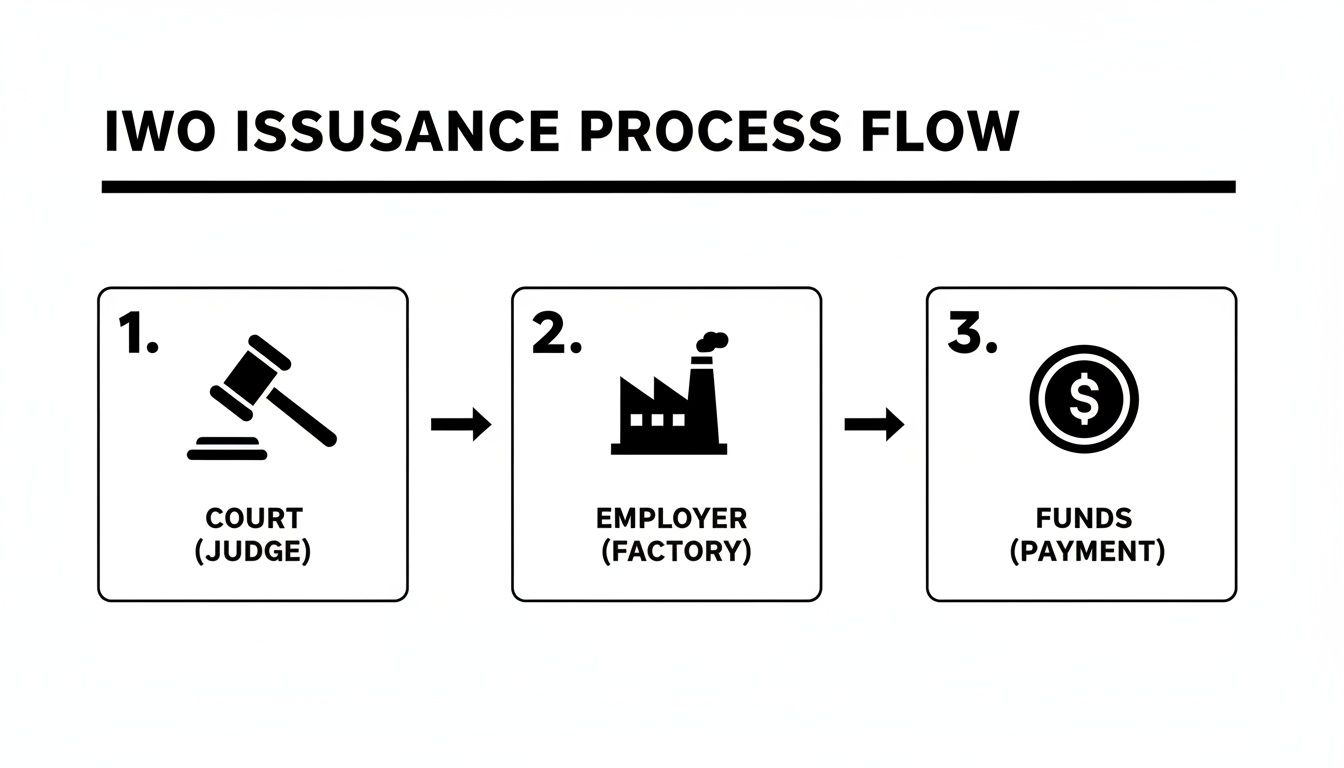
As you can see, the court's order becomes a direct instruction to your employer, who is then legally required to send the funds as directed.
The 50 Percent Rule and Disposable Earnings
Here's the most important protection you have: under Texas law, an income withholding order for child support can't take more than 50% of your disposable earnings. "Disposable earnings" is just a formal way of saying what’s left in your paycheck after all legally required deductions are made.
This isn't a suggestion—it's a legal safeguard. The whole point is to find a balance, making sure your kids get the financial support they need without pushing you into financial distress. Unfortunately, this is one area where trial courts often make mistakes.
Common Reversible Errors in Withholding Orders
Even with clear rules, judges can get it wrong, and these mistakes are a common reason for family law appeals. A judge might miscalculate your net resources by counting income that shouldn't be included or by failing to subtract all the mandatory deductions. In some cases, a court might even ignore the 50% cap completely.
These aren't just small oversights; they are serious legal errors that can have a crushing financial impact. When a judge misapplies the law like this, appellate lawyers call it an abuse of discretion.
Abuse of Discretion: This legal term means the trial court made a decision that was unreasonable, arbitrary, or completely detached from the guiding legal principles of the Texas Family Code. A judge ignoring the statutory limits on child support is a classic example of this, and it can be a solid basis for a successful Texas child custody appeal.
If the final order in your case results in a withholding amount that breaks these legal rules, it may be what we call a reversible error. This is exactly the kind of mistake an appellate court is empowered to fix.
An appeal isn't about re-arguing the facts of your case. It’s about having a higher court review the trial record for legal or procedural errors made by the judge. Demonstrating that the court botched the income calculation or ignored the withholding cap is a powerful argument for getting the order overturned and sent back to be done right. The ultimate goal of the appeal is to bring the final order back into compliance with Texas law.
Your Options for Challenging an Unfair Order
When an income withholding order feels wrong and starts draining your paycheck, it's easy to feel powerless. But you do have options. The key is to be strategic, because the right move depends entirely on what kind of error you're up against. Some problems are simple typos, while others are serious legal mistakes that demand a formal appeal.
That feeling of unfairness, seeing it deducted from your pay every week, is frustrating. The trick is to channel that frustration into a clear-headed plan. Your first job is to pinpoint the source of the problem. That will tell you whether you're looking at a quick fix in the trial court or if you need to prepare for a full-scale appellate review.
Simple Fixes vs. Substantive Legal Errors
Not every incorrect income withholding order requires a massive legal battle. Sometimes, the problem is just a simple administrative slip-up.
- Clerical Errors: These are minor mistakes that don't question the judge's legal reasoning. Think of things like the wrong employer address, a misspelled name, or a typo in the dollar amount.
- How to Fix Them: You can often correct these by filing a simple motion back in the same trial court. A "Motion to Clarify" or a "Motion to Correct Clerical Error" is usually all it takes to get the judge's attention and have a corrected order sent out. No higher court needed.
But often, the problem runs much deeper. Unfair orders frequently come from substantive legal errors—mistakes the judge made during the trial itself. These can only be challenged through the formal appeals process. An appeal isn't about a typo; it's about arguing that the judge’s entire decision was legally flawed from the get-go.
Common Reversible Errors You Can Appeal
It’s important to understand that an appeal is not a do-over. You don't get to present new evidence or re-argue your entire case. Instead, an appeal is a highly focused review of the trial record to find a reversible error. This is a legal mistake so significant that it very likely led to an improper and unjust result.
Here are some common reasons for appealing the underlying child support order that led to your IWO:
- Abuse of Discretion: This is a big one in family law. It means the trial judge made a decision that was arbitrary, unreasonable, or completely disconnected from guiding legal principles. A classic example is a judge who ignores the Texas child support guidelines without explaining why in the court record, which the law requires.
- Miscalculation of Income: The court might have gotten your "net resources" wrong. This can happen if they included income that should have been left out or, just as often, failed to make mandatory deductions that the law allows.
- Failure to Consider Evidence: If you presented crucial evidence about your income or expenses and the judge just flat-out ignored it, that could be grounds for an appeal. Judges are required to base their decisions on the evidence, not a gut feeling.
A reversible error isn't just any mistake; it's a legal blunder that undermines the fairness of the entire ruling. Identifying these errors requires a meticulous review of the trial transcript and evidence by an experienced appellate attorney.
If your case involves one of these major legal mistakes, you can't just go back and ask the trial judge to change their mind. The trial court has lost its power to make major changes to the order. Your only path forward is to file a timely appeal with a higher court. You can learn more about the specific arguments involved in our detailed guide to Texas child support appeals. Knowing the difference between a simple fix and a true legal error is the first step toward getting a just outcome.
Distinguishing Between an Appeal and a Modification
When you're staring at an income withholding order that just doesn’t seem right, it’s crucial to know you have two completely different avenues for challenging it: an appeal or a modification. Picking the wrong path isn't just a minor mistake—it can cost you valuable time, money, and potentially your only chance at a fair outcome. The right choice hinges entirely on why the order is wrong.
Here’s the simplest way to think about it: an appeal looks backward, while a modification looks forward. An appeal argues that the judge made a legal mistake and the original order was flawed from the very start. A modification, in contrast, says the original order was probably fine back then, but life has changed so much that the order is now unfair and needs an update.
When to Pursue a Modification
A modification is your best bet when your life has been turned upside down by a "material and substantial change" since the judge signed the original order. The Texas Family Code sets this high bar to keep people from running back to court every time something minor changes.
So, what counts as a "material and substantial change"? Here are a few classic examples:
- Involuntary Job Loss: Getting laid off or having your position eliminated is a clear-cut reason.
- Significant Drop in Income: A major, involuntary pay cut can also be enough to trigger a review.
- New Needs for the Child: If a child is diagnosed with a medical condition requiring expensive new treatments, the support amount may need to change.
- Shift in Custody: If the child starts living with the other parent most of the time, the support order has to be flipped or adjusted.
Since a modification deals with new facts that have cropped up since the original case, it gets filed right back in the same trial court that issued the first order. If this sounds like your situation, our guide on how to file a motion to modify child support is a great starting point.
When an Appeal Is the Only Answer
An appeal, on the other hand, doesn’t care one bit about what happened to your job last month. Its entire focus is on spotting reversible errors that the judge made during the trial or in the final ruling. You’re essentially telling a higher court, “The trial judge got the law wrong, and that mistake led directly to this unfair order.”
An appeal is your only remedy if the problem is baked into the original judgment itself. Maybe the judge completely miscalculated your net resources, ignored the child support guidelines for no good reason, or flat-out refused to look at critical evidence you tried to present. These are legal errors, and no change in your life circumstances is going to fix a fundamentally flawed court order.
The core difference is timing and focus. A modification addresses new events that happened after the court order. An appeal addresses legal mistakes that happened before or during the court's decision.
Getting this right is absolutely critical because appeals operate on a brutal and unforgiving timetable. In most cases, you have only 30 days from the day the final order is signed to file your Notice of Appeal. If you miss that deadline, the door to challenging the court's errors slams shut, likely forever. This is precisely why you must contact an appellate attorney the moment you suspect the judge made a mistake.
Modification vs. Appeal: Which Path Is Right for You?
Choosing between a modification and an appeal can feel overwhelming, but it boils down to identifying the root of the problem. Was the original order wrong from day one due to a legal mistake, or has life simply changed? This table breaks down the key differences to help guide your decision.
| Factor | Modification (For New Circumstances) | Appeal (For Original Errors) |
|---|---|---|
| Purpose | To adjust the order based on new life events. | To correct legal or procedural mistakes made by the trial judge. |
| Timing | Can be filed anytime after a "material and substantial change" occurs. | Must be filed within a strict deadline (usually 30 days) of the final order. |
| Focus | Looks forward at what has changed since the order was signed. | Looks backward at what went wrong during the trial. |
| Legal Standard | "Material and substantial change of circumstances." | "Reversible error" or "abuse of discretion." |
Ultimately, understanding this distinction is the first step toward getting the relief you need. A modification offers a path forward when life throws you a curveball, while an appeal provides a way to correct injustices from the past.
How an Appellate Attorney Can Restore Fairness

If you’re walking away from a court ruling feeling like the judge simply got it wrong, you’re not out of options. An appeal provides a structured pathway to challenge legal errors and regain financial stability, particularly when a flawed income withholding order threatens your livelihood.
The first step in any appeal is a deep, methodical dive into the trial record. We're talking about every transcript, exhibit, and motion from your original case. The goal is to pinpoint "reversible errors"—specific moments where the trial judge misapplied Texas law or went beyond their legal authority.
Building a Persuasive Legal Argument
Finding a potential error is one thing; proving it is another. This is where we construct the appellate brief, which is the core of your appeal. This isn't a simple letter to the court; it's a meticulously crafted legal argument that connects the dots between the trial court’s mistake and the unjust outcome you received.
The brief relies entirely on the Texas Family Code and the Texas Rules of Appellate Procedure to show the higher court how and why its intervention is legally necessary. While the attorney leads the charge, the complex work behind the scenes is often managed by skilled support staff. For many firms, hiring a paralegal is essential to manage the immense detail involved in these cases.
An effective appeal isn't about re-litigating your case or making emotional pleas. It's a technical, logical exercise focused on a single mission: demonstrating that the trial court's decision was legally flawed and must be corrected to uphold the law.
Everyone deserves a fair outcome based on the correct application of the law. At The Law Office of Bryan Fagan, we have the specialized experience needed to navigate the appellate system and advocate for the result you should have gotten in the first place. Whether it's an improperly calculated income withholding order or another unfair ruling, having the right family law appeal attorney on your side can change everything.
If you believe the court made a mistake in your family law case, our appellate attorneys can help you seek a fair outcome. Contact The Law Office of Bryan Fagan today for a free consultation.
Common Questions About Income Withholding Orders
When you're dealing with an income withholding order (IWO), it's easy to get overwhelmed by questions and feel like the system isn't on your side. Let's walk through some of the most common concerns we hear from parents in Texas and clear up the confusion.
Can They Really Take My Whole Paycheck?
Absolutely not. Texas law puts a firm limit on how much can be taken for child support. An IWO can't claim more than 50% of your disposable earnings.
So, what are "disposable earnings"? Think of it as your take-home pay after mandatory deductions—like federal income tax and Social Security—have been subtracted. This 50% cap is a crucial protection. If an order served to your employer results in a higher deduction, it’s a major red flag that the trial court may have made a reversible error, which could be a powerful basis for an appeal.
What if My Employer Messes Up the Withholding?
Employers are legally bound to follow the IWO to the letter. But people make mistakes. If your payroll department withholds too much, too little, or sends the payment late, they could be held responsible for that mistake.
The first step is always to talk to your HR or payroll department. Bring a copy of the order and point out the discrepancy. If that doesn't fix it, you might need to file a motion with the court to ensure the order is followed correctly. Just remember, your employer is only following a directive from the court; any real legal challenge needs to be aimed at correcting the court order itself.
The Bottom Line: Your employer must comply with the court order. They have no legal authority to change the withholding amount on their own, no matter what you ask them to do. Only a new order from a judge can change their legal duty.
Can We Stop the IWO if We Both Agree?
Even if you and the other parent work out a different way to handle payments, you can't just tell your employer to stop the deductions. An IWO is a formal court order, and it takes another court order to undo it.
To stop the automatic withholding, you'll need to file a formal agreement with the court. A judge must then sign a new order that officially terminates the IWO. This process is in place to make sure child support payments are reliable and legally recorded, protecting everyone involved. Trying to sidestep the court can open the door to serious legal trouble down the road, including enforcement actions for unpaid support.
Will Filing an Appeal Automatically Stop the Withholding?
This is a critical point that trips many people up: filing an appeal does not automatically pause an income withholding order. The original child support order stays in effect while the appeal is underway, which means the deductions from your paycheck will continue as usual.
However, an appellate lawyer can file a special motion to "supersede" the judgment. This is essentially asking the appellate court to hit pause on enforcement actions, including the IWO, while they review your case. This step often requires posting a bond to ensure the child support will be paid if your appeal doesn't succeed. Your attorney can help you decide if this is the right strategic move for your situation.
If you believe the court made a mistake in your family law case, our appellate attorneys can help you seek a fair outcome. Contact The Law Office of Bryan Fagan today for a free consultation at https://familylawcourtappeals.com.