
If you are facing a divorce in Texas, you may feel that the legal system is complex and impersonal. The path you choose to resolve your case will fundamentally shape your finances, your timeline, and the well-being of your family. The decision often comes down to a critical choice: will you negotiate a private agreement with your spouse through mediation, or will a judge decide your future in a public courtroom battle known as litigation?
Even more importantly, what happens if you believe the final outcome was unfair? Understanding how mediation and litigation differ is the first step, but knowing your rights to challenge an unjust result through the appellate process is essential to securing a fair outcome.
Choosing Your Path: Divorce Mediation vs. Litigation in Texas

Feeling overwhelmed by the legal system is understandable. The first step toward gaining clarity is understanding the stark differences between mediation and litigation. This isn’t just a legal distinction; it’s a strategic one that needs to align with your personal goals and protect your right to a just resolution.
The Mediation Approach: A Guided Negotiation
Mediation is a form of alternative dispute resolution (ADR). Think of it as a structured, confidential negotiation. You and your spouse sit down with a neutral third-party—the mediator—whose job is to guide the conversation, not make decisions for you.
The entire point is to help the two of you reach a voluntary, mutually acceptable agreement on everything from property division to child custody. In mediation, you and your spouse remain in control of the outcome.
The Litigation Approach: A Courtroom Battle
Litigation is the traditional, court-based process. If you and your spouse cannot agree, you take your case before a judge. Each side presents evidence and arguments according to the Texas Rules of Evidence and Procedure, and the judge issues a final, binding ruling.
This process is inherently adversarial and public, meaning the details of your divorce become part of the public record. A judge, who is a stranger to your family, makes the final call based only on the evidence presented in court. The cost and time disparities in divorce resolution are significant, with litigation often costing tens of thousands of dollars more and taking over a year to complete.
Mediation vs. Litigation Key Differences at a Glance
This table offers a quick, side-by-side summary of the fundamental differences between divorce mediation and litigation in Texas, helping you immediately grasp the contrasting approaches.
| Factor | Mediation | Litigation |
|---|---|---|
| Control | You and your spouse keep control over the outcome. | A judge makes the final, binding decisions. |
| Privacy | The entire process is confidential and private. | Proceedings are public record in an open courtroom. |
| Cost | Significantly lower, often a fraction of litigation. | Substantially higher legal fees and court costs. |
| Timeline | Much faster, typically resolved in weeks or months. | Slower, can easily take over a year to finalize. |
| Tone | Collaborative and focused on cooperative problem-solving. | Adversarial and confrontational by nature. |
| Finality | Results in a binding Mediated Settlement Agreement. | Results in a Final Decree of Divorce issued by a judge. |
| Right to Appeal | Extremely limited and difficult to challenge. | Clear right to appeal if the judge made a reversible error. |
Ultimately, one path gives you and your spouse the power to craft your own future, while the other hands that power over to the court. Understanding these core distinctions is the first critical step in navigating your divorce.
How the Texas Divorce Mediation Process Works
You may feel your case deserves its day in court, but the reality is that Texas law requires most divorce cases to go through mediation before a trial. It is a critical stage where a vast number of divorces are finalized.
The entire process is confidential and guided by a neutral third-party mediator. This person isn’t a judge—they don’t issue rulings or pick sides. Their only job is to facilitate negotiation between the parties to help find common ground.
The Stages of a Typical Mediation Session
Mediation is a strategic process broken down into distinct phases. Having an experienced attorney by your side is vital to navigate these stages and ensure your rights are protected.
Here’s a step-by-step overview of what to expect:
- Initial Joint Session: The mediator explains the ground rules, confidentiality, and the goal of the process. Each side may make a brief opening statement.
- Separate Caucuses: This is where most of the work happens. The parties are placed in separate rooms, and the mediator shuttles back and forth, carrying offers, counteroffers, and discussing potential compromises.
- Negotiation and Drafting: As you get closer to an agreement on key issues like property division or child custody, the mediator helps draft the specific terms. Your attorney’s role is crucial here to ensure the language is precise and legally sound.
- Final Agreement: If a resolution is reached, the mediator drafts a Mediated Settlement Agreement (MSA).
The Power of a Mediated Settlement Agreement
The most important document that can come out of mediation is the Mediated Settlement Agreement (MSA). Under the Texas Family Code, a properly signed MSA is more than a simple contract—it is binding and irrevocable.
Once signed, an MSA creates an absolute right to a judgment based on its terms. This finality is a key feature of Texas mediation, designed to make settlements stick.
Challenging an MSA is exceptionally difficult. You cannot appeal it just because you change your mind. An appeal is generally only possible if you can prove you were forced to sign under extreme circumstances like duress, coercion, or fraud. Because the bar to overturn an MSA is so high, having skilled legal counsel during mediation is a necessity to protect your long-term interests before your signature makes it permanent.
Navigating the Texas Divorce Litigation Process

When negotiations break down and you feel your case was handled unfairly, litigation becomes the necessary path. Unlike mediation, litigation is an adversarial process governed by strict legal rules where a judge holds the decision-making power.
The journey begins when one spouse files an Original Petition for Divorce, setting in motion a series of structured phases designed to prepare the case for a final trial.
Key Stages of a Contested Divorce
Litigation is not a single event but a series of critical steps. Each stage demands a sharp legal strategy and a deep understanding of the Texas Rules of Appellate Procedure and the Texas Family Code.
A contested divorce in Texas moves through these phases:
- Discovery: This is the formal evidence-gathering phase, where attorneys use tools like written questions and requests for documents to obtain financial records, communications, and other relevant information.
- Temporary Orders Hearing: Early in the case, a judge issues temporary orders to establish rules for custody, support, and property use while the divorce is pending. This differs from an appeal, where the focus is on reviewing the trial record for errors.
- Final Trial: If no settlement is reached, the case proceeds to a trial. Attorneys present evidence, question witnesses, and make legal arguments. This is where the official trial record is created—the very record an appellate court will later review.
Understanding the Standard of Review and Reversible Error
In a trial, the judge has significant authority, known as judicial discretion. However, that discretion is not unlimited. A judge’s decision must be based on the law and supported by the evidence in the record.
If a judge makes a ruling that is arbitrary, unreasonable, or without reference to any guiding legal principles, it is known as an “abuse of discretion.” In plain English, this means the judge made a decision that was fundamentally unfair or legally wrong.
Abuse of discretion is a common type of “reversible error”—a legal mistake so significant that it likely caused an improper judgment. An appellate court can correct this by reversing the trial court’s decision and sending the case back for a fair ruling. Other examples of reversible error include mischaracterizing separate property as community property or making a custody ruling not supported by the evidence. This focus on legal error is a key way appeals differ from trials, which focus on establishing facts.
If you believe the court made a mistake in your case, this is precisely where the appeals process becomes so important. An appellate attorney will scrutinize the trial record, including transcripts and evidence, looking for these exact kinds of legal errors to seek justice.
Comparing Costs, Timelines, and Emotional Impact
Choosing between mediation and litigation is a decision that will profoundly shape your financial future, your personal timeline, and your family’s emotional health. One approach helps preserve your resources and relationships, while the other can quickly drain both.
The Financial Reality
When it comes to cost, litigation is almost always the far more expensive route. The adversarial process involves significant attorney fees for discovery, depositions, hearings, and trial preparation. Costs can become unpredictable and financially devastating. To learn more, it’s worth understanding how much for a divorce in Texas.
Mediation, on the other hand, presents a much more manageable financial commitment. You and your spouse typically split the cost of one neutral mediator, saving thousands of dollars by avoiding prolonged court battles.
The Timeline Disparity
Time is another precious resource, and each process consumes it differently.
- Litigation: A contested divorce can easily drag on for a year or more, subject to crowded court dockets and procedural delays.
- Mediation: A mediated divorce can often be resolved in just a few months, putting you in control of the schedule.
This stark difference means mediation allows you to move on with your life far more quickly. A lengthy litigation can also complicate major decisions, such as the tax implications of selling your marital home during divorce.
The Emotional Toll
The financial and time savings are significant, but the greatest difference may be the emotional impact. Litigation is an adversarial system that can destroy any goodwill left between spouses, making future co-parenting difficult and leaving emotional scars on children.
Mediation is built on cooperation. By focusing on mutual problem-solving, it helps de-escalate tension and lays the groundwork for a respectful and functional co-parenting relationship, giving your family a healthier path forward.
Detailed Comparison of Divorce Processes
To make the choice clearer, here’s a side-by-side breakdown of what you can expect from each process.
| Aspect | Divorce Mediation | Divorce Litigation |
|---|---|---|
| Control | High. You and your spouse make the final decisions. | Low. A judge makes the final, binding decisions. |
| Cost | Significantly lower. Shared cost of one neutral mediator. | Very high. Fees for two attorneys, experts, and court costs. |
| Timeline | Fast. Typically resolved in 2-4 months. | Slow. Often takes 12-18+ months, dictated by the court. |
| Privacy | Completely private. All negotiations are confidential. | Public record. Hearings and filings are open to the public. |
| Emotional Impact | Lower stress. Focuses on cooperation and de-escalating conflict. | Extremely stressful. Adversarial process that amplifies conflict. |
| Co-Parenting | Positive foundation. Encourages functional co-parenting. | Often damaged. Creates animosity that harms co-parenting. |
| Appeal Rights | Extremely limited. An MSA is nearly impossible to appeal. | Protected. You have the right to appeal reversible legal errors. |
This table highlights the fundamental difference in philosophy. Mediation empowers you to craft your own future, while litigation hands that power to the court system but preserves your right to seek justice through an appeal if the outcome is unfair.
Finality, Enforceability, and Your Right to Appeal
What happens if you feel the final outcome of your divorce was unfair? Your options for recourse are worlds apart depending on whether you went through mediation or litigation.
The path you choose directly impacts how permanent the result is and whether you have a realistic shot at challenging it in the appellate courts.
Challenging a Mediated Settlement Agreement
In Texas, the finality of a mediated agreement is one of its defining features. When you sign a properly drafted Mediated Settlement Agreement (MSA), it’s not just a contract; it’s practically set in stone. The Texas Family Code makes it irrevocable and gives you an absolute right to a judgment on its exact terms.
The grounds for overturning a judgment based on an MSA are incredibly narrow. To successfully challenge an MSA, you have to prove you signed it because of something extreme, like:
- Fraud: Your spouse intentionally lied about a critical fact.
- Duress or Coercion: You were forced to sign against your will.
- Illegality: The terms of the agreement violate the law.
Meeting this burden of proof is an uphill battle, which is why having sharp legal counsel protecting your interests during the mediation is so important.
Appealing a Judge’s Ruling from Litigation
The situation is completely different if a judge issues the final decree after a trial. You absolutely have the right to appeal if you believe the judge made a serious legal mistake. This is where our appellate attorneys step in to seek a fair outcome.
We perform a deep dive into the trial record—the official account of what happened in court—looking for what is called “reversible error.”
A reversible error isn’t a minor mistake. It’s a legal blunder so significant that it likely led the judge to the wrong conclusion and resulted in an unjust outcome. Identifying these errors is the foundation of a successful family law appeal.
Common examples of reversible error include a judge misapplying Texas property law or making a child custody ruling that was an “abuse of discretion”—a decision so arbitrary it defies logic and the law. If we can prove such an error occurred through legal analysis and briefing (the formal written arguments submitted to the appellate court), the higher court can reverse the judge’s decision and send the case back for a new, fair ruling. You can learn more by reading about how to challenge a final divorce decree in Texas.
When to Choose Mediation vs. When to Litigate
Choosing between mediation and taking your divorce to court is a critical decision. The right path depends on the dynamics of your relationship and the specifics of your situation. You are deciding whether to keep control over the outcome or hand that power to a judge while preserving your right to appeal.
This decision tree can help you visualize the key questions and see which route makes more sense for you.
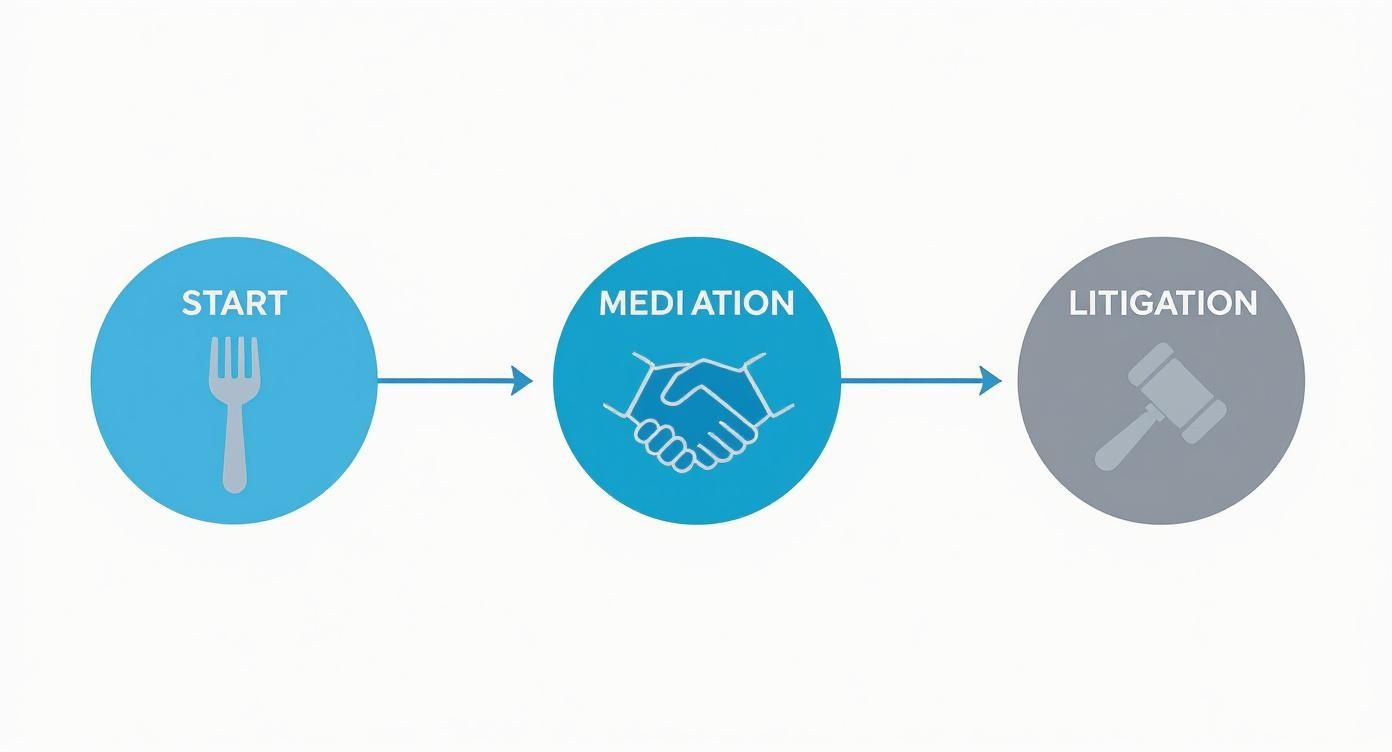
The choice often boils down to core issues like communication, safety, and fairness. Each path is designed for very different family needs.
Scenarios Favoring Mediation
Mediation is often the better option for couples who can still communicate respectfully, even when they disagree. Its success depends on both parties negotiating in good faith. Learning how to improve communication in relationships can make the process smoother.
Mediation might be the right fit if:
- You value privacy. Everything discussed in mediation stays confidential.
- You want to control the final agreement. You and your spouse create a custom settlement that works for your family.
- Effective co-parenting is your top priority. Mediation is collaborative and helps preserve a working relationship for raising children.
Situations Requiring Litigation
Litigation becomes necessary when cooperation isn’t possible or safe. The formal court system offers protections that mediation cannot provide.
You will almost certainly need to litigate your case if it involves:
- Domestic violence or abuse. The courtroom is the only place to get legal protections like a protective order.
- Hidden assets or financial deception. Litigation provides powerful tools like formal discovery and subpoenas to uncover the truth.
- A major power imbalance. When one spouse is controlling, the advocacy of a skilled attorney in court is essential to ensure a fair result on issues like determining what is spousal support in Texas.
Frequently Asked Questions
When a divorce is finalized, it is common to have questions, especially if you feel the outcome was unfair. Here are some of the most common questions we hear from clients seeking justice through the appeals process.
Can a Judge Force Me to Mediate My Divorce in Texas?
Yes. Under the Texas Rules of Appellate Procedure and Texas Family Code, judges frequently order couples to mediation before setting a final trial. The goal is to provide an opportunity to settle the case, which saves judicial resources.
However, while a judge can order you to attend and participate in good faith, no one can force you to sign an agreement. If mediation is unsuccessful, your case proceeds to trial, preserving your right to appeal a judge’s decision later.
What You Can Appeal in a Texas Divorce Case
You can appeal most final orders from a trial court, including decisions on property division, child support, and child custody. The appeal must be based on a legal error made by the judge, not just disagreement with the outcome. Common grounds for appeal, or “reversible errors,” include:
- Abuse of Discretion: The judge made a decision that was arbitrary or unreasonable, such as a custody ruling not supported by the evidence.
- Misapplication of Law: The judge incorrectly applied the Texas Family Code, for example, by mischaracterizing separate property as community property.
- Procedural Errors: The judge violated procedural rules that harmed your ability to present your case fairly.
Can I Appeal a Mediated Settlement Agreement If I Regret Signing It?
Appealing a judgment based on a Mediated Settlement Agreement (MSA) is extremely difficult. Texas law makes a properly signed MSA binding and irrevocable to ensure finality. An appeal is generally only possible if you can prove your signature was obtained through fraud, duress, or coercion. “Buyer’s remorse” is not a valid ground for appeal.
Does My Lawyer Go to Mediation With Me?
Yes, and you should insist on it. Your attorney’s role in mediation is crucial. They provide on-the-spot legal advice, analyze settlement proposals, and protect you from agreeing to unfair terms. They are your legal and strategic safeguard, ensuring that any agreement you consider protects your rights before it becomes permanent and unappealable.
If you believe the court made a mistake in your family law case, our appellate attorneys can help you seek a fair outcome. Contact The Law Office of Bryan Fagan today for a free consultation at https://familylawcourtappeals.com.