Receiving the court's final decision can be disheartening, especially if the outcome feels profoundly unjust. A Texas final divorce decree is the official order that legally ends your marriage, but it's much more than a piece of paper. It serves as the legal blueprint for your family's future, dictating property division, financial responsibilities, and the rules of co-parenting. You may feel your case was handled unfairly, that the judge misunderstood the facts, or simply applied the law incorrectly.
While the word "final" suggests permanence, Texas law provides specific, time-sensitive pathways to challenge a judge's decision if you believe a serious legal mistake was made. Understanding these options is the first step toward seeking the fair outcome you deserve.
What a Texas Final Divorce Decree Means for You

When you read a final decree that seems to ignore crucial evidence or misinterpret the law, the result can feel deeply unfair—an improper division of your life’s work or a custody order that is not in your children's best interest. If this is your experience, you are not alone. Judges in Texas sign tens of thousands of these comprehensive documents every year, and they are not infallible. According to the Texas Department of State Health Services, judges issue an average of over 60,000 final divorce decrees annually. You can dig into more Texas divorce statistics on Findmypast.com.
The Power and Finality of a Decree
Once a judge signs the decree, it becomes a legally binding court order. It is a command, not a suggestion. You and your former spouse are legally required to comply with every provision, from transferring property titles to adhering to the possession schedule. Ignoring these terms can lead to serious consequences, including enforcement actions and contempt of court charges.
The finality of the decree is significant. It marks the end of the case at the trial court level and, more importantly, starts a very short, strict timeline for challenging the outcome through an appeal. Missing these deadlines means losing your right to seek justice for an incorrect ruling.
A Final Divorce Decree is not merely a summary of the trial; it is the legal blueprint for your future. It dictates your rights and responsibilities regarding property, finances, and, most importantly, your children. An error in this blueprint can have lasting consequences.
Your Path Forward After an Unfair Ruling
It is natural to feel powerless when faced with an unfair court order. However, it is crucial to understand that you have options. The Texas justice system provides a dedicated process designed to correct judicial errors: the appellate process.
An appeal is not a second trial where you can present new evidence or re-argue your case. Instead, it is a highly technical review of the trial record, where a skilled appellate attorney analyzes the proceedings for specific, reversible errors—legal mistakes made by the judge that unfairly impacted the outcome. The personal and financial stakes are enormous, which is why it’s critical to understand not just the decree, but also the potential cost of a divorce in Texas and what it takes to secure a just result. If you believe the court made a mistake, now is the time to act decisively.
Decoding the Key Parts of Your Divorce Decree
A final divorce decree is a dense, formal document filled with legal terminology. However, understanding its main components is the first step in identifying where the court may have gone wrong. Each section outlines the judge's final orders on a specific issue, forming the rulebook for your post-divorce life. By translating this legalese, you can pinpoint rulings that may be legally flawed and ripe for appeal.
The Division of Property and Debt
At its core, a divorce is a financial separation. The Texas Family Code requires that community property—all assets and debts acquired during the marriage—be divided in a "just and right" manner. This does not always mean a 50/50 split. The decree must list every asset and liability, from the family home to credit card debt, and state precisely who receives what.
A common and devastating reversible error occurs when a judge mischaracterizes property. For example, if you owned a rental property before marriage, it is your separate property. If the judge mistakenly classifies it as community property and orders it to be sold and the proceeds divided, that is a significant legal mistake that can be corrected on appeal. A proper appraisal for divorce is also essential for a fair outcome.
Orders Affecting Your Children
For parents, the sections of the decree concerning children are the most critical. Every decision must be based on the "best interest of the child," but a judge's application of this standard can sometimes miss the mark.
These orders include several key components:
- Conservatorship: This is the Texas term for legal custody. The decree will name the parents as Joint Managing Conservators (the most common arrangement) or one as the Sole Managing Conservator. This section outlines who has the right to make key decisions regarding the child's education, medical care, and general welfare.
- Possession and Access: This is the visitation schedule, often a Standard Possession Order, which details when the children will be with each parent, including holidays, summers, and weekends.
- Child Support: The decree will order one parent to pay a specific amount of child support each month. This amount is typically based on a statutory formula, but a judge may deviate from it if they provide specific, written reasons in the decree.
A reversible error in this context could be a judge severely limiting a parent's time with their child without any evidence of endangerment, such as family violence or substance abuse. Another example is ordering child support that deviates significantly from state guidelines without providing the legally required explanation.
Financial Support Between Spouses
The final major component involves financial support paid from one former spouse to the other, known as spousal maintenance (or alimony). Texas law is very strict regarding spousal maintenance, with firm eligibility requirements and limits on the amount and duration of payments. A judge cannot order it simply because it seems "fair." They must make a specific legal finding that a spouse is eligible, such as due to a marriage of 10 years or more or a history of family violence. If a judge orders you to pay spousal maintenance without these required legal findings, it is a clear error that can be challenged on appeal.
To help you navigate your own document, here’s a quick-glance table breaking down the most important sections you'll find in a Texas divorce decree.
Key Sections Inside Your Final Divorce Decree
| Decree Component | What It Governs | Common Area for Legal Errors |
|---|---|---|
| Property Division | Division of assets (real estate, bank accounts, retirement) and debts (mortgages, credit cards) acquired during the marriage. | Mischaracterizing separate property as community property, or an unequal division without a "just and right" reason. |
| Conservatorship | The rights and duties of each parent, including who makes decisions about education, healthcare, and welfare. | Stripping a parent of rights without sufficient cause or evidence of endangerment. |
| Possession & Access | The detailed visitation schedule, including holidays, summers, and regular parenting time. | Imposing restrictions on a parent's time with the child that aren't supported by the facts of the case. |
| Child Support | The amount of monthly financial support one parent pays to the other for the children's care. | Deviating from statutory guidelines without providing the legally required written findings. |
| Spousal Maintenance | Post-divorce financial support (alimony) paid from one ex-spouse to the other. | Ordering maintenance when the receiving spouse doesn't meet the strict legal eligibility requirements. |
By carefully reviewing each section of your decree, you and your appellate counsel can begin to identify where the court may have made a critical legal mistake, laying the groundwork for an appeal.
Your First Moves After the Decree Is Signed
The moment a judge signs your Texas final divorce decree, a critical timeline begins. After a long and emotionally draining legal battle, it may be tempting to set the paperwork aside. However, this is a time for decisive action. Texas law provides a very short window to challenge an unjust ruling, and every day counts.
Missing a post-judgment deadline could permanently close the door on your opportunity to correct a legally flawed outcome. Understanding the immediate steps you must take is essential to preserving your right to seek a fair resolution through the appellate process.
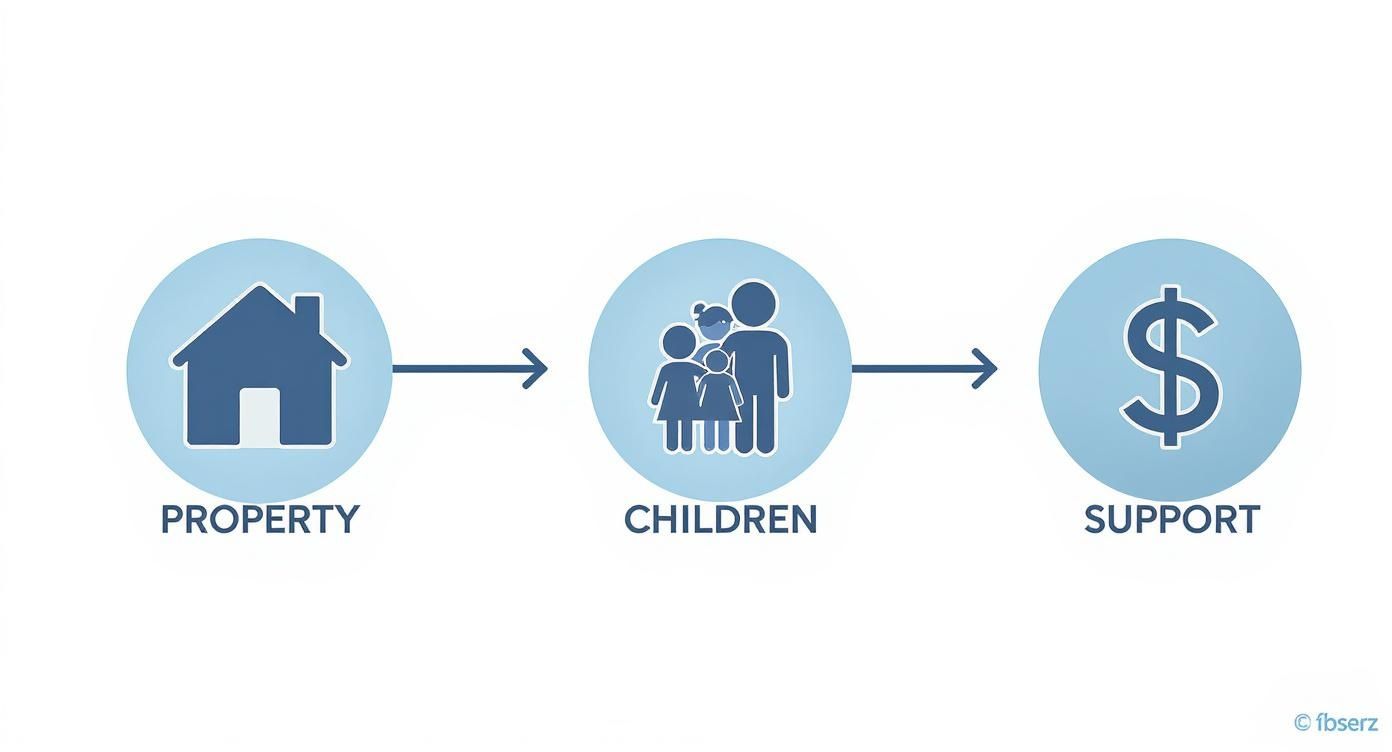
Every key area of your decree—property, children, and support—is susceptible to judicial error. A well-executed appeal is the specific legal mechanism designed to correct these mistakes and restore fairness.
The Motion for New Trial: Your Crucial First Step
Your most immediate and powerful tool is the Motion for New Trial. This is a formal written request asking the trial judge to reconsider and change their own decision. While it may seem unlikely that the same judge will reverse their ruling, filing this motion is a non-negotiable step in the appellate process.
Filing a Motion for New Trial serves two vital purposes:
- It allows the trial judge to correct their own error. Sometimes, a clear legal argument presented on paper, away from the pressure of trial, can persuade a judge to recognize and fix a mistake, potentially avoiding the need for a lengthy appeal.
- It extends the deadline for filing an appeal. This is a crucial strategic advantage. Filing this motion extends the deadline to file a Notice of Appeal from 30 days to 90 days from the date the decree was signed. It also extends the trial court's jurisdiction over the case, known as its plenary power. This additional time is invaluable for preparing a strong appeal.
A Motion for New Trial isn't just asking for a "do-over." It is a required legal instrument that formally puts the trial court on notice of specific errors. This step is essential for preserving those issues for the appellate court's review.
Appeal vs. Modification: Looking Backward vs. Looking Forward
It is vital to understand the difference between an appeal and a modification. An appeal, which begins with post-trial motions like the Motion for New Trial, is focused on correcting a legal mistake made during the trial.
A Motion to Modify, conversely, is used to change the decree because circumstances have changed significantly after the divorce was finalized. For example, if you lose your job a year after the decree is signed, you can file a Motion to Modify your child support payments. You cannot use a modification to argue that the original child support calculation was wrong from the start.
- An appeal looks backward to fix an error the judge made in the original ruling.
- A modification looks forward to adjust the decree based on a significant change in circumstances.
Post-Decree Deadlines and Strategic Actions
The first 30 days after a decree is signed are governed by deadlines that cannot be missed. This table outlines the most common actions, their purpose, and their strict timelines.
| Action | Purpose | Typical Deadline |
|---|---|---|
| Motion for New Trial | Asks the trial judge to reconsider their ruling; a critical step to preserve issues for appeal and extend appellate deadlines. | Must be filed within 30 days of the decree being signed. |
| Notice of Appeal | The official document that initiates the appeal process and notifies the courts and the other party of your intent to appeal. | Within 30 days of the decree, or 90 days if a timely Motion for New Trial was filed. |
| Motion to Modify | Seeks to change an order (like custody or support) due to a "material and substantial change" in circumstances. | Can be filed anytime after the decree, but only if a significant change has occurred. |
Because these deadlines are absolute, your most important first move is to consult with an appellate attorney immediately upon receiving your Texas final divorce decree. An expert can quickly analyze the rulings, identify potential reversible errors, and ensure every critical deadline is met, preserving your right to fight for a just outcome.
How the Divorce Appeals Process Really Works
https://www.youtube.com/embed/qpaLeYxGxh8
If you are considering challenging your Texas final divorce decree, it's essential to understand that an appeal is not a retrial. Many people mistakenly believe it is a second chance to argue their case, introduce new witnesses, or submit evidence that was overlooked.
This is not how the appellate process works. An appeal is a formal review of the trial proceedings. The appellate court acts as a panel of referees, carefully examining the trial court record to determine if the judge made a significant legal mistake—a reversible error—that unfairly affected the final outcome. The entire process is governed by the Texas Rules of Appellate Procedure and requires a specialized legal strategy.
The First Step: Filing the Notice of Appeal
The appellate journey begins with a single, critical document: the Notice of Appeal. This is the formal paperwork filed with the court that officially states your intention to challenge the trial court’s judgment.
The deadlines for filing this notice are strict and unforgiving. In most cases, you have only 30 days from the date the judge signed the final decree. If a timely Motion for New Trial was filed, this deadline extends to 90 days. Missing this deadline will almost certainly forfeit your right to appeal, regardless of the strength of your case.
Assembling the Appellate Record
After the Notice of Appeal is filed, the next step is to assemble the appellate record. This is the complete case file that the court of appeals will review. It is the only information the appellate justices are permitted to consider—no new evidence can be added.
The appellate record consists of two parts:
- The Clerk's Record: This includes all documents filed in your case, such as the original petition for divorce, motions, discovery responses, and the final decree.
- The Reporter's Record: This is the official, word-for-word transcript of everything said during the trial, including all testimony, arguments from attorneys, and the judge's rulings.
The accuracy and completeness of the appellate record are paramount. Any omissions or errors can severely damage your appeal. It’s also important to consider that implications of virtual meeting recordings in legal discovery can make these digital files part of the evidence reviewed on appeal.
Understanding the Standard of Review
One of the most important concepts in an appeal is the standard of review. This is the specific lens through which the appellate court examines the trial judge's decisions. It determines how much deference the higher court must give to the original rulings. In Texas family law, a common standard is "abuse of discretion."
In plain English, “abuse of discretion” means you must prove the trial judge made a decision that was unreasonable, arbitrary, or made without reference to guiding legal principles. The appellate court doesn't ask, "Would we have ruled differently?" Instead, it asks, "Was the trial judge’s decision outside the bounds of the law?"
This is a high standard to meet. It is not enough to simply disagree with the outcome. You must demonstrate that the ruling was so legally flawed that it requires correction.
Crafting the Brief and Identifying Reversible Error
The core of any appeal is the appellate brief. This is a lengthy, highly structured legal document written by your appellate attorney. It presents the facts of the case, cites relevant laws and prior court decisions (precedent), and builds a persuasive argument that the trial court committed a reversible error.
A reversible error is not just any mistake. It is a legal blunder so significant that it likely caused an improper judgment. For example, a judge misclassifying a $500,000 separate property inheritance as community property and dividing it would almost certainly be a reversible error. The entire process of how to appeal a family court decision hinges on identifying and proving these types of critical mistakes in the Texas final divorce decree.
Common Grounds for a Successful Divorce Appeal
The feeling that your case was decided unfairly is valid, but in appellate law, that feeling must be connected to a specific, provable reversible error. An appeal is not a forum to retry your case; it is a focused legal challenge designed to demonstrate that the trial court made a significant mistake that led directly to an improper outcome in your Texas final divorce decree.
So, what qualifies as a "reversible error"? It is a legal term that can feel abstract, but it often applies to concrete mistakes. Below are real-world examples of errors that Texas family courts can make—mistakes an appellate court has the power to correct.
Errors in Property Division
The division of property is a frequent source of appellate challenges. Texas is a community property state, but the law provides clear rules protecting each spouse's separate property—assets owned before the marriage or received as a gift or inheritance.
- Example: Mischaracterizing Separate Property: You inherited a stock portfolio from a relative during your marriage and kept it in a separate account under your name only. At trial, the judge incorrectly classifies it as community property and orders it to be divided. This is a classic reversible error. The court misapplied the law, and an appellate court can correct the judgment to restore your separate property. Learn more about the challenges of property division.
Another common error is a property division that is not "just and right." While the division does not have to be 50/50, a disproportionate split must be supported by evidence and sound legal reasoning.
- Example: An Unjust Division: A judge awards 80% of the community estate to your spouse and only 20% to you, citing your spouse's "need" but without any supporting evidence in the record. If the judge cannot provide a legally sound reason for such an unequal division, it is likely an abuse of discretion—a key standard for winning an appeal.
Errors in Child Custody and Support
When children are involved, all court decisions must be based on the "best interest of the child." While this standard is broad, it does not give a judge unlimited authority. The final order must be supported by the evidence presented in court.
A “reversible error” isn't a minor mistake or a ruling you simply disagree with. It is a substantial legal blunder—a misapplication of the law or a decision with no factual support in the record—that likely caused the trial court to reach the wrong conclusion.
Here are examples of reversible errors related to children:
- Example: Unwarranted Custody Restrictions: You have always been an involved parent, but the judge severely restricts your access to your children and orders supervised visitation based on an unproven allegation. If the trial record contains no credible evidence of abuse, neglect, or substance abuse to justify such a drastic measure, an appellate court would likely find that the trial court abused its discretion. You can read more about fighting for your parental rights in a child custody appeal.
- Example: Incorrect Child Support Calculation: The judge orders you to pay child support well above the amount set by the Texas Family Code guidelines. While a judge has the discretion to do this, the law requires them to make specific, written findings in the decree explaining why the deviation is in the child's best interest. If the judge fails to provide this required justification, the order is legally defective and can be overturned on appeal.
If these scenarios seem familiar, you may have strong grounds to challenge the court's decision. Identifying these errors in your Texas final divorce decree is the critical first step toward seeking a fair outcome.
How an Appellate Attorney Can Seek a Fair Outcome
When you receive a Texas final divorce decree that feels unjust, the path forward is not about re-litigating your case. The appellate process is a specialized legal field that demands a different skill set from that of a trial lawyer. An appellate attorney is a legal strategist who focuses exclusively on the appellate rules and procedures. Their role is to meticulously analyze the trial record to find critical legal mistakes and build a compelling argument to have them corrected.
Their work is less about courtroom performance and more about precise, methodical analysis of the written record.

Think of your appellate lawyer as a legal detective reviewing a closed case file. They examine every piece of evidence from your trial—every word in the transcript, every document admitted as an exhibit, and every ruling the judge made. They are searching for one thing: a reversible error. This is not just any mistake; it is a specific legal error significant enough to have caused an improper outcome. It takes a deep understanding of the Texas Family Code and the Texas Rules of Appellate Procedure to identify such an error.
Building the Case for Justice
Finding a potential error is only the beginning. The primary role of your appellate attorney is to construct a powerful, logical argument entirely on paper. This process does not involve new testimony or evidence; it is about demonstrating how the law was misapplied to the facts already in the record.
Here is what that process involves:
- Intensive Legal Research: Appellate attorneys research decades of case law to find prior appellate court decisions (legal precedent) that support your position and demonstrate that the trial court erred.
- Persuasive Brief Writing: The main work product of an appeal is the brief—a formal legal document that methodically lays out the facts, the applicable law, and a detailed argument explaining how the judge erred. This brief is the primary tool for persuading a panel of appellate judges.
- Navigating Complex Procedures: The appellate system is a maze of strict deadlines and rigid rules. A single procedural mistake can result in the dismissal of your entire appeal. Your attorney's precision is therefore critical.
An appellate attorney’s goal isn't to give you a do-over of your trial. Instead, they aim to prove that the original outcome was legally flawed and must be corrected to achieve justice.
If you believe the court made a mistake in your family law case, our appellate attorneys can help you seek a fair outcome. Contact The Law Office of Bryan Fagan today for a free consultation.
Answering Your Questions About Divorce Appeals
When a judge signs a Texas final divorce decree that seems fundamentally wrong, it's natural to feel overwhelmed and confused. Getting clear answers to a few key questions can help you understand your options and the path forward.
How Long Do I Have to Appeal My Texas Divorce Decree?
This is the most critical question, and the answer is not long. The deadlines in Texas appellate law are absolute and unforgiving.
You generally have only 30 days from the date the judge signs the final decree to file your Notice of Appeal.
There is one important exception: if you file a timely Motion for New Trial with the trial court, that deadline can be extended to 90 days. Because these deadlines are so strict, it is essential to contact an appellate lawyer immediately after receiving your decree to ensure you do not forfeit your right to appeal.
Can I Present New Evidence During My Appeal?
This is a common misconception. An appeal is not a second trial. The appellate court acts as a review panel, examining the record of the trial that has already occurred. The court's review is strictly limited to the official "record" from your trial, which includes all documents filed in your case and the court reporter's word-for-word transcript of the proceedings.
Think of it this way: The appeal isn't about re-arguing the facts. It's about pointing out where the trial judge may have made a critical legal mistake based on the evidence and arguments that were presented to them at the time.
No new witnesses can be called, and no new evidence can be introduced.
What Happens if I Actually Win My Appeal?
If the court of appeals agrees that a significant "reversible error" occurred in your case, it has several options for remedying the mistake. The court might:
- Reverse and Render: This is less common. It means the appellate court reverses the trial court's decision and issues the correct judgment itself, ending the case.
- Reverse and Remand: This is the more frequent outcome. The appellate court identifies the error, reverses the flawed portion of the judgment, and sends the case back (remands it) to the original trial court for a new hearing or trial on the specific issues that were decided incorrectly, with instructions on how to apply the law correctly.
If you believe the court made a mistake in your family law case, our appellate attorneys can help you seek a fair outcome. Contact The Law Office of Bryan Fagan today for a free consultation.