When a judge issues a ruling in your Texas family law case that feels profoundly wrong, the sense of injustice can be overwhelming. You may feel your case was handled unfairly—that crucial facts were ignored or the law was misapplied, leaving you with a result that undermines the well-being of your family.
The good news is that a trial court’s order does not have to be the final word. Texas law provides a clear path for seeking justice through the appeals process. Understanding how to appeal a family court decision is the first step toward restoring balance. An appeal is not a do-over of your trial, but a meticulous review of the record designed to correct legal errors and ensure a fair outcome.
What You Can Do After an Unfair Family Court Ruling

If you are facing a court order that defies logic or fairness, your instinct may be to return to court and argue your case all over again, perhaps with new evidence. However, the appellate process works differently.
An appeal is a highly structured legal proceeding focused on identifying specific errors the trial judge made. This process is guided by the strict Texas Rules of Appellate Procedure and the Texas Family Code. A panel of higher court judges will review your case through a very specific legal lens, focusing on procedural and legal correctness, not the emotional arguments from the trial.
Time is of the essence. The entire process is controlled by rigid deadlines that wait for no one.
How an Appeal Differs From a Trial
An appeal is worlds away from a trial. During a trial, the focus is on presenting facts and telling your story. In an appeal, the mission is to convince a panel of appellate judges that the trial court made a significant legal error that unfairly impacted the outcome.
An appellate lawyer’s job is not to re-litigate the facts. Their role is to dive deep into the trial record—every transcript, every piece of evidence, every ruling—and identify mistakes that led to an unjust outcome. We are looking for what the law calls "reversible errors." These are not minor disagreements with the judge. They are substantial mistakes, such as:
- The judge misinterpreting or misapplying a Texas law.
- Crucial evidence being improperly excluded or inadmissible evidence being allowed.
- The judge’s decision being so arbitrary or unreasonable that it qualifies as an "abuse of discretion."
Abuse of Discretion: A legal term meaning the trial court’s decision was made without reference to guiding legal principles, was arbitrary, or was unreasonable. It doesn’t mean the judge acted in bad faith, only that the ruling falls outside the bounds of sound legal judgment.
An appeal is your opportunity to argue for the correct application of Texas law. It is about restoring balance and ensuring the final outcome is legally sound.
Your First Steps Are Critical
After receiving an unfavorable ruling, the clock starts ticking.
In Texas, you typically have only 30 days from the day the judge signs the final order to file a "Notice of Appeal." This deadline is absolute. If you miss it, you will almost certainly lose your right to challenge the decision forever.
This is why you must contact an appellate attorney immediately. A lawyer with experience in family law appeals can quickly evaluate the trial record and provide an honest assessment of whether you have valid grounds to move forward. They will analyze every detail to build a compelling case focused on correcting the court's errors and fighting for the fair result you need in your divorce, child custody dispute, or other family law matter.
Identifying Legal Grounds for a Texas Family Law Appeal
While a family court loss can feel deeply unfair, that feeling alone is not enough to win an appeal. An appeal is a highly technical legal argument focused on proving the trial judge made a significant legal mistake—a "reversible error"—that changed the outcome of your case.
Reversible Error: A legal mistake made by the trial court that is serious enough to have likely caused an incorrect judgment. Proving this type of error is the central goal of an appeal.
Your appellate lawyer will not introduce new evidence or call new witnesses. Their job is to analyze the existing trial record—transcripts, evidence, and rulings—to find a mistake so critical that it likely led to an improper final judgment on issues like child custody or property division.
Can the Court's Order Be Appealed?
Before searching for errors, the first question is whether the judge's order is appealable. In Texas, you can typically only appeal a "final judgment." This is the court’s last word on the matter—the order that resolves all major issues and closes the case at the trial level.
Appealable orders usually include:
- A Final Decree of Divorce.
- A final order in a Suit Affecting the Parent-Child Relationship (SAPCR).
- A final ruling on a protective order or enforcement action.
Temporary or interim orders made while your case was ongoing are generally not appealable. This system prevents constant appeals over temporary decisions, which would bring the legal process to a halt.
Common Reversible Errors in Texas Family Courts
The most common argument in Texas family law appeals is that the trial judge committed an "abuse of discretion." This means the judge made a decision that was arbitrary, unreasonable, or without reference to guiding legal rules and principles.
For example, the Texas Family Code outlines specific factors a judge must consider when determining the best interest of a child. If the trial record shows the judge ignored several of these key factors, you may have a strong argument for an abuse of discretion. The same applies to a property division that is so lopsided it cannot be justified by the evidence.
Other common reversible errors include:
1. Misapplication of the Law
This occurs when the judge understands the facts but applies the wrong legal rule. For instance, if a judge incorrectly labels your separate property (like an inheritance) as community property and divides it, that is a clear misapplication of Texas law. These are powerful arguments on appeal because they are pure questions of legal interpretation.
2. Evidentiary Errors
Trials are governed by strict rules of evidence. When a judge violates these rules, it can be grounds for reversal. Common evidentiary errors include:
- Wrongfully excluding key evidence: The judge refused to allow crucial testimony or documents that should have been considered.
- Wrongfully admitting harmful evidence: The judge allowed the other side to present inadmissible evidence that prejudiced the case against you.
Imagine the judge in your custody case refused to allow testimony from a credible witness who observed your ex-spouse’s dangerous behavior around the children. This is a significant evidentiary error that likely prevented a fully informed decision.
Appealing a family court decision is a serious undertaking. Appellate courts give significant weight to a trial judge's decisions and will only intervene when a clear error of law has been proven. As noted by Farrer & Co, appeals hinge on precise legal arguments, not just disagreements over the facts.
The Appeal Process: First Critical Steps
Once you and your appellate attorney determine there are solid grounds for an appeal, the process begins immediately. The Texas appellate system is built on strict, unforgiving deadlines. Missing one can close the door to a higher court permanently.
The first step is filing a Notice of Appeal. This is a formal document that informs the trial court and the opposing party that you are challenging the judge's final order. This single filing puts the entire appellate process into motion.
The Strict 30-Day Deadline
According to the Texas Rules of Appellate Procedure, you generally have just 30 days from the day the judge signs the final order to file your Notice of Appeal. This is a hard deadline, not a guideline.
In some cases, if your attorney files certain post-judgment motions—such as a Motion for New Trial—that deadline can be extended to 90 days from the date the order was signed. This can be a strategic move, but it must be executed perfectly by an experienced appellate lawyer.
The infographic below illustrates the shift from being unhappy with a ruling to identifying the specific legal error required to launch a successful appeal.
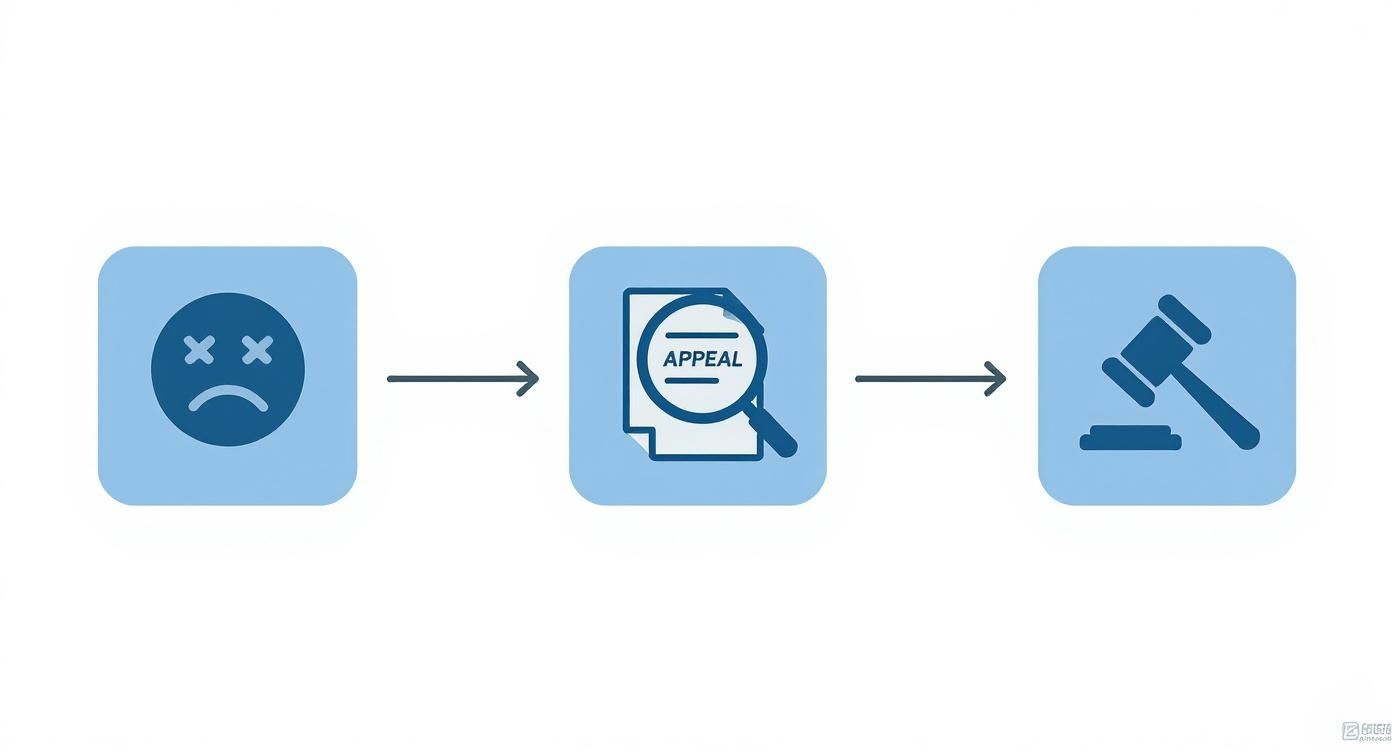
As you can see, the focus is not on disagreeing with the outcome but on finding a reversible error that the law recognizes as a valid reason to challenge the decision.
Preparing the Official Record
An appeal is not a new trial. You cannot present new evidence or call new witnesses. The appellate court's job is to review what already happened by examining the official appellate record.
Your attorney must formally request and pay for two key parts of this record:
- The Clerk’s Record: A compilation of every document filed in your case, including petitions, motions, and the final order you are appealing.
- The Reporter’s Record: The word-for-word transcript of everything said in court, including testimony, arguments, and the judge's rulings.
From the appellate court's perspective, if it is not in the record, it did not happen.
Key Takeaway: Preparing the appellate record is a meticulous task. A single missing document or an incomplete transcript can undermine an otherwise powerful legal argument. Your attorney's job is to ensure the record is complete and accurate.
Understanding the Standard of Review
Navigating an appeal requires a completely different strategy than a trial. The focus shifts from presenting new facts to persuading a panel of justices with legal arguments based on the existing record. This is known as the standard of review, which determines how closely the appellate court will scrutinize the trial judge's decisions.
| Aspect | Trial Court | Appellate Court |
|---|---|---|
| Primary Goal | Present evidence, establish facts, and obtain a favorable ruling. | Persuade justices that a legal error occurred at trial. |
| Key Players | Judge, jury (sometimes), witnesses, attorneys. | A panel of appellate justices and attorneys. |
| Evidence | New testimony and documents are presented. | No new evidence. Review is limited to the existing record. |
| Focus | "What happened?" (Facts) | "Did the trial court make a legal mistake?" (Law) |
This table highlights why the skillset for a trial lawyer differs from that of an appellate specialist. Once the Notice of Appeal is filed and the record is being prepared, the focus shifts to the heart of your appeal: crafting a persuasive legal argument. For context on how legal notices work, understanding the waiver of service in Texas can be helpful.
Crafting Your Argument: The Appellate Brief

Appeals are won on paper, not with dramatic courtroom speeches. The foundation of your case is the appellate brief—a formal, written argument submitted to the appellate judges.
Briefing: The process of writing and submitting the formal legal arguments (the briefs) to the appellate court. The appellant (the person appealing) files an opening brief, the appellee (the other party) files a response brief, and the appellant may file a reply brief.
This is where your attorney meticulously lays out the legal argument for why the trial court’s decision was flawed. The process involves combing through the trial record to identify legal errors and weaving them into a compelling narrative grounded in Texas law.
The brief must prove to the appellate judges that a clear legal mistake was made and that this mistake unfairly skewed the final judgment on your divorce, property division, or child custody arrangement.
The Structure of an Appellate Brief
The appellate brief is a highly structured document governed by the Texas Rules of Appellate Procedure. Each section builds on the last, guiding the judges to the conclusion that a reversible error occurred. A strong brief includes:
- Statement of the Case: A concise overview of what happened at the trial court.
- Issues Presented: The precise legal questions the appellate court must answer, framed to highlight the trial court's errors. For example: "Did the trial court abuse its discretion by failing to consider all statutory best interest factors?"
- Statement of Facts: A neutral, objective summary of the evidence presented at trial, with every fact cited directly to the official record.
- Argument and Authorities: The core of the brief. Here, your attorney connects the facts of your case to established Texas law, previous court decisions (precedent), and statutes to show exactly how and why the trial judge erred.
The argument section is where deep legal research and strategic writing demonstrate that a mistake was made and that this mistake was harmful, demanding correction to ensure justice is served.
The Role of Legal Research
You cannot win an appeal simply by claiming a decision was unfair. You must prove it using the law. This requires intensive legal research to find supporting case law—prior appellate decisions that bolster your legal position. An appellate specialist knows how to find the most relevant and persuasive cases to construct an argument that will resonate with the judges.
Explaining the Reversible Error
The brief's primary job is to clearly identify a reversible error. For example, when arguing an abuse of discretion, the brief must:
- State the correct legal standard from the Texas Family Code or relevant cases.
- Cite specific evidence from the record that the trial judge overlooked or misinterpreted.
- Explain precisely why the judge's decision falls outside the zone of reasonable judgment according to established law.
Ultimately, a successful appeal comes down to the quality of the appellate brief. It is a demanding process that requires a powerful combination of research, writing, and strategic legal thinking to give you the best chance at a fair outcome.
Oral Argument and the Final Decision
After the briefs are filed, some cases are selected for oral argument. This is not a new trial but a focused Q&A session with the appellate judges.
If your case is chosen for oral argument, it is a critical opportunity. The judges will have already read the briefs and will come prepared with questions designed to test the limits of your legal arguments. A seasoned appellate attorney uses this time to have a direct conversation with the court, clarify complex points, and emphasize why the trial court's errors must be corrected.
The Purpose of Oral Argument
Oral argument is about persuasion. Your attorney’s goals are to:
- Directly Answer the Judges' Questions: This is the top priority. The judges use this time to probe legal issues they are grappling with.
- Reinforce the Core Argument: It is an opportunity to refocus the court’s attention on the central theme of your appeal.
- Establish Credibility: A well-prepared lawyer who confidently navigates the facts and the law shows the court that your position is built on a solid legal foundation.
This stage requires a different skill set than a trial, focusing on a precise, respectful, and legally sharp dialogue with the decision-makers.
The Court's Final Decision
Sometime after the briefs are filed and any oral argument is held, the appellate court will issue its written ruling, called an "opinion." The wait for this decision can take several months. For more on legal timelines, you can review our guide on how long it takes to process a divorce in Texas.
The court's opinion will deliver one of three outcomes:
- Affirm: The appellate court finds no reversible error and agrees with the trial court's decision. The original order stands.
- Reverse: A win. The appellate court agrees that a significant legal error occurred and overturns the trial court's decision.
- Remand: Often accompanies a reversal. The case is sent back to the trial court with specific instructions, such as reconsidering a property division using the correct legal standard or holding a new hearing on a protective orders matter.
A "win" on appeal often means earning a second chance to get it right back in the trial court—this time, without the legal error that skewed the first outcome.
Why Your Trial Lawyer May Not Be the Right Choice for Your Appeal
After an unfair trial outcome, your first instinct may be to stick with the lawyer who knows your story. However, the skills that win a trial are very different from those that win an appeal.
A trial is like a live performance where your lawyer presents evidence and connects with a judge. An appeal is more like editing a film—the focus is on meticulously reviewing the existing record to find critical errors.
A Fresh Perspective Uncovers Errors
It is difficult for a trial attorney to critique their own work to find appealable mistakes. An appellate specialist brings a fresh, unbiased eye. They are not emotionally invested in the original trial strategy, allowing them to objectively pinpoint legal errors that the trial attorney may have overlooked.
This is not about blaming your trial lawyer; it is about strategy. A skilled family law appeal attorney knows how to dissect a trial record and frame arguments that resonate with appellate judges, focusing on legal precision and procedural correctness.
Mastering Complex Appellate Procedure
The legal world is complex. With roughly 56,970 family law attorneys in the U.S., you have options, but the system itself can be a hurdle. Court backlogs are a serious issue, and in some parts of Texas, an appeal can take well over a year.
These delays can be difficult, especially when a child's living situation is at stake. An attorney who specializes in appeals understands the unique procedural rules, deadlines, and strategies needed to navigate the system as efficiently as possible. For more information, you can read about how family court delays can impact your case.
Your Questions About Texas Family Law Appeals Answered
The idea of an appeal can be overwhelming. Let’s address some common questions.
How Long Does a Family Law Appeal Take in Texas?
Be prepared for a lengthy process. A typical family law appeal in Texas takes anywhere from nine months to well over a year to receive a final decision. The complexity of the legal issues and the specific caseload of the appellate court can affect this timeline.
Can I Introduce New Evidence on Appeal?
The answer is a firm no. An appeal is not a second trial or a "do-over" where you can present new evidence.
The court of appeals is limited to reviewing only what happened in the trial court. Its job is to examine the existing official record—transcripts and admitted evidence—and determine if the judge made a legal mistake based on the information they had at the time.
What Are My Chances of Winning an Appeal?
Appealing is an uphill battle. Appellate courts give significant deference to trial judges' decisions, especially regarding witness credibility, because the trial judge observed the proceedings firsthand.
However, winning is possible. Your chances depend entirely on whether your attorney can identify a significant "reversible error" in the record that likely caused an unjust outcome. If you can pinpoint a clear error and make a compelling legal argument, your odds improve dramatically. A skilled appellate lawyer can provide a frank, realistic assessment of your case's potential.
If you believe the court made a mistake in your family law case, our appellate attorneys can help you seek a fair outcome. Contact The Law Office of Bryan Fagan today for a free consultation at our family law court appeals website.