When your divorce is finalized, you expect a clean break and a fair division of your life together. But what happens when the court's order regarding your family home leaves you financially exposed? If you feel the judge made a mistake in handling your mortgage, you may be left wondering if the outcome was truly just. This is a common and distressing situation, but it's important to know that a flawed court order isn't necessarily the final word.
A mortgage assumption is a critical tool in a Texas divorce. It allows one spouse to take over the existing home loan—preserving a potentially low interest rate—while legally releasing the other spouse from all responsibility. However, if the trial court’s final decree is vague, unworkable, or fails to protect you, it can create a financial nightmare. These are the kinds of judicial mistakes that can often be corrected through the appellate process.
What You Can Appeal in a Texas Divorce Property Division
In a Texas divorce, a judge is required to divide community property in a "just and right" manner. But a "just and right" division must also be practical and enforceable. When a judge’s order about a mortgage assumption is flawed, it can be considered a reversible error.
For instance, a judge might order your ex-spouse to assume the mortgage but fail to include a firm deadline or a backup plan if the lender denies the assumption. This leaves you legally tied to a debt on a home you no longer own. If your ex-spouse misses a payment, it damages your credit. This isn't just unfair; it's a potentially appealable issue.
A true mortgage assumption is a formal process with the lender that results in a "release of liability," completely severing your financial connection to the loan. The division of your home and its debt is governed by the Texas Family Code. If your divorce decree fails to provide a clear path to this release, it may be an abuse of discretion by the trial court—the specific type of error an appellate attorney looks for when evaluating a case for appeal.
Understanding the Standard of Review
An appeal is not a new trial. We don't present new evidence. Instead, our appellate attorneys meticulously review the trial record for legal errors. The standard of review for property division in Texas is typically "abuse of discretion."
- Abuse of Discretion: This is a legal term meaning the trial judge made a decision that was arbitrary, unreasonable, or without reference to any guiding rules and principles. For example, ordering an assumption without ensuring it was actually possible for the spouse to qualify for it could be an abuse of discretion.
- Reversible Error: This is a mistake so significant that it likely caused an improper judgment. A vague property division order that leaves one party financially vulnerable is a classic example.
- Briefing: This is the process of writing a detailed legal argument (a "brief") that explains to the appellate court exactly where the trial judge erred and why the decision should be overturned.
Getting a handle on these concepts is the first step toward seeking justice. An assumption should protect you financially. Here’s why it’s so important:
- You Keep Your Great Interest Rate: The primary benefit is preserving a low interest rate from years past, which can save hundreds of dollars a month compared to refinancing at today's higher rates.
- The Lender Has to Approve It: The spouse keeping the home must qualify for the loan on their own. The lender will review their credit, income, and debt-to-income ratio.
- You Get a "Release of Liability": This is the crucial document that officially releases the departing spouse from the loan. Without it, the process is incomplete.
- A Federal Law Protects You: The Garn-St. Germain Act prevents lenders from using a "due-on-sale" clause to call the loan due simply because the property was transferred in a divorce.
In 2022, 53.4% of divorced people were co-owners of their home, according to data from Rothcap.com. This shows how many people need a fair, workable solution. If your divorce decree left you exposed, it's not just unfair—it might be a reversible error that an appellate attorney can help you correct.
Why an Improper Refinance Order Can Be a Reversible Error
When a divorce is final, decisions about the family home have a lasting impact on your financial future. One of the most critical decisions is whether to assume the mortgage or refinance. Forcing a refinance in a high-interest-rate environment can be financially devastating and may constitute an abuse of discretion by the court.
Ordering a refinance often means giving up a fantastic low-interest loan for a new one with a much higher rate. This can add hundreds, or even thousands, of dollars to the monthly housing cost, placing an unnecessary and unjust burden on the spouse keeping the home.
The impact of rising interest rates has made mortgage assumption after divorce a far more equitable solution. For example, the average mortgage rate in the United States shot up from 3.5% in early 2022 to over 6.75% by late 2024. On a $500,000 30-year mortgage, that’s the difference between a $2,245 monthly payment and a $3,242 payment—nearly a $1,000 increase every month.
This isn't a niche problem. As this data shows, more than half of all divorcing couples are homeowners who must resolve this issue.
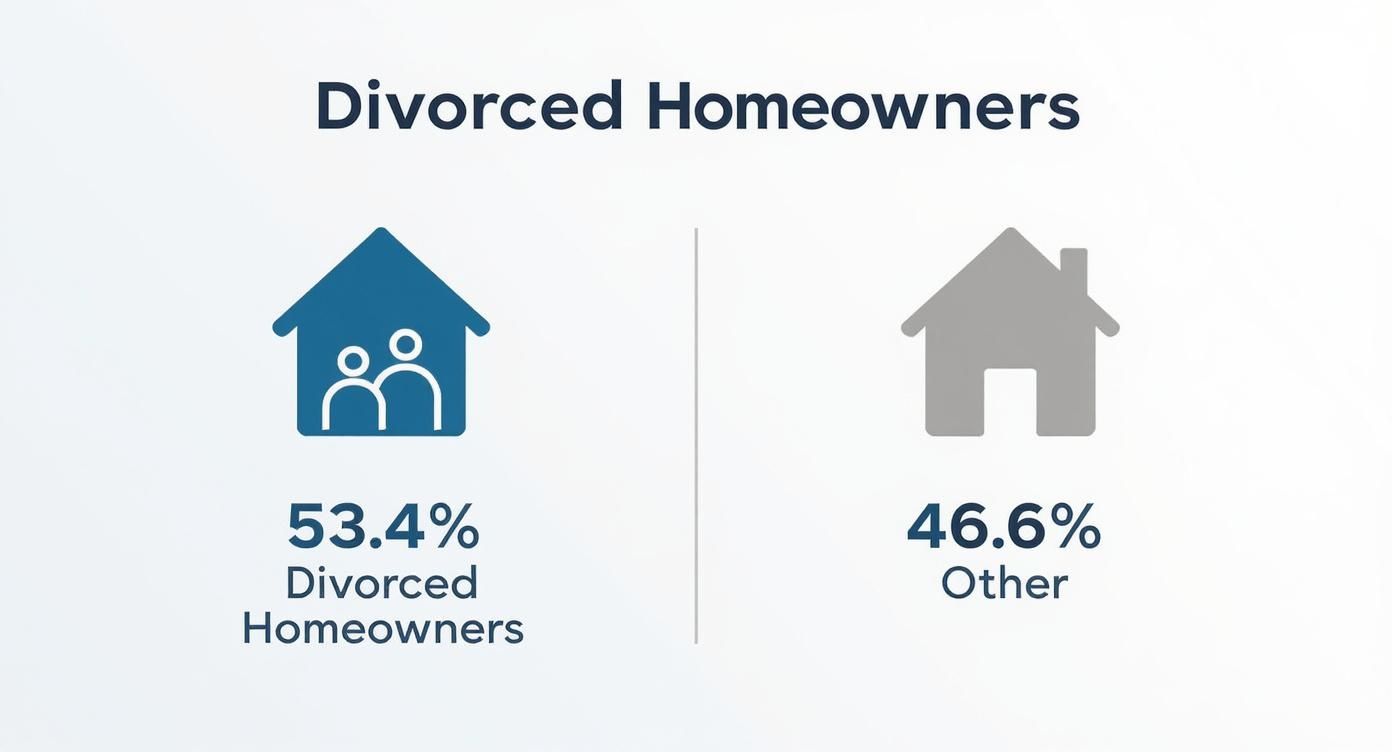
The numbers make it clear: a majority of divorcing couples need a smart, workable solution for their shared home and mortgage.
Cost Comparison: Assumption vs. Refinancing
Let's examine what these numbers mean for your finances. An assumption allows you to keep a great rate locked in years ago, while refinancing forces you into the current market.
This table illustrates a typical scenario, and the difference is staggering.
| Metric | Mortgage Assumption (Example 3.5% Rate) | Refinancing (Example 6.75% Rate) |
|---|---|---|
| Loan Amount | $400,000 | $400,000 |
| Interest Rate | 3.5% | 6.75% |
| Monthly Payment | $1,796 | $2,594 |
| Total Interest Paid (over 30 years) | $246,628 | $533,757 |
| Closing Costs | Typically lower (1-2% of loan) | Higher (2-5% of loan) |
The choice is dramatic. Opting for assumption in this example could save a staggering $287,000 in interest and reduce the monthly payment by almost $800. This kind of financial stability is a powerful foundation for your post-divorce life. A critical first step is understanding your home's value, which you can learn about in our guide on how a home appraisal for divorce works.
Federal Protections That Make Assumption Possible
A common fear is that transferring the house title will trigger the "due-on-sale" clause, allowing the lender to demand the full loan balance. Thankfully, a key federal law prevents this.
The Garn-St. Germain Depository Institutions Act of 1982 is a crucial protection. This federal law explicitly prohibits lenders from triggering a due-on-sale clause when a property title is transferred between spouses due to a divorce decree.
This law provides the legal foundation to pursue a mortgage assumption after divorce, provided the remaining spouse can qualify for the loan. If a trial court judge overlooked these protections and ordered a needlessly expensive refinance, it could very well be a reversible error—exactly the kind of issue our appellate attorneys are here to challenge.
Getting Your Lender to Approve the Mortgage Assumption

The biggest practical hurdle in a mortgage assumption after divorce is securing the lender's approval. Many clients mistakenly believe a judge's order forces the bank to comply. This is not the case.
Lenders are not parties to your divorce and are not bound by the decree. Their sole focus is managing risk. To them, removing one borrower significantly increases their risk. The remaining spouse must essentially re-apply for the loan and prove they can handle the payments alone. This is a full underwriting process, and preparation is essential to avoid delays that leave both parties in financial limbo.
What the Lender Is Really Looking For
When you apply for an assumption, the bank’s underwriters will scrutinize your finances. They must be confident you can manage the mortgage payment without your former spouse's income.
Their decision rests on a few key metrics:
- Consistent Income: Lenders need to see a stable and sufficient income stream. You will need to provide pay stubs, tax returns, and possibly a letter from your employer.
- Solid Credit: Your credit score and payment history are critical. The bank will review your full credit report for any red flags, such as late payments or high debt levels.
- Debt-to-Income (DTI) Ratio: This is perhaps the most important factor. It is wise to calculate your debt-to-income ratio beforehand to know where you stand. A lower DTI indicates financial stability and makes you a more appealing borrower.
If you fall short in any of these areas, the lender will likely deny the assumption, complicating the property division outlined in your decree.
Putting Together a Bulletproof Application
You can significantly speed up the process by submitting a complete, well-organized application package. This makes the lender's job easier and reflects positively on you.
In our experience, the primary cause of delays is an incomplete application. Each time the lender requests another document, your file goes to the bottom of the stack. A comprehensive package demonstrates professionalism and diligence.
Prepare these documents before contacting the bank:
- The Final Divorce Decree: A certified copy is required. Ensure the section ordering the assumption and awarding you the house is clearly marked.
- Income Verification: Have at least 30 days of recent pay stubs and your last two years of W-2s or tax returns ready.
- Proof of Assets: Provide bank statements for the last two to three months for all checking and savings accounts to show you have cash reserves.
- Personal Identification: A clear copy of your driver's license or another government-issued photo ID is necessary.
Treating this as a formal loan application is crucial. If a lender unjustly denies your request despite your qualifications, the problem may stem from a poorly drafted divorce decree. If the court's order was ambiguous or unworkable, you may have grounds for an appeal to clarify the language and secure a fair outcome.
Using Legal Documents to Protect Yourself

A successful mortgage assumption after divorce requires more than just the lender's approval; it must be supported by precise legal documents. Even if you believe your case was resolved fairly, without the proper paperwork, you could remain financially entangled with your ex-spouse for years. Strategic legal foresight is your best defense.
Many people mistakenly believe a quitclaim deed is sufficient to transfer a house. It is not. To truly achieve a clean break, you need specific legal instruments that transfer both property ownership and, critically, liability for the mortgage debt. These documents work in concert with your divorce decree to ensure a final and complete separation.
Key Documents for a Clean Transfer
To finalize a mortgage assumption and protect the departing spouse, two documents are absolutely essential. Each serves a distinct and vital role.
- Special Warranty Deed: This document officially transfers the property title from both spouses to the one keeping the home. It offers more protection than a quitclaim deed by guaranteeing the title was free from issues during your joint ownership.
- Deed of Trust to Secure Assumption: This is your safety net. It creates a lien on the property, formally linking the assumption obligation to the home itself. This gives the departing spouse a powerful legal tool to force a sale if their ex-spouse fails to complete the assumption as ordered.
Without these properly drafted and recorded documents, the departing spouse remains in a precarious situation. Their name could still be on the title, or they may have no legal recourse if the mortgage payments stop. For any such agreement to be enforceable, it must satisfy the fundamental elements of a contract.
The Power Is in Your Divorce Decree
While deeds transfer property, your final divorce decree is the legal engine that drives the entire process. Vague or sloppy language in a decree creates loopholes that can leave one party financially liable for decades. This is one of the most common—and devastating—reversible errors a court can make.
A well-drafted decree must be relentlessly specific, like a clear set of instructions, leaving no room for misinterpretation.
A judge’s order is only as strong as its language. In property division, ambiguity is the enemy of justice. An appellate court can review a decree that fails to set forth clear, enforceable terms, as this may be considered an abuse of discretion by the trial judge.
To fully protect yourself in a mortgage assumption after divorce, your decree must explicitly command the following:
- Mandate the Assumption: It must use strong, directive language, such as stating one spouse "is ordered to assume the mortgage" and "shall secure a full release of liability" for the other.
- Set a Firm Deadline: The decree must include a specific deadline for completing the assumption, typically 90 to 180 days after the divorce is final.
- Outline the Consequences: It must clearly define what happens if the deadline is missed. This often includes a "contingency clause" that automatically triggers a forced sale of the house, ensuring the mortgage is paid off and both parties are freed from the debt.
If your property division order from the trial court lacks these critical details, it may be a reversible error. An experienced appellate attorney can analyze your decree to determine if the court's failure to include this protective language constitutes an abuse of discretion under Texas law. Learn more about the importance of specific language in our guide to the Texas final divorce decree. Your financial future depends on ensuring every legal document is precise and enforceable.
What Happens If Your Ex Fails to Comply?
The judge signed the decree, and you believed the matter was settled. Your ex-spouse was ordered to take over the mortgage, but months have passed with no action. Suddenly, the court order feels hollow, and your credit remains tied to a house you no longer own. This is not just frustrating; it's a serious financial risk. But you are not without recourse. The Texas Family Code provides powerful tools for holding a non-compliant ex-spouse accountable.
Forcing the Issue in Court
When your ex-spouse ignores a court order, you can take action. The typical first step is to file an enforcement action in the same court that issued your divorce decree. This formal legal motion informs the judge that their order is not being followed and that you require assistance.
An enforcement action can proceed in several ways:
- Motion to Compel: This directly asks the judge to issue a new, unequivocal order demanding your ex-spouse begin the mortgage assumption process immediately.
- Contempt of Court: If the judge finds your ex-spouse is willfully disobeying the decree, they can be held in contempt. This can result in fines or even jail time until compliance is achieved.
- Clarification Orders: If the original decree was ambiguous, you can ask the court to clarify the terms, deadlines, and consequences, making the order stronger and easier to enforce.
This highlights the importance of a meticulously drafted divorce decree. A judge can only enforce what is clearly written.
What If the Court Order Itself Is the Problem?
Sometimes, the issue isn't your ex-spouse's non-compliance but a flawed property division order from the trial court. Perhaps the order was unworkable from the start, leaving you financially exposed.
For example, maybe the judge failed to set a firm deadline for the mortgage assumption after divorce. Or perhaps they omitted a backup plan, such as forcing a sale if the assumption fails. These are not minor oversights; they are significant legal flaws with devastating consequences. This is where appellate law becomes crucial. If you believe the trial court made a significant error, you may have grounds for an appeal.
A common reversible error is a trial court order that is impossible to perform or fails to protect a spouse's financial well-being. This is often termed an "abuse of discretion"—a legal standard meaning the judge's decision was unreasonable, arbitrary, or contrary to established legal principles.
An appeal is not a second trial. It is a thorough review of the court record by appellate attorneys searching for such errors. We then construct a powerful legal argument—a "brief"—to demonstrate to the higher court how the trial judge's mistake led to an unjust outcome that must be corrected. You can find a complete breakdown of this process in our article on how a divorce loan assumption works in Texas.
Getting this right matters. Divorce is a major driver in the U.S. housing market, creating over 1.4 million new households annually and influencing nearly 35% of existing home sales. Countless people rely on processes like mortgage assumption to work correctly. Whether you need to enforce a valid order or appeal a flawed one, the goal remains the same: to achieve the clean financial break you were promised.
Untangling the Mortgage: Common Questions After a Divorce
The divorce decree is signed, but that doesn't automatically sever the biggest financial tie you have with your ex-spouse: the mortgage. Getting one person's name off the loan is a critical step, but it's rarely straightforward.
It's natural to have a lot of questions. Based on my experience helping clients navigate this, here are the answers to the most pressing concerns that come up time and time again.
Can a Lender Actually Say No to a Mortgage Assumption?
Yes, they absolutely can, and you need to be prepared for this. This is probably the biggest misconception people have. While a federal law—the Garn-St. Germain Act—stops a lender from calling the entire loan due just because you transferred the house title in a divorce, it does not force them to let your ex take over the loan.
Think about it from the bank's perspective. They approved the original loan based on two incomes and two credit histories. Now, you're asking them to put that same risk on just one person.
The spouse keeping the house has to qualify all over again, on their own. They'll go through the lender's full underwriting process, which scrutinizes:
- Credit Score: Do they meet the lender's current minimum score requirements?
- Stable Income: They’ll need to prove they have enough consistent income with pay stubs, tax returns, and other financial documents.
- Debt-to-Income (DTI) Ratio: The lender will look at how much of their income is already going toward other debts (car loans, credit cards, etc.).
If the spouse who wants the house can't meet these standards alone, the lender will deny the assumption. This is precisely why a well-drafted divorce decree includes a backup plan, like a clause forcing the sale of the house if an assumption or refinance fails.
What If My Ex Misses a Payment Before the Assumption Goes Through?
This is a nightmare scenario, and unfortunately, a common one. Until your name is officially removed from that mortgage note, you are still 100% legally on the hook for the entire debt.
Your divorce decree is a court order between you and your ex; it is not a contract with the bank. The original mortgage you both signed is what matters to the lender, and they will hold both of you responsible for any missed payments.
If your ex-spouse is late on the mortgage, the lender will report that delinquency on both of your credit reports. This can tank your credit score for years, making it incredibly difficult to qualify for a new loan or even get approved to rent an apartment.
If this happens, you have to move fast. You might need to file an enforcement motion with the court to force your ex to follow the decree. But if the original order was poorly written—lacking clear deadlines or consequences—you could be looking at a reversible error. That’s a serious legal issue where you may need an appellate attorney to step in and fix the flawed order.
How Long Does This Whole Assumption Process Take?
Patience is key here. A realistic timeframe is anywhere from 30 to 90 days, but I've seen it drag on for much longer. The timeline really depends on the lender, how busy they are, and how organized you and your ex are with the paperwork.
The biggest delays almost always come from incomplete applications. Every single time the lender has to ask for a missing pay stub or a bank statement, your file gets kicked to the back of the queue.
The best way to light a fire under the process is to have a firm deadline written directly into your divorce decree. A specific date creates urgency and gives you legal grounds to take action if your ex is dragging their feet. My best advice? Start the application the day the judge signs your decree. The sooner you start, the sooner you can finally cut that last major financial cord.
If you believe the court made a mistake in your family law case, our appellate attorneys can help you seek a fair outcome. Contact The Law Office of Bryan Fagan today for a free consultation.