You may feel your case was handled unfairly, and now a Texas judge has signed the final decree of divorce. This is more than just a piece of paper—it's the official court order that legally dissolves your marriage and sets the rules for your new reality. It dictates how assets are split, when you see your children, and what financial obligations you have for years to come.
If you are looking at your decree and feel a profound sense of injustice—perhaps the property division is wildly imbalanced, or the custody plan does not serve your children's best interests—you are not powerless. The first step is to understand that the Texas appellate process exists to correct legal errors and restore fairness. An experienced appellate attorney can analyze your decree to determine if a legal mistake gives you grounds to fight for a just outcome.
What Your Final Decree of Divorce Controls
The final decree is the blueprint for your post-divorce life, and its terms are mandatory. It covers critical areas where judicial errors can have lasting consequences:
- Property Division: A detailed inventory of community property and debts, spelling out exactly who gets what. A mischaracterization of property or an unjust division can be grounds for appeal.
- Child Custody (Conservatorship): Defines the specific rights and responsibilities each parent holds.
- Possession and Access: The court-ordered parenting schedule that dictates when the children are with each parent.
- Child Support and Spousal Maintenance: The precise dollar amounts, payment dates, and duration for all financial support orders.
Before you can challenge the outcome, you must understand what is inside the https://familylawcourtappeals.com/texas-final-divorce-decree/. It is within the specific sections of this document that an appellate attorney will search for reversible errors—the kind of legal mistakes that can be overturned on appeal.
Understanding the Strict Deadlines to Appeal
The moment a judge signs your Final Decree of Divorce in Texas, a clock starts ticking. The timelines set by the Texas Rules of Appellate Procedure are strict and unforgiving. If you believe the outcome was unjust, you must act quickly. Your feelings about the judgment will not change it; only taking the correct legal steps within these deadlines can preserve your right to seek justice.
This immediate post-judgment period is controlled by a crucial legal concept called plenary power. For 30 days after signing the final decree, the trial court judge retains the authority to change, correct, or even vacate the judgment. This is your first—and often best—opportunity to have a mistake corrected.
The Strategic Importance of Post-Judgment Motions
Filing a post-judgment motion is a strategic necessity. It formally asks the trial court to reconsider its decision, but just as importantly, it extends the deadlines for filing an appeal. If you let that 30-day window close without taking action, the court loses its plenary power, and the judgment becomes infinitely harder to challenge.
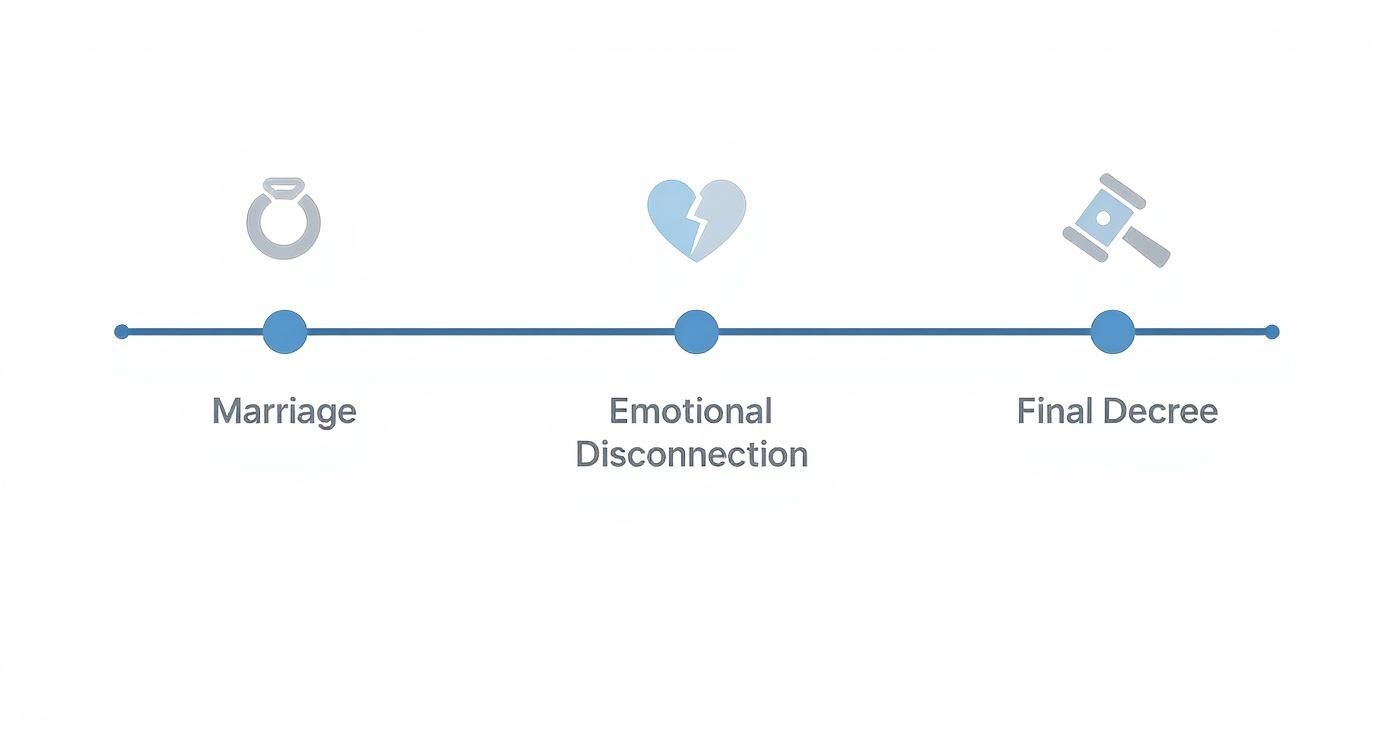
This journey from marriage to the final legal order is the reason immediate action is so vital. You've come too far to let a critical error stand unchallenged.
Two of the most common and effective post-judgment motions are the Motion for New Trial and the Motion to Modify the Judgment.
- Motion for New Trial: You have 30 days from the date the decree was signed to file this motion. It asks the court to set aside the original judgment and start over with a new trial due to a significant legal error or injustice that prevented a fair outcome.
- Motion to Modify, Correct, or Reform the Judgment: This also has a 30-day deadline. It is used to ask the judge to fix specific, clear mistakes in the decree—such as a clerical error in a property description or a miscalculation in child support—without requiring a new trial.
Filing one of these motions on time is a game-changer. It extends the court's plenary power up to 75 days (or longer in some cases), giving the judge more time to rule on your request. Crucially, it also extends your deadline to file a Notice of Appeal from 30 days to 90 days from the judgment date.
Key Appellate Deadlines in Texas Family Law
These timelines are absolute. Missing one can extinguish your right to an appeal before you even begin. This table summarizes the critical deadlines you must know.
| Action | Deadline | Purpose and Legal Effect |
|---|---|---|
| Motion for New Trial | Within 30 days of judgment | Asks the court to vacate the judgment and grant a new trial due to significant error. |
| Motion to Modify/Correct | Within 30 days of judgment | Requests specific changes to fix clear errors in the decree without a full retrial. |
| Court's Plenary Power (No Motion) | Expires 30 days after judgment | The court loses all authority to change its judgment. The order is final. |
| Court's Plenary Power (With Motion) | Extends up to 75 days after judgment | The court has more time to consider and rule on your motion. |
| Notice of Appeal (No Motion) | Within 30 days of judgment | Your absolute deadline to initiate an appeal. Missing it is fatal to your case. |
| Notice of Appeal (With Motion) | Within 90 days of judgment | Filing a motion extends this deadline, giving you and your attorney vital time to prepare. |
Understanding and adhering to these dates is the foundation of any potential appeal. An experienced appellate attorney ensures every procedural step is handled perfectly to protect your opportunity to fix an unjust result. If you're questioning the fairness of your divorce decree, it's time to learn how to appeal a family court decision. Don't let this critical window of opportunity close.
What You Can Appeal: Finding Reversible Error
Receiving a final divorce decree that feels fundamentally unfair can be disheartening. However, it is crucial to understand that an appeal is not a second chance to re-argue your case or present new evidence. An appeal is a highly specific legal challenge aimed at correcting a significant legal mistake made by the trial court judge. To succeed, you must demonstrate a reversible error.
What is a reversible error?
A reversible error is a legal mistake so substantial that it likely caused the judge to issue an improper judgment. This is not a minor procedural slip-up or a ruling you simply disagree with. It must be a major error that harmed your case and led to an unjust outcome in your final decree.

Understanding the Standard of Review: Abuse of Discretion
In Texas family law, most appeals hinge on a key legal standard: abuse of discretion. This term doesn't mean the judge acted with ill intent.
What is abuse of discretion?
It means the judge made a decision that was unreasonable, arbitrary, or made without reference to guiding legal rules and principles. An abuse of discretion occurs when a judge acts without a sound legal basis for their decision.
The appellate court does not ask, "Would we have made the same decision?" Instead, it asks, "Was the trial judge's decision so far outside the bounds of the law that it must be reversed?"
Examples of Common Reversible Errors in Texas Divorce Decrees
While every case is unique, certain types of judicial mistakes frequently form the basis for an appeal. Identifying them requires an appellate attorney to meticulously review the entire trial record, including hearing transcripts, evidence, and court filings.
Here are examples of common reversible errors:
- Mischaracterizing Property: The judge incorrectly classifies separate property (e.g., an inheritance) as community property and divides it between the spouses.
- Unjust Property Division: The court divides the community estate in a grossly disproportionate manner, such as an 80/20 split, without providing legally valid reasons in the record to justify it.
- Violating the Texas Family Code: A judge issues a custody or support order that ignores a mandatory provision of the Texas Family Code.
- Improperly Excluding Evidence: The court wrongfully prevents you from presenting essential evidence—such as financial records proving hidden assets—that was necessary to prove your case.
Not every judicial mistake is appealable. The law recognizes harmless error, which is a mistake that, while technically incorrect, did not affect the case's final outcome. To win an appeal, your attorney must prove the error was reversible—meaning it probably caused the court to render an improper judgment. Proving this causal link is fundamental to establishing the grounds for appeal in family court.
How an Appeal Differs From Your Divorce Trial
https://www.youtube.com/embed/S87WIPVjG3c
Many people believe an appeal is a chance for a do-over—a second opportunity to tell their story. This is a critical misunderstanding. An appeal is not a new trial. You cannot call new witnesses or introduce new evidence.
Instead, an appeal is a focused, technical review of what already happened in the trial court. Appellate judges act as auditors, not a new jury. Their sole function is to examine the existing case file and transcripts to determine if the trial judge made a serious legal mistake that affected the outcome of your case.
The Trial Record is All That Matters
In your original trial, the goal was to present evidence to convince the judge of the facts. On appeal, those facts are considered established. The only thing the appellate court is permitted to review is the official record from the trial court.
The record consists of two parts:
- The Clerk’s Record: This contains every document filed in your case, including petitions, motions, orders, and the final decree of divorce.
- The Reporter’s Record: This is the official, word-for-word transcript of everything said during your trial and hearings, captured by technologies like real-time court reporting.
If a mistake is not documented in the record, for appellate purposes, it did not happen.
No New Evidence. No New Witnesses.
This is a fundamental rule of appellate procedure. You cannot introduce new information to the appellate court, no matter how significant. The appellate court's question is not "Did the judge reach the best outcome?" but rather, "Did the judge reach the outcome legally based on the evidence and arguments presented at the time?" The entire focus shifts from the facts of your life to the application of the law.
The Standard of Review Limits the Appellate Court
As discussed, appellate courts are bound by the standard of review. In most family law matters, that standard is abuse of discretion. This high standard requires the appellate court to give significant deference to the trial judge's decisions. The court cannot simply substitute its own judgment. It can only reverse a decision if it finds the trial judge acted arbitrarily, unreasonably, or without reference to guiding legal rules.
From Courtroom Testimony to Written Legal Briefing
A trial often involves emotional testimony and arguments in a courtroom. An appeal, in contrast, is primarily a battle of legal writing. The most important tool is the appellate brief.
What is appellate briefing?
Briefing is the process of writing a formal, meticulously researched legal argument. The appellate brief must:
- Identify the specific legal errors the trial court made.
- Support every argument with citations to statutes and prior court decisions (precedent).
- Prove the error occurred by referencing the exact page and line in the trial record.
The case is almost always won or lost on the strength of the written briefs. While a contested divorce in Texas can be costly, averaging between $15,000 and $30,000 as noted in analysis of the costs and nuances of Texas divorce on lishmanlaw.com, the appellate process exists as a crucial check to ensure that the final result is legally sound. When a final decree of divorce in Texas is tainted by legal error, the path to a fair outcome is through a well-executed appeal.
Mistakes That Can Prevent a Successful Appeal

The groundwork for a successful appeal is laid long before the judge signs the final decree. The appellate court only reviews specific, documented legal errors made during the trial. Critical missteps at the trial level can permanently close the door on your right to seek justice on appeal.
The most important concept is preservation of error. In plain English, you cannot complain on appeal about a mistake the trial judge made unless your attorney properly objected to it at the exact moment it happened. If there’s no objection in the court record, the appellate court will almost always consider the issue waived.
This rule exists to give the trial judge a fair chance to correct their own mistakes in real-time. Without preserved errors, even the most flawed final decree of divorce in Texas may be impossible to challenge.
Failing to Get a Clear Ruling on the Record
Making an objection is only the first step. To preserve an error for appeal, your attorney must also push the judge to make a clear "sustained" or "overruled" ruling on the record. If the judge is non-committal, the error may not be preserved. A skilled trial attorney knows they must press for a decision to protect your appellate rights.
Accepting the Benefits of the Judgment
You generally cannot appeal a judgment after you have voluntarily accepted its benefits. For example, if you cash a large property settlement check awarded in the decree, a court may rule that you have waived your right to complain about other parts of that same decree. This legal principle, known as the "acceptance of benefits doctrine," can prevent an appeal before it even starts.
Common but Costly Errors to Avoid
The path to preserving your appellate rights is lined with procedural requirements. Missing just one can be fatal to your case. Here are frequent mistakes that can forfeit your right to appeal:
- Not Making Timely Objections: As stated, if your attorney fails to object to improper evidence or testimony when it is presented, the error is waived.
- Failing to Make an "Offer of Proof": If the judge wrongly excludes a key piece of your evidence, your attorney must formally state for the record what that evidence would have been and why it was important. This is called an offer of proof and is required to preserve the error.
- Signing a Binding Mediated Settlement Agreement (MSA): Once you sign an MSA in Texas, it is extremely difficult to challenge. You generally cannot appeal the terms of a final decree of divorce in Texas that is based on an MSA you signed voluntarily, except in rare cases of fraud or coercion.
An appeal is a specific legal remedy that is only available when your rights were carefully protected throughout the trial process.
How to Determine if You Have Grounds for an Appeal
If you suspect the judge made a serious legal misstep in your divorce case, it's time to seek a strategic evaluation of your options. An appellate case review is a forensic investigation into the trial court record to search for reversible error. The process sets aside emotion and focuses squarely on the law and procedure.
Gathering the Necessary Documents
To conduct a proper review, an appellate attorney needs the complete case file from your trial. The evidence for a successful appeal is found within these documents:
- The Final Decree of Divorce: The court's final order containing the specific rulings you wish to challenge.
- The Reporter’s Record: The official, word-for-word transcript of all trial and hearing proceedings.
- The Clerk’s Record: The complete collection of every document filed in your case, including motions, pleadings, and evidence exhibits.
- All Post-Judgment Motions: Any Motion for New Trial or Motion to Modify the Judgment is critical for analyzing deadlines and preserved issues.
The Search for Reversible Error
With the complete record, an appellate attorney analyzes every phase of the proceedings. They are looking for specific legal mistakes that were significant enough to have caused an improper judgment. A crucial part of this review is verifying that your trial lawyer properly preserved these errors by making the right objections at the right time.
Our guiding principle is that everyone is entitled to a fair process and a result that follows the law. An appellate review is the first step toward seeking the just outcome you deserve.
If you believe the court made a mistake in your family law case, our appellate attorneys can help you seek a fair outcome. Contact The Law Office of Bryan Fagan today for a free consultation.
Your Top Questions About Texas Divorce Appeals Answered
When your divorce case ends with an unjust ruling, you are naturally faced with a new set of questions. Here are answers to some of the most common concerns for those considering an appeal.
I Signed an Agreement in Mediation. Can I Still Appeal?
This is a very difficult situation. Texas law strongly favors the enforcement of Mediated Settlement Agreements (MSAs). Challenging an MSA is an uphill battle, but it is not impossible in rare situations. You would typically need to prove that you were a victim of fraud, were illegally coerced into signing, or that the agreement itself is illegal. An appellate lawyer can review the specific circumstances of your mediation to determine if a viable path forward exists.
What’s the Realistic Timeline for a Divorce Appeal?
The appellate process is a marathon, not a sprint. From filing the notice of appeal to receiving a final opinion from the appellate court, the timeline is typically nine months to two years. The process involves multiple steps with their own deadlines, including preparation of the record, legal briefing by both sides, and the court’s own deliberation schedule.
Do I Still Have to Follow the Judge's Orders While the Appeal is Happening?
Yes, absolutely. A Final Decree of Divorce is a valid and enforceable court order, even while it is being appealed. You must continue to comply with every provision, including custody schedules and support payments. In limited circumstances, you can ask the court to temporarily pause ("supersede") enforcement of property division orders, but this usually requires posting a significant financial bond. Orders related to child custody and support are almost never suspended.
If you're questioning the fairness of your final decree, don't wait. Understanding your options is the first step. The appellate attorneys at The Law Office of Bryan Fagan, PLLC can review your case and explain your rights. Contact us today for a free consultation on your Texas family law appeal.