Skip to content
You may feel your case was handled unfairly. When you walk out of a family law courtroom believing the judge made a serious mistake, it’s easy to feel powerless. But you are not out of options. In Texas, you have the right to challenge that outcome. The most common grounds for an appeal in family court are built on identifying a significant legal error—a mistake so critical that it likely led to an unjust result.
An appeal isn’t a second trial or a simple do-over. It is a focused, strategic review by a higher court designed to correct a wrongful outcome and restore fairness under the law.
Your Path to Justice After an Unfair Ruling

The sense of injustice that follows an unfair ruling is profound, especially when your children and financial future are at stake. The Texas legal system provides a specific remedy for this situation. Filing an appeal is your formal request for a higher court to examine the trial judge’s decision for a critical mistake—what lawyers call a reversible error—that tainted the final judgment.
You cannot appeal a case just because you are unhappy with the result. You and your attorney must identify a specific, recognized legal error that very likely caused the improper outcome. Our goal is to help you move from feeling uncertain to feeling empowered by explaining how the appellate process is built to restore fairness when the system gets it wrong.
How Appeals Differ from Trials
It’s critical to understand that an appeal is entirely different from a trial. The appellate court will not hear new testimony from witnesses or consider new evidence. Its sole function is to meticulously review the existing record from your trial—every transcript, every exhibit, and every motion—to search for legal mistakes. This entire process is strictly governed by the Texas Rules of Appellate Procedure and the Texas Family Code.
An appeal is about legal correctness, not a second chance to tell your story. The focus shifts from arguing facts to arguing the law.
The mission is to prove that the trial judge’s mistake was so substantial that it probably caused the court to issue the wrong judgment. Finding and arguing these errors requires a unique skillset that relies on deep legal research, persuasive writing, and a thorough command of appellate standards of review. If you are considering this path, having a skilled Texas family law appeal attorney evaluate your case is the essential first step toward a just resolution.
What You Can Appeal in a Texas Family Law Case
https://www.youtube.com/embed/K16K2zvl8xk
Losing a case is difficult, but it’s important to know that you can’t appeal a decision just because you disagree with it. An appeal isn’t a simple do-over. Instead, we must pinpoint a specific, critical mistake made by the trial judge—what the legal system calls a “reversible error.”
A reversible error is a legal misstep so serious that it almost certainly led to the wrong outcome in your divorce or custody battle. In other words, if that one error had not occurred, the final judgment would likely have been very different.
Think of it like a referee in a football game. A missed minor penalty that doesn’t affect the game’s outcome isn’t enough to overturn the final score. But if the referee makes a terrible call that incorrectly awards the game-winning touchdown, that’s a game-changer. That’s the kind of substantial mistake an appellate court is looking for. This is often called a “harmful error.” Our job on appeal is to prove to a panel of higher court judges that the mistake wasn’t just a minor slip-up but the direct cause of an unjust result.
What Qualifies as a Reversible Error?
So, what does a reversible error look like in a Texas family law case? These aren’t just disagreements with the judge’s opinion; they are specific failures rooted in law and procedure.
Common examples of reversible errors include:
- Misapplication of the Law: The judge understood the facts but applied the wrong legal rule to decide something critical, like how your property was divided or the final child support amount.
- Abuse of Discretion: This happens when a judge’s decision is so arbitrary or unreasonable that it falls outside any acceptable legal boundary. We often see this in contentious child custody rulings.
- Improper Admission or Exclusion of Evidence: The judge might have allowed the other side to present evidence that should have been excluded or, just as damaging, refused to consider crucial evidence that supported your case.
Spotting these errors requires a deep dive into the trial record—the official transcript of everything said and every document submitted in court. This process is complex, and while tools like an AI legal research assistant can help sort through case law, they are no substitute for an experienced appellate attorney’s analysis.
The core question the appellate court will ask is: Did this error harm the person’s case? If the answer is yes, you have a solid foundation for an appeal.
Common Errors in Divorce and Custody Cases
More often than not, the strongest ground for a family law appeal is that the trial judge misinterpreted or misapplied the law. An appeal has a strong chance of success if we can show that the judge’s legal mistake directly skewed the outcome on major issues like who gets custody of the children or how assets are divided.
In fact, claims of legal error are a factor in a huge percentage of successful appeals. You can discover more about how legal errors form the basis for an appeal and see real-world examples. Proving a reversible error is the heart of any appeal. It’s a meticulous, demanding job that leaves the emotion of the trial behind and focuses squarely on the letter of the law. A skilled appellate lawyer can analyze your case file to determine if a genuine error exists and then build the persuasive legal argument needed to correct it.
Common Grounds for a Texas Family Law Appeal

If you believe the final order in your case was fundamentally wrong, you’re likely wondering what comes next. A successful appeal hinges on proving the trial court made a specific, significant legal mistake. These mistakes are called grounds for appeal in family court, and they are the foundation of any appellate case.
Think of them as legally recognized flaws that corrupted the trial process and led to an unjust result. While every family law case is unique, most successful appeals in Texas trace back to one of several key types of reversible error. Let’s break down the most common grounds you will encounter.
Abuse of Discretion: The Unreasonable Ruling
One of the most common arguments in a family law appeal is abuse of discretion. This is a legal term for when a judge’s decision is so arbitrary, unreasonable, or disconnected from the facts that it simply cannot be justified under the law.
The key here isn’t whether the appellate judges would have made the same decision. The real question is whether the trial judge’s decision was defensible at all. Imagine a judge making a ruling without any guiding legal rules or principles to back it up. Simply put, the decision lacks a logical or factual basis.
Here’s what an abuse of discretion can look like in practice:
- Ignoring Crucial Evidence: In a custody case, a judge sees documented, credible evidence of a parent’s ongoing substance abuse but awards that parent primary custody anyway, with no explanation for why the evidence was ignored.
- An Unjust Property Division: When dividing assets, a judge awards 90% of the marital estate to one spouse without any evidence of fault or other legal justification for such an extremely lopsided split.
- Unfairly Restricting Visitation: A judge limits a fit parent’s time with their child to just a few supervised hours per month, even when there is no evidence of abuse, neglect, or any danger to the child.
Proving this kind of error means combing through the trial record to show that the final judgment was not based on sound reasoning.
Misapplication of the Law: Getting the Rules Wrong
Another powerful basis for an appeal is a misapplication of the law. This happens when the judge understands the facts of the case perfectly but applies the wrong legal rule or statute to those facts. This is a pure legal error, and it creates a strong foundation for an appeal because it shows the entire decision was built on a faulty premise.
For instance, Texas law has clear rules about what counts as separate versus community property. If a judge incorrectly labels an inheritance you received (which is almost always separate property) as community property and divides it with your ex-spouse, that’s a clear misapplication of the Texas Family Code. Likewise, in a child support hearing, a judge might use the wrong percentage to calculate the monthly payment. These are not judgment calls; they are black-and-white mistakes about what the law says.
Legally or Factually Insufficient Evidence: A Verdict with No Support
Every decision a judge makes must be supported by evidence presented in court. When a ruling is issued with little or no factual support in the record, it can be overturned for having legally or factually insufficient evidence.
This error typically shows up in two ways:
- No Evidence (Legally Insufficient): This is an argument that there is a complete lack of evidence to support a critical finding. For example, a judge issues a protective order based on a finding of family violence, but no witness or document presented at trial ever mentioned violence.
- Against the Great Weight of the Evidence (Factually Insufficient): In this scenario, there might be a tiny shred of evidence supporting the judge’s decision, but the evidence against it is so overwhelming that the ruling is clearly wrong.
This is especially critical in cases involving claims of parental alienation, where a court’s failure to see a mountain of evidence pointing to manipulation could be a reversible error. You can see more by reviewing our guide on the common examples of parental alienation and how they play out in court.
Harmful Procedural Errors: When the Process Fails
Finally, an appeal can be based on harmful procedural errors. The court system has strict rules of procedure and evidence designed to make every trial fair. When those rules are broken in a way that truly affects the outcome, it can be grounds for a reversal. The mistake has to be significant enough that it actively prevented you from properly presenting your case or defending your rights.
Common examples of harmful procedural errors include:
- Improperly Excluding Key Evidence: Your lawyer tries to admit bank statements that prove your spouse was hiding assets, but the judge wrongly refuses to allow them into evidence.
- Denying Cross-Examination: The judge stops your attorney from questioning a key witness for the other side, leaving their damaging testimony unchallenged.
Identifying these grounds is a job for a lawyer who understands not just the Texas Family Code, but also the Texas Rules of Appellate Procedure. An appellate specialist’s role is to dissect the trial record, pinpoint these critical mistakes, and craft a compelling argument to convince a higher court that the original decision was unjust.
Understanding the Standard of Review
An appellate court doesn’t re-try your case. Instead, the appellate judges act as reviewers, looking back at the decisions made by the trial judge through specific legal lenses called standards of review. This concept is crucial in appellate law because it dictates how much respect—or deference—the higher court must give to the original judge’s rulings. It sets the rules for the appeal.
Knowing which standard applies to which part of your case is the bedrock of building a winning appellate strategy.
The Abuse of Discretion Standard
In Texas family law, most major decisions are reviewed under the abuse of discretion standard. This is the standard for any ruling where the trial judge had to weigh evidence, assess witness credibility, and make a judgment call.
This covers the most important issues in nearly every family law case:
- Child Custody and Visitation: Determining the “best interest of the child” is a classic example of a decision left to the trial judge’s discretion.
- Property Division: There is no magic formula for a “just and right” division of community property; it requires the judge to balance many factors.
- Spousal Maintenance: The amount and duration of alimony are also judgment calls.
Under this standard, an appellate court cannot reverse the decision just because the judges might have ruled differently. To win, we must show that the trial judge’s decision was so arbitrary or unreasonable that it falls outside the zone of reasonable disagreement.
The De Novo Standard of Review
On the other end of the spectrum is de novo review. “De novo” is Latin for “from the new.” It means the appellate court looks at the issue with a completely fresh set of eyes, giving zero deference to the trial court’s conclusion.
This standard applies to pure questions of law. For instance, did the trial judge misread a statute in the Texas Family Code? Did they apply the wrong legal test to the facts? When that happens, the appellate court reviews the mistake de novo. Our team has argued these points for years and has a deep understanding of how specific courts, like the 14th Court of Appeals in Texas, handle these nuanced legal arguments.
Here’s the bottom line: Abuse of discretion review asks, “Was the trial judge’s decision reasonable?” De novo review asks, “Was the trial judge’s decision legally correct?”
Why the Standard of Review Matters
The standard of review is not just academic—it shapes our entire game plan for your appeal. If we’re challenging an abuse of discretion ruling, our legal brief will focus on the facts in the record, showing how the evidence does not support the judge’s illogical conclusion. If we are arguing under a de novo standard, our brief becomes a deep dive into statutes and case law to prove the judge made a critical legal error. This strategic focus is essential when seeking a fair outcome.
Preserving Errors for a Successful Appeal
You might think an appeal starts after you receive a bad ruling, but the groundwork for a winning appeal is laid much earlier—during the trial itself. You cannot wait until you are in front of the appellate court to point out a mistake. Your trial attorney must identify and object to the error the moment it happens.
This critical step is called preserving the error. In simple terms, it means your lawyer must officially notify the trial judge that they believe a legal mistake is being made. This gives the judge a chance to fix the problem right then. If the judge overrules the objection and lets the error stand, then you have a valid issue to raise on appeal.
Making Your Objection Count
Preserving an error is a strategic process. Keeping track of every document, motion, and piece of evidence is a massive undertaking, which is why having a solid system like cloud document management for lawyers can make a difference when it’s time to build the appellate record.
Key actions that preserve an error for appeal include:
- Making Timely Objections: Your lawyer must speak up immediately when the other side asks an improper question or tries to admit evidence that shouldn’t be allowed.
- Stating Specific Grounds: A generic objection is not enough. The lawyer must state the precise legal reason for the objection, such as “Objection, Your Honor, that’s hearsay.”
- Making an Offer of Proof: If the judge mistakenly excludes your evidence, your lawyer must then make an “offer of proof,” which is a formal summary of what the evidence would have shown. This gets it into the record so the appellate court can see what was lost.
This is where the “standard of review” comes into play, as it dictates how closely the appellate court will scrutinize the trial judge’s decisions on these preserved errors.
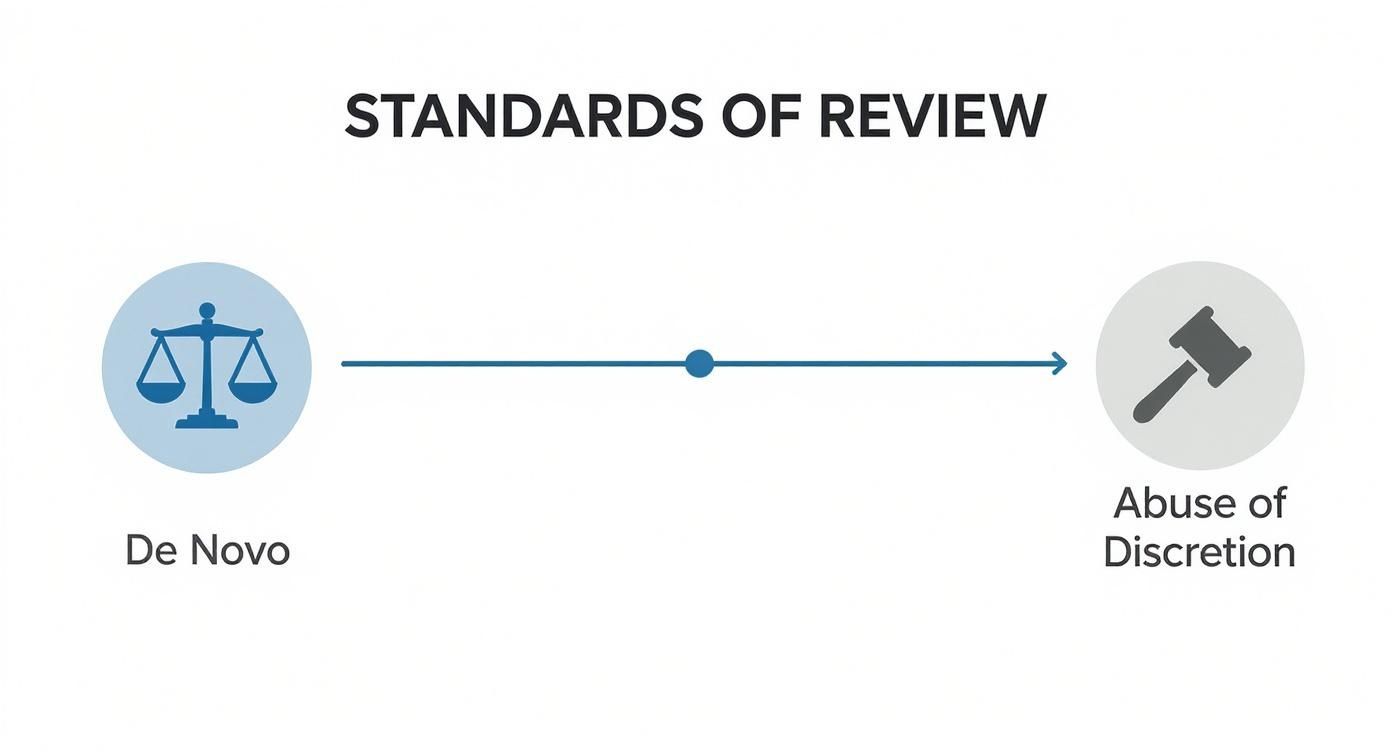
As the diagram shows, a pure legal mistake gets a fresh look from the appellate court (De Novo review), but for a judge’s discretionary calls, the appeals court only intervenes if the decision was completely arbitrary or unreasonable (Abuse of Discretion).
Why Preservation Is Non-Negotiable
If an error was not properly preserved, it is invisible to the appellate court. It doesn’t matter how unfair or damaging the mistake was. The Texas Rules of Appellate Procedure are clear: if your lawyer did not bring it up at trial, you have likely lost your right to complain about it later.
Think of it this way: You can’t complain that the referee missed a foul if your team never challenged the play. The appellate court acts as the replay booth, but it can only review the plays the trial lawyer challenged in real-time.
This is why you need a trial lawyer who is constantly thinking like an appellate lawyer, fighting for you in the moment while simultaneously protecting your right to appeal if things go wrong.
What Happens After a Successful Appeal?
Winning your appeal is a huge victory, but it’s important to understand what it means for your case. An appellate court rarely hands you a brand-new, final order. Think of it less as a finish line and more as hitting a reset button to correct a serious mistake made in the trial court. The remedy you get is tailored specifically to fixing that harmful legal error.
Reverse and Remand: A Second Chance
By far, the most common outcome of a successful family law appeal is a “reverse and remand.” This means you get a second chance to get it right, this time with the correct legal rules.
Here’s how it works:
- Reverse: The court of appeals officially vacates (wipes out) the trial court’s incorrect decision.
- Remand: The case is sent back down to the same trial court for a new hearing or trial on the specific issue that was appealed.
The appellate court provides specific instructions on what the trial court did wrong and how to handle it correctly this time. For example, if the judge mishandled the rules for dividing your property in a divorce, the remand order will instruct the court to re-do the property division using the proper legal standard.
Reverse and Render: A Decisive Victory
A less common but more powerful outcome is a “reverse and render.” When this happens, the appellate court not only overturns the bad decision—it issues the correct judgment itself. The issue is settled then and there, without needing another trial court hearing.
A “reverse and render” is possible only when the appellate court has everything it needs in the existing record to make the correct decision. No new facts or evidence are needed.
For instance, if a trial judge mistakenly classified your separate property inheritance as community property, the court of appeals could reverse that ruling and “render” a new judgment declaring that the inheritance belongs to you alone. This provides immediate finality. A successful appeal is about ensuring the law was applied fairly to you and your family, giving you the just outcome you should have received from the start.
Common Questions About Texas Appeals
The thought of appealing a court’s decision can feel complex. It is a different world with its own rules and language. Let’s walk through some of the most common questions we hear when evaluating potential grounds for an appeal in family court.
How Long Do I Have to File an Appeal in Texas?
This is the most critical question, and the deadlines are strict. In most family law cases, you have only 30 days from the date the judge signs the final order to file a Notice of Appeal. If you miss that deadline, your right to appeal is lost forever.
In some situations, filing a motion for a new trial can extend this window to 90 days. However, you should never count on that extension. The safest course of action is to speak with an appellate lawyer immediately after receiving a decision you believe is wrong.
Can I Introduce New Evidence on Appeal?
No. This is a common misconception. An appeal is not a re-trial; it is a review of what already happened in the trial court. The court of appeals can only look at the official “record” from the trial. This record is a time capsule containing the court reporter’s transcript of everything said and the clerk’s collection of every document filed. The appellate judges are limited to reviewing that material to determine if a legal mistake was made.
What’s the Difference Between an Appellant and an Appellee?
These are the official terms for the two sides in an appeal:
- The appellant is the party who lost at the trial level and is now appealing the decision.
- The appellee is the party who won at trial and is now defending the trial court’s decision.
Are Appeals Expensive?
Appeals are a serious investment because they are complex and time-intensive. The process involves an attorney meticulously reviewing the entire trial record, conducting in-depth legal research, and writing a persuasive legal document called an appellate brief. The costs cover specialized attorney time, court filing fees, and the expense of preparing the official record. When a judge’s error has led to a deeply unfair result in your divorce or child custody case, a successful appeal is a crucial step to protect your family’s future and restore fairness.
If you believe the court made a mistake in your family law case, our appellate attorneys can help you seek a fair outcome. Contact The Law Office of Bryan Fagan today for a free consultation.