If you have received a final court order in your family law case that feels fundamentally wrong or unfair, you are likely wondering what can be done. This concern often leads to a critical question: how much does an appeal cost?
There is no single price tag for seeking justice through the appellate process. The total cost of a Texas family law appeal is a combination of your attorney’s fees, the expense of preparing the official court record, and various court filing fees. The final investment will depend entirely on the unique circumstances of your case.

Understanding the True Cost of a Family Law Appeal
When a judge issues a final order in your divorce or child custody case that seems unjust, you may feel that the court misunderstood the facts, misapplied the law, or made a decision that jeopardizes your family’s future.
The Texas appellate process exists to correct these kinds of mistakes. However, it is a distinct legal journey with its own set of rules, strict timelines, and—importantly—its own costs.
It is crucial to understand that an appeal is not a second trial. You cannot present new evidence or re-question witnesses. Instead, the appellate court conducts a careful review of the existing trial record to determine if a “reversible error” occurred. This is a legal mistake so significant that it likely caused an improper outcome. Understanding the financial components of this process is the first step in deciding whether an appeal is the right path for you.
What Goes Into the Cost of an Appeal?
The final cost of an appeal is not a single line item. It is the sum of several necessary components, each playing a vital role in presenting your case to the higher court.
Here’s a breakdown of what you can expect to pay for:
- Attorney's Fees: This is the largest portion of the cost. It covers the extensive time your appellate attorney will spend on legal research, analyzing the trial record, and writing the persuasive legal arguments required for the appellate briefs.
- Record Preparation Costs: The appellate court cannot review your case without the official record from the trial court. This includes two key parts: the Clerk’s Record (all documents filed in your case) and the Reporter’s Record (the word-for-word transcript of all court proceedings).
- Court Fees and Other Expenses: These are administrative costs, such as the filing fee for your Notice of Appeal. You may also need to post a bond to suspend the trial court's order while the appeal is pending.
Each of these costs can vary significantly. An appeal focused on a simple calculation error will require less attorney time and a smaller record than a complex appeal challenging multiple rulings in a high-asset property division case.
Quick Breakdown of Texas Family Law Appeal Costs
This table summarizes the main expense categories you can expect when appealing a family law decision in Texas.
| Expense Category | What It Covers | Primary Cost Driver |
|---|---|---|
| Attorney's Fees | Research, brief writing, legal analysis, oral argument prep. | The complexity of the legal issues and the length of the record. |
| Court Reporter's Record | The official word-for-word transcript of the trial or hearing. | The number of days the trial lasted and the amount of testimony. |
| Court Clerk's Record | Copies of all documents filed in the trial court (pleadings, motions, orders). | The total volume of documents filed throughout the case. |
| Filing Fees & Bonds | Court fees to initiate the appeal and potential security bonds. | Fixed court fees, but bond amounts vary based on the judgment. |
By breaking down these core expenses, you can begin to demystify the process. Knowing what you are paying for empowers you to make a calm, informed decision about seeking justice at the appellate level.
Breaking Down the Three Main Costs of an Appeal
When you ask, "how much does an appeal cost," there is no simple answer because the total expense is a combination of three distinct cost categories. Once you understand how these components work together, you will have a much clearer picture of the financial side of pursuing an appeal.

The total cost of your appeal is built from attorney’s fees, the cost of preparing the official case record, and various court fees and bonds. The final amount for each will depend on the specifics of your case.
Attorney's Fees: The Engine of Your Appeal
Your attorney's fees will be the most significant part of the total cost. This is because appellate work is fundamentally different from trial work. An appeal is not a do-over; it is an analytical process focused on identifying legal errors and crafting a powerful written argument to persuade a panel of judges that a serious mistake was made.
Your appellate attorney will dedicate significant time to:
- Analyzing the trial record with meticulous care to find a reversible error—a mistake substantial enough that it likely changed the outcome.
- Conducting exhaustive legal research into statutes and case law that support your position.
- Writing the appellate brief, a highly structured legal document that forms the foundation of your appeal. This process is known as briefing.
- Preparing for and delivering oral arguments if the court schedules one, where they must present complex legal points persuasively.
This specialized work is why most appellate lawyers work on a retainer. You can learn more about these fee structures in our guide on the average retainer fee for a lawyer.
Preparing the Appellate Record: The Official Story
Before the court of appeals can review your case, it needs the official record of what happened in the trial court. This collection of documents and testimony is called the appellate record, which consists of two parts:
- The Clerk’s Record: A compilation of every document filed in your case, including pleadings, motions, and the final judgment.
- The Reporter’s Record: The verbatim transcript of everything said during hearings and the trial, prepared by the official court reporter.
The cost of the record is directly tied to the length and complexity of your trial. A one-day trial will produce a much smaller and less expensive record than a multi-week trial with extensive testimony and numerous exhibits.
What this means in plain English: The appellate record contains all the evidence and testimony the appellate judges can review. They are limited to what is in that record and cannot consider any new information.
The Reporter’s Record alone can cost several thousand dollars, depending on the number of days you were in court.
Court Fees and Bonds: The Administrative Tolls
Finally, there are administrative costs required to initiate and maintain your appeal. These are typically the smallest portion of the total expense but are mandatory.
These costs generally include:
- Filing Fees: The Texas Rules of Appellate Procedure require a fee to file your Notice of Appeal, the document that officially begins the process.
- Supersedeas Bond: If you want to prevent the trial court's order from being enforced while the appeal is pending (for example, stopping the sale of a house), you will likely need to post a supersedeas bond. This bond serves as a financial guarantee to the other party in case you lose the appeal.
Getting a handle on these three core components—attorney's fees, record preparation, and court costs—is the first, most important step toward building a realistic budget and deciding if an appeal is the right move for you.
What Drives the Final Cost of Your Appeal?
When you explore your legal options after an unfavorable court ruling, you will often hear that the cost of an appeal "depends." This is the honest truth, because every appeal presents a unique set of circumstances. The final cost is shaped by key variables that determine the amount of work required. Understanding these cost drivers is the first step toward having a realistic conversation with an appellate attorney.
The Complexity of the Legal Issues
The single greatest factor influencing the cost of an appeal is the legal complexity of your case. A simple appeal might focus on one specific, isolated error, such as a clear mathematical mistake in a child support calculation. This is a contained issue that requires a focused legal argument.
A complex appeal, on the other hand, might involve challenging multiple, interconnected errors. For example, you might need to challenge a judge’s decisions on child custody, a geographic restriction, and the division of a complex business all at once. An appeal involving multiple issues requires significantly more legal research, analysis, and briefing. More complex cases mean your attorney must spend more time developing a cohesive and persuasive argument for the appellate court.
The Length of the Original Trial
The next major cost driver is the duration and complexity of your original trial. This directly impacts the cost of preparing the Appellate Record—the official collection of documents and testimony the higher court will review. A longer trial creates a larger record, which costs more to prepare and takes your attorney much longer to master.
Consider the difference:
- A one-day bench trial may result in a Reporter’s Record of approximately 200 pages.
- A five-day jury trial could easily produce a transcript of over 1,000 pages, plus hundreds of exhibits in the Clerk's Record.
The court reporter charges by the page, so a longer trial means a higher transcript cost. More importantly, your appellate attorney must read, analyze, and cite every relevant page of that record. A 1,000-page record requires exponentially more attorney hours than a 200-page one, which is reflected in your legal fees. For more context on how case duration affects costs, you can read our insights on how long it takes to process a divorce in Texas.
An appeal is not a retrial; it's a meticulous review of what already happened. The bigger the record of what happened, the more time and resources it takes to find the critical errors that can win your case.
The Amount of Legal Briefing Required
Finally, the cost is shaped by the amount of briefing your case requires. A "brief" is the formal written argument your attorney submits to the court of appeals. It is a highly technical document that outlines the facts, identifies legal errors, and explains why the trial court’s decision should be reversed.
More complex cases naturally require longer, more detailed briefs. However, the process often involves multiple filings. After your attorney files the initial brief, the other party files a response. Your attorney may then need to file a reply brief to address their arguments. Each of these documents adds to the total workload and cost.
Estimating Appeal Costs with Real-World Scenarios
Understanding the factors that drive appeal costs is helpful, but seeing how they apply in real-world situations can provide a clearer financial picture. Below are a few common scenarios in Texas family law, from the most straightforward to the most complex, to give you a realistic idea of what an appeal might cost.
Please remember that these are only estimates, as every case is unique.
Scenario 1: A Straightforward Appeal
Imagine a divorce decree where the judge made a clear mathematical error in calculating retroactive child support. The hearing was brief—perhaps half a day—and the evidence for this single issue is contained in just a few documents. This is a straightforward appeal.
- Key Legal Issue: A single, demonstrable error, like a miscalculation or a clear misapplication of a statutory formula.
- Appellate Record: The record would be small, with a reporter's transcript under 100 pages and a minimal clerk’s record.
- Briefing: The legal argument is focused and direct, requiring less time for extensive research and writing.
In this scenario, the lower complexity and smaller record help manage costs effectively. Your attorney's time is dedicated to proving one specific error, making it the most cost-effective type of appeal.
The image below illustrates the main factors driving appeal costs, showing how legal complexity, trial length, and the amount of briefing influence the final price.
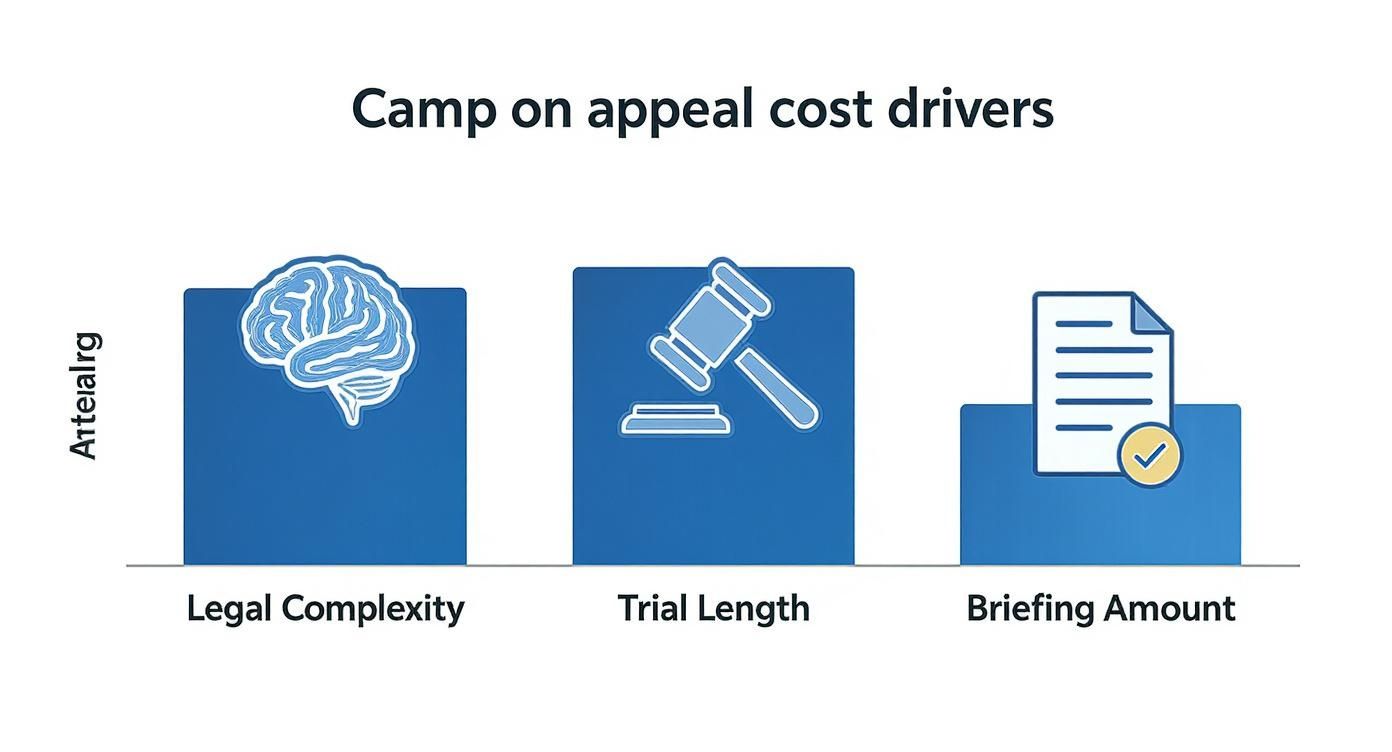
As you can see, the complexity of the legal questions is often the biggest factor, followed closely by the length of the trial, which directly determines the size (and cost) of the record.
Scenario 2: A Moderately Complex Appeal
Now, consider a more involved case concerning the characterization of a major asset, such as a family business or an investment portfolio. The trial lasted several days and included testimony from competing financial experts. The judge ruled the asset was community property, but you believe it should have been classified as your separate property. This is a moderately complex appeal.
In Texas, the difference between separate and community property can be worth hundreds of thousands, or even millions, of dollars. An appeal challenging a property division ruling often requires a deep dive into financial records and expert testimony to prove the trial court got it wrong.
This type of appeal involves:
- Key Legal Issue: A significant legal question requiring a detailed analysis of evidence and case law.
- Appellate Record: The record will be substantial, likely containing hundreds of pages of trial testimony and numerous financial exhibits.
- Briefing: The attorney must construct a nuanced argument, carefully analyzing expert testimony and financial documents to show the judge committed an “abuse of discretion.” This means the judge's decision was unreasonable, arbitrary, or made without regard for the facts and law.
This appeal costs more because your attorney must master a large record and develop a sophisticated legal argument to persuade the appellate court that the trial judge's interpretation of the evidence was legally flawed.
Scenario 3: A Highly Complex Appeal
Finally, imagine a contentious child custody case that resulted in a geographic restriction, preventing you from relocating for a new job. The trial lasted a full week and included testimony from multiple witnesses and a custody evaluator. You want to appeal both the geographic restriction and the judge’s unequal division of the marital estate. This is a highly complex appeal.
Here, you are challenging multiple, interconnected errors. Your attorney must prove the judge abused their discretion on the custody issue—a very high legal standard—while also proving a separate error in the property division. This requires weaving together different arguments to show a pattern of improper decision-making. Tackling multiple issues from a long trial demands the most time and resources, placing it at the highest end of the cost spectrum.
Estimated Cost Ranges for Different Appeal Scenarios
To provide a general overview, this table offers ballpark estimates for what you might expect to pay for each of these scenarios in a Texas family law appeal.
| Appeal Scenario | Key Legal Issues | Estimated Record Cost | Estimated Attorney Fees | Total Estimated Range |
|---|---|---|---|---|
| Straightforward | Single, clear-cut error (e.g., mathematical miscalculation) | $1,000 – $2,500 | $10,000 – $20,000 | $11,000 – $22,500 |
| Moderately Complex | Substantive legal issue (e.g., property characterization) | $2,500 – $7,000 | $20,000 – $40,000 | $22,500 – $47,000 |
| Highly Complex | Multiple substantive issues (e.g., custody + property) | $7,000 – $15,000+ | $40,000 – $75,000+ | $47,000 – $90,000+ |
Remember, these figures are estimates. The final cost will always depend on the unique facts of your case.
Is an Appeal the Right Financial Strategy for You?
Deciding to appeal a court’s decision is a significant step, both financially and emotionally. The first question to ask is not just "Was the ruling unfair?" but "Did the judge make a legal mistake that can be overturned?"
This is the core of appellate law: identifying “reversible error.” This is a specific legal standard. You cannot win an appeal simply because you disagree with the outcome. You and your attorney must pinpoint a clear legal mistake the judge made—one that violates Texas law and likely led directly to the wrong result.
Understanding the Standard of Review
In family law, many rulings, especially those involving child custody, are based on the trial judge's discretion. To reverse one of these decisions, you must prove the judge committed an “abuse of discretion.”
This is a high legal standard. It means the judge’s decision was not just incorrect, but unreasonable, arbitrary, or made without any regard for the guiding rules and principles of the law. If there is any reasonable evidence in the trial record to support the judge’s ruling—even if there is also evidence pointing the other way—the appellate court will likely uphold the decision.
A successful appeal is not built on feelings of injustice. It is built on finding a specific, significant legal error—such as the judge misinterpreting a law, mischaracterizing property division, or improperly admitting evidence that clearly influenced the final decision.
Weighing the Potential Reward Against the Cost
Since there are no guarantees in an appeal, you must conduct a careful cost-benefit analysis. The best way to do this is to have a candid conversation with an appellate specialist who can help you define what a “win” would mean for you and your family.
Consider what is truly at stake. A successful appeal could mean:
- Reversing a custody order or removing a geographic restriction.
- Correcting a property division error worth hundreds of thousands of dollars.
- Modifying a child support or spousal maintenance order, impacting your finances for years.
Making an Informed and Strategic Decision
The question "how much does an appeal cost" is only half the equation. The more important question is whether the cost is a worthwhile investment for the potential benefit.
An experienced appellate attorney can review the trial record, identify potential reversible errors, and provide an honest assessment of your chances of success. They will help you see the risks and rewards clearly, so you can make a strategic decision based on logic and sound legal advice.
Strategies for Managing and Planning Appeal Costs
Pursuing an appeal is a significant financial commitment. Creating a solid financial plan from the start is key to navigating the process with confidence, allowing you to focus on seeking a fair outcome for your family.
Open and honest communication with your legal team is the most powerful tool for managing these expenses. Your financial plan should be based on a transparent fee agreement that clearly outlines all potential costs, including realistic estimates for preparing the appellate record and paying court filing fees. A thorough agreement leaves no room for surprise.
Can You Recover Your Legal Fees?
A common question is: "If I win, can I make the other party pay my legal fees?" The answer is, sometimes.
Under the Texas Family Code, the court of appeals has the authority to order the losing party to pay the winner's reasonable attorney's fees and costs. However, this is never guaranteed. The court will consider the specifics of your case, the strength of your legal arguments, and the financial circumstances of both parties. It is a possibility, but you should not count on it. Your attorney can help set realistic expectations from the beginning.
Partnering with Your Legal Team
The best way to manage appeal costs is to work collaboratively with your appellate lawyer. A good attorney will keep you informed about expenses and discuss strategic decisions that could affect your budget. They should explain the cost-benefit of every action, ensuring you feel in control of the financial aspects of your case.
A strong attorney-client relationship built on trust and clear communication is essential. It ensures that your financial strategy is aligned with your legal goals, providing clarity so you can focus on what truly matters—seeking justice.
If you believe the trial court made a serious mistake, your first step is to explore your options. To get a clear understanding of the potential costs and the legal strength of your case, speak with an experienced Texas family law appeal attorney.
A Few Common Questions About Appeal Costs
The financial side of an appeal can seem as complex as the legal process itself. Here are straightforward answers to some of the most common questions clients ask.
Can the Court Make Me Pay My Ex's Legal Fees if I Lose?
Yes, this is a possibility. In Texas, the court of appeals has the discretion to order the losing party to pay the winning party's reasonable attorney's fees and court costs. This is a significant financial risk that you must discuss with your attorney before proceeding.
Is It Cheaper to Stick with My Original Trial Lawyer for the Appeal?
While it might seem more cost-effective, it is often not the case—and may not be the best strategic choice. Trial and appellate work require different skill sets. A trial lawyer excels at presenting evidence and thinking on their feet in the courtroom. An appellate lawyer is a specialist in legal research, persuasive writing, and navigating the complex Texas Rules of Appellate Procedure.
An appellate specialist's expertise in identifying reversible error and crafting a powerful written argument can be more efficient and provide a stronger chance of success.
Can I Appeal Just One Part of the Judge's Ruling?
Absolutely. This is a common and often effective strategy. You do not have to challenge the entire ruling. For instance, you might agree with the divorce itself but believe the judge made a significant error in the property division or when issuing a protective order. Focusing an appeal on a single, high-value issue can make the process more direct and often more affordable.
When mapping out your appeal budget in Texas, it’s useful to get a handle on all potential financial factors. For broad, state-specific estimations that might help you contextualize certain expenses, you can explore tools like Texas-specific cost calculators.
If you believe the court made a mistake in your family law case, our appellate attorneys can help you seek a fair outcome. Contact The Law Office of Bryan Fagan today for a free consultation.