
You may feel your case was handled unfairly or that the court didn't get the full story. A deposition in a Texas divorce is a formal, out-of-court interview where you, your spouse, or another witness answers questions under oath. This is a critical part of the discovery phase—the official fact-finding stage of your case. The testimony gathered here doesn't just impact a trial; it can be the foundation for a successful appeal if the court gets it wrong.
Understanding the Purpose of Depositions in a Texas Divorce
A deposition isn't the dramatic courtroom showdown you see on TV. It’s a controlled, strategic conversation designed to build a clear, factual record. For those who believe their case was decided unfairly and are seeking justice, understanding this process is the first step.
The goals here are straightforward and absolutely critical to building a strong case, whether for trial or appeal. Depositions serve several key functions:
- Gathering Information: This is your attorney's chance to ask direct questions about finances, parenting, or the history of the marriage. The sworn testimony helps create a complete picture for the judge and the appellate court.
- Assessing Witness Credibility: It's one thing to read a statement, but it's another to see how someone answers questions under pressure. This gives your legal team a preview of how your spouse or other witnesses will perform in court.
- Preserving Testimony: A court reporter records every single word, creating an official transcript. This "locks in" a person's story, making it incredibly difficult for them to change their testimony later. This record is vital for an appeal, as it shows the appellate court exactly what evidence the trial judge had.
Depositions Are a Standard Part of Contested Divorces
Depositions are a cornerstone of the legal process in Texas, especially when a divorce is contested. In fact, it's estimated that over 70% of contested divorce cases involve at least one deposition. For more complex cases involving significant assets or heated custody disputes, it's not uncommon to have anywhere from two to four depositions.
Ultimately, depositions are a tool for clarity and accountability. They help eliminate surprises at trial and are fundamental for both settlement talks and courtroom battles. By ensuring all important information is on the record, you protect your rights, whether your case is headed for mediation, litigation, or an eventual appeal. You can learn more about the differences between divorce mediation vs litigation in our detailed guide.
Who Attends a Deposition?
A deposition might feel intimidating, but the room is usually filled with a specific cast of characters, each with a defined role. It’s not a free-for-all; it's a structured legal proceeding.
Here's a quick rundown of who you can expect to see and what they do.
| Who Participates in a Deposition |
| :— | :— |
| Participant | Role and Responsibility |
| The Deponent | This is the person being questioned (you, your spouse, or a witness). Their job is to answer questions truthfully under oath. |
| Attorneys | Both your attorney and your spouse's attorney will be present. The opposing attorney asks the questions, while your attorney is there to protect you, make objections, and ensure the process is fair. |
| The Court Reporter | A certified professional who records every word spoken and creates the official written transcript of the deposition. They also administer the oath. |
| The Parties | You and your spouse both have the right to be present for any deposition in your case, even if you are not the one being questioned. |
| Videographer (Optional) | In some cases, the deposition is also video-recorded. This can be used to show a witness’s demeanor and tone, which a written transcript can't capture. |
Understanding these roles helps demystify the process, making it feel less like an interrogation and more like the structured, fact-finding tool it is.
A Step-by-Step Guide to the Deposition Process
Depositions can sound intimidating, but they’re a lot more manageable once you understand the moving parts. According to the Texas Rules of Civil Procedure, it’s a formal, structured process designed to let both sides gather the facts they need. Let's walk through it step by step.
It all kicks off when one side's attorney sends out a formal document called a "Notice of Deposition." This is the official starting gun, a legal notice that formally requests someone—the "deponent"—to show up and give testimony at a specific time and place.
The Notice and Who Is Called to Testify
Usually, this notice comes with a "subpoena," which is a court order that makes attendance mandatory. You can't just ignore it. In a Texas divorce, the net can be cast pretty wide to find people with relevant information.
You can expect depositions for:
- The Spouses: It’s almost a given that you and your spouse will be deposed. This is the primary way to get firsthand accounts of everything from finances to parenting.
- Expert Witnesses: Think forensic accountants, business valuators, or anyone hired to analyze complex property issues.
- Custody Evaluators: If a professional was brought in to assess the parenting situation, their methods and conclusions will be put under the microscope.
- Other People: Sometimes friends, family members, or even coworkers who have knowledge about key facts might be called to testify.
One common misconception is that this all happens in a dramatic courtroom scene. The reality is much more low-key. Depositions are almost always held in a lawyer's conference room, a neutral setting that keeps things professional and focused.
The whole point is to achieve three key goals, as shown below.
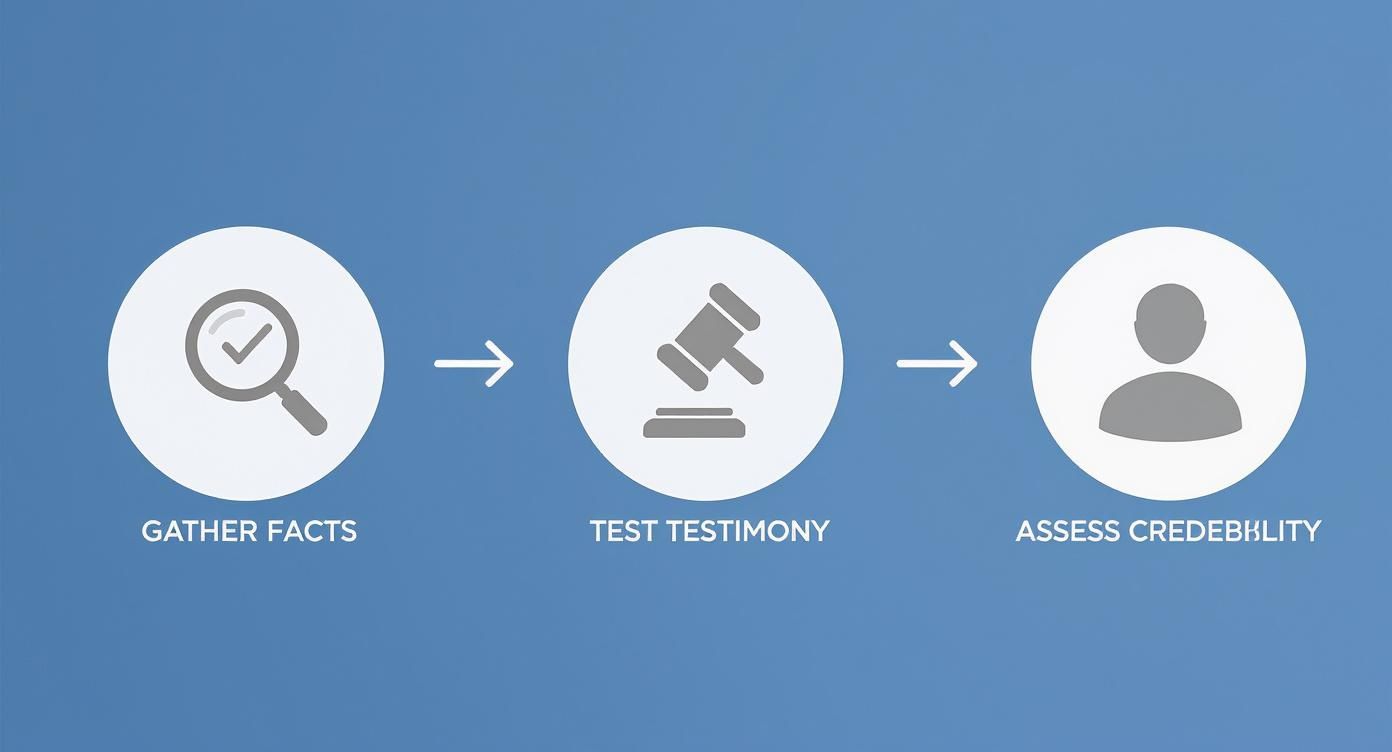
This process is how lawyers uncover the facts, see how a story holds up under pressure, and get a real feel for how credible a witness will seem to a judge.
Who’s in the Room and How Your Attorney Protects You
When you walk into the room, you’ll see a few key players. The opposing attorney will be asking the questions. Your attorney will be right beside you, acting as your shield. And a court reporter will be typing away, creating a word-for-word transcript of the entire proceeding. These days, many firms rely on specialized legal transcription software solutions to ensure every word is captured accurately and efficiently.
Your lawyer's most important job during the deposition is to object to improper questions. If the other attorney asks something that’s out of line—maybe it's meant to harass you or it asks for privileged information—your lawyer will speak up. This isn't just for show. An objection protects you in the moment and, just as importantly, preserves the issue on the record in case it's needed for a later motion or an appeal.
Common Questions Asked in Divorce Depositions
Walking into a deposition can feel intimidating, but knowing what's coming helps immensely. The questions aren't random—they're strategic. The other attorney is trying to build a complete picture of your case, and the questions will almost always circle back to the two core issues in any Texas divorce: property division and child custody.
Understanding these key areas allows you and your lawyer to prepare thoughtful answers and pull together the documents needed to back them up.
Financial and Property Questions
A huge chunk of any divorce deposition is dedicated to the marital estate. The opposing counsel needs to get a handle on the full scope of your community and separate property to argue for a "just and right" division, as required by the Texas Family Code.
Be ready to dig into the details on topics like:
- Income and Employment History: This isn't just about your current salary. Expect questions about bonuses, commissions, your education, past jobs, and what your future earning potential looks like.
- Assets: You’ll have to list out everything—bank accounts, retirement funds like 401(k)s and IRAs, real estate, cars, and any valuable personal items. They'll want to know when and how each one was acquired to figure out if it's community or separate property.
- Debts and Liabilities: This is the other side of the balance sheet. They'll ask about the mortgage, car loans, credit card balances, and student loans.
- Business Interests: If a business is involved, the questions get much more detailed. You’ll be asked about how it operates, its revenue, expenses, and what it’s worth. Properly valuing a business is tricky, which is why a professional appraisal for divorce is often a critical step.
- Spending Habits: Questions about your lifestyle and day-to-day expenses help paint a picture of financial needs, which is directly relevant to spousal maintenance and child support calculations.
The goal of all these financial questions is simple: transparency. The court can't make a fair ruling without a complete and honest accounting of the marital estate. Your truthful, well-documented answers are the best way to protect your financial future.
Questions About Children and Parenting
When children are involved, the tone of the deposition shifts to their best interest. The questions are designed to figure out each parent’s role in the children's lives, their capabilities, and what the family dynamic looked like before the divorce.
You can expect the conversation to cover:
- Daily Routines: Who got the kids ready for school? Who helped with homework? Who took them to doctor or dentist appointments?
- Parenting Decisions: How were big decisions made about school, healthcare, or religious upbringing? Was it a team effort or did one parent take the lead?
- Parent-Child Relationships: The lawyer will want to understand the nature of your bond with each of your children.
- Concerns or Allegations: This is where things can get tough. If there are allegations of substance abuse, neglect, or family violence, you will face very direct and detailed questions. Your answers are incredibly important for things like protective orders and final custody decisions.
Answering these questions clearly and honestly gives the judge the insight needed to craft a possession order that truly supports your children’s stability and well-being.
How To Prepare For Your Deposition

Walking into a deposition cold is never a good idea. The single most important factor for success is how well you prepare beforehand. Think of it less like an interview and more like an open-book test—the better you know the material, the more confident and precise you'll be.
The cornerstone of your preparation is a deep-dive session with your attorney. You'll sit down together and review every critical document in your case. This means combing through financial statements, tax returns, bank records, and even specific emails or text messages that could come up. The goal is to refresh your memory on the hard facts so your answers are consistent and truthful.
Strategies For Answering Questions
How you answer questions in a deposition is just as critical as what you say. Your main objective is to be direct and honest without handing the other side ammunition they didn't ask for. It's a delicate balance, but a few simple rules will keep you on the right track.
Follow these core principles:
- Listen to the Full Question: Don't jump the gun. Wait for the opposing attorney to finish their entire question before you even think about answering.
- Pause and Breathe: Take a beat before you speak. This small pause gives you a moment to organize your thoughts and, crucially, gives your attorney a window to object if the question is out of line.
- Answer Only the Question Asked: If a question can be answered with a "yes" or "no," that's your full answer. Resist the natural urge to explain yourself or add context. Less is more.
- "I Don't Know" Is a Perfect Answer: If you don't know or can't remember something, say so. Guessing is one of the worst mistakes you can make. A wrong guess can destroy your credibility later.
Staying calm under pressure is easier said than done, but it’s a huge part of the process. Your preparation isn't just about the legal facts; it's also about getting into the right headspace. Learning some strategies to stop worrying and calm your mind can make a world of difference when you're in the hot seat.
Your deposition is not your day in court. You are not there to tell your side of the story or win over the other attorney. It is a fact-finding mission for them. Your role is simply to provide honest, concise answers to the questions they ask. That's it.
To help you remember the essentials during the real thing, here's a quick cheat sheet.
Deposition Do's and Don'ts
This table is a quick reference for the most important behaviors to practice—and avoid—while you're giving testimony.
| Do | Don't |
|---|---|
| Do listen to the entire question before answering. | Don't volunteer extra information or elaborate beyond the question. |
| Do tell the truth, always. | Don't guess or speculate if you are unsure of an answer. |
| Do stay calm and professional, even if questioned aggressively. | Don't argue with the opposing attorney or become emotional. |
| Do ask for clarification if you don't understand a question. | Don't use absolute terms like "always" or "never" if they are not entirely accurate. |
Keeping these simple rules in mind will help you navigate your depositions for divorce with confidence. A well-handled deposition provides a strong, accurate record of the facts and is a major step toward achieving a fair outcome in your case.
How Depositions Impact Your Trial and Appeal

It’s easy to think of a deposition as just a stressful Q&A session, but it's a critical strategic tool that can make or break your case, both at trial and later on if you need to appeal an unfair decision. The testimony you give is under oath, and the official transcript becomes a powerful piece of evidence that locks in a version of the facts.
Think of it as a tool for accountability. If your spouse gets on the witness stand at trial and tells a different story, their deposition transcript can be used to show the judge the inconsistency. This is called impeachment, and it's a powerful way to damage a witness's credibility. It ensures that sworn testimony can't be conveniently changed down the road.
Building the Foundation for a Fair Appeal
If you feel your trial court's decision was wrong, the deposition is where we often find the evidence to prove it. A strategic family law appellate attorney is always thinking one step ahead, laying the groundwork for a potential appeal right from the beginning.
This is where you'll see your lawyer make objections during the deposition. Those objections serve two critical purposes:
- First, they protect you from having to answer an unfair, misleading, or harassing question right then and there.
- Second, and this is crucial for an appeal, the objection preserves the error for the appellate court record.
What does that mean? It means if the opposing attorney asks an improper question and the trial judge later makes a bad ruling based on that line of questioning, we have proof that we objected from the start. Without that objection noted in the transcript, your right to argue that point on appeal is often lost. It's one of the most important ways we protect your long-term interests.
What is Reversible Error?
An appeal is not a second trial. The appellate court only looks at the existing record to see if the trial judge made a legal mistake that impacted the outcome. This is known as a "reversible error."
A reversible error is a mistake made by a trial judge that was so significant it likely caused an improper judgment. In Texas family law, a common example is an "abuse of discretion," where a judge makes a ruling that is arbitrary or unreasonable. Catching and preserving these potential errors during depositions is fundamental to winning on appeal.
Ultimately, a deposition creates a permanent record. How it’s handled will directly influence settlement talks, trial strategy, and your ability to seek justice if the final outcome isn't fair. A well-managed deposition keeps all your options open, especially your right to be heard by appealing a family court decision.
Common Questions About Depositions
Even after walking through the process, it's completely normal to have a few questions. A deposition is a significant step, and the more you know, the more confident you'll feel. Let's tackle some of the most common questions our clients bring to us.
How Long Will a Deposition Take?
Under the Texas Rules of Civil Procedure, each side technically gets six hours to question a witness. Don't let that number scare you—it's more of a maximum limit than a typical timeframe.
For most divorce cases, a deposition will last a few hours, maybe stretching into a full day. If your finances are relatively simple, it could be on the shorter side. But if we're dealing with complex assets like a family business or navigating a contentious custody battle, it will likely take longer. We'll always give you a realistic estimate based on the specifics of your case.
What If I Am Asked Something I Don’t Want to Answer?
You’re under oath, so the general rule is that you must answer every question truthfully. However, there are important exceptions, and your attorney is there to protect you. My job is to listen to every single question and object if anything is improper. This includes questions that are designed to harass you or, most importantly, questions that ask for privileged information.
What exactly is "privileged information"? Think of it as a legally protected cone of silence. The most critical example is the attorney-client privilege, which protects anything you and I have discussed about your case. Our conversations are confidential. If the other attorney asks a question that crosses that line, I will immediately object and instruct you not to answer. Your only job is to follow my lead.
What Happens After the Deposition?
Once the questioning is done, the court reporter produces a complete, word-for-word transcript. This document is now the official, sworn record of your testimony.
You and your attorney will get a copy to review for any typos or mistakes. You'll have a chance to make corrections on what's called an "errata sheet." After it's finalized, that transcript becomes a powerful tool. We can use it for a few key things:
- Driving a Settlement: Having clear testimony locked in under oath often brings everyone to the negotiating table with a more realistic view, paving the way for a fair agreement.
- Winning in Court Hearings: We can submit key excerpts from the transcript to the judge to support our arguments in pre-trial motions.
- Preparing for Trial: The transcript locks the other side into their story and helps us impeach a witness if they try to change their tune on the stand.
Who Pays for the Deposition?
The party who schedules the deposition pays for it. The main cost is the court reporter’s fee for their time and for preparing the transcript. If we decide to videotape the deposition (which can be very effective), that’s an added expense. While it's an investment, a well-planned deposition is one of the best ways to uncover critical facts, avoid surprises in the courtroom, and put you in the strongest possible position to achieve a just outcome.
If you believe the court made a mistake in your family law case, our appellate attorneys can help you seek a fair outcome. Contact The Law Office of Bryan Fagan today for a free consultation at https://familylawcourtappeals.com.