When a family court judge issues a ruling that feels fundamentally wrong, it can leave you feeling blindsided and helpless. You may feel your case was handled unfairly, but that initial decision doesn’t have to be the last word. The entire basis for an appeal in a Texas family law case hinges on one key thing: proving the trial court made a significant legal mistake—what we call a reversible error—that almost certainly led to that unjust outcome.
What Happens When a Court Gets It Wrong

It’s a difficult position to be in. The judge issues an order that seems to ignore the evidence or misapply the law. While it’s easy to feel powerless, Texas law provides a clear path forward for those seeking justice. That path is the appellate process, a system designed specifically to review and correct legal errors made at the trial level.
It’s vital to know that an appeal isn’t a second trial or a “do-over.” You don’t get to bring in new evidence or have witnesses testify again. Think of the appellate court as a panel of expert referees. They won’t re-play the game; instead, they review the “game tape”—the official court record from your trial—to see if the trial judge made a bad call that changed the outcome.
Shifting from Disagreement to Legal Error
Most people who are unhappy with a court’s decision disagree with the judge’s final ruling on property or custody. That’s perfectly normal, but simply disagreeing isn’t enough to win an appeal. Your focus must pivot from your personal feelings about the outcome to identifying a specific, provable legal mistake the judge made.
The journey starts by combing through every detail of your case to pinpoint these critical errors. Common grounds for appeal in civil cases often include:
- The judge incorrectly applied a specific part of the Texas Family Code.
- The court made a ruling so illogical or arbitrary it qualifies as an “abuse of discretion.”
- Key evidence was wrongly allowed or excluded, which likely would have changed the result.
- Mandatory legal procedures weren’t followed, violating your fundamental right to due process.
An appeal is a highly strategic process focused on law, not emotion. It requires a detailed legal argument showing that an error was not only made but was also harmful enough to have likely caused an improper judgment.
Before filing an appeal, it’s smart to explore all post-judgment options. Sometimes, filing a Motion for New Trial in Texas is a necessary first step to preserve your right to appeal certain issues. This is where the real strategy begins, and it’s how the foundation for a successful challenge is built. Our appellate attorneys excel at this kind of detailed analysis, helping you transform that feeling of frustration into a clear, methodical plan for seeking justice.
Understanding Reversible Error in Texas Family Law

The entire foundation of a successful appeal is built on one critical concept: reversible error. This isn’t just about disagreeing with the judge’s final decision. It’s about proving the judge made a specific legal mistake so significant that it very likely caused the wrong outcome.
Think of it this way: an appellate court isn’t there to re-try your case or second-guess every judgment call. Its job is to review the trial for game-changing errors. The central question they ask is, “Did this mistake probably lead to an unjust final order?” If we can show the answer is yes, you may have solid grounds for appeal in civil cases like yours.
What Is Reversible Error?
Imagine the trial is a building. A minor procedural hiccup that didn’t change the result is like a cosmetic crack in the wall—this is called a “harmless error,” and it won’t be enough to tear the building down.
A reversible error, on the other hand, is a major crack in the building’s foundation. It’s a flaw so serious that it compromises the structural integrity of the entire verdict. These errors can happen when a judge misinterprets the Texas Family Code, makes an arbitrary and unfair ruling, or mishandles critical evidence. Any of these can undermine the fairness of your divorce or child custody orders.
Common Grounds for Appeal
To succeed, an appellate lawyer must comb through the trial record and pinpoint these exact errors. While the specifics of every family law case are different, most successful appeals fall into a few key categories.
Here is a quick look at the major grounds for appeal that we see most often.
| Type of Error | Plain-English Explanation | Example in a Texas Family Law Case |
|---|---|---|
| Misapplication of the Law | The judge used the wrong legal rule or interpreted a law incorrectly. | A judge uses an outdated standard to decide spousal maintenance or incorrectly labels your separate inheritance as community property during property division. |
| Abuse of Discretion | The judge’s decision was completely arbitrary, unreasonable, and not based on any guiding legal principles. | A judge severely restricts a parent’s time with their child for no valid reason supported by evidence. |
| Improper Evidence Rulings | The court either allowed evidence it shouldn’t have (like gossip) or refused to consider evidence it should have (like a key financial statement). | The court allows your ex-spouse’s friend to testify about something they didn’t personally witness (hearsay), and that testimony sways the final property division. |
| Procedural Errors | The court failed to follow the required legal steps, denying you a fair chance to present your case. | The court made a major ruling on your parenting time without giving you proper notice of the hearing, so you couldn’t prepare or attend. |
This table provides a simple overview, but identifying these errors in a real case requires deep legal expertise.
A successful appeal is not about arguing the facts again. It is a precise legal argument that demonstrates how a specific, harmful error of law by the trial judge led directly to an unjust result. You can see how these principles are applied by reviewing an example of a successful appeal.
Winning an appeal is not easy; it requires a compelling legal argument. However, appeals provide a vital check on the power of the trial court and are a cornerstone of ensuring fairness. Data from the Bureau of Justice Statistics shows that while trial court decisions are often affirmed (65.9% of the time), they were reversed in 13.9% of cases reviewed on their merits. This shows that appeals absolutely succeed when a compelling legal error is proven.
Finding these grounds requires a meticulous, line-by-line review of every court filing, exhibit, and transcript from your trial. It’s a hunt for the legal and procedural mistakes that derailed justice and provide a clear path to challenge an unfair outcome.
How an Appeal Is Different from a Trial
It’s completely understandable to feel like your trial was unfair. You might be thinking, “If I just had one more chance to tell my story, the judge would see things differently.” While that feeling is valid, it’s crucial to understand that an appeal isn’t a second chance to do that.
Thinking of an appeal as a “do-over” is one of the biggest misconceptions people have. It’s not a new trial. Instead, it’s a focused, high-level review of what already happened to see if a significant legal mistake was made.
No New Evidence. No New Testimony.
This is perhaps the single most important difference. In an appeal, you cannot introduce new evidence, call new witnesses, or re-argue the facts. The appellate court will not hear from anyone. Its job is strictly to review the law, not re-weigh the evidence.
The best analogy is a referee reviewing a controversial call using instant replay. The refs in the booth don’t get to run a new play or ask the players what they were thinking. They are limited to the “game tape”—the official appellate record—and can only decide if the call on the field was correct based on the rules.
That “game tape” in a legal appeal consists of a few key things:
- The Reporter’s Record: This is the official, word-for-word transcript of everything said during the trial.
- The Clerk’s Record: This includes all the documents filed in your case, like the original petition, motions, and the final order you’re appealing.
- Exhibits: Any documents, photos, or other items that were formally admitted as evidence during the trial.
Your entire appeal rises or falls based only on what’s inside that record. If it didn’t happen in the trial court, for the purpose of the appeal, it didn’t happen at all.
Understanding the Standard of Review
Another key concept is the standard of review. This is a legal framework that tells the appellate judges how much respect (or “deference”) they have to give the trial judge’s decisions. The standard changes depending on the type of mistake you’re claiming the judge made.
For instance, if a trial judge had to decide a question of fact—like which parent was more credible in a child custody dispute—the appellate court gives that decision a huge amount of deference. Why? Because the trial judge was the only one in the room to see the witnesses’ body language and hear their tone of voice.
But if the issue is a pure question of law—say, the judge misinterpreted a statute in the Texas Family Code during a property division—the appellate court gives zero deference. The appellate judges will look at the legal question with fresh eyes to decide for themselves if the law was applied correctly.
What Is an “Abuse of Discretion?”
You’ll hear this term a lot in Texas family law appeals. It’s one of the most common standards of review we work with. An abuse of discretion occurs when the trial court’s decision was so arbitrary, unreasonable, or out of line with guiding legal rules that no reasonable judge would have made the same call. It’s a high bar to clear, but it’s often the central argument in a successful civil appeal.
The Battle Is Fought on Paper
In a trial, you persuade the judge through live testimony, physical evidence, and oral arguments. On appeal, the fight is almost entirely on paper. The main weapon is the brief.
A brief is a highly structured, formal legal argument. It’s where your appellate lawyer methodically points out the trial judge’s errors, citing specific pages from the trial record and backing up the arguments with established case law. The other side gets to file their own brief arguing against you, and we may get to file a final reply.
Sometimes, the court will allow a short oral argument, but the written briefs are where the case is truly won or lost. This is how we make a compelling case for the grounds for appeal in civil cases and convince the higher court that the original outcome was legally wrong and needs to be fixed.
The Appellate Record: Why It’s the Only Thing That Matters
You don’t win an appeal by coming up with new arguments or trying to introduce evidence you forgot to mention at trial. You win by showing the appellate court that a serious legal mistake was made during your trial, and—this is the important part—that mistake is documented in the official appellate record.
The record is everything. It’s the entire universe of information the court of appeals will look at. If something wasn’t said, filed, or objected to on the record, then for the purpose of your appeal, it might as well have never happened. That’s why the very first thing our team does is obtain this file and go through it with a fine-tooth comb. We’re hunting for the specific grounds for appeal in civil cases that live and die within its pages.
What Exactly Is the Appellate Record?
Think of the record as the official “game tape” of your trial. It’s a complete, closed collection of documents that tells the story of what happened in the trial court. The appellate judges weren’t there to see it live, so this is all they have to go on. It’s generally broken down into two key parts:
- The Reporter’s Record: This is the court reporter’s word-for-word transcript of everything said in court. It captures witness testimony, arguments the lawyers made to the judge, and any rulings the judge made from the bench.
- The Clerk’s Record: This is a compilation of all the paperwork filed in your case. We’re talking about the initial lawsuit, motions, official court orders, exhibits that were admitted into evidence, and, of course, the final judgment you’re trying to overturn.
These two components form the exclusive basis for your appeal. Our job is to dig into this record and find the reversible errors that led directly to the unfair outcome you’re now facing.
Preserving Error: The “Speak Now or Forever Hold Your Peace” Rule of Appeals
One of the most important concepts in appeals is preserving error. Before an appellate court will even consider your complaint about a mistake the trial judge made, your lawyer had to have done something very specific at the trial: they had to have objected, on the record, right when it happened.
If an error wasn’t preserved, it’s waived. In other words, if your trial lawyer didn’t object to improper evidence or a legally flawed ruling at the exact moment it occurred, you typically lose the right to complain about it on appeal.
The logic here is to give the trial judge a chance to fix their own mistakes on the spot. Imagine the other side tries to bring up unreliable hearsay testimony in your child custody hearing. Your attorney has to immediately stand up and say, “Objection, hearsay.” That objection and the judge’s ruling on it are now “preserved” in the record, giving you a potential issue to raise on appeal. This is why the skill of your trial lawyer is so foundational—their quick thinking (or lack thereof) directly creates or destroys your options for an appeal later.
How We Hunt for Appealable Errors in the Record
When we take on a potential appeal, we’re not just reading the record; we’re launching a full-blown investigation. We’re on the lookout for moments where the rules of evidence or procedure were violated. We’re searching for misapplications of the Texas Family Code in a divorce case or instances where a judge’s ruling was so far off the mark that it qualifies as an “abuse of discretion.”
Interestingly, studies on appellate review standards show that appellate courts are often more willing to dig into the factual findings in civil cases—like those involving property division or spousal maintenance—than they are in criminal cases. This just underscores how vital it is to have a trial record that’s packed with clear documentation of financial details, testimony about parental fitness, and other key facts.
This deep dive into the record is where the blueprint for your appeal is drawn. By finding those preserved errors and tying them directly to the unjust result, we can build the powerful, persuasive argument needed to convince the higher court to step in and make things right.
Navigating the Texas Appellate Process and Timeline
Taking a case to appeal isn’t a spur-of-the-moment decision; it’s a journey down a highly structured path governed by rigid rules and unforgiving deadlines under the Texas Rules of Appellate Procedure. For anyone new to this world, the appellate timeline can feel like a maze. But understanding the map is the first step toward feeling in control. This process is intentionally rigorous to make sure every appeal gets the careful, precise legal review it deserves.
The stopwatch starts the second the trial judge signs the final judgment. From that moment on, the path is marked by critical milestones, and missing a single one can be disastrous. As appellate attorneys, our job is to be your guide, managing every filing with strategic foresight so you can focus on the bigger picture: fighting for a just outcome.
The First and Most Urgent Step: The Notice of Appeal
To even begin to challenge a trial court’s decision, you must file a Notice of Appeal. This is a simple, often one-page document that formally tells the court and the other side that you plan to take the fight to a higher court. It might seem like a small piece of paperwork, but its timing is everything.
Under the Texas Rules of Appellate Procedure, you generally have just 30 days from the date the judge signs the final judgment to get this notice filed. Missing this deadline is almost always fatal to your case. The appellate court will likely dismiss your appeal for lack of jurisdiction, and there’s no going back. This is why it’s so critical to talk to an appellate lawyer the moment you get a bad ruling. You can dive deeper into the specifics by reading our guide on what a Notice of Appeal is.
From Filing the Notice to Final Decision
Once the Notice of Appeal is on file, a series of coordinated steps kicks off, all designed to package your case for the appellate judges’ review. Each stage builds on the one before it, leading up to the court’s final ruling.
This visual shows the critical path from trial to appeal, highlighting how the official record is built and why it’s so important.
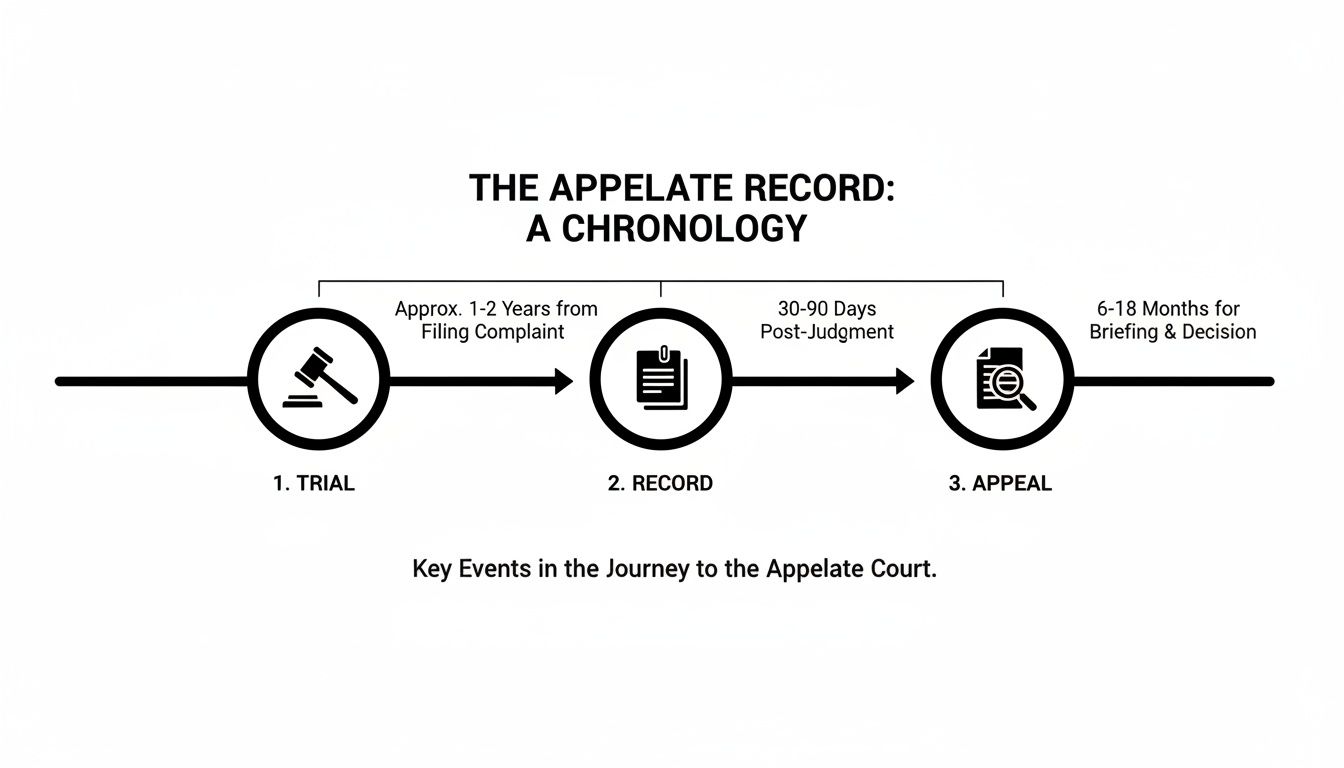
As the flowchart shows, an appeal isn’t a do-over. It’s a review of what already happened, which puts the official record from the trial court front and center.
To give you a clearer picture, here is a breakdown of the key stages you can expect in a Texas family law appeal.
Key Stages of a Texas Family Law Appeal
| Stage | Typical Deadline/Timing | What Happens in This Stage |
|---|---|---|
| Final Judgment Signed | Day 0 | The clock officially starts. |
| File Notice of Appeal | Within 30 days of judgment | Your attorney files this critical document to initiate the appeal. |
| Prepare Appellate Record | Within 60 days of judgment | We request the Clerk’s Record (all filed documents) and the Reporter’s Record (trial transcript) from the court. |
| File Appellant’s Brief | 30 days after the record is filed | This is our main argument—a detailed legal document explaining the judge’s errors, with citations to the record and case law. |
| File Appellee’s Brief | 30 days after our brief is filed | The other side files their response, arguing why the trial court was correct. |
| File Reply Brief (Optional) | 20 days after appellee’s brief | We get a final chance to respond to the other side’s arguments. |
| Oral Argument | Scheduled by the court (if granted) | A formal hearing where attorneys argue before a panel of judges and answer their direct questions about the case. |
| Appellate Court Decision | Several months after briefing/argument | The court issues a written opinion that either affirms, reverses, or modifies the trial court’s judgment. |
This timeline provides a high-level overview. Each step involves precise legal work and strategy, from crafting the initial arguments in the appellant’s brief to preparing for the intense questioning that can happen during oral argument. The entire process is a marathon, not a sprint, and requires careful navigation from start to finish.
Potential Outcomes of a Successful Appeal

So, you’ve done the hard work. You’ve pinpointed a reversible error, your attorney has crafted a powerful argument, and you’ve submitted your brief. Now what? What does “winning” an appeal actually look like?
It’s a common misconception that a successful appeal means the higher court simply gives you the result you wanted all along. The reality is a bit more nuanced. The appellate court has a few different tools at its disposal to fix what went wrong in the trial court. The specific remedy the court chooses boils down to the type of mistake it found. Understanding these potential outcomes is key to setting realistic expectations for your case.
Reverse and Render
This is the home run, the clean win. When an appellate court reverses and renders a judgment, it’s not just saying the trial court got it wrong—it’s stepping in and issuing the legally correct judgment itself. The case is over. You’ve won.
This outcome is most common when the mistake was a pure question of law, and all the facts needed to fix it are already in the record. For instance, imagine a judge misreads a Texas statute about what counts as community property in a property division dispute. If the evidence about the asset is clear, the appellate court can just correct the legal error and “render” the right decision on the spot. No need to go back.
Reverse and Remand
More often, a win looks like a reverse and remand. Here, the appellate court agrees a serious error occurred and overturns the original decision. But instead of ending the case, it sends it back—or “remands” it—to the same trial court for another go. The difference is that this time, the trial judge has specific instructions from the higher court on how to get it right.
When a case is remanded, it’s like a football referee ordering a play to be re-run after a penalty. The game isn’t over, but the next play will happen under a corrected set of rules dictated by the higher authority.
A remand is necessary when, for example, the trial judge wrongly excluded crucial evidence. The appellate court can’t consider that evidence for the first time; its job is to review the existing record. So, it sends the case back for a new hearing where that evidence can finally be heard and properly weighed. We also see this frequently in child custody appeals where a judge fails to make legally required findings of fact.
Modify the Judgment
Finally, an appellate court can choose to simply modify the judgment. This is a more surgical fix. The court corrects a specific, isolated part of the trial court’s order while leaving the rest of it in place. Think of it as a line-item veto.
This is a practical tool for fixing things like a clear mathematical error in a child support calculation or cleaning up ambiguous language in a divorce decree without upending the entire ruling.
It’s worth noting that getting an appellate court’s attention is harder than ever. Starting in the 1960s, the number of appeals filed in federal courts exploded, growing by nearly 600% by the late 1980s. While that’s federal data, it reflects a broader trend that has made all appellate courts more selective. This history underscores why having strong, well-preserved grounds for appeal in civil cases is absolutely essential to have a shot at any of these corrective outcomes. You can dig into the data yourself to understand the history of appellate jurisdiction.
Common Questions About Texas Civil Appeals
Stepping into the world of appeals can feel overwhelming, especially when you’re already reeling from an unfair family court decision. It’s completely normal to have a lot of questions. Let’s walk through some of the most common concerns we hear from clients to give you a clearer picture of the road ahead.
How Long Does a Civil Appeal Take in Texas?
There’s no simple answer here, as the timeline really depends on the specifics of your case. A relatively straightforward appeal might wrap up in several months, but it’s not uncommon for more complex matters to take over a year.
Several things can affect the timing, like the appellate court’s current workload, how complicated the legal arguments are, and whether the court schedules a live oral argument. It definitely requires patience, but the process is designed to be meticulous, giving your case the careful review it deserves.
Can I Bring in New Evidence on Appeal?
This is probably one of the biggest misconceptions about the process, and the answer is a firm no.
An appeal isn’t a do-over of your trial. Instead, the appellate court acts like a referee, reviewing the game that was already played. Its only job is to look at the official trial record—every piece of testimony, every exhibit, and every motion presented to the original judge—to see if a legal mistake was made. Because of this, new evidence is off the table; the review is strictly limited to what the trial judge had in front of them when they made their ruling.
What Does It Cost to File an Appeal?
Fighting an incorrect ruling is an investment, and the costs typically break down into three main areas:
- Court Filing Fees: These are the required fees to get your case on the appellate court’s docket.
- Record Preparation Costs: You’ll need to pay the court reporter for the trial transcripts and the clerk for the official case file. This complete record is the absolute foundation of your appeal.
- Attorney’s Fees: This is the most significant part. It covers the hours of deep-dive legal research, brief writing, and strategy development needed to build a winning argument.
What Are My Real Chances of Winning an Appeal?
It’s true that, statistically, most trial court rulings stand. But don’t let that number discourage you. That statistic includes every appeal filed, even the ones with weak legal arguments.
The success of your appeal has nothing to do with those broad numbers. It boils down to one thing: whether a reversible error occurred in your case. A strong appeal isn’t a lottery ticket; it’s a carefully constructed case built on solid grounds for appeal in civil cases. The key is identifying those critical mistakes and presenting them effectively. That’s precisely how a skilled appellate lawyer can turn the odds in your favor.
If you believe the court made a mistake in your family law case, our appellate attorneys can help you seek a fair outcome. Contact The Law Office of Bryan Fagan today for a free consultation at https://familylawcourtappeals.com.